Economics — March 9, 2026 — Edu AI Team
If you’re searching for the best online economics courses for beginners, you’re likely looking for something clear, practical, and easy to follow. Economics can feel intimidating at first — with graphs, models, and unfamiliar terminology — but the right course can make it engaging, relevant, and even empowering.
Whether you’re a student, aspiring entrepreneur, working professional, or simply curious about how money and markets work, this guide will help you choose a beginner-friendly economics course that builds real understanding from the ground up.
Economics isn’t just for academics or policymakers. It shapes everyday decisions — from how you budget your income to how businesses set prices and how governments respond to inflation.
A beginner economics course helps you:
The best online courses simplify complex concepts without oversimplifying them. They teach you how to think like an economist.
Not all courses are created equal. When evaluating beginner-level programs, look for these essential features:
A true beginner course assumes zero prior knowledge. It explains key terms like opportunity cost, marginal utility, elasticity, and GDP in simple language before diving deeper.
Economics builds on itself. The best courses follow a logical progression:
Abstract theory becomes powerful when connected to real life. Strong beginner courses use examples like:
Quizzes, case studies, visual graphs, and scenario-based exercises significantly improve understanding. AI-powered platforms can personalize your learning pace and reinforce weak areas.
The best beginner courses connect economics to personal finance — helping you apply concepts directly to budgeting, saving, investing, and debt management.
When comparing options, make sure the curriculum includes these essential topics:
The "best" course depends on your goals. Here are the main types available:
These are structured like traditional college classes. They often include lectures, readings, and formal assessments. They’re ideal if you want a strong theoretical foundation or plan to pursue further academic study.
These focus more on real-life application than theory. They’re perfect for professionals and individuals who want to improve financial decision-making.
Modern platforms use artificial intelligence to adapt lessons to your pace, provide instant feedback, and identify knowledge gaps. This approach makes complex economic ideas easier to master.
If you’re looking for structured, beginner-friendly programs, explore our courses in Economics & Personal Finance designed specifically for foundational learners.
One of the biggest challenges in learning economics is falling behind early. If you don’t fully understand supply and demand, later topics become confusing.
AI-powered platforms help by:
This personalized approach is especially powerful for beginners who need clarity and reinforcement.
Before enrolling, ask yourself these questions:
Your objective determines whether you need a theory-heavy or application-focused course.
Some beginner courses take 4–6 weeks. Others are self-paced and flexible. If you’re balancing work or school, a flexible online option may be better.
Some learners thrive on deadlines and assignments. Others prefer on-demand modules they can complete at their own speed.
Check if lessons start from zero assumptions. The best beginner economics courses never assume prior knowledge of graphs or formulas.
Economics isn’t about memorizing definitions. It’s about understanding relationships — like how price changes affect demand. Focus on cause and effect.
Don’t rush into advanced macroeconomics without mastering microeconomics fundamentals first.
Apply concepts immediately. When you read news about inflation or interest rates, connect it to what you’re learning.
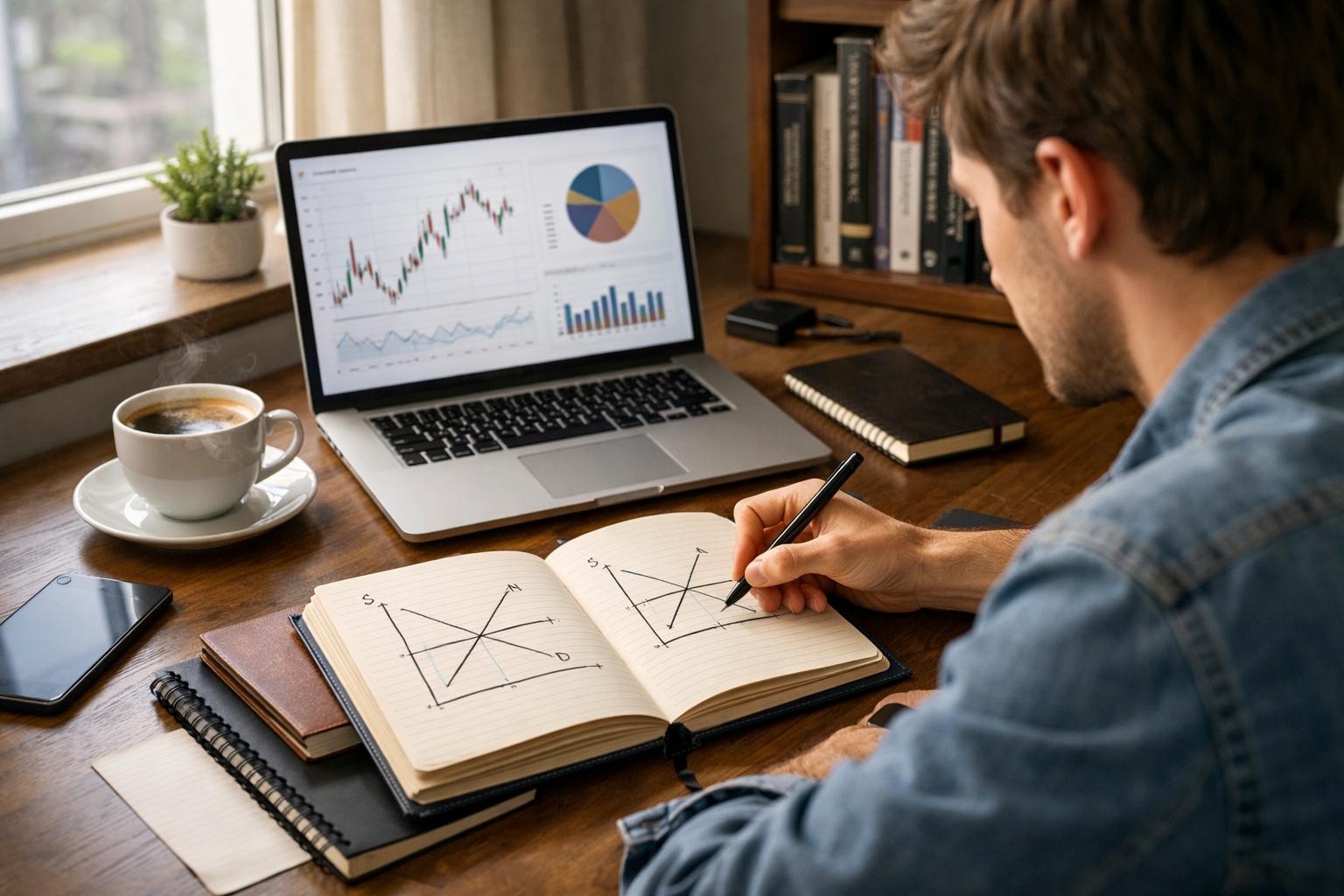
Graphs may look intimidating, but they simplify economic thinking. A good beginner course will guide you step-by-step through reading and drawing them.
Online learning offers distinct advantages for beginners:
With platforms like Edu AI, you can combine economic theory with practical personal finance skills in one structured path. You can also register free to explore beginner modules before committing fully.
Economics doesn’t exist in isolation. It overlaps with:
By understanding economics, you strengthen analytical thinking — a skill valued across industries.
The best online economics courses for beginners make complex ideas simple without removing their depth. They start with clear explanations, build gradually, and connect theory to real life.
You don’t need a background in math or finance to begin. What you need is a structured, beginner-friendly path that helps you think logically about choices, trade-offs, and incentives.
If you're ready to build a strong foundation in economics and personal finance, explore our courses designed specifically for beginners. With AI-guided learning, practical examples, and step-by-step instruction, you can move from confusion to confidence — one concept at a time.
Economics isn’t just a subject. It’s a way of thinking. And the right course can change how you see the world.



- Learning Evolved.
- Intelligence Amplified.