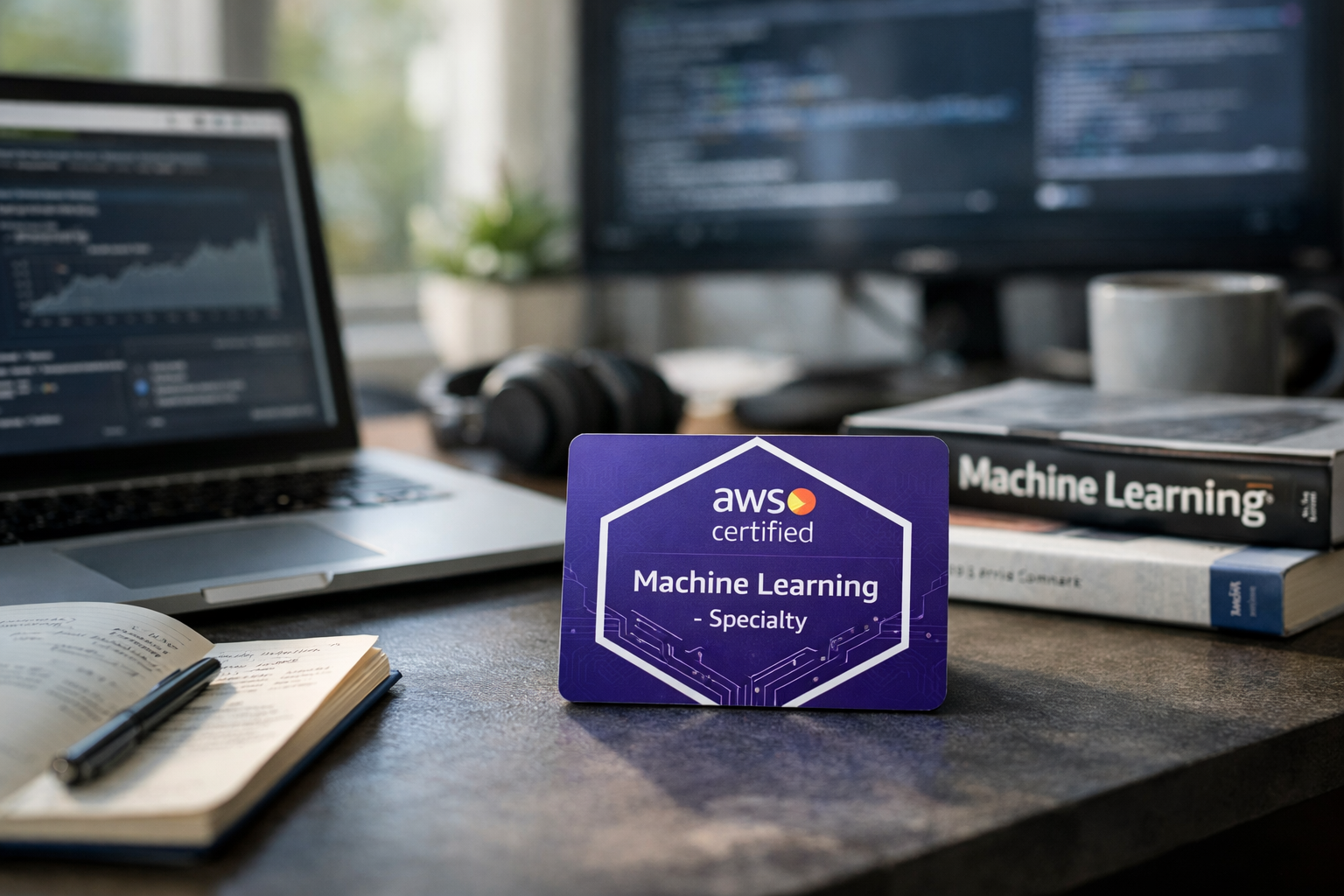
Yes—AWS machine learning specialty certification can be worth it in 2026 if your goal is to work with machine learning on AWS (Amazon’s cloud) and you can commit to a focused study plan. It’s usually not worth it if you’re brand new to tech and you’re hoping the badge alone will get you hired. For beginners, it becomes “worth it” when you use it as a structured roadmap: learn the basics of machine learning, practice with real AWS services, and build 2–3 small projects you can show employers.
What this certification actually is (in plain English)
Machine learning (ML) is a way to teach computers to find patterns from examples. For instance, instead of writing strict rules to detect spam emails, you show the computer lots of “spam” and “not spam” examples, and it learns what spam tends to look like.
AWS is a “cloud” platform, meaning you can rent computing power and tools over the internet instead of buying your own servers. The AWS Certified Machine Learning – Specialty credential (often shortened to “MLS-C01” historically) is designed to prove you can build, train, and run ML systems using AWS services.
In everyday job terms, it signals that you can:
- Turn a business question into an ML problem (for example, “predict which customers might cancel”).
- Prepare data (clean it, organize it, store it) so a model can learn from it.
- Train and evaluate ML models (check whether they’re accurate enough and not “cheating”).
- Deploy a model so it can be used in an app or process (for example, a website that scores loan risk).
- Use AWS tools to do the above reliably and securely.
Is it worth it in 2026? A decision in 60 seconds
Use this quick checklist. If you say “yes” to most items in a column, that path is likely right for you.
It’s worth it if…
- You want a cloud + ML career (ML engineer, data scientist on AWS, MLOps/ML platform roles).
- Your target employers use AWS (common in startups, e-commerce, media, and many enterprises).
- You learn best with a structured goal and deadlines.
- You can invest both time and some money in practice labs and an exam.
- You already have basic foundations (Python basics, simple data handling, and intro ML concepts)—or you’re willing to build them first.
It may NOT be worth it (yet) if…
- You’re starting from zero and want the fastest route to “first job.” A smaller first step may be better.
- You don’t plan to use AWS; your work will be on Google Cloud, Microsoft Azure, or on-premise.
- You dislike troubleshooting and hands-on building (this exam rewards practical judgment, not memorization).
What you really get: the benefits (and what you don’t)
Benefits in 2026
- Signal + vocabulary: Recruiters and hiring managers quickly understand what you studied. It gives you a shared language around data pipelines, model training, deployment, monitoring, and cloud architecture.
- A practical roadmap: The best value is that it forces you to learn the end-to-end process: data → training → evaluation → deployment → monitoring.
- Better project quality: Preparing for this exam pushes you toward realistic projects (using cloud storage, scalable training, and production-style deployment), not just toy notebooks.
What it does NOT do
- It won’t replace experience. Employers still want proof you can build something: a portfolio, a GitHub repo, a case study, or a work sample.
- It won’t teach fundamentals from scratch. If “model,” “training,” or “Python” are brand-new words, you’ll need a beginner ramp-up first.
Costs in 2026: money, time, and effort (realistic numbers)
Exact prices can change, but you should plan for three types of costs:
- Exam fee: Typically a few hundred USD for AWS specialty-level exams (check AWS for current pricing in your region).
- Learning resources: Courses, practice exams, and labs can range from $0 (free content) to a few hundred dollars, depending on what you choose.
- AWS hands-on practice: Many AWS services are pay-as-you-go. If you’re careful, you can often practice with small costs, but it’s smart to budget something monthly so you can learn without fear of surprise bills.
Time cost: For an absolute beginner, a realistic timeline is 3–6 months if you study 5–8 hours/week. If you already know Python and basic ML, many learners compress it to 6–10 weeks with 8–12 hours/week.
What’s different in 2026: why this question matters now
In 2026, AI tools are everywhere. Many people can “use AI,” but fewer can build reliable AI systems that work in a real business: correct data, privacy and security, monitoring, costs, and performance.
This is where AWS-focused certifications remain relevant: they emphasize the operational side—how models move from a laptop experiment into something a company can run.
Also, many teams now combine traditional ML with generative AI (tools that generate text/images/code). Even when generative AI is involved, companies still need the same foundations: clean data, evaluation, deployment, and responsible access. The specialty certification helps you speak that “production” language.
Who should take it (with beginner-friendly examples)
1) Career changers aiming for cloud ML roles
If you’re moving from a non-tech job into tech, the certification can be a strong “story” when paired with small projects. Example path:
- Project 1: Predict customer churn (who might cancel a subscription).
- Project 2: Classify support tickets (route messages to the right team).
- Project 3: Forecast demand (predict next month’s sales for a product).
Even if the projects are small, doing them end-to-end (data storage → training → deployment) makes them credible.
2) Data analysts who want to “level up”
If you already work with spreadsheets or dashboards, you likely understand business questions and data. ML Specialty can help you move into modeling and deployment.
3) Software developers who want ML + cloud credibility
If you can code but haven’t done ML, this certification can be worth it because you’ll learn how ML systems differ from normal software (data drift, model monitoring, retraining, and evaluation).
If you’re a total beginner: the simplest learning path before the exam
Here’s the order that prevents overwhelm. Think of it like building blocks:
- Block 1: Basic computing + Python. Python is a beginner-friendly programming language commonly used in ML. You need variables, functions, reading files, and working with lists/tables.
- Block 2: Data basics. Learn what “data” means (rows/columns), how missing values happen, and why messy data can break models.
- Block 3: ML fundamentals. Learn the difference between:
- Classification: choosing a label (spam vs not spam).
- Regression: predicting a number (price prediction).
- Training: letting the model learn from examples.
- Testing: checking performance on new examples.
- Block 4: AWS basics. Understand what cloud storage is, what a “role/permission” is, and how services connect.
- Block 5: AWS ML services and end-to-end workflows. Practice building a pipeline: store data, train, evaluate, deploy, monitor.
If you want a guided start without guessing what to learn first, you can browse our AI courses and pick a beginner pathway in Python, data science, and machine learning. Our learning tracks are designed to be friendly to first-time learners and align with major certification frameworks (including AWS, Google Cloud, Microsoft, and IBM) where it makes sense.
A practical “worth it” test: ROI for your situation
Ask yourself these four questions and score each from 0 to 2. If your total is 6+, it’s likely worth it in 2026.
- Job fit (0–2): Are the roles you want asking for AWS or cloud ML skills?
- Foundation (0–2): Can you already write basic Python and explain what training/testing mean (even at a high level)?
- Portfolio plan (0–2): Will you build 2–3 small projects alongside studying?
- Time commitment (0–2): Can you sustain 5–8 hours/week for a few months?
How to prepare in 10 weeks (beginner-friendly schedule)
This plan assumes you’re starting near-beginner (you can use a computer confidently, but ML is new). Adjust the pace if you need more time.
- Weeks 1–2: Python basics + working with data tables. Goal: load a CSV file, clean a column, compute simple averages.
- Weeks 3–4: ML fundamentals. Goal: train a simple model, understand accuracy, and avoid common mistakes (like testing on your training data).
- Weeks 5–6: AWS foundations for ML. Goal: store data in the cloud, understand permissions, and run a basic workflow.
- Weeks 7–8: End-to-end ML on AWS. Goal: train, evaluate, deploy, and make a prediction via an endpoint (a web address your app can call).
- Weeks 9–10: Practice exams + fix weak areas. Goal: review mistakes, redo labs, and write a one-page project summary you can show in interviews.
Tip: treat your study like training for a fitness goal—short sessions you can repeat beat occasional long sessions you skip.
Better alternatives (or complements) if you’re starting from zero
If your main goal is “get employable as soon as possible,” consider these options:
- Start with ML basics first, then certify. For many beginners, the best sequence is: foundations → small projects → certification.
- Cloud practitioner or associate-level cloud cert first. If AWS itself is new, a more basic AWS certification can make the ML Specialty easier later.
- Portfolio-first approach. Two strong, well-explained projects can outperform a certification with no projects behind it.
Common beginner questions (quick answers)
Do I need to be good at math?
You need basic comfort with numbers (percentages, averages) and the willingness to learn a few ideas like “error” and “probability.” You don’t need advanced calculus to start.
Do I need coding experience?
For the specialty level, yes—at least basic Python. The good news: you can learn enough Python for ML without becoming a software engineer first.
Will this help me get a job?
It can help you get interviews if paired with a portfolio and a clear story. On its own, it’s rarely a golden ticket.
Next Steps: a low-risk way to start (even if you’re unsure)
If you’re still deciding whether the AWS machine learning specialty certification is worth it in 2026, take a two-step approach:
- Step 1: Build your foundations first (Python, data basics, intro ML). This removes 80% of the confusion and makes the certification decision obvious.
- Step 2: Once fundamentals feel comfortable, follow a certification-aligned track and start an end-to-end AWS project.
You can start learning without pressure by register free on Edu AI and exploring beginner-friendly paths. When you’re ready to commit, you can view course pricing and choose a plan that fits your schedule.
Bottom line: In 2026, the certification is worth it for learners who combine it with real practice and small projects—especially if you want to work specifically in AWS-powered ML roles.