AI Education — June 1, 2026 — Edu AI Team
If you are looking for a beginner roadmap to change careers into AI without coding, the short answer is this: start by learning what AI actually is in plain English, focus on no-code and low-code tools first, build one or two simple portfolio projects, learn where AI fits into real business work, and then apply for beginner-friendly roles such as AI analyst, prompt specialist, operations assistant, junior data support, or product support roles with AI exposure. You do not need to become a software engineer before you can start. Many people move into AI by first understanding the ideas, tools, and business use cases.
That matters because AI is not one single job. It is a broad field that includes tools that can write text, sort images, answer questions, predict trends, and automate repetitive tasks. Some roles involve advanced mathematics and programming, but many entry points do not. If you are changing careers from teaching, customer service, marketing, HR, finance, admin, sales, or operations, you may already have useful skills such as communication, problem-solving, research, and workflow improvement.
Artificial intelligence, or AI, is software that can perform tasks that usually need human judgment, such as recognising patterns, making suggestions, or generating content. Machine learning is one part of AI. It means a system learns from examples instead of being told every rule one by one.
When people say “without coding,” they usually mean one of three things:
For example, a marketing professional can use generative AI tools to draft campaign ideas, test headlines, and analyse customer feedback. A teacher can use AI to create lesson materials and personalise study plans. An operations worker can use AI automation tools to reduce repetitive admin work. These are real forms of AI work, even if they do not begin with code.
Beginners often assume AI is only for computer science graduates. In practice, companies also need people who can explain user problems, review AI outputs, organise data, improve processes, write prompts, check quality, and connect technical tools to business goals.
If you have worked in another field for 2 to 10 years, you may already bring valuable strengths:
In many beginner roles, these strengths matter as much as technical depth.
Before touching tools, learn a few simple ideas:
You do not need to memorise advanced definitions. Your goal is simple understanding. If a friend asked, “What does machine learning mean?” you should be able to answer in one sentence.
Do not try to learn all of AI at once. Choose one direction based on your past work:
This makes learning faster because you build on what you already know instead of starting from zero in every area.
No-code tools let you use AI features through menus, forms, and guided workflows. This is ideal for beginners because you can see what AI can do before worrying about technical setup.
Examples of beginner-friendly activities include:
The goal here is not perfection. It is confidence. In your first 30 days, you want to say, “I understand what AI tools can and cannot do.”
You do not need 20 projects. Two practical examples are enough to begin. A portfolio project is simply proof that you can use AI to solve a real problem.
Good beginner project ideas:
Each project can be documented in one page: the problem, the tool used, the steps taken, the result, and what you learned. Employers like seeing clear thinking, not just technical terms.
Even in non-coding AI roles, data matters. Data is simply information. That could be sales numbers, survey answers, text reviews, or images. AI tools depend on good data to produce useful results.
You should understand a few basic ideas:
This kind of practical thinking helps you stand out from beginners who only know buzzwords.
You said “without coding,” and that is a fair starting point. Still, basic technical comfort can help your career. That does not mean becoming a full programmer overnight. It may simply mean understanding what Python is, what an API is, or how a workflow tool connects apps.
Python is a beginner-friendly programming language widely used in AI. An API is a way for one software tool to talk to another. You do not need to build with these on day one, but knowing the terms makes job descriptions less intimidating.
If you want a structured way to learn these topics gently, you can browse our AI courses and start with beginner-focused lessons in AI, machine learning, generative AI, or Python fundamentals.
Many career changers make the mistake of aiming only for “AI Engineer,” which usually requires strong coding and mathematics. A better first move is to target adjacent entry roles.
Examples include:
These roles vary by company, but many ask for tool familiarity, communication skills, and curiosity more than deep coding ability.
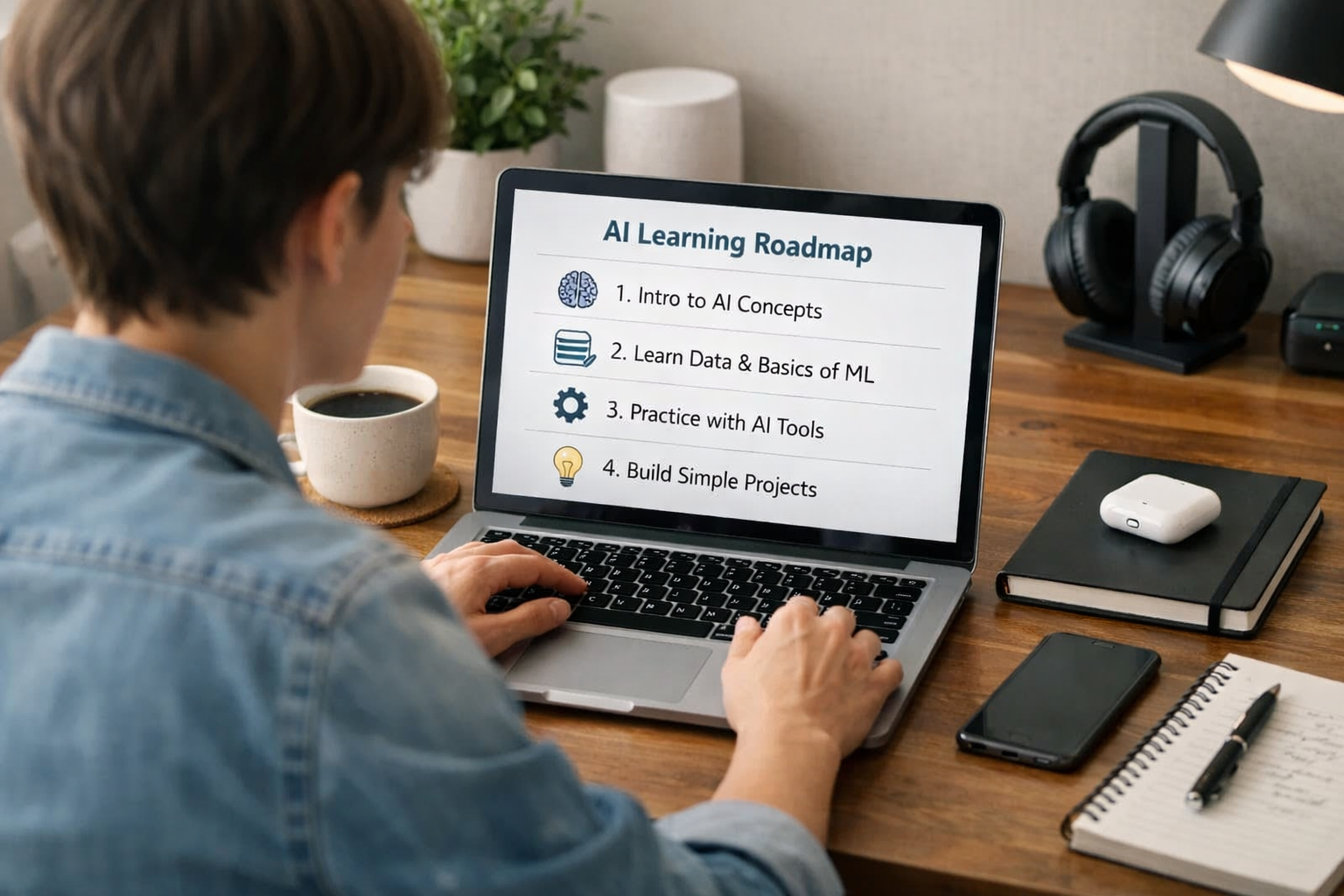
Here is a simple roadmap you can follow.
This plan is realistic for someone studying a few hours each week. You do not need to rush. Consistency beats intensity.
As a beginner, you need structured lessons, plain-language explanations, and a clear path from theory to practical use. Look for courses that start from zero, include examples, and help you connect AI learning to real work. It also helps if the content aligns with major certification frameworks from AWS, Google Cloud, Microsoft, and IBM, because those names often appear in AI and cloud career pathways.
Edu AI is designed for newcomers who want simple, guided learning across AI, machine learning, deep learning, generative AI, natural language processing, computer vision, Python, and more. If you want to compare options before committing, you can also view course pricing and choose a path that fits your budget and schedule.
Changing careers into AI without coding is possible when you break it into small, manageable steps: learn the basics, choose one direction, practise with no-code tools, and build proof of your skills. You do not need to know everything before you begin.
If you want a beginner-friendly place to start, register free on Edu AI and begin exploring practical courses designed for first-time learners. A small first step today can turn into a very different career over the next 6 to 12 months.




- Learning Evolved.
- Intelligence Amplified.