AI Education — April 10, 2026 — Edu AI Team
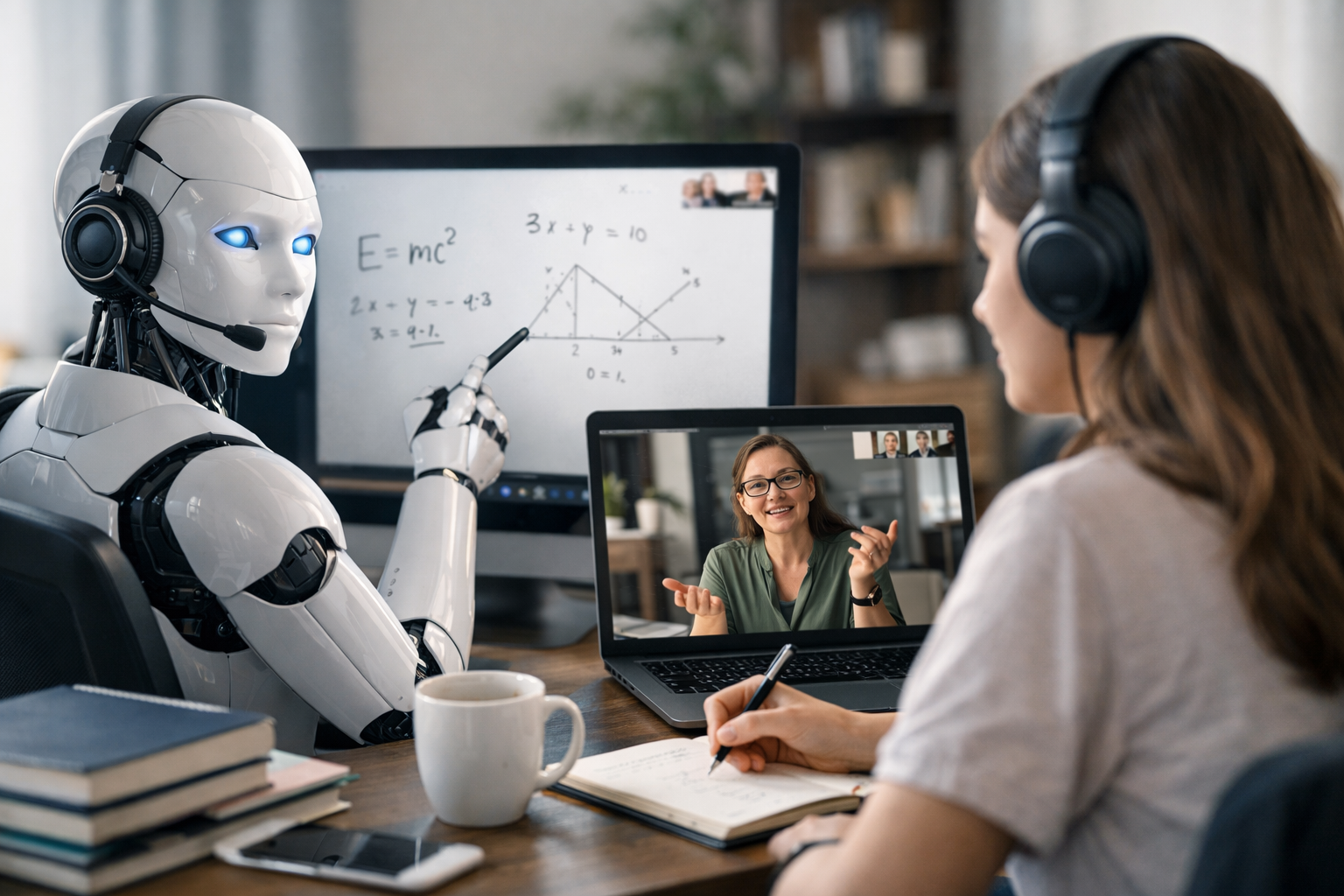
No, AI cannot fully replace teachers in online education. AI can answer questions, recommend lessons, grade simple assignments, and give instant feedback at any hour. But teachers still do important human work that AI cannot truly copy, such as understanding emotions, building trust, motivating struggling learners, and adapting to complex real-life situations. In most online education settings, the best model is not AI instead of teachers. It is AI plus teachers.
This matters because more students now learn online than ever before. They want flexible, affordable, beginner-friendly education. At the same time, schools, course platforms, and employers are using AI tools more often. So it is natural to ask: if a computer can explain a lesson and check your answers, do we still need teachers?
For absolute beginners, the short answer is simple: AI is a powerful teaching assistant, not a full replacement for a great teacher. Let us break down why.
AI, or artificial intelligence, is software designed to perform tasks that usually need human thinking. In education, that can include:
For example, if a student gets 4 out of 10 questions wrong in algebra, an AI system may notice the pattern and suggest a beginner lesson on fractions before moving on. That is called personalized learning, which simply means adjusting the learning path to fit the student.
This is one reason AI is attractive in online education. A human teacher may have 50, 100, or even 500 online learners. AI can help support all of them at scale, 24 hours a day.
One of AI's biggest strengths is speed. A student studying at 11 p.m. does not have to wait until the next day for a reply. AI can explain a basic concept immediately, such as the difference between a noun and a verb, or what a percentage means.
This can reduce frustration. Quick feedback often helps beginners keep going instead of quitting.
Many beginners feel embarrassed asking the same question more than once. AI does not get tired or impatient. A student can ask, "What is machine learning?" five different ways and still get a response.
That matters because learning often requires repetition. Most people do not understand a new topic the first time they see it.
In a live class, everyone often moves at one speed. In AI-supported online learning, students can slow down or speed up. Someone new to coding may spend three days on basic Python variables, while another learner moves ahead in one afternoon.
This flexibility is one of the strongest benefits of online education.
AI tools can help educational platforms support more learners without needing a one-to-one teacher for every student. That can make learning more affordable and accessible, especially for students in different time zones or regions with fewer education resources.
Used well, AI can make good education available to more people, not fewer.
A teacher can notice when a student is discouraged, confused, anxious, or losing confidence. AI can detect patterns in words or clicks, but it does not truly understand feelings the way humans do.
Imagine two students both scoring 60% on a quiz. One simply needs more practice. The other is going through family stress and is close to dropping out. A caring teacher may spot the difference and respond with encouragement, flexibility, or a different approach. AI usually cannot handle this well.
Many people do not finish online courses because of life, not intelligence. They get busy, doubt themselves, or lose direction. Great teachers do more than explain lessons. They motivate, challenge, and inspire.
A message from software saying "Keep going" is not the same as a teacher who knows your progress, understands your goals, and says, "You improved a lot this week. Let us tackle the next step together."
AI is useful for simple right-or-wrong tasks. But deeper learning often needs nuanced feedback. For example:
These judgments often depend on context, creativity, and experience. Human teachers are still better at this, especially in subjects involving writing, discussion, ethics, design, or career advice.
Teachers often shape confidence and identity. A learner may remember the person who first made them believe they could succeed in math, language learning, or coding. AI can provide information, but it does not serve as a genuine role model in the same human sense.
Yes, for some tasks AI can replace part of the teacher's workload. That is different from replacing the teacher completely.
AI is especially good at:
In practical terms, this means AI can remove repetitive tasks and free teachers to focus on the parts that matter most: coaching, mentoring, explaining difficult ideas, and supporting learners who need a human touch.
Think of AI like a calculator in math class. A calculator can speed up arithmetic, but it does not replace understanding. In the same way, AI can support teaching, but support is not the same as education by itself.
The most realistic future is a hybrid model. A hybrid model means AI handles speed and scale, while human teachers handle connection and judgment.
Here is what that might look like in an online course:
This approach gives students the best of both worlds: efficiency and humanity.
That is also why many modern learning platforms are not removing teachers entirely. Instead, they are combining smart tools with structured teaching. If you are curious how beginner-friendly AI learning can work in practice, you can browse our AI courses to see how online learning paths are organized for newcomers.
Students should be careful with AI-only education, especially at the beginner level.
Why? Because beginners usually do not yet know when an answer is incomplete, misleading, or too advanced. AI can sound confident even when it oversimplifies or misses context. A human teacher, tutor, or well-designed course structure helps reduce this risk.
This is especially important in technical subjects like machine learning, programming, finance, or language learning. Beginners need clear foundations, simple explanations, and a logical order. Without that structure, many students jump between topics and become overwhelmed.
A strong platform should therefore do more than provide an AI chat box. It should offer a learning path, practical examples, and guidance suited to new learners.
AI is unlikely to eliminate teachers, but it will change teaching.
Teachers who use AI well may become more effective because they can spend less time on repetitive admin and more time helping students think, apply, and grow. In that sense, AI may improve teaching jobs rather than remove them completely.
For example, instead of manually grading 200 simple quizzes, a teacher can review common mistakes and then record a focused lesson addressing them. That is a better use of human expertise.
So the real question is not "Will AI replace teachers?" It is often "How can teachers use AI to teach better online?"
If you are looking for a plain-English conclusion, here it is:
AI can teach information. Teachers teach people.
Online education works best when students get:
That combination is much more powerful than AI alone.
If you are new to AI or online learning, start with a course built for beginners rather than trying to piece everything together from random tools. A structured learning path can save time, reduce confusion, and help you build confidence step by step.
You can register free on Edu AI to explore the platform, or view course pricing if you want to compare options before committing. The goal is simple: learn at your own pace with support that makes difficult topics feel approachable.




- Learning Evolved.
- Intelligence Amplified.