AI Education — April 8, 2026 — Edu AI Team
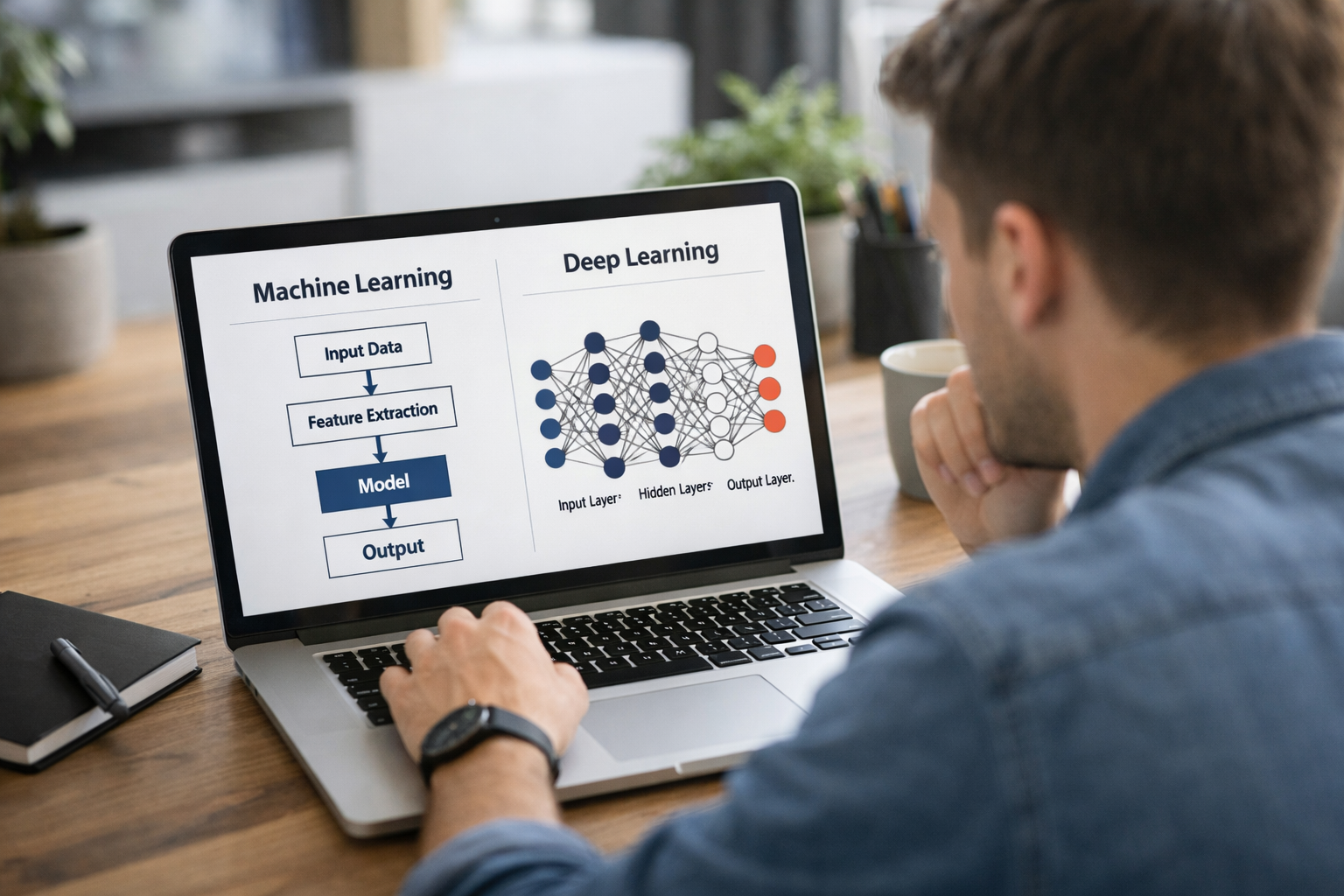
Deep learning vs machine learning: key differences come down to how data is used, how much human guidance is needed, and how complex the problems are. Machine learning is the broader field where computers learn patterns from data to make predictions or decisions. Deep learning is a smaller part of machine learning that uses layered models called neural networks to learn more automatically, especially from large amounts of data like images, audio, and text.
If you are new to AI, think of it like this: machine learning often needs humans to help choose what information matters, while deep learning tries to discover useful patterns on its own. Both are important, both are used in real products, and both can lead to beginner-friendly learning paths.
Machine learning is a way of teaching computers by showing them examples instead of writing every rule by hand. In traditional programming, a developer tells a computer exactly what to do step by step. In machine learning, the computer studies data and learns patterns from it.
For example, imagine you want to predict house prices. You might give a machine learning model information such as:
The model looks at past home sales and learns how these factors affect price. Then it can estimate the price of a new house it has never seen before.
This approach is used in many everyday systems, including spam filters, product recommendations, fraud detection, and customer churn prediction.
A simple machine learning workflow often looks like this:
One important point for beginners: in many machine learning projects, humans play a big role in choosing the right features. If you are predicting whether an email is spam, someone might decide that word frequency, sender reputation, and suspicious links are useful signals.
Deep learning is a type of machine learning that uses neural networks. A neural network is a computer model loosely inspired by the way the human brain processes information. It is made of layers that pass information forward and gradually learn more complex patterns.
The word deep means the network has many layers. These layers help the model move from simple patterns to more advanced ones.
For example, in image recognition:
This is why deep learning is so powerful for tasks where the raw data is messy or complex, such as photos, speech recordings, video, and natural language.
Deep learning powers tools like voice assistants, face recognition, language translation, image generation, and chatbots.
Now let us compare them directly in simple language.
Machine learning is the bigger umbrella. Deep learning sits inside it. So every deep learning system is a machine learning system, but not every machine learning system is deep learning.
Machine learning can work well with smaller datasets. In many business problems, a few thousand or tens of thousands of rows may be enough to build a useful model.
Deep learning usually performs best with much larger datasets. It often needs thousands, millions, or even billions of examples, depending on the task. That is one reason large tech companies use it heavily: they have access to huge amounts of data.
Machine learning often needs manual feature engineering. That means people decide what information the model should focus on.
Deep learning learns features automatically from raw data. This is a major difference. If you feed a deep learning system many cat photos, it can gradually learn what makes a cat look like a cat without someone manually listing ear shape, whiskers, and fur patterns.
Machine learning is usually lighter and faster to train. It can often run on normal computers for smaller projects.
Deep learning is more demanding. Training deep models often requires powerful hardware such as GPUs, which are chips designed to process many calculations at once.
A basic machine learning model might train in minutes. A large deep learning model may take hours, days, or much longer.
Machine learning models are often easier to understand. For example, some models can clearly show which factors influenced a prediction.
Deep learning models are often harder to explain. They can be highly accurate, but the exact reason behind one prediction may be less clear. This matters in fields like healthcare, finance, or law, where decisions must often be explained.
Machine learning is often a strong choice for structured data, meaning neat rows and columns like spreadsheets or databases.
Deep learning is often best for unstructured data, meaning information that does not fit neatly into tables, such as:
A bank wants to estimate whether a customer is likely to repay a loan. It may use structured data such as income, credit history, age of account, and debt level. A machine learning model can find patterns in past loans and predict risk. This is a classic machine learning problem.
When you speak to a voice assistant, the system has to process raw sound waves, understand words, and sometimes even detect intent. This is far more complex than reading a spreadsheet. Deep learning is commonly used here because it handles audio patterns very well.
If machine learning is like a student learning from a summary sheet prepared by a teacher, deep learning is like a student reading the full textbook, looking at pictures, and finding patterns with less direct guidance.
For most people, machine learning is the best starting point. Here is why:
Once you understand basic machine learning, deep learning becomes much less intimidating. You will already know key ideas such as training, testing, prediction, overfitting, and data quality.
If your goal is to work in areas like computer vision, natural language processing, or generative AI, then deep learning is worth learning soon after the basics. A smart path is to start with Python, then learn core machine learning, and then move into neural networks and deep learning projects.
If you want a beginner-friendly route, you can browse our AI courses to explore step-by-step learning paths in machine learning, deep learning, Python, NLP, and computer vision.
Not always. This is a common beginner question, and the honest answer is: the best method depends on the problem.
Deep learning can achieve excellent results on very complex tasks, but it is not automatically the better choice. In fact, many businesses still use standard machine learning because it is:
For example, if a company wants to predict customer cancellations from spreadsheet data, a well-built machine learning model may outperform a deep learning system in terms of cost, speed, and simplicity.
On the other hand, if the same company wants to analyse customer support calls, detect emotion from voice, or summarise long text conversations, deep learning may be a much better fit.
If you are thinking about an AI career, learning both is useful, but you do not need to master everything at once.
Many entry-level learners start with:
Then they move into deep learning if they want to specialise in advanced AI areas. This step-by-step approach is more realistic than trying to jump straight into large neural networks on day one.
Employers often value people who understand the difference between these tools and know when to use each one. That practical judgment matters. It is also helpful if your learning path connects to broader industry expectations. Many structured AI learning routes now align with major certification frameworks from providers such as AWS, Google Cloud, Microsoft, and IBM, especially in cloud AI and machine learning fundamentals.
Here is the simplest way to remember the comparison:
If you remember just one thing, let it be this: deep learning is a powerful subset of machine learning, not a separate alternative to it.
If this topic sparked your interest, the best next step is to learn the basics in order: Python, core machine learning, then deep learning. You do not need a technical background to begin, just a clear roadmap and beginner-friendly lessons.
You can register free on Edu AI to start exploring AI as a beginner, or view course pricing if you want to compare learning options before choosing a path.
Start simple, build confidence, and let each step prepare you for the next. That is how most successful AI learners begin.




- Learning Evolved.
- Intelligence Amplified.