AI Education — June 1, 2026 — Edu AI Team
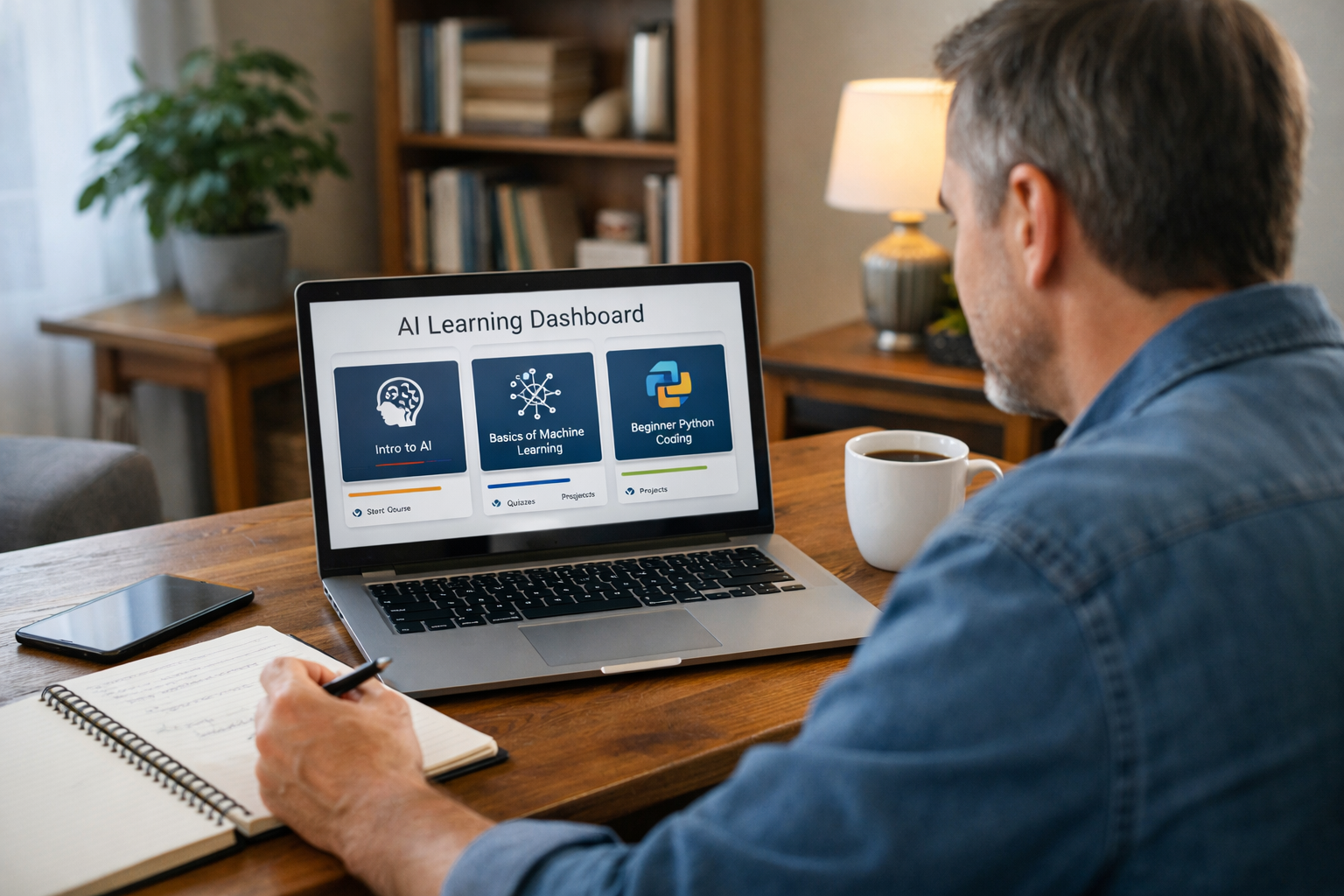
If you want to know the first steps to switch into AI with no experience, the short answer is this: start by learning basic digital skills, then beginner Python, then simple data concepts, and only after that move into machine learning projects. You do not need a computer science degree, advanced maths, or years of coding before you begin. What you do need is a clear plan, realistic expectations, and a way to practise a little each week.
Many people imagine AI as something only experts can do. In reality, plenty of beginners enter AI from teaching, marketing, finance, customer service, administration, design, or other non-technical roles. The key is to treat it like learning a new language: first understand the alphabet, then words, then sentences, and only later full conversations.
Before choosing courses or job titles, it helps to understand what AI is. Artificial intelligence, or AI, is a broad term for computer systems that can do tasks that usually need human judgment, such as recognising images, answering questions, spotting patterns, or making predictions.
Inside AI, you will often hear a few related terms:
For a beginner, switching into AI does not mean mastering all of these at once. It means building enough understanding and practical skill to move toward an entry-level AI, data, automation, or analytics role.
The biggest mistake beginners make is starting too far ahead. They jump straight into advanced topics like neural networks or research papers, then feel lost after two lessons. A better approach is to begin with the foundations.
Your first goal is not “become an AI expert in 30 days.” Your first goal is much simpler: become comfortable using basic tools and ideas.
If that list feels manageable, that is a good sign. Beginner progress should feel challenging but not impossible.
Python is a programming language, which means a way to write instructions for a computer. It is widely used in AI because it reads more like plain English than many other languages, and it has many ready-made tools for beginners.
You do not need to become a software engineer. At the start, you only need a few basics:
Think of Python like giving a recipe to a very literal assistant. If your instructions are clear, the computer follows them exactly. If the instructions are missing steps, it gets stuck.
A realistic beginner target is 3 to 5 hours per week for 6 to 8 weeks. That is often enough to write simple scripts, clean small datasets, and understand beginner AI lessons without panic.
AI runs on data. Data is simply information collected in a usable form, such as numbers in a spreadsheet, customer reviews, website clicks, or photos.
Imagine you want a computer to tell whether an email is spam. You would show it many examples of emails already labelled “spam” or “not spam.” The model studies patterns in those examples and uses them to make future guesses. That is why data matters so much: better examples usually lead to better results.
You do not need advanced statistics at the start. You just need to understand what the information represents and how to work with it carefully.
Once you know basic Python and data handling, you can move into machine learning. Machine learning means a computer improves at a task by learning from examples rather than being told every rule by hand.
Here is a simple example. Suppose you want to predict whether a customer will cancel a subscription. You might give a model information such as how long they have been a customer, how often they log in, and whether they contacted support. The model looks for patterns and estimates the chance of cancellation.
As a beginner, focus on understanding three ideas:
This stage is where structured beginner learning helps. If you want a guided path, you can browse our AI courses to see beginner-friendly options in Python, machine learning, data science, and related subjects.
You do not become confident before practice. You become confident because of practice. That is why small projects matter so much.
Your first project should be simple enough to finish in a few days, not a huge app that takes six months. Good beginner project ideas include:
Finished small projects are more valuable than half-finished ambitious ones. They show progress, build habits, and can later become part of a portfolio.
One reason people think they have “no experience” is that they only count technical experience. But career changes rarely start from zero. Your previous work still matters.
For example:
This matters because AI jobs are not only about coding. Many roles involve communication, problem-solving, business understanding, experimentation, and responsible use of tools.
You do not need your first AI-related job to be “Machine Learning Engineer.” For many beginners, a better first move is adjacent to AI.
These roles can help you gain practical experience while continuing to build deeper AI knowledge. Over time, you can specialise in areas like machine learning, natural language processing, computer vision, or generative AI.
If certifications are part of your plan, it is useful to know that strong beginner learning can support paths aligned with major industry frameworks from AWS, Google Cloud, Microsoft, and IBM. You do not need to chase certificates immediately, but structured study now can make those later goals easier.
This depends on your schedule, starting point, and goal. But for many beginners, a practical timeline looks like this:
That does not mean everyone is job-ready in six months. It means six focused months can move you from “I know nothing” to “I understand the basics, can build simple projects, and can talk clearly about what I am learning.” That is real progress.
The first steps to switch into AI with no experience are simple, even if they are not always easy: learn beginner Python, understand data, study machine learning in plain English, and build a few small projects. You do not need to know everything before you begin. You just need to begin in the right order.
If you want a structured, beginner-friendly place to start, you can register free on Edu AI and explore learning paths designed for newcomers. If you are comparing options before committing, you can also view course pricing and choose a pace that fits your goals and budget.
Start small, stay consistent, and give yourself permission to be a beginner. That is how most successful career changes into AI really begin.




- Learning Evolved.
- Intelligence Amplified.