AI Education — March 31, 2026 — Edu AI Team
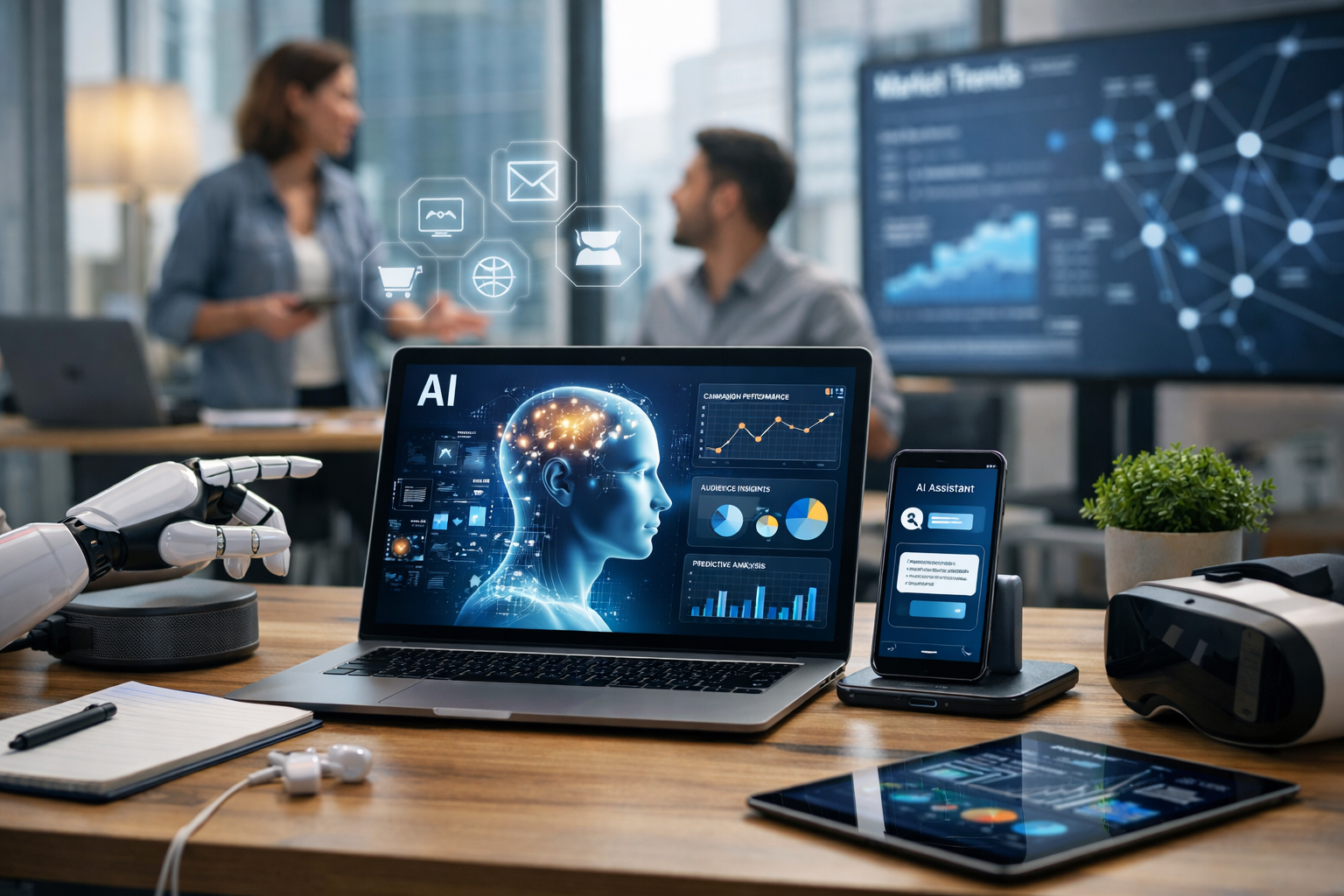
The future of AI in marketing in 2026 is clear: marketers will use AI not just to save time, but to make better decisions, create more personal customer experiences, and improve results across content, ads, email, search, and customer support. The biggest trends every marketer must know in 2026 are smarter personalization, AI-generated content with human editing, predictive analytics, conversational AI, privacy-first marketing, and AI tools becoming part of everyday work. Even beginners should understand these shifts, because they are quickly becoming standard in modern marketing teams.
If that sounds technical, do not worry. AI, or artificial intelligence, simply means software that can learn patterns from data and help with tasks that usually need human thinking, such as writing, predicting, sorting, or recommending. In marketing, that means AI can help answer questions like: Which customer is most likely to buy? What subject line will get more email opens? Which ad message fits this audience best?
In 2026, the marketers who do well will not necessarily be the most technical. They will be the ones who understand what AI can do, where it helps, and where human judgment still matters most.
Marketing has always been about reaching the right person with the right message at the right time. The problem is scale. A small business might have hundreds of customers. A growing online brand might have thousands or even millions. No human team can manually personalize every email, ad, landing page, and product recommendation at that level.
That is where AI helps. It can process large amounts of information very quickly. For example, instead of sending one email to 50,000 people, AI can help group customers by behavior, such as:
Then marketers can tailor messages for each group. This often leads to better open rates, more clicks, and stronger conversion rates. Conversion rate means the percentage of people who take a desired action, such as signing up, buying, or downloading something.
One of the biggest AI marketing trends in 2026 is hyper-personalization. This means going beyond basic personalization like using a customer’s first name in an email. AI can now help brands personalize offers, timing, product suggestions, and even website layouts based on behavior.
Imagine two people visit the same online store. One usually buys budget-friendly items. The other often shops for premium products. In 2026, AI tools can help show each person different recommendations, different homepage banners, and different follow-up emails. The goal is simple: make the experience feel more relevant.
For beginners, the key idea is this: AI studies patterns from past actions and uses them to improve the next interaction. It is similar to how streaming platforms recommend shows based on what you watched before.
By 2026, more marketing teams will use AI to draft blog posts, social media captions, email campaigns, ad copy, product descriptions, and video scripts. This is because generative AI can create new text, images, audio, or video based on prompts. A prompt is simply an instruction you give the AI.
But there is an important truth many beginners miss: AI-generated content is not automatically good content. It can sound repetitive, generic, or even inaccurate. That is why the winning approach in 2026 will be AI plus human review.
For example, a marketer might ask AI to write five ad variations for a new course. AI can produce them in seconds. Then the marketer checks tone, facts, brand fit, and clarity before publishing. This saves time without losing quality.
Google and readers both reward helpful, trustworthy content. That means marketers must focus on accuracy, original examples, and clear explanations, not just speed.
If you want to build practical AI skills step by step, you can browse our AI courses to explore beginner-friendly learning paths in AI, machine learning, and generative AI.
Predictive analytics sounds advanced, but the basic idea is simple: using past data to make an educated guess about what might happen next. In marketing, AI can look at historical patterns and help answer questions like:
This matters because better predictions lead to better decisions. If a company knows which customers are at risk of leaving, it can send a special offer before they disappear. If a team knows which leads are most promising, it can focus sales time more efficiently.
In 2026, predictive tools will become easier to use, even for non-technical marketers. Many platforms will include simple dashboards instead of complex coding. That lowers the barrier for beginners and small businesses.
Another major trend is the rise of conversational AI. This includes AI chatbots, voice assistants, and smart website assistants that can answer questions, recommend products, book demos, or guide users to the next step.
In the past, many chatbots felt robotic and frustrating. In 2026, they will be far better at understanding natural language. Natural language means everyday human language, such as the way people type or speak in real life.
For example, a visitor might ask, “What is the best beginner course if I know nothing about AI?” A strong AI assistant can understand that request and suggest a course path, explain the level, and answer follow-up questions instantly.
This improves user experience and can reduce support workload. But brands must still be careful. AI should help customers, not trap them in endless automated responses. Easy handoff to a human remains important.
As AI gets more powerful, concerns about data privacy are growing too. Customers want personalized experiences, but they also want to know how their data is being used. Governments and platforms are also increasing privacy rules.
That means one of the most important AI marketing trends in 2026 is privacy-first marketing. Marketers will need to be more transparent, collect data responsibly, and rely more on first-party data. First-party data means information collected directly from your own audience, such as website sign-ups, purchase history, survey responses, or app activity.
This is healthier than depending too heavily on outside tracking. It builds trust, and trust is a major marketing advantage.
Many beginners think marketing is only about social media or ads, but search remains one of the most powerful channels. In 2026, AI will continue changing how people discover information online. Search engines are becoming more conversational, and users increasingly expect direct answers instead of just a list of links.
For marketers, this means content must be clearer, more helpful, and more structured. Pages should answer real beginner questions quickly. Articles should explain terms simply, include examples, and show real expertise.
This shift is especially important for brands that want long-term traffic. Helpful educational content can attract people at the exact moment they are learning about a problem.
Perhaps the most important trend is not about tools. It is about people. In 2026, marketers who understand AI will have a clear advantage in hiring, promotion, and career change opportunities.
You do not need to become a programmer to benefit. Even basic knowledge can help you work faster, ask better questions, and collaborate more effectively with technical teams. Understanding concepts like machine learning, automation, prompts, and data analysis can make a real difference.
Machine learning is a branch of AI where systems learn from examples instead of following only fixed rules. For marketers, that often shows up in recommendation systems, ad targeting, forecasting, and content optimization.
As more companies adopt AI, beginner-friendly learning becomes essential. If you are exploring a move into AI-powered marketing or digital strategy, it can help to view course pricing and compare practical learning options before committing.
It is easy to feel overwhelmed by constant AI news. A simple plan is better than chasing every new tool. Focus on these five actions:
The future of AI in marketing is not about replacing marketers. It is about helping marketers work smarter. AI is good at speed, pattern recognition, and repetition. Humans are still better at empathy, judgment, strategy, ethics, and creativity with context.
If you are new to AI, the best next step is to learn the basics in plain English and practice with guided examples. Edu AI offers beginner-friendly courses designed for people with no coding or data science background, including topics like machine learning, generative AI, natural language processing, and Python.
When you are ready to take the first step, you can register free on Edu AI and start exploring how AI works in the real world. Small, steady learning today can open up much bigger marketing opportunities in 2026 and beyond.




- Learning Evolved.
- Intelligence Amplified.