AI Education — March 17, 2026 — Edu AI Team
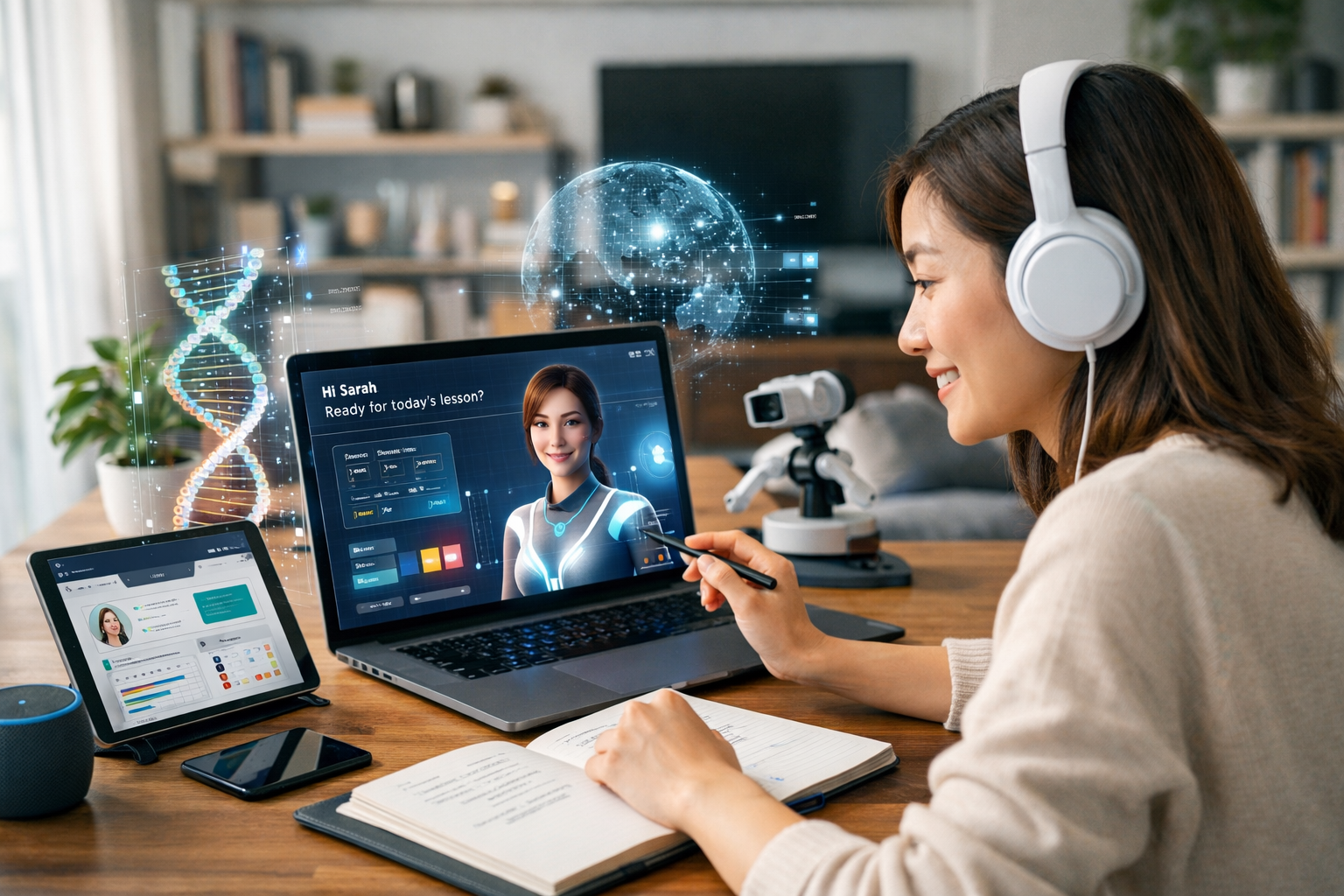
AI is personalising online education in 2026 by dynamically adapting what you learn, how you practise, and when you get support—based on your goals, current skill level, time constraints, and performance signals. Instead of a one-size-fits-all course path, modern platforms use adaptive diagnostics, AI tutors, and project generators to tailor difficulty, pacing, and feedback in near real time, often improving completion and skill transfer because learners spend less time on content they’ve already mastered and more time where they struggle.
Personalisation used to mean simple content recommendations (“people also watched…”). In 2026, it typically includes four deeper layers:
What’s new is the combination of generative AI (for explanations, hints, and new practice) with adaptive learning analytics (for accurate skill estimation). Together, they can do something older e-learning rarely did well: adjust instruction and assessment continuously, not only at the end of a module.
Many platforms now start with a short diagnostic (often 10–20 minutes) that estimates your mastery across prerequisites and core competencies. Instead of forcing everyone through the same intro videos, AI uses your results to:
Example: If you’re transitioning from finance to data science, the system may fast-track statistics concepts you already use (like distributions and hypothesis testing) while assigning extra practice on Python data wrangling and model validation.
In 2026, personalisation often includes time-aware learning plans. Learners rarely fail because they’re incapable; they fail because the plan doesn’t fit real life. AI pacing features commonly:
Comparison: A static course might ask for “6 hours/week” regardless of your calendar. A personalised plan can shift to “25 minutes/day + 2 hours Saturday” while keeping the same learning outcome.
Practice is where skill forms—and where traditional online courses often fall short. Modern AI systems can detect patterns like:
Then they generate or select just-in-time exercises at the right difficulty. Instead of 30 random questions, you get 8–12 targeted ones that close the gap faster.
AI tutors in 2026 do more than chat. The most helpful ones behave like a teaching assistant:
Example: In a deep learning lesson, if your model won’t converge, a good AI tutor will ask about learning rate, batch size, data normalisation, and loss curves—then propose a small controlled experiment rather than offering generic advice.
Projects are where personalisation becomes career leverage. In 2026, AI can generate project briefs that align with your target role and industry, while keeping the underlying skills consistent.
This matters because hiring managers care less about “watched a course” and more about “built something relevant.” Personalised projects shorten the distance from learning to portfolio.
For a global audience, AI personalisation includes language support and accessibility features that used to require separate tools:
Practical impact: If English is your second language, you can focus on mastering ML concepts rather than losing time to unfamiliar phrasing.
Traditional quizzes are easy to game. In 2026, better platforms combine:
This makes personalisation more reliable. If the system can measure skill accurately, it can adapt the pathway without guesswork.
Many learners in 2026 are pursuing credentials to change careers or validate skills. AI personalisation helps because certification prep is not just “cover the syllabus”—it’s closing your specific gaps efficiently.
For example, cloud and AI certification tracks often require you to combine multiple competencies: data handling, model evaluation, deployment concepts, and responsible AI. Personalised learning plans can allocate time based on what you already know (e.g., strong Python, weak MLOps basics) and focus your practice on high-impact areas like metrics selection, overfitting prevention, and model monitoring.
At Edu AI, our course paths are designed to be compatible with the competencies found in major industry frameworks (including AWS, Google Cloud, Microsoft, and IBM) where relevant—so the skills you build map cleanly to real job requirements and common certification expectations.
If you’re exploring what to learn next, start by scanning structured paths and prerequisites in the catalog: browse our AI courses.
Personalisation works best when you give it the right signals. Here’s a practical approach you can use on any modern platform:
This structure keeps you in control. The AI adapts the content, but you drive the outcome.
AI personalisation is powerful, but it isn’t magic. Three common pitfalls matter for learners:
A good rule: personalisation should make you more independent over time—fewer hints, stronger mental models, better project decisions—not more dependent on the tool.
Whether you’re starting from scratch or upskilling while working full time, the most valuable personalisation is the kind that moves you toward job-ready competence: stronger fundamentals, more targeted practice, and projects that match the roles you want.
Edu AI focuses on practical pathways across Machine Learning, Deep Learning, Generative AI, NLP, Computer Vision, Reinforcement Learning, Computing & Python, Economics & Finance, and Language Learning—so you can combine technical depth with career relevance. If you’re comparing options, it can help to check what’s included and how it matches your schedule: view course pricing.
If you want to benefit from AI-personalised learning in 2026, choose one target (a role, a certification, or a project outcome), then commit to a plan you can sustain for 6–10 weeks. When you’re ready, register free on Edu AI to start exploring personalised course paths and build momentum with structured practice and projects.



- Learning Evolved.
- Intelligence Amplified.