AI Education — April 6, 2026 — Edu AI Team
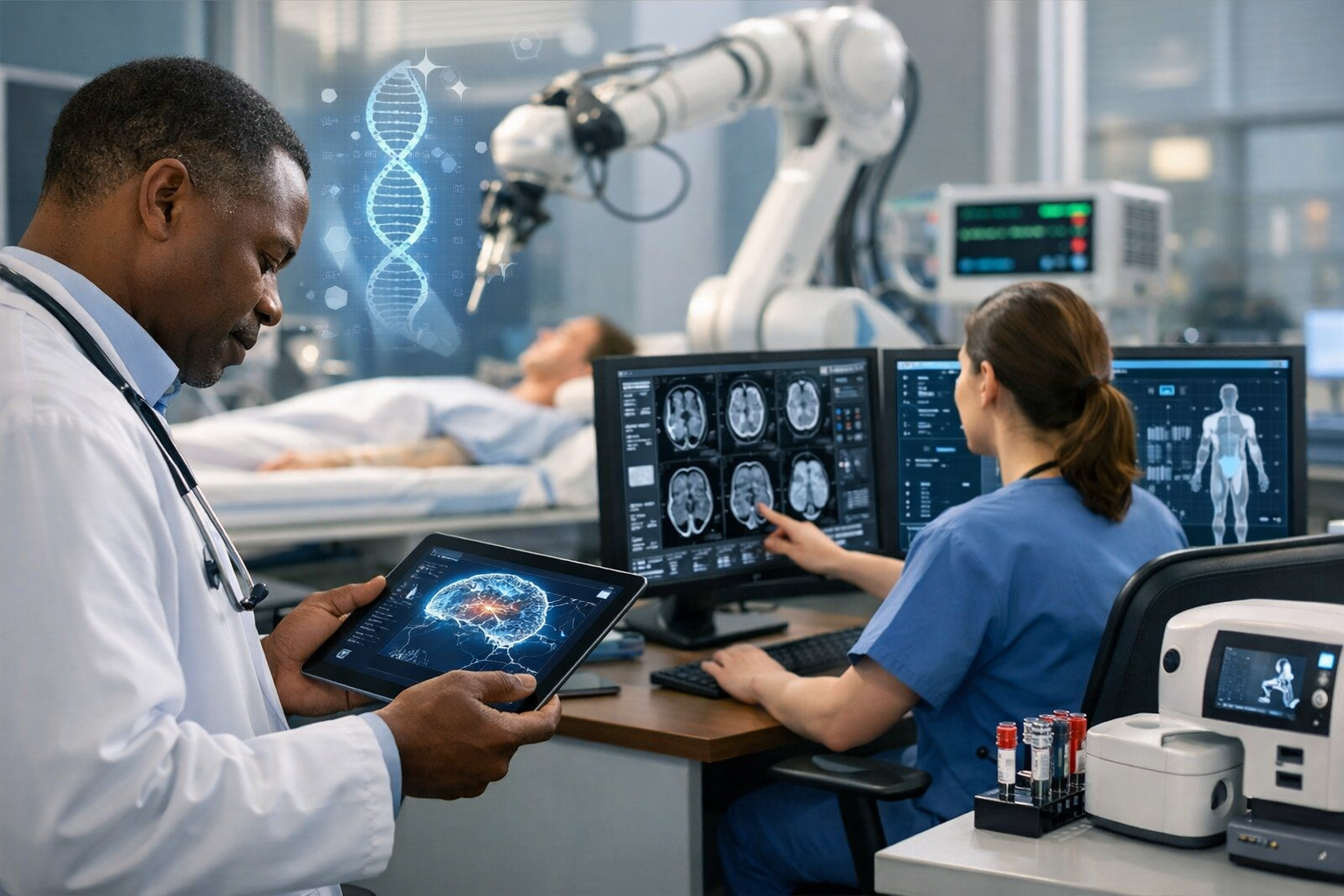
How AI is used in healthcare in 2026 can be summed up in one simple idea: AI helps medical professionals make faster, more informed decisions and helps patients get more personalized care. In 2026, hospitals and clinics use AI to read medical images, predict health risks, summarize doctor notes, support virtual assistants, speed up drug discovery, and improve scheduling and hospital operations. AI is not replacing doctors. Instead, it works like a smart assistant that can spot patterns in large amounts of data much faster than a human can.
If you are completely new to this topic, do not worry. You do not need a background in coding, medicine, or data science to understand the basics. This guide explains the current applications of AI in healthcare in plain English, with real-world examples and clear definitions.
Artificial intelligence, or AI, is a broad term for computer systems that perform tasks that usually need human thinking. In healthcare, that can mean recognizing a tumor in an X-ray image, predicting which patient might need extra monitoring, or turning a long doctor-patient conversation into a short clinical summary.
Many healthcare AI systems use machine learning. Machine learning is a type of AI where the system learns patterns from examples instead of following only fixed rules. For example, if a machine learning model studies thousands of scans labeled by experts, it can learn what signs of disease often look like.
This matters because healthcare creates huge amounts of information every day:
Humans are still essential, but AI can help make sense of this information more quickly.
One of the most visible current applications of AI in healthcare is medical imaging. This means using AI to analyze scans and images to help detect problems earlier or more accurately.
An AI model is trained on large numbers of medical images. It learns to recognize patterns linked to conditions such as pneumonia, fractures, breast cancer, stroke, diabetic eye disease, or lung nodules.
Imagine a radiologist reviewing 200 chest X-rays in a day. An AI tool can quickly flag the images most likely to show an abnormality. The radiologist still makes the final decision, but the tool helps prioritize urgent cases.
In 2026, many healthcare providers use AI not as a final judge, but as a second reader. That means it gives an extra opinion, which can reduce oversight and save time. This is especially valuable in busy hospitals where delays can affect patient outcomes.
AI imaging tools are now commonly discussed in areas such as:
Another major application is predictive analytics. That sounds technical, but the idea is simple: AI looks at past and current patient data to estimate what may happen next.
For example, an AI system may help identify patients who are at higher risk of:
This can help care teams act earlier. If a system detects that a patient’s lab results, heart rate, and breathing pattern match a high-risk pattern, nurses and doctors can check sooner.
Think of it like a weather forecast. A forecast cannot guarantee rain, but it can warn you that conditions suggest rain is likely. In healthcare, that warning can make a real difference.
One of the biggest hidden uses of AI in healthcare in 2026 is reducing administrative work. Doctors and nurses spend many hours on documentation, forms, and record updates. AI can help by handling repetitive text-based tasks.
This often uses natural language processing, or NLP. NLP is a branch of AI that helps computers understand and work with human language. If you speak to a phone assistant and it understands your request, that involves NLP. In healthcare, the same idea can help process clinical text.
For beginners interested in these areas, it can be helpful to browse our AI courses and see how topics like machine learning, NLP, and data analysis connect to real industries such as healthcare.
AI is also being used on the patient side. Healthcare providers now use AI chat tools and virtual assistants to help with basic support tasks.
These systems are useful because they can provide help 24 hours a day. They do not replace medical advice for emergencies or complex diagnosis, but they can reduce waiting times and improve access for routine questions.
In 2026, many clinics use AI assistants as the first step in the patient journey. This is similar to how customer support chatbots work, but in healthcare the systems usually operate within tighter rules because privacy and safety matter so much.
Developing a new medicine is usually slow and expensive. Researchers may test thousands of chemical candidates before finding one worth taking into clinical trials. AI helps by narrowing down the most promising options faster.
Instead of replacing scientists, AI can scan large biological and chemical datasets to identify patterns people might miss. It may suggest which molecules are more likely to work, which patient groups may benefit most, or which existing drugs could be repurposed for new diseases.
AI is also supporting personalized medicine. This means tailoring treatment to the individual rather than using exactly the same plan for everyone. In some cases, AI can help doctors consider a person’s medical history, genetics, test results, and response patterns when choosing treatments.
That does not mean every patient gets a perfect custom plan instantly. But it does mean healthcare is moving toward more data-informed care.
Not all healthcare AI is about diagnosis. A lot of value comes from improving how hospitals run day to day.
Current applications in 2026 include:
This may sound less exciting than a robot reading scans, but it matters a lot. If AI helps a hospital reduce delays, patients get seen sooner and staff can work more effectively.
It is important to keep expectations realistic. AI in healthcare is powerful, but it has limits.
That is why responsible healthcare AI needs human oversight. Doctors, nurses, radiologists, technicians, data teams, and regulators all play a role in checking that systems are safe and useful.
In short, AI should support care, not control it.
If you are exploring AI for the first time, healthcare is one of the clearest examples of why AI matters. It shows that AI is not just about robots or science fiction. It is about solving real problems: reducing paperwork, spotting disease earlier, improving patient support, and helping health systems work better.
This is also one reason many people move into AI from non-technical backgrounds. You do not need to start by building hospital software. You can begin by understanding the foundations: what data is, how machine learning works, how AI models find patterns, and where ethics and privacy fit in.
If your long-term goal is employment, many beginner AI learning paths also align with major certification ecosystems from AWS, Google Cloud, Microsoft, and IBM, which are widely recognized in industry. The key is to start with the basics before worrying about advanced tools.
No. AI is mainly assisting healthcare professionals. It can speed up analysis and highlight risks, but final care decisions still need trained humans.
Sometimes yes, especially in pattern-heavy tasks like image review or risk scoring. But accuracy depends on the quality of the system, the data, and how it is used.
No. Large hospital systems often adopt it first, but clinics, telehealth providers, insurance companies, and health startups also use AI tools.
The best way to understand how AI is used in healthcare is to learn the simple building blocks behind it: machine learning, data analysis, language processing, and AI ethics. You do not need prior coding experience to begin, and starting small is often the smartest move.
If you want a beginner-friendly next step, you can register free on Edu AI and explore learning paths designed for complete newcomers. If you are comparing options first, you can also view course pricing and choose a pace that fits your goals.
Healthcare is just one field being reshaped by AI, but it is one of the most practical and meaningful places to start learning. Once you understand these current applications in 2026, the bigger AI picture becomes much easier to follow.




- Learning Evolved.
- Intelligence Amplified.