AI Education — March 21, 2026 — Edu AI Team
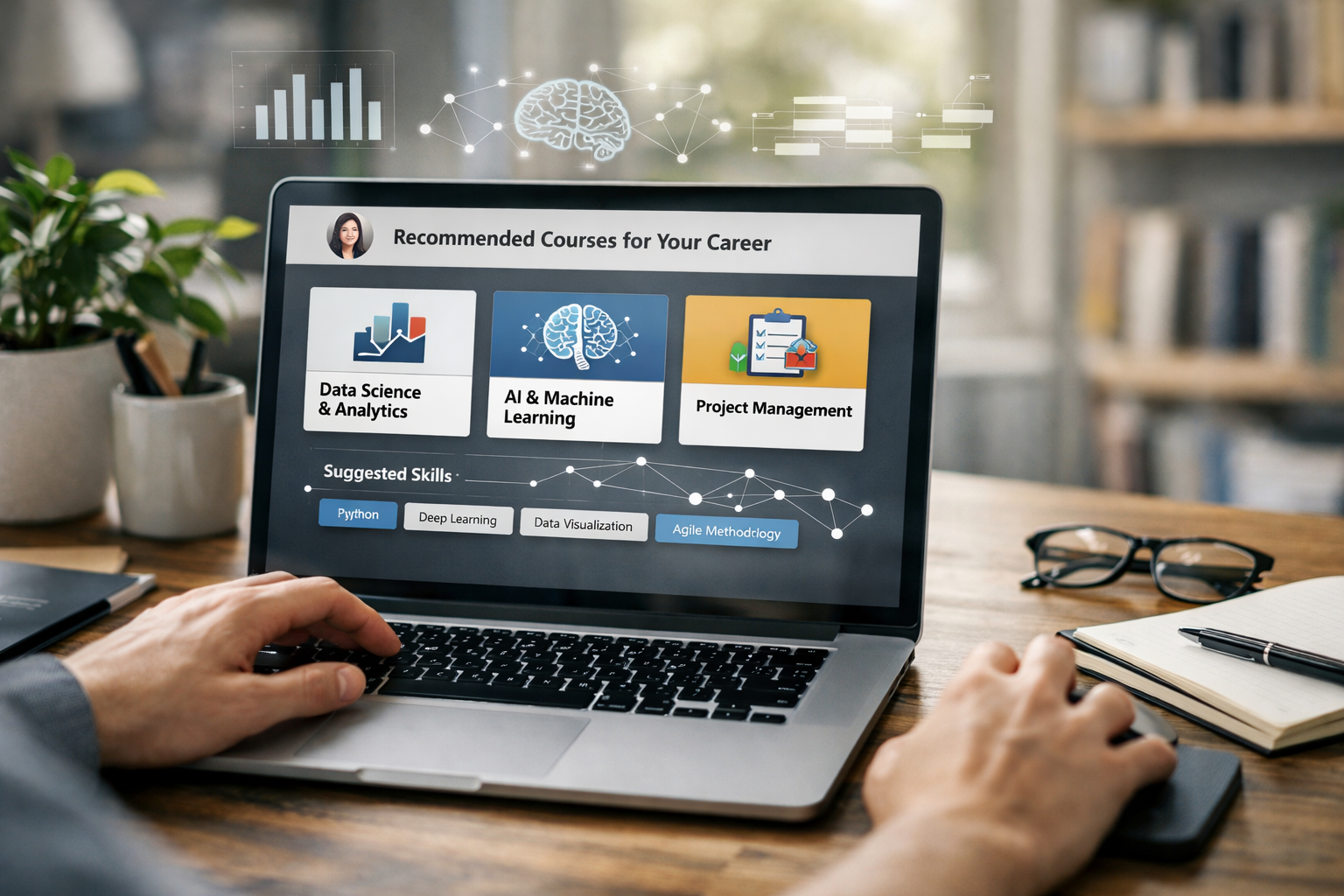
Machine learning recommends the right courses for your career goals by predicting which learning path will most likely close your skill gaps—based on your target role, current level, behavior (what you watch, finish, and practice), and outcomes from similar learners. Instead of showing “popular” courses, a good recommender system tries to answer: “What should you study next to reach your goal faster, with fewer detours?”
If you’re switching careers or trying to get promoted, time and focus are your scarcest resources. Two learners can type the same search (“machine learning certificate”) and need totally different paths:
Machine learning-based recommendations aim to personalize those paths using data—so your next course is chosen because it improves the probability of reaching your goal, not because it’s trending this week.
Recommendation models don’t “understand” your ambition like a human mentor—but they can learn patterns from large amounts of learner and course data. Most systems combine several signals:
These are explicit inputs you provide (or inferable from choices):
These are implicit signals from how you learn:
For example, if you consistently score 80%+ in Python exercises but struggle with probability, the model may recommend a targeted statistics refresher before advanced ML.
To match you with the right content, platforms tag courses with structured information:
This is where machine learning becomes powerful: it can learn which sequences of courses tend to correlate with real progress. Outcomes might include:
If learners who successfully move into ML engineering often take “Python → ML fundamentals → model deployment → MLOps basics,” the system can recommend that path to similar profiles.
Most modern course recommenders combine multiple approaches rather than relying on one model. Here are the core techniques—explained without heavy math.
Collaborative filtering finds patterns across users: if many learners with similar behavior and goals liked Course A and Course B, the system recommends B to someone who liked A. It works even when course descriptions are short because it learns from interactions.
Strength: great at discovering non-obvious matches (you didn’t search for it, but it helps).
Weakness: struggles with new courses or new users (the “cold start” problem).
Content-based models recommend based on course attributes (skills, level, prerequisites) and your profile. If your goal is “NLP Engineer,” and you’ve already completed Python + ML basics, the system can prioritize “transformers,” “text classification,” and “LLM fine-tuning” modules.
Strength: interpretable and precise for skill matching.
Weakness: can be narrow—may keep recommending “more of the same” unless diversified.
Hybrid recommenders combine collaborative filtering + content-based ranking + rules (prerequisites, level gating). This is common in education because learning paths have dependencies. A hybrid system might:
Many platforms treat recommendation as a ranking problem: given 200 possible courses, sort the top 10 that maximize a goal like completion probability, learning gain, or goal alignment. The model weighs factors such as difficulty, course length, your recent momentum, and relevance to your target role.
A simple, realistic example: if you have only 5 hours/week, the model may rank shorter, project-focused courses higher because you’re more likely to complete them—creating momentum that compounds.
Consider the goal: “Get a job in data science”. Machine learning recommendations differ depending on the starting point.
Notice what changes: not the ambition, but the shortest path that fits your starting skills.
Not all recommendations are equally useful. For career transitions, look for these qualities:
Edu AI is built for practical upskilling in areas like Machine Learning, Deep Learning & Generative AI, NLP, Computer Vision, Reinforcement Learning, Computing & Python, and more. When you’re choosing your next step, the most effective approach is to pair career intent with skill coverage and evidence of learning (projects, assessments, and progression).
If you’re aiming for certification-backed learning, many topics covered in Edu AI’s technical tracks naturally align with common industry frameworks used by major providers (AWS, Google Cloud, Microsoft, IBM)—for example, domains such as ML fundamentals, data preparation, model training, evaluation, and deployment concepts. This matters because certification frameworks often reflect real job task analysis, making them a practical compass for course planning.
To see what fits your goal, you can start by exploring the catalog and filtering by topic and level: browse our AI courses.
You don’t need to be a data scientist to benefit from ML-driven personalization. These steps make recommendations more accurate in almost any learning platform:
No. It can’t guarantee employment. What it can do is increase the odds that your learning time targets the skills most associated with your goal, based on patterns across many learners and course outcomes.
Common reasons include cold start (not enough data about you yet), missing goal context, or noisy behavior (skipping around). After you complete a few lessons and assessments, recommendations usually improve.
Not necessarily. Popularity is a weak proxy for usefulness. A strong recommender prioritizes fit: prerequisites, your gaps, and what helps you progress to the next milestone (project, interview skills, or certification domains).
If your goal is to upskill efficiently, the best next move is to map your target role to a short course sequence (foundation → specialization → project). Start exploring options by topic and level: browse our AI courses. When you’re ready to track your learning and get tailored progress, you can register free on Edu AI. If you’re comparing plans or budgeting for a career transition, view course pricing.




- Learning Evolved.
- Intelligence Amplified.