AI Education — April 24, 2026 — Edu AI Team
How to choose your first AI role without technical skills starts with one simple idea: do not begin by asking, “Which AI job pays the most?” Begin by asking, “What kind of work do I already enjoy, and how close is that work to AI?” If you have no coding background, the best first AI role is usually one that uses your existing strengths in communication, research, operations, writing, sales, teaching, or project coordination. That means your first step is not learning advanced machine learning. It is finding the role where you can contribute quickly while building AI knowledge over time.
Many beginners think AI careers are only for programmers or data scientists. That is not true. AI, or artificial intelligence, means computer systems that can perform tasks that normally need human thinking, such as answering questions, recognizing images, summarizing text, or spotting patterns in data. Companies need technical people to build these systems, but they also need non-technical people to explain them, organize projects, support customers, review outputs, create content, and connect AI tools to real business needs.
If you are changing careers, this is good news. You may already have transferable skills that fit an entry-level AI role.
AI products do not succeed because of code alone. They succeed when people can use them to solve real problems. For example, imagine a company launches an AI chatbot for customer service. Someone still needs to:
Only some of those tasks require programming. Many do not.
This is why beginners often do well in roles around AI rather than deeply technical roles at the start. Think of it like entering the healthcare field. Not everyone starts as a surgeon. There are coordinators, educators, analysts, assistants, administrators, and specialists. AI works in a similar way.
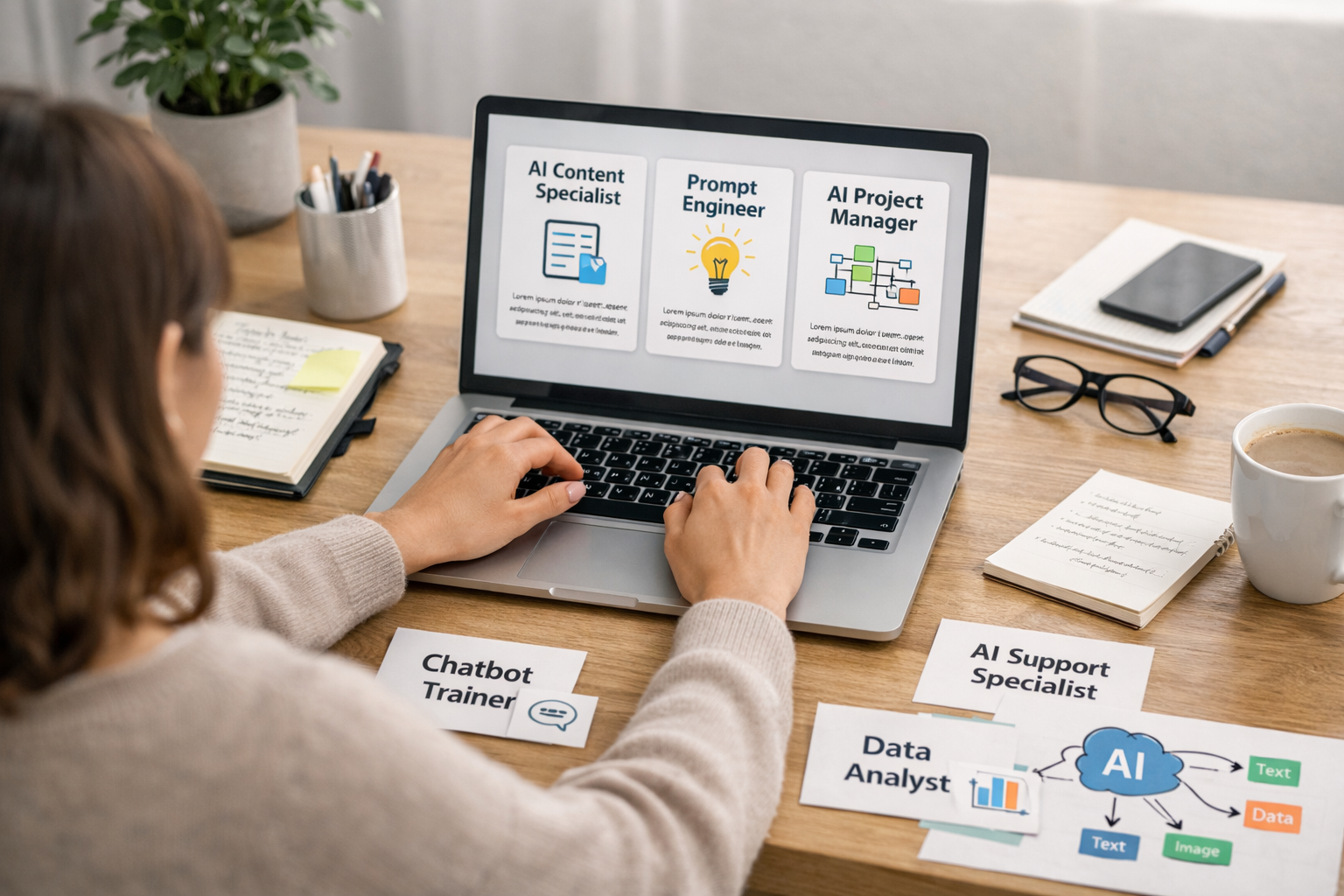
Here are five realistic role categories to consider if you have little or no technical experience.
This role helps teams stay organized. You may schedule meetings, track tasks, update documents, and make sure different departments communicate clearly.
Good fit if you enjoy: planning, checklists, timelines, teamwork, and problem solving.
Common background: administration, operations, office support, customer service, education, or event planning.
Why it works for beginners: you can learn AI concepts gradually while using strong organizational skills from day one.
A prompt is the instruction you give an AI tool, such as “write a short product description” or “summarize this meeting in bullet points.” Some beginner roles involve testing prompts, improving outputs, writing simple instructions, or creating AI-assisted content.
Good fit if you enjoy: writing, editing, research, teaching, and creativity.
Common background: marketing, communications, education, journalism, copywriting, or social media.
Why it works for beginners: many tasks focus on language and clarity, not coding.
In this role, you help customers understand how to use an AI tool. You may answer questions, create guides, run demos, or report common issues back to the product team.
Good fit if you enjoy: helping people, explaining ideas simply, and solving practical problems.
Common background: retail, hospitality, call centers, training, account management, or support teams.
Why it works for beginners: companies often value communication and patience more than technical depth for entry-level support roles.
This type of role focuses on how AI tools fit into daily business processes. For example, a company might use AI to sort emails, summarize documents, or speed up reports.
Good fit if you enjoy: improving systems, saving time, and making work more efficient.
Common background: operations, administration, HR, recruiting, finance support, or business assistance.
Why it works for beginners: you are often improving workflows rather than building software.
Some AI companies need people to research markets, qualify leads, prepare presentations, or explain product benefits to potential customers.
Good fit if you enjoy: communication, persuasion, research, and understanding business needs.
Common background: sales, recruitment, business development, marketing, or client relations.
Why it works for beginners: strong people skills can matter more than technical skills in early-stage roles.
Use this simple 4-step method.
Write down 5 to 10 skills you already use. Be specific. Instead of writing “people skills,” write “handling customer questions calmly” or “explaining complex policies in simple words.”
Examples of transferable skills include:
Your first AI role should build on what you can already do.
A job title can sound exciting, but daily tasks matter more. Ask yourself:
For example, if you dislike constant meetings, project coordination may not be your best fit. If you enjoy writing and testing ideas, prompt or content work may suit you better.
A learning gap is the difference between what you know now and what the role requires. Your best first role is usually the one with the smallest learning gap and the strongest overlap with your current skills.
Here is a practical comparison:
For a complete beginner, the second option is often much more realistic as a first step.
You do not need to guess. Try small experiments for 7 to 14 days:
These small tests can quickly show what feels natural to you.
Many people rush toward roles like machine learning engineer because they sound impressive. Machine learning is a branch of AI where computers learn patterns from data. It is exciting, but it is usually not the easiest first step for someone without technical skills.
Choosing a role that is too advanced too early can lead to frustration and burnout.
If you have worked in customer service for 3 years, that experience matters. If you have taught students, managed schedules, or written reports, those are valuable skills. AI employers still need people who can communicate, organize, and think clearly.
Focus on fit. Applying to 20 well-matched jobs is often better than applying to 200 random ones. Read job descriptions carefully and look for repeated words such as “support,” “operations,” “content,” “research,” “training,” or “coordination.”
Rate each possible role from 1 to 5 in these four areas:
Add the scores. A role with 16 out of 20 is usually a stronger first target than a role with 9 out of 20, even if the lower-scoring role sounds more glamorous.
You do not need to become an expert overnight. Start with the basics: what AI is, how common tools work, where businesses use them, and what ethical use means. Ethical use means using AI responsibly, fairly, and safely.
A beginner-friendly course can help you build confidence without drowning in technical language. If you want a structured place to start, you can browse our AI courses to explore beginner learning paths in AI, machine learning, generative AI, Python, and business-focused topics. Many learners start with broad foundations before choosing a more specific direction.
As you grow, it also helps to know that many AI learning paths connect with major industry certification frameworks from AWS, Google Cloud, Microsoft, and IBM. Even if you are not ready for certifications yet, studying with those standards in mind can make your learning more career-relevant over time.
In many entry-level roles, employers look for:
Notice what is missing from that list: advanced mathematics, software engineering, and research-level machine learning. Those skills matter for some jobs, but not all jobs.
If you can show that you understand AI at a basic level and can apply it to real work, you can stand out much sooner than you think.
If you are unsure which AI role to choose, start small and stay practical. Pick one role category, spend one week exploring its tasks, and learn the basic AI concepts connected to it. Then update your CV to highlight your transferable strengths.
When you are ready, you can register free on Edu AI and begin building confidence with beginner-friendly lessons. If you want to compare options before committing, you can also view course pricing and choose a path that matches your goals and budget.
Your first AI role does not need to be perfect. It only needs to be realistic, learnable, and aligned with the skills you already have. That is often the fastest route into the AI field.




- Learning Evolved.
- Intelligence Amplified.