AI Education — June 21, 2026 — Edu AI Team
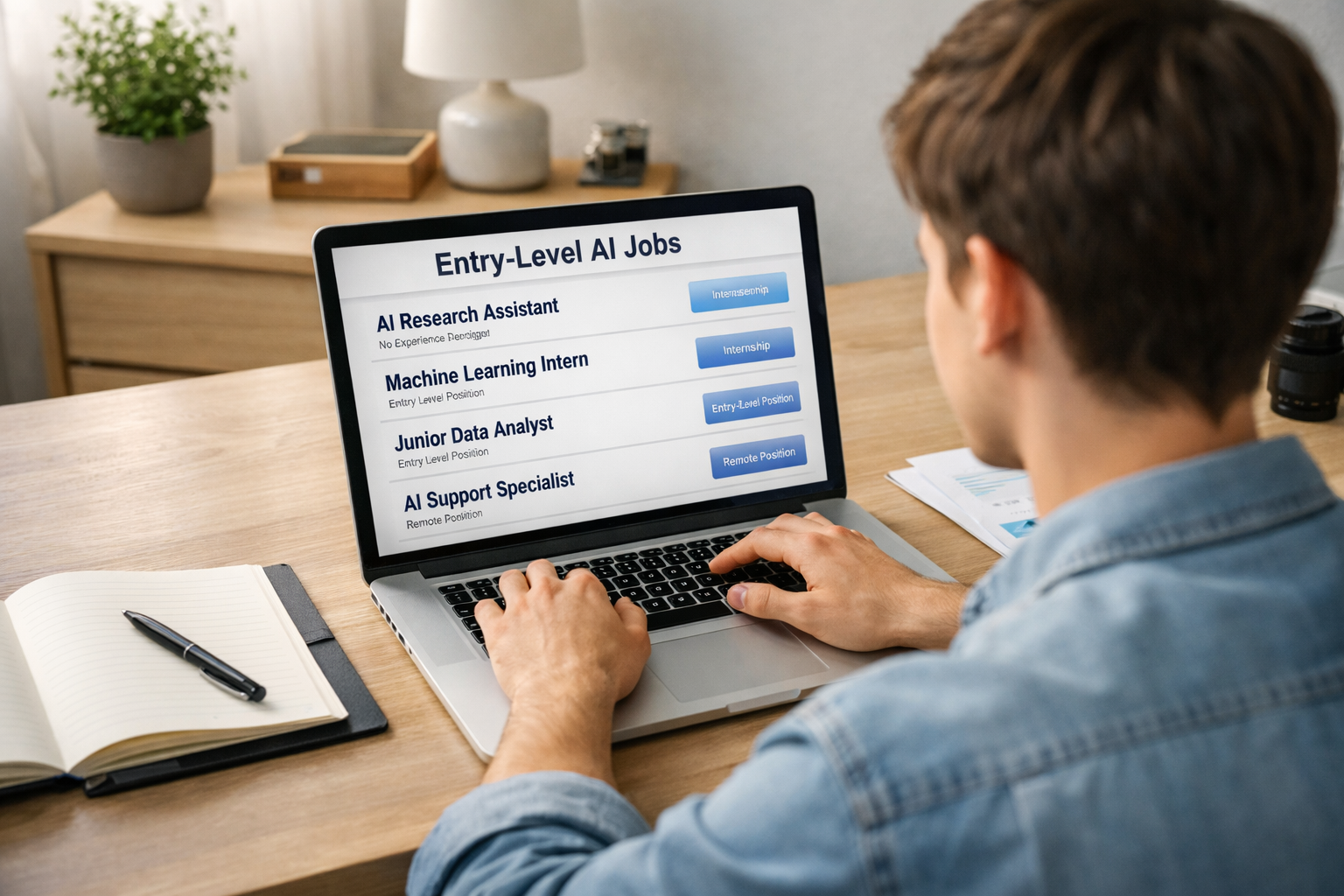
You can find beginner AI jobs without a tech resume by targeting entry-level roles that value problem-solving, communication, research, operations, and curiosity more than formal engineering experience. The fastest path is to learn a few practical AI basics, build 2-3 simple proof-of-skill projects, rewrite your resume around transferable skills, and apply for roles like AI data annotator, AI operations assistant, prompt tester, junior analyst, customer support for AI products, or entry-level QA. You do not need to become a machine learning engineer first. You need to show that you can learn tools, follow workflows, and help companies use AI in real business tasks.
That is good news if you are coming from retail, teaching, admin work, marketing, customer service, healthcare support, finance, or another non-technical background. Many companies hiring around AI are not only looking for coders. They also need people who can test systems, review outputs, organize data, explain results, and work with customers.
A beginner AI job is any role where you support, use, test, improve, or work alongside AI tools without needing deep engineering knowledge on day one. AI stands for artificial intelligence, which means computer systems designed to perform tasks that usually need human thinking, such as answering questions, recognizing images, sorting information, or generating text.
Here are common beginner-friendly AI-related roles:
Many of these jobs ask for 0-2 years of experience, not a computer science degree. Some are remote, contract-based, or part-time, which can make them easier to enter.
A tech resume usually means a resume full of programming jobs, software projects, and technical degrees. If you do not have that, you are not automatically out. Employers often hire beginners because they need people who can do real work reliably, not just list technical buzzwords.
For example:
These are all useful in AI teams. AI projects often fail not because of advanced math, but because data is messy, workflows are unclear, or users do not trust the outputs. Strong communication and attention to detail matter a lot.
You do not need to learn everything. You need a working understanding of a few ideas:
If that sounds new, do not worry. Start with beginner-friendly lessons and plain-English examples. A short course can help you understand the language used in job posts and interviews. If you want a structured place to begin, you can browse our AI courses for entry-level learning paths in AI, machine learning, Python, data science, and generative AI. Edu AI courses are designed for beginners and align with major certification frameworks from AWS, Google Cloud, Microsoft, and IBM where relevant, which can also help if you later want a more formal credential path.
The biggest mistake beginners make is waiting until they feel “ready.” Employers are more convinced by small, clear proof than by endless study.
Create 2-3 simple projects you can finish in 1-2 weeks each. They do not need to be complicated.
Each project should answer three questions:
For example, instead of saying “I learned prompt engineering,” say: “I tested 15 prompt versions for a customer FAQ chatbot and improved answer clarity from 6 out of 10 to 9 out of 10 based on a simple review checklist.” That sounds more real because it includes action and measurement.
If you do not have a tech resume, build a results resume. This means highlighting work you have already done that matches beginner AI tasks.
Add a short summary at the top of your resume, such as: “Career changer with experience in operations and customer support, now building beginner AI skills in data handling, prompt testing, and workflow improvement.”
Then include a small “Projects” section, even if your projects were self-directed. This can matter just as much as previous job titles for entry-level roles.
Many beginners search only for “AI jobs” and get discouraged because the results are full of senior engineering roles. Instead, search with wider and more realistic terms.
Look at the actual tasks, not just the title. A job might not say “AI” in large letters, but still involve working with AI tools, data workflows, automation, or reporting. That still counts as valuable entry experience.
Sending 100 generic applications is exhausting and often ineffective. A better approach is to apply to 15-20 carefully chosen roles each month with tailored documents.
For each application:
If a posting asks for Python, do not panic. Python is a beginner-friendly programming language often used in AI and data work. Many entry roles list it as “nice to have,” not mandatory. If you are interested in building confidence step by step, beginner courses in computing and Python can help you close that gap without needing a technical background first.
You are unlikely to be asked advanced formulas for a junior support or operations role. More often, employers want to know whether you can learn and think clearly.
A strong answer is simple and specific. For example: “I became interested in AI because I saw how much time it can save in routine tasks. I completed beginner learning in generative AI, tested prompts for writing support, and built a small project comparing output quality across different instructions.”
For many beginners, a realistic starting plan is 6-12 weeks. In that time, you can learn core concepts, complete a few projects, improve your resume, and begin targeted applications. Some people move faster, especially if they already have strong admin, analysis, writing, teaching, or customer-facing experience.
You do not need to become an expert before you start. You need enough skill to be useful in one narrow area, then grow from there.
If you want to move from “interested in AI” to “ready to apply,” focus on one beginner path this week: learn the basics, complete one small project, and update your resume. A structured course can make that process much less confusing. You can register free on Edu AI to start learning, compare beginner-friendly options, and build job-ready confidence at your own pace. If you want to see costs before choosing a path, you can also view course pricing and plan your next step calmly.




- Learning Evolved.
- Intelligence Amplified.