AI Education — May 24, 2026 — Edu AI Team
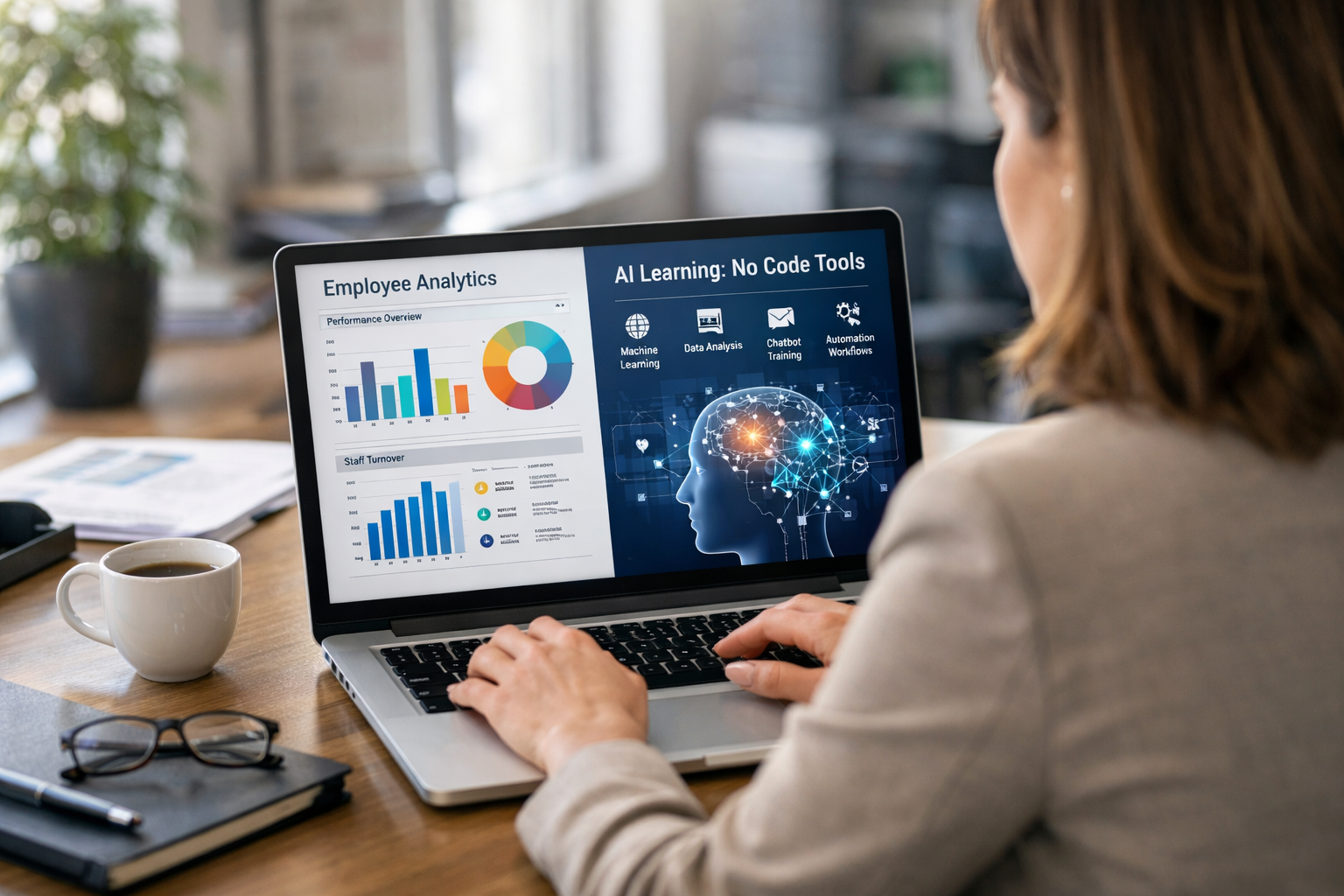
Yes, you can move into AI from human resources with no coding. In fact, HR professionals often have a strong starting advantage because AI teams need people who understand hiring, employee data, performance, ethics, communication, and business decisions. The easiest path is not to become a software engineer overnight. It is to start with AI fundamentals, learn how AI is used in people-focused work, build one or two simple project examples, and target beginner-friendly roles where HR knowledge matters as much as technical skill.
If you have worked in recruitment, learning and development, compensation, people analytics, or employee experience, you may already have transferable skills that AI employers value. The key is learning how to connect your HR background to AI tools and data-driven decision-making.
Many beginners assume AI is only for mathematicians or programmers. That is not true. Artificial intelligence, or AI, is a broad field focused on building systems that can learn patterns from data and help people make decisions, automate tasks, or generate useful outputs.
HR already uses many AI-related ideas, even if they are not always called AI. For example:
If you understand how hiring works, what makes a good candidate, how bias can affect decisions, and what employee data means in the real world, you already bring valuable domain knowledge. Domain knowledge means expertise in a specific area of work. In your case, that area is human resources.
AI projects often fail when technical teams do not understand the real people and business process behind the data. That is where someone from HR can stand out.
Before choosing a path, it helps to understand a few basic terms in plain English.
Machine learning is a type of AI where computers learn from examples instead of being given every rule by hand. For example, if a system looks at thousands of past job applications and learns which patterns were linked with successful hires, that is machine learning.
Data is simply information. In HR, data might include time-to-hire, employee survey responses, retention rates, training completion, or salary bands.
A model is the pattern-finding system created from data. Think of it as a tool that makes predictions or classifications based on what it has learned.
Generative AI creates new content, such as text, images, or summaries. In HR, it can help draft job descriptions, summarise interview notes, or create learning materials.
You do not need to code first to understand these ideas. For career changers, concept clarity comes before technical depth.
You do not need to aim for the most technical role. A smarter move is to look for positions where your HR background is useful from day one.
This role focuses on using employee data to answer business questions, such as why retention is dropping or which training programmes improve performance. Some jobs ask for spreadsheets and dashboards more than programming.
As AI hiring grows, companies need recruiters who can understand AI job titles, skill requirements, and candidate profiles. This is a practical entry point because it combines your HR experience with new AI knowledge.
Many organisations use AI-enabled HR software for recruitment, onboarding, workforce planning, and performance management. Specialists help choose, implement, and improve these systems.
Companies need staff who can help employees understand and safely use AI tools. If you come from training or L&D, this can be a strong fit.
AI raises questions about fairness, privacy, and bias. HR professionals often have useful experience with ethics, governance, and people impact.
Here is a simple plan you can follow over 8 to 12 weeks while working full-time.
Start by understanding what AI, machine learning, data science, and generative AI actually mean. At this stage, your goal is not to build systems. It is to become comfortable with the language and the main use cases.
Look for beginner-friendly lessons that explain concepts slowly and show real examples. If you want a structured starting point, you can browse our AI courses to find beginner options in AI, machine learning, Python, and generative AI.
Once you know the basics, connect them to your own field. Learn how AI is used in:
This step matters because employers care about outcomes, not just theory. If you can explain how AI might reduce time-to-hire by 20% or help identify flight-risk employees earlier, you become much more credible.
You do not need to become a data scientist right away, but you should learn how to read tables, spot trends, and ask good questions. Start with simple business thinking, such as:
For example, imagine employee turnover rises from 12% to 18% in one year. An HR-to-AI candidate should be able to think through possible variables such as manager quality, pay, location, workload, and onboarding experience.
Even though your goal is no coding at the start, learning a small amount of Python later can help. Python is a beginner-friendly programming language widely used in AI and data work. You do not need months of study before applying for AI-adjacent roles, but knowing the basics can open more doors over time.
A short introductory course is often enough to remove fear and help you understand how AI tools work behind the scenes.
A portfolio is proof that you can apply what you learned. It does not need to be technical or complex. For example, you could create:
These examples show practical thinking, which matters a lot for career changers.
Many HR professionals underestimate how much of their experience carries over. Here are some examples:
For example, if you have ever redesigned an interview process, rolled out a new HR system, or reported on attrition trends, you already have experience that maps well to AI-related projects.
You do not need to pretend you are a senior AI engineer. Employers hiring beginners usually want evidence of three things:
That means your CV and LinkedIn profile should highlight both your HR experience and your AI learning. Instead of writing only “HR Business Partner,” you could frame your experience with measurable outcomes, such as improving hiring efficiency, analysing employee trends, or implementing HR technology.
If relevant, mention beginner training that aligns with recognised industry directions. Many AI learning paths today reflect the skills expected in major ecosystems such as AWS, Google Cloud, Microsoft, and IBM. This can help show employers that your learning is practical and current.
You do not need machine learning, deep learning, cloud computing, and advanced coding in your first month. Start small.
Roles like machine learning engineer often require stronger coding and maths skills. That can come later if you want it. Begin with AI-adjacent roles.
Your background is not a weakness. It is your angle. Companies need people who understand both technology and people.
Career changers often delay applying. In reality, once you understand the basics and can discuss practical use cases, you can start networking and applying for junior or adjacent roles.
For most beginners, it is realistic to build a solid foundation in 2 to 3 months of part-time study. That does not mean you will master AI in 12 weeks. It means you can become confident enough to speak about AI, understand common tools, and position yourself for interviews in AI-related HR, people analytics, or HR tech roles.
The pace depends on your schedule, but even 4 to 6 hours per week can make a visible difference over a few months.
If you are wondering how to move into AI from human resources with no coding, the most practical answer is this: start with beginner-friendly AI knowledge, connect it to HR problems you already understand, and build confidence step by step. You do not need to become technical overnight to begin your transition.
If you are ready for a structured path, you can register free on Edu AI and explore beginner learning options. You can also view course pricing if you want to compare the next step that fits your budget and goals.
A small start today can lead to a very different career a few months from now.




- Learning Evolved.
- Intelligence Amplified.