AI Education — June 12, 2026 — Edu AI Team
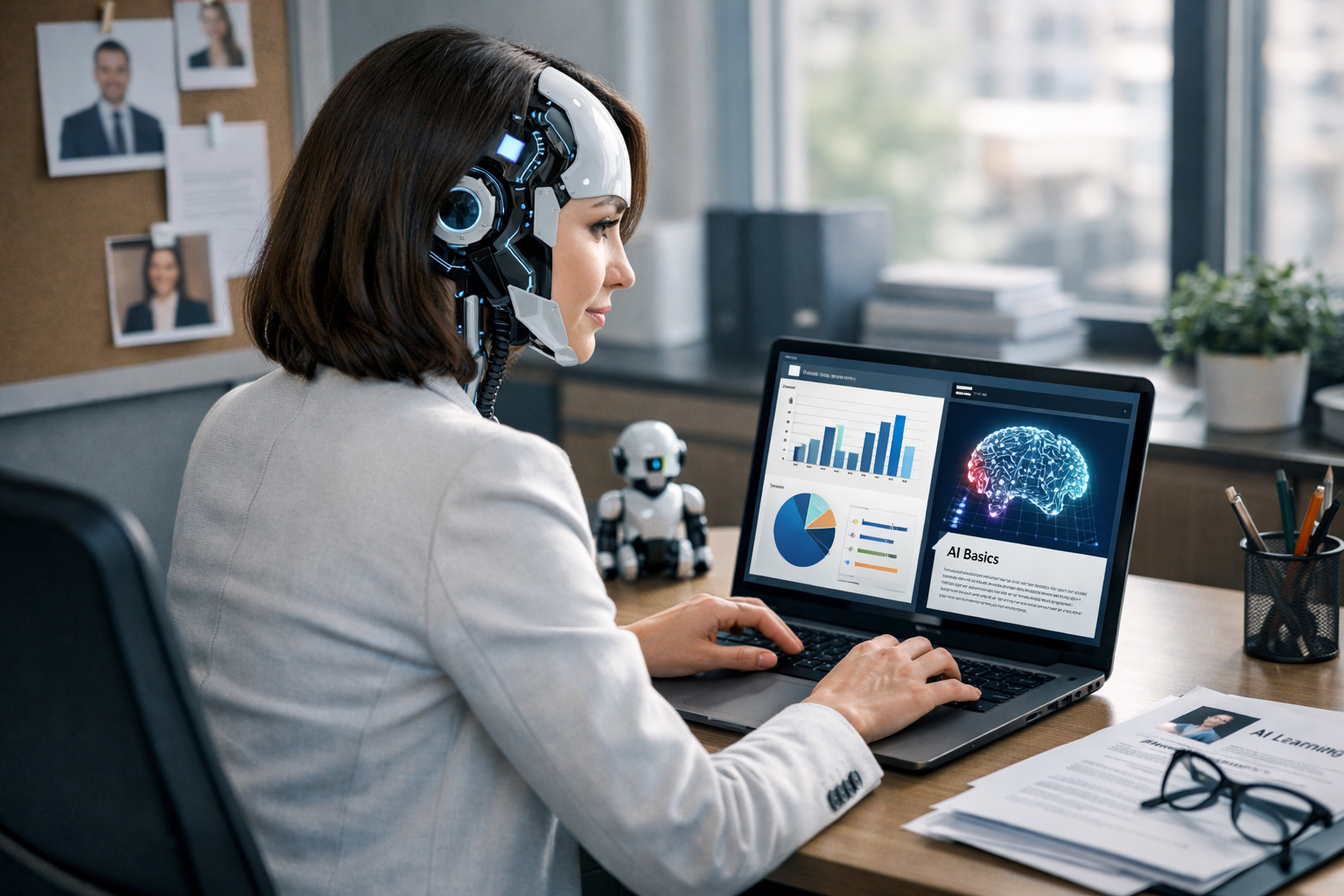
Yes, you can move into AI from human resources with no coding. The most realistic path is not to become a full-time programmer overnight. Instead, start by learning how AI works in plain English, then focus on AI tools and use cases that solve real HR problems such as screening CVs, predicting employee turnover, improving onboarding, and answering common staff questions. Many HR professionals already have valuable skills for AI work: communication, process design, decision-making, compliance awareness, and understanding people data.
If you come from HR, you are not starting from zero. You already understand hiring, performance, learning and development, employee experience, and workforce planning. AI needs that business context. What you need now is a beginner-friendly bridge into the technology side.
Artificial intelligence, or AI, means computer systems doing tasks that normally need human judgment, pattern recognition, or prediction. A simple example is software that reviews thousands of job applications and highlights candidates whose experience matches a role. Another example is a chatbot that answers common employee questions about leave policies.
In many companies, AI projects fail because the people building them do not fully understand the business problem. This is where HR professionals can stand out. You already know:
That means your HR background is not a weakness. It is often your advantage.
Many beginners think AI only means writing complex code all day. That is not true. Coding is useful in some roles, but there are several entry points where you can begin with low-code or no-code tools.
Machine learning is a part of AI where computers learn patterns from data instead of being given fixed rules. For example, if a system studies past hiring data, it may learn which CV patterns often lead to successful hires. You do not need to build that system from scratch on day one. You can start by understanding what data goes in, what result comes out, and how to judge whether the output is useful and fair.
No coding usually means:
Over time, even a little Python can help, but it does not have to be your first step.
This is the simplest transition. You stay close to HR work but become the person who understands and applies AI tools responsibly. You might help choose recruitment software, test AI screening tools, or improve employee support chatbots.
People analytics means using employee data to make better decisions. For example, a company may study absence rates, training completion, or resignation patterns to spot where teams need support. This role often starts with spreadsheets and dashboards before moving into advanced AI.
Companies that build HR software need people who understand customers, workflows, and real business pain points. If you know HR operations, you may be a good fit for implementation, customer success, or product roles focused on AI tools.
AI is now used to personalise training, recommend courses, and create learning content. If you have an L&D background, this can be a natural fit.
HR professionals often understand ethics, policy, and fairness. These skills matter in AI, especially where systems affect hiring, promotion, or pay.
You do not need 20 skills to begin. Focus on five foundations.
This means understanding basic ideas like AI, machine learning, data, models, automation, and bias. A model is simply a system trained to recognise patterns and produce an output, such as a prediction or recommendation.
You do not need advanced maths. But you should become comfortable with tables, charts, trends, averages, and simple business questions such as: What is rising? What is falling? Which team has the highest turnover?
Start using beginner-friendly AI tools for writing, summarising, searching, reporting, and workflow automation. The goal is practical confidence.
This means turning a broad challenge into a clear question. Instead of saying, “We need AI in HR,” say, “Can we reduce time-to-hire from 42 days to 30 days by automating the first screening stage?” That is a much better AI starting point.
In HR, AI must be used carefully. If a hiring tool is trained on biased past decisions, it can repeat those mistakes. Beginners should learn to ask: Is this fair? Is it explainable? Is employee data protected?
Start with plain-English introductions to AI, machine learning, data science, and automation. Data science is the practice of collecting, cleaning, and analysing data to find useful insights. Spend 20 to 30 minutes a day learning core ideas.
This is a good stage to browse our AI courses and look for beginner lessons in AI, machine learning, data science, and Python. Choose courses designed for complete newcomers rather than advanced technical learners.
Pick 2 or 3 real HR use cases and explore how AI could help. For example:
Create small practice projects. For example, build a simple document showing how AI could reduce manual screening time by 25% if a recruiter spends 2 minutes less per application across 500 applications. That equals about 1,000 minutes saved, or more than 16 hours.
Now turn your learning into proof. Update your CV and LinkedIn profile with project-based language such as:
You can also start basic Python later if you want broader options. Python is a beginner-friendly programming language widely used in AI. It is helpful, but not essential for your first move.
Here is how your current experience can transfer directly:
If you have ever improved a workflow, managed confidential data, written policies, or trained managers, you already have relevant experience.
You do not need deep learning, computer vision, and advanced maths in your first month. Start with beginner AI literacy and one practical use case.
It counts a lot. AI projects need domain expertise. Knowing people processes is valuable.
AI in HR can affect careers and livelihoods. Fairness, privacy, and transparency matter from the start.
Most career changers never feel perfectly ready. The better approach is to learn, practise, and show progress.
Certifications can help, especially if you are changing careers and want structured proof of learning. They are most useful when backed by practical understanding, even at a beginner level. Many learners begin with foundation courses, then later prepare for broader cloud or AI certification tracks. Edu AI courses are designed to support beginner learning paths that align with major certification frameworks from AWS, Google Cloud, Microsoft, and IBM where relevant.
If budget matters, compare your options and view course pricing before choosing a path. A short, well-structured beginner course is often more useful than jumping into an expensive advanced programme too early.
For most beginners, it is realistic to build a solid foundation in 2 to 4 months with part-time study. A full role change may take 3 to 9 months depending on your target job, current experience, and how much time you can commit each week. If you study for 4 to 6 hours a week, complete beginner projects, and learn how AI applies to HR problems, you can make meaningful progress without leaving your current job immediately.
If you want to move into AI from human resources with no coding, start small and stay practical. Learn the core ideas, connect them to HR problems, and build proof through simple projects. You do not need to become an engineer first. You need to become confident using AI in a business context.
A good next step is to register free on Edu AI and begin with beginner-friendly courses in AI, machine learning, data science, and Python. Focus on understanding, not speed. With the right learning path, your HR background can become a strong foundation for an AI career.




- Learning Evolved.
- Intelligence Amplified.