AI Education — May 26, 2026 — Edu AI Team
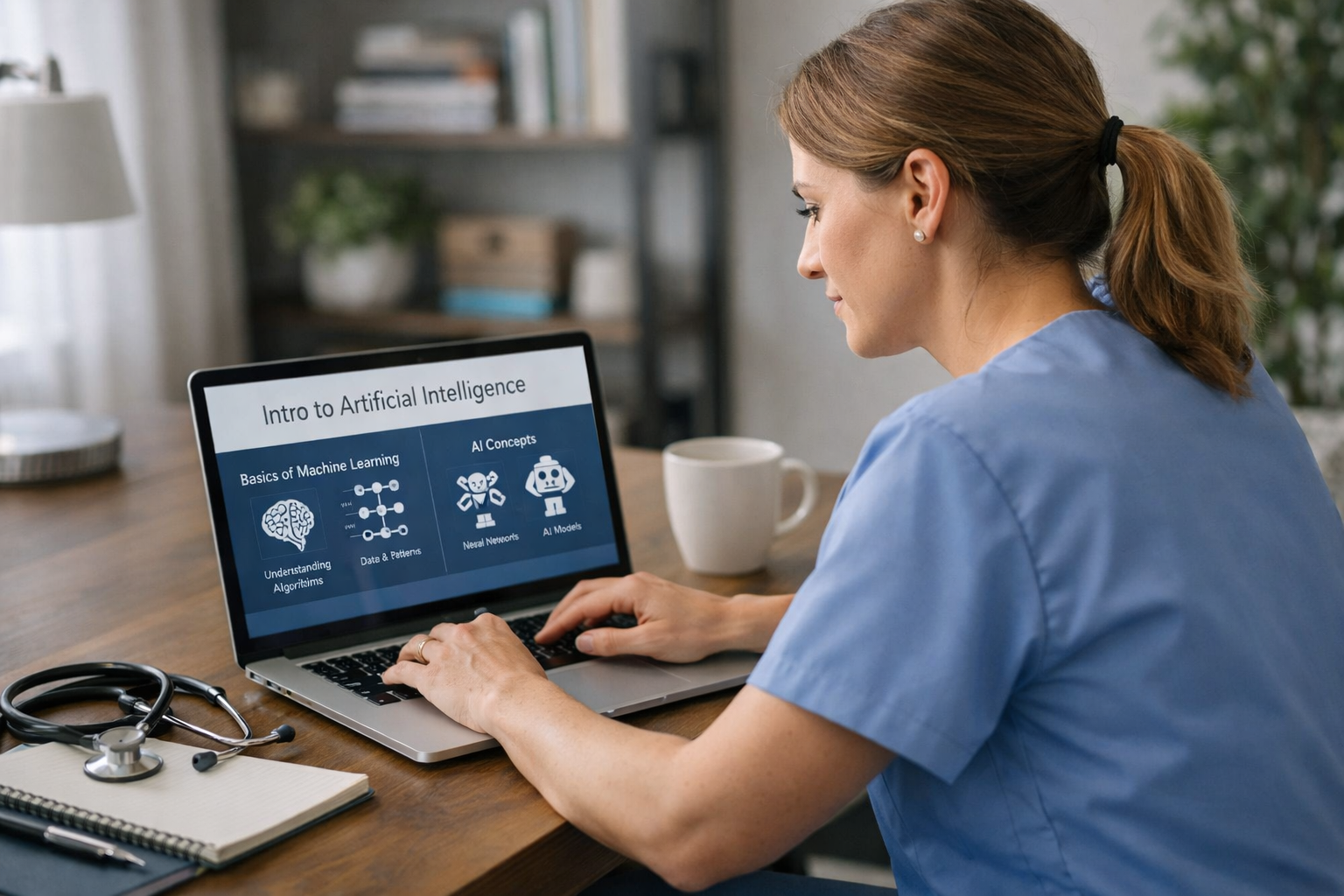
Yes, you can move into AI from nursing even if you have no coding experience. The simplest path is to start with beginner-friendly digital skills, learn basic Python and data concepts, understand how AI is used in healthcare, and then build one or two small portfolio projects around real nursing problems. You do not need to become a software engineer overnight. Many nurses move into AI-related roles by combining their clinical knowledge with new technical skills learned step by step.
If you are a nurse who feels curious about artificial intelligence but intimidated by coding, you are not behind. In fact, healthcare needs more people who understand patients, workflows, safety, and real clinical problems. AI systems are only useful when they solve the right problem in the right setting. That is where your nursing background can become a real advantage.
Many people assume AI is only for mathematicians or programmers. That is not true. Artificial intelligence means teaching computers to spot patterns, make predictions, or generate useful outputs from data. In healthcare, that could mean helping predict patient deterioration, summarising clinical notes, identifying high-risk cases, or improving staffing and operations.
Nurses already work with pattern recognition every day. You notice when a patient looks slightly worse before the numbers fully show it. You understand documentation, triage, handovers, and patient safety. These are valuable skills in healthcare AI because AI tools must fit real clinical practice.
Your experience may help you in areas such as:
In other words, you do not start from zero. You are adding technical skills to an existing professional foundation.
You do not need to become a machine learning researcher. Machine learning is a branch of AI where computers learn patterns from examples instead of following only fixed rules. For beginners coming from nursing, there are several realistic entry points.
These roles focus on working with healthcare data, dashboards, trends, and reporting. You may use spreadsheets, basic statistics, or simple programming to help answer questions like: Which patients are being readmitted most often? Which ward has longer waiting times?
Hospitals and health companies need people who can help introduce AI tools safely. This may involve testing systems, training staff, checking outputs, and making sure tools fit real workflows.
If you enjoy communication and problem-solving, you could help build healthcare tools by acting as the bridge between clinicians and technical teams.
Some nurses do go further into data science or machine learning. This path usually takes longer, but it is possible if you enjoy coding and want a more technical career change.
The key point is this: AI is not one job. It is a group of skills and tools used across many job types.
Before you touch code, understand the basics. Learn the difference between AI, machine learning, data science, and generative AI.
Data science means finding useful insights from data. Generative AI means AI that creates content, such as text, images, or summaries. In healthcare, a generative AI tool might help draft administrative notes, while a machine learning model might predict which patients need extra support.
Your first goal is not mastery. Your first goal is comfort.
If you feel nervous about tech, begin with simple tasks: working with spreadsheets, understanding rows and columns, sorting information, making charts, and asking basic questions from data. This gives you a foundation before coding.
For example, imagine a table of 500 patient appointments. Can you spot missed appointments by age group? Can you count how many were follow-up visits? These are early data skills, and they matter.
Python is a beginner-friendly programming language often used in AI and data work. A programming language is just a way to give instructions to a computer. Python is popular because its syntax is relatively readable.
You do not need to build advanced systems straight away. Start with basics like:
A realistic first milestone is writing a short script that reads a small dataset and counts something useful, such as the number of patients in each risk category.
If you want a structured place to begin, you can browse our AI courses to find beginner lessons in Python, AI, and data topics designed for complete newcomers.
Once Python feels less scary, learn the core idea behind machine learning. Imagine you give a computer 1,000 examples of patient cases and whether they were low risk or high risk. The system looks for patterns and learns how to estimate risk on new cases. That is the basic concept.
You should understand simple ideas such as:
In healthcare, accuracy alone is not enough. You also need to think about fairness, patient safety, and whether the tool works well in real practice.
This is where your nursing background becomes powerful. Instead of learning AI in the abstract, connect it to familiar examples:
When you study real healthcare examples, concepts become easier to remember because they connect to your lived experience.
A portfolio is proof of what you can do. For a beginner, this does not need to be complicated. A simple project can be enough to show curiosity, initiative, and practical thinking.
Examples:
One thoughtful project linked to healthcare is often stronger than five random technical exercises.
For most beginners, a realistic timeline is 3 to 9 months for foundational skills if you study consistently for 4 to 7 hours per week. If you want to apply for more technical roles, it may take 9 to 18 months to build stronger confidence.
A sample timeline could look like this:
This pace is manageable for many working nurses because it avoids the trap of trying to learn everything at once.
You do not always need a certification to get started, but certificates can help show commitment and structure your learning. This is especially useful if you are changing careers and want clear milestones.
Beginner courses can also prepare you for larger certification paths over time. Where relevant, many AI learning paths align with major industry frameworks from AWS, Google Cloud, Microsoft, and IBM, which can be helpful later if you choose a more technical route.
Before paying for anything expensive, ask: Will this help me build practical skills and a portfolio? If the answer is no, think twice. You can also view course pricing to compare affordable learning options before committing.
You do not need advanced maths on day one. Many beginners can start with logic, simple graphs, averages, and basic probability. More advanced maths can come later if needed.
That is normal. Everyone starts somewhere. Coding is a skill, not a personality type. If you can follow a nursing protocol step by step, you can learn the logic behind programming.
Healthcare AI needs domain experts. A nurse with technical skills can offer something a general beginner cannot: real clinical insight. That makes you valuable.
When you start applying, do not present yourself as “just a beginner.” Show the overlap between nursing and AI work.
For example, instead of writing “Staff nurse,” expand with achievements like “analysed ward documentation patterns to support quality improvement” or “worked with digital record systems and multidisciplinary teams in fast-paced clinical settings.”
If you are moving into AI from nursing with no coding experience, the best first step is not to overcomplicate it. Start small, stay consistent, and focus on healthcare problems you already understand. Over time, basic coding, data skills, and AI knowledge can open doors to analytics, health tech, and AI-related roles.
If you want a clear beginner path, you can register free on Edu AI and start exploring simple, structured learning. From there, choose one beginner course, complete one small project, and build momentum week by week. That is how career transitions really happen: one practical step at a time.




- Learning Evolved.
- Intelligence Amplified.