AI Education — August 18, 2026 — Edu AI Team
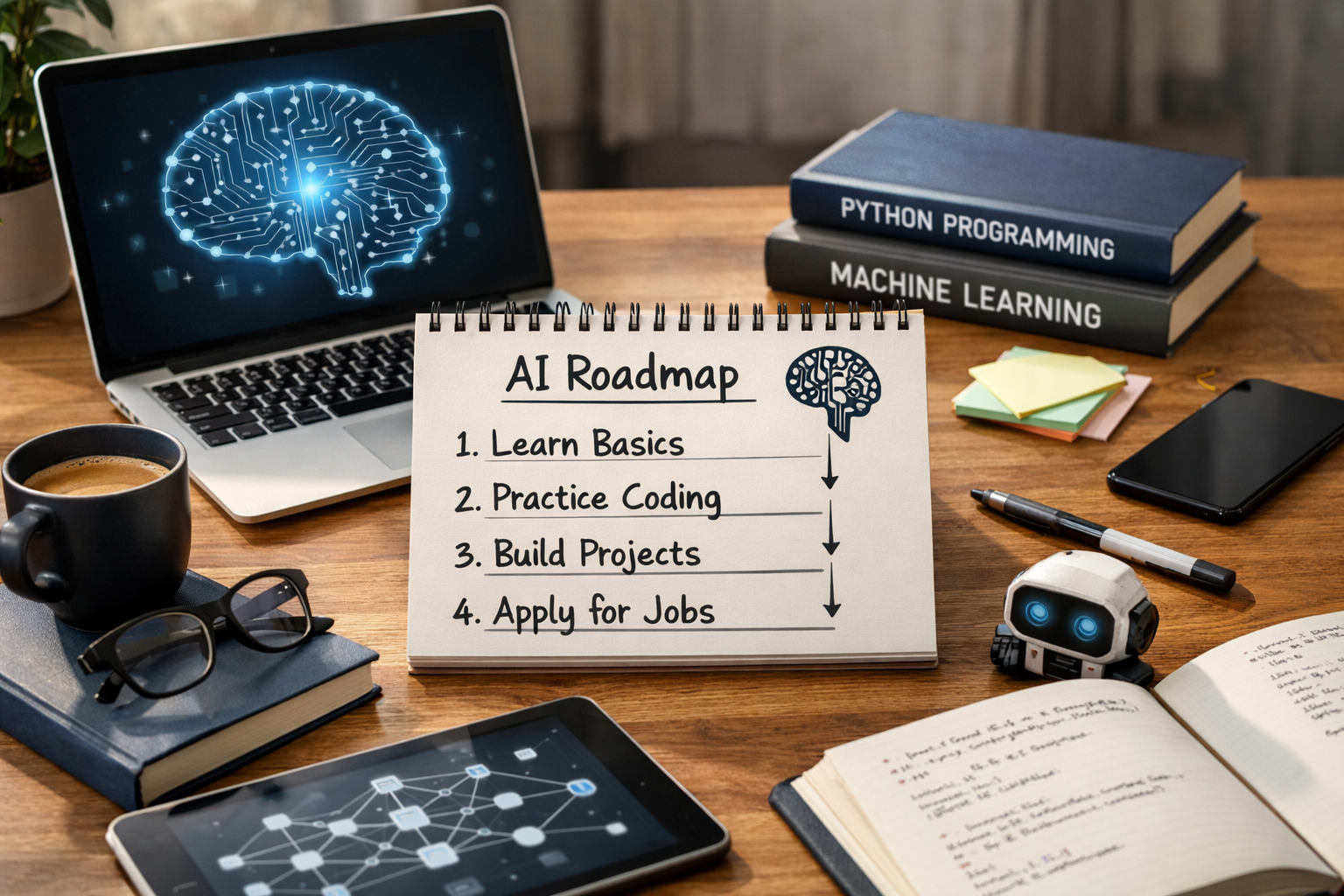
Yes, you can switch into AI with no coding classes—if you start with the right order. You do not need a computer science degree, advanced maths, or months of formal programming lessons before you begin. A better path is to learn AI in small beginner steps: understand what AI is, practise simple tools, learn basic Python only when you need it, and build a few small projects that show employers you can solve real problems. For many beginners, this is faster, less overwhelming, and more practical than jumping straight into a long coding course.
If you are changing careers, the goal is not to become a software engineer overnight. The goal is to become useful with AI. That means understanding how AI systems work, where they are used, what tools beginners can handle, and how to show clear progress.
Many beginners think AI is one single job. It is not. Artificial intelligence, or AI, is a broad field where computers are trained to do tasks that usually need human judgement, such as recognising images, answering questions, finding patterns in data, or predicting outcomes.
So when you switch into AI, you are usually moving into one of several types of roles:
This matters because not every AI career needs the same level of coding. Some roles need more programming. Others need more problem-solving, communication, experimentation, and tool knowledge.
Here is the honest answer: you may not need traditional coding classes, but learning some basic coding will still help a lot.
The good news is that beginner AI coding is often much smaller than people imagine. You do not need to build apps from scratch in your first month. In many cases, you only need enough Python to:
Python is a popular beginner programming language used heavily in AI because it reads almost like plain English. For example, a simple Python line can ask a computer to count rows in a file or sort a list of numbers. That is far less scary than many career changers expect.
So the smarter question is not, “Can I avoid coding forever?” It is, “Can I start AI before mastering coding?” And the answer is absolutely yes.
Before touching code, understand the basic ideas.
Machine learning is a part of AI where computers learn patterns from examples instead of being told every rule. For example, if you show a system thousands of past house prices, it can learn to estimate the price of a new house. That is machine learning.
Data is the information used for that learning. Data can be numbers, text, images, audio, or clicks from a website.
At this stage, your goal is not deep theory. Your goal is to understand the big picture clearly enough to explain it to someone else in simple words.
No-code tools let beginners test AI ideas without writing much or any code. This is useful because it teaches the logic behind AI: inputs, patterns, outputs, testing, and improvement.
For example, you might:
This early hands-on practice builds confidence fast. It also helps you decide whether you enjoy prediction, language tasks, automation, or data work.
Once the concepts make sense, learn basic Python with a purpose. Focus only on beginner topics that support AI learning:
You do not need to spend 6 months on coding theory before touching AI. A focused beginner can learn useful Python basics in a few weeks of steady practice.
If you want a structured path, it helps to browse our AI courses and start with beginner-friendly computing, Python, or introductory machine learning lessons rather than advanced material.
Small projects are one of the fastest ways to switch careers because they prove you can apply what you learn.
Your first projects can be simple:
These do not need to be business-ready. They need to show that you understand the process: define a problem, use data, test a tool, explain the result.
This step is where many career changers gain an advantage. If you already work in marketing, finance, teaching, healthcare, sales, or operations, you already know real-world problems. AI skills become more valuable when paired with domain knowledge.
For example:
Employers often prefer someone who understands both the business problem and the basics of AI over someone who only knows theory.
For absolute beginners, a realistic timeline is often 3 to 9 months for entry-level confidence, depending on your schedule.
A simple example:
If you study 5 to 7 hours per week, progress will be slower but still meaningful. If you can do 10 to 15 hours per week, you can move faster. The important part is consistency, not speed.
AI includes machine learning, deep learning, natural language processing, computer vision, and more. You do not need all of it at the start. Begin with foundations.
Reading is helpful, but skill grows through doing. Even one small project teaches more than many hours of passive watching.
Some maths helps later, especially statistics and algebra, but most beginners can start AI concepts and tools before studying maths in depth.
Your goal is not to match a senior AI researcher. Your goal is to become a capable beginner with evidence of learning and practical understanding.
Certificates can help, especially when you are changing careers, but they work best when combined with projects and clear skills. A certificate shows structured learning. A project shows you can apply it.
That is why many learners look for courses that fit recognised industry pathways. Beginner AI study can be a helpful foundation for certification-aligned learning connected to major ecosystems such as AWS, Google Cloud, Microsoft, and IBM, especially if you later move into cloud AI tools or data services.
If cost is part of your decision, you can also view course pricing and compare beginner options before committing to a study plan.
If you only remember one thing from this article, remember this order:
This sequence works because it lowers fear. Instead of facing everything at once, you build confidence layer by layer.
Switching into AI with no coding classes is possible because the field is more beginner-accessible than ever before. You do not need to know everything before you begin. You only need a clear starting point, steady practice, and a learning path that explains concepts simply.
If you are ready for the next step, a good place to begin is to register free on Edu AI and explore beginner-friendly lessons in AI, Python, machine learning, and related career skills. Start small, keep going, and let each simple project move you closer to your first AI opportunity.




- Learning Evolved.
- Intelligence Amplified.