AI Education — April 1, 2026 — Edu AI Team
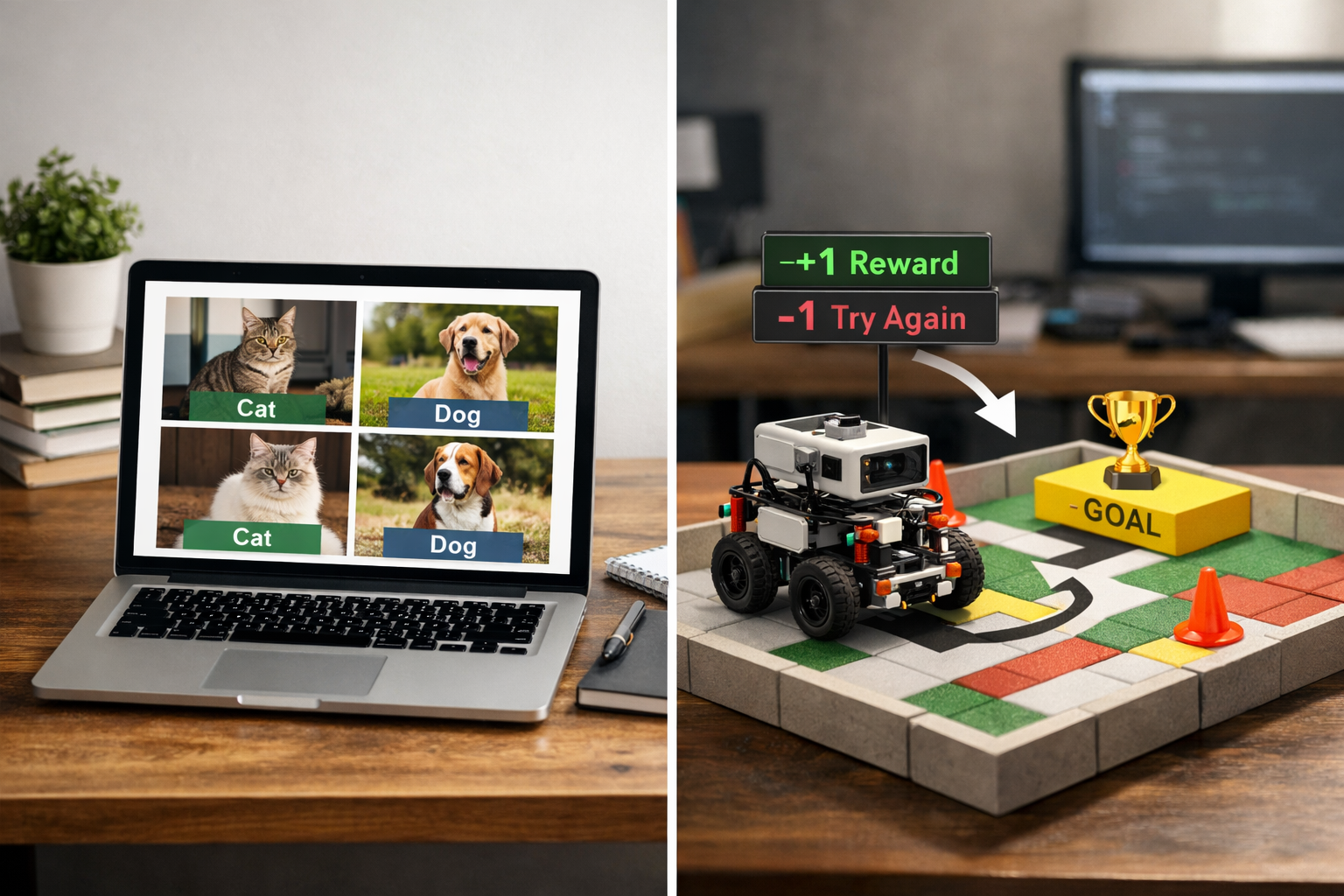
Reinforcement learning and supervised learning are both ways to teach a computer, but they learn in very different ways. In supervised learning, the computer learns from examples that already have the correct answers. In reinforcement learning, the computer learns by trying actions, making mistakes, and receiving rewards or penalties. If you are new to AI, the simplest way to remember the difference is this: supervised learning learns from labeled answers, while reinforcement learning learns from feedback over time.
This matters because each method is useful for different problems. If you want a system to predict house prices, detect spam emails, or recognize handwritten numbers, supervised learning is usually the better fit. If you want a system to learn how to play a game, control a robot, or make a sequence of decisions step by step, reinforcement learning is often more suitable.
In this beginner-friendly guide, we will explain both methods from scratch, compare them side by side, and help you understand when to use each one.
Supervised learning is a type of machine learning where a computer learns from examples that include both the input and the correct output.
Let us make that simple. Imagine you are teaching a child to identify fruit. You show 100 pictures and label each one: apple, banana, orange. Over time, the child starts to notice patterns such as color, shape, and size. Then, when shown a new fruit, they can make a good guess. That is very similar to supervised learning.
In AI, the “input” could be an email, an image, or a row of numbers. The “correct output” could be spam or not spam, cat or dog, or a house price.
Supervised learning is often the first kind of machine learning beginners study because it is easier to understand and easier to test. You can compare the model’s answer to the known correct answer and measure how accurate it is.
Reinforcement learning is a type of machine learning where a computer learns by interacting with an environment and receiving rewards or penalties based on what it does.
Think about teaching a dog a trick. You do not hand the dog a sheet with all the right answers. Instead, the dog tries something. If it does the right thing, it gets a reward. If it does not, there is no reward. Over many attempts, the dog learns which actions lead to better outcomes.
That is the basic idea of reinforcement learning.
In reinforcement learning, the computer is often called an agent, which simply means the decision-maker. The world it interacts with is called the environment. The agent takes an action, gets a reward, and then decides what to do next. Its goal is to maximize total reward over time.
Unlike supervised learning, reinforcement learning does not usually get the correct answer for every step. It has to discover useful behavior through trial and error.
Now let us compare them directly.
The biggest difference is the feedback they receive.
For example, if you show 10,000 labeled cat photos to a supervised model, it knows the right label each time. In reinforcement learning, a game-playing agent may only know it won or lost after many moves.
This means reinforcement learning is usually more dynamic. The agent’s actions affect what happens next.
Supervised learning is often about one answer. Reinforcement learning is often about a chain of decisions.
Supervised learning needs labeled data. That means humans or systems must prepare examples with correct answers. This can take time and money.
Reinforcement learning does not need labeled answers in the same way, but it often needs many practice attempts. In some cases, an agent may need thousands, millions, or even billions of steps to learn good behavior.
For most beginners, supervised learning is easier to start with. The training process is more straightforward, and the results are easier to measure.
Reinforcement learning is usually harder because:
Supervised learning is used much more widely in everyday business tools because many companies already have stored data like customer records, images, and past decisions.
Reinforcement learning is powerful, but it is more common in specialized areas such as robotics, game AI, industrial control, and advanced optimization problems.
Imagine you want to build two AI systems for a delivery company.
Supervised learning example: You feed the system 50,000 past deliveries, including package size, distance, weather, and delivery time. The goal is to predict how long a new delivery will take. Because you already know the correct answers from past data, this is supervised learning.
Reinforcement learning example: You build a system that controls a delivery robot moving through a warehouse. The robot must decide when to turn left, right, speed up, or slow down. It gets a reward for reaching the correct shelf quickly and safely, and a penalty for collisions or delays. Because it learns through actions and rewards, this is reinforcement learning.
Both systems are useful, but they solve different kinds of problems.
In most cases, beginners should start with supervised learning first.
Here is why:
If you are just entering AI, learning supervised learning first can help you understand how computers find patterns in data. After that, reinforcement learning makes more sense because you already understand the basics of training a model.
If you want a structured path, you can browse our AI courses to find beginner-friendly lessons in machine learning, Python, and reinforcement learning.
No. One is not “better” in all situations. The better method depends on the problem.
Use supervised learning when:
Use reinforcement learning when:
A good rule for beginners is this: if the problem looks like “predict the answer,” think supervised learning. If the problem looks like “choose the best action again and again,” think reinforcement learning.
For most entry-level AI and data roles, supervised learning is more immediately useful. Many junior roles in data science, analytics, and machine learning involve classification, forecasting, recommendation, and prediction tasks built from labeled or historical data.
Reinforcement learning is a valuable advanced skill, but it appears more often in research, robotics, simulation, gaming, and specialized AI engineering roles.
That means beginners often gain job-ready skills faster by starting with Python, data handling, and supervised machine learning, then moving into deeper topics such as deep learning and reinforcement learning later. A solid learning path can make that transition much easier, especially if you are changing careers from a non-technical background.
The good news is that you do not need to master everything at once. Start with the basics, practice one concept at a time, and build confidence gradually.
To recap, supervised learning learns from examples with correct answers, while reinforcement learning learns from actions, rewards, and consequences. Supervised learning is usually the easier starting point for beginners, while reinforcement learning becomes useful when decisions happen step by step over time.
If you are ready to move from reading to learning by doing, a practical next step is to register free on Edu AI and explore beginner-friendly lessons. You can also view course pricing if you want to compare learning options before choosing your path.
Start with the fundamentals, keep your goals simple, and remember: every AI expert once began by learning the difference between concepts just like these.




- Learning Evolved.
- Intelligence Amplified.