AI Education — March 30, 2026 — Edu AI Team
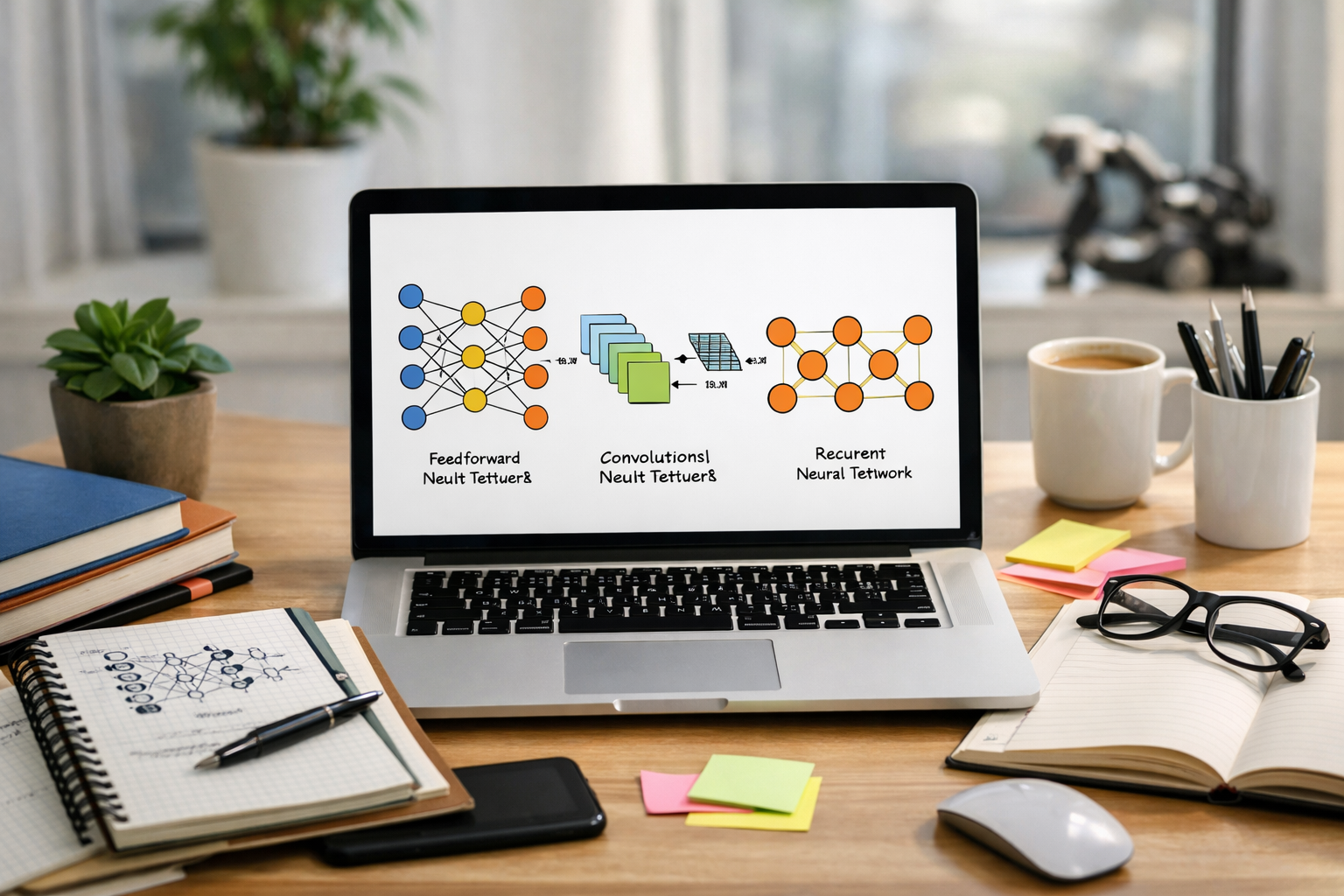
The short answer: there are several main types of neural networks, and each is best for a different kind of data. Use a feedforward neural network for basic prediction on structured data, a convolutional neural network (CNN) for images, a recurrent neural network (RNN) or LSTM for sequences such as time series, a transformer for language and modern AI assistants, an autoencoder for compression or anomaly detection, and a generative adversarial network (GAN) when you want to create realistic new content. The right choice depends on one simple question: what kind of data are you working with, and what result do you want?
If you are completely new to AI, do not worry. You do not need to understand advanced maths to follow this guide. We will explain what a neural network is, the main types, and when to use each one in plain English.
A neural network is a computer system designed to find patterns in data. It is loosely inspired by the human brain, but in practice it is simply a set of connected layers that learn from examples.
For example, if you show a neural network 50,000 photos of cats and dogs, it can learn which visual patterns usually belong to a cat and which belong to a dog. Later, when it sees a new image, it makes a prediction.
Think of it like this:
Different network types were created because not all data looks the same. A photo, a voice recording, and a stock price chart all have different structures, so they need different tools.
A feedforward neural network is the most basic type. Information moves in one direction: from input to output. It does not “remember” previous inputs and does not specially handle images or language.
This model is useful when your data is in rows and columns, like an Excel sheet. If each row is one example and each column is one feature, a feedforward network can often do the job.
If your problem looks like a table rather than an image, audio file, or paragraph of text, this is often the first neural network to learn.
A convolutional neural network, or CNN, is designed for image data. Instead of looking at every pixel equally, it learns visual patterns such as edges, shapes, textures, and eventually full objects.
Images have spatial structure, which means nearby pixels are related. A CNN takes advantage of this. For example, in a 224 x 224 image, there are more than 50,000 pixels. A basic network may struggle to use this efficiently, but a CNN is built to handle visual patterns much better.
If you want to tell whether an image shows a cat, a CNN first learns small features like whiskers or ears, then combines them into bigger patterns. That is why CNNs became one of the most important tools in computer vision.
A recurrent neural network, or RNN, is built for data that arrives in order. That includes sentences, speech, and time-based data such as daily sales numbers. Unlike a feedforward model, an RNN has a form of memory, so earlier information can influence later predictions.
An LSTM is a stronger version of an RNN that handles longer sequences better. LSTM stands for Long Short-Term Memory.
Sequence data has order. The sentence “dog bites man” means something different from “man bites dog.” RNNs and LSTMs were designed to pay attention to that order.
RNNs were very influential, but for many language tasks they have now been replaced by transformers, which are faster and better at handling long context.
A transformer is the neural network architecture behind many of today’s most famous AI tools, including chatbots, translation systems, and text generators. Transformers are especially strong at understanding relationships between words, even when they are far apart in a sentence or document.
Transformers use a method called attention. In simple terms, attention helps the model decide which words or parts of the input matter most. That is a big reason why transformers became the foundation of modern generative AI.
They are not only for text. Variants of transformers are also used in image analysis, video understanding, and speech systems.
If you want to understand the AI models behind tools like ChatGPT, this is one of the most useful areas to study. A practical next step is to browse our AI courses and look for beginner-friendly deep learning or generative AI lessons.
An autoencoder is a neural network that tries to copy its input to its output. That may sound pointless, but it learns to compress the data into a smaller internal representation first. This forces it to learn the most important patterns.
If the model has mostly seen normal examples, it becomes good at recreating normal data. When it sees something unusual, it often reconstructs it poorly. That reconstruction error can signal an anomaly.
For example, if a factory sensor usually follows a normal pattern, an autoencoder can flag a strange pattern before a machine breaks down.
A GAN is made of two networks competing with each other. One creates fake content, and the other tries to detect whether the content is real or fake. Over time, the generator improves and can produce highly realistic results.
This competition helps the model get better. GANs played a major role in early image generation systems, although newer generative methods are now often preferred for some tasks.
If all these names feel overwhelming, use this beginner shortcut:
You should also think about three practical questions:
If you are moving into AI from another career, start with foundations first: Python, basic machine learning, then deep learning. That path is usually easier and more practical than jumping straight into advanced research papers.
Neural networks power many tools people use every day: recommendation engines, voice assistants, fraud alerts, medical imaging systems, and generative AI products. Learning the differences between them helps you understand not just how AI works, but also where it is useful in real jobs.
For beginners, this knowledge is valuable whether you want to become a machine learning engineer, work in data science, or simply understand the technology shaping modern business. If you want structured guidance, you can view course pricing and compare beginner options before committing to a learning path.
You do not need to master every neural network at once. A smart first step is to learn the basics of machine learning, then move into deep learning with simple projects such as image classification or text analysis. Once those ideas click, the different network types become much easier to understand.
If you are ready to begin, register free on Edu AI to start exploring beginner-friendly courses in machine learning, deep learning, generative AI, NLP, computer vision, and Python. The best way to understand when to use each neural network is to see them in action with guided practice.




- Learning Evolved.
- Intelligence Amplified.