AI Education — April 3, 2026 — Edu AI Team
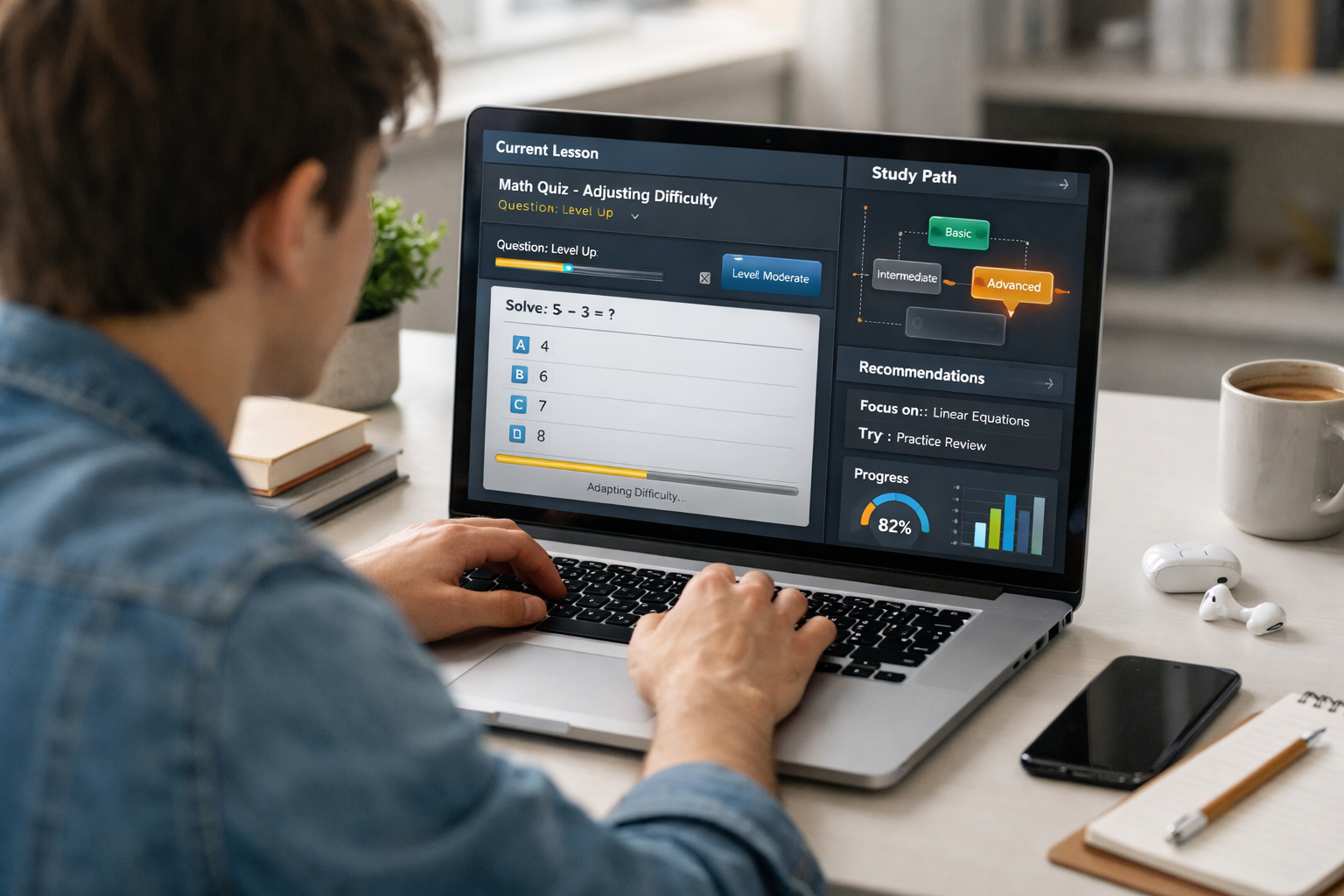
Adaptive learning is a way of teaching that changes the lesson, practice questions, and pace based on each learner's needs. AI powers adaptive learning by looking at simple signals such as correct answers, mistakes, time spent, repeated struggles, and confidence levels, then using that information to decide what a student should see next. In plain English, it is like having a digital tutor that notices where you are stuck and adjusts the lesson to help you move forward.
That matters because no two learners start from the same place. In a traditional classroom or fixed online course, everyone often gets the same lesson in the same order. But one student may need extra help with basics, while another is ready to move faster. Adaptive learning tries to solve that problem by making learning more personal without requiring a human teacher to sit beside every student.
Imagine two people learning basic Python programming. Student A has never written a line of code before. Student B has used spreadsheets and understands logic, so they learn faster. In a normal course, both students watch the same video and answer the same quiz. In an adaptive system, Student A might get a simpler explanation, more beginner examples, and extra practice. Student B might skip the easier parts and move to the next topic sooner.
That is the core idea: the system adapts instead of forcing every learner through one fixed path.
Adaptive learning can change several things:
This makes learning feel less random and more supportive, especially for beginners who often lose confidence when content moves too quickly.
To understand how AI helps, it is useful to start with what AI means here. In education, AI usually refers to computer systems that can learn from data and make useful decisions. A common method is machine learning, which means teaching a computer to spot patterns from examples instead of writing every rule by hand.
In adaptive learning, the "data" is often very simple. It can include:
The AI system studies these patterns and tries to answer questions such as:
Suppose a learner answers 10 algebra questions. They get 8 out of 10 correct, but all their mistakes involve fractions. The AI does not just record a final score of 80%. It notices a pattern: fractions are the weak point. So instead of saying, "Great, move on," the platform may insert a short fractions refresher before the next algebra lesson.
This is more helpful than a basic quiz because the system is not just measuring performance. It is using that information to change the learning experience.
A teacher can adapt lessons too, but doing this for hundreds or thousands of learners at once is difficult. AI helps scale personalisation. It can review many small learning signals in seconds and make fast recommendations. That means more learners can get support that feels tailored to them.
You do not need a technical background to understand the basic process. Most adaptive learning platforms follow a simple cycle:
Think of it like a navigation app. A standard course is like following one fixed route no matter what happens. Adaptive learning is like a smart map that checks traffic, notices delays, and suggests a better path as conditions change.
Adaptive learning already appears in many types of digital education, even if the learner does not always notice it.
If you keep forgetting certain words, the app may show them more often. If you master greetings quickly, it may reduce repetition and move on to harder phrases. This helps balance challenge and confidence.
A student who struggles with multiplication may receive extra number drills, visual explanations, and step-by-step hints. Another student who performs strongly may move into division or word problems faster.
In workplace learning, employees may receive different training modules based on quiz performance. Someone who already understands cybersecurity basics might skip introductory content and focus on higher-risk topics.
In beginner technical courses, adaptive systems can be especially useful. A learner who finds variables and loops difficult may need more guided examples before writing small programs alone. Someone with stronger logic skills may progress faster into machine learning basics. If you are curious about these topics, you can browse our AI courses to explore beginner-friendly pathways.
For new learners, adaptive learning can solve some of the biggest reasons people give up early.
Research across digital learning has repeatedly shown that timely feedback and appropriate difficulty improve engagement. While results vary by platform and subject, the basic principle is strong: people learn better when content is neither too easy nor too hard.
Adaptive learning is useful, but it is not magic. A few myths are worth clearing up.
It does not. Good learning still benefits from human support, good course design, motivation, and clear explanations. AI is best seen as a tool that helps personalise parts of the experience.
Not true. Sometimes the best adaptation is to slow down, review a key idea, or switch to a different explanation style.
Not necessarily. What matters is using the right signals in a helpful way. A platform should collect useful learning data responsibly and focus on improving the student experience, not just tracking activity.
Adaptive learning can support language learning, professional skills, finance education, coding, and more. Any subject with clear progress signals can benefit.
If you are choosing a course or platform, look for practical signs instead of marketing buzzwords.
For people starting from zero, simplicity matters. A smart system is only helpful if the lessons themselves are clear and friendly.
Education is moving away from one-size-fits-all delivery. As more people learn online, platforms need better ways to support different backgrounds, goals, and speeds. That is where adaptive learning and AI can make a real difference.
This is especially important for adults changing careers. Someone moving into AI, data science, or programming may not have recent study experience. They may also be balancing work and family. Adaptive learning can reduce wasted time and help them focus on exactly what they need next.
That learner-first approach is one reason many people now choose guided online platforms over random free resources. If you want structure without feeling lost, it helps to compare options and view course pricing before committing to a learning path.
So, what is adaptive learning and how does AI power it? It is a more personal way to learn, where AI studies your progress and adjusts lessons, difficulty, and review to fit your needs. For beginners, that can mean less confusion, better momentum, and a smoother start.
If you are ready to learn AI, coding, language skills, or other in-demand subjects in a beginner-friendly environment, the best next step is to register free on Edu AI. You can explore courses at your own pace and find a path that matches where you are starting today.




- Learning Evolved.
- Intelligence Amplified.