AI Robotics & Autonomous Systems — Beginner
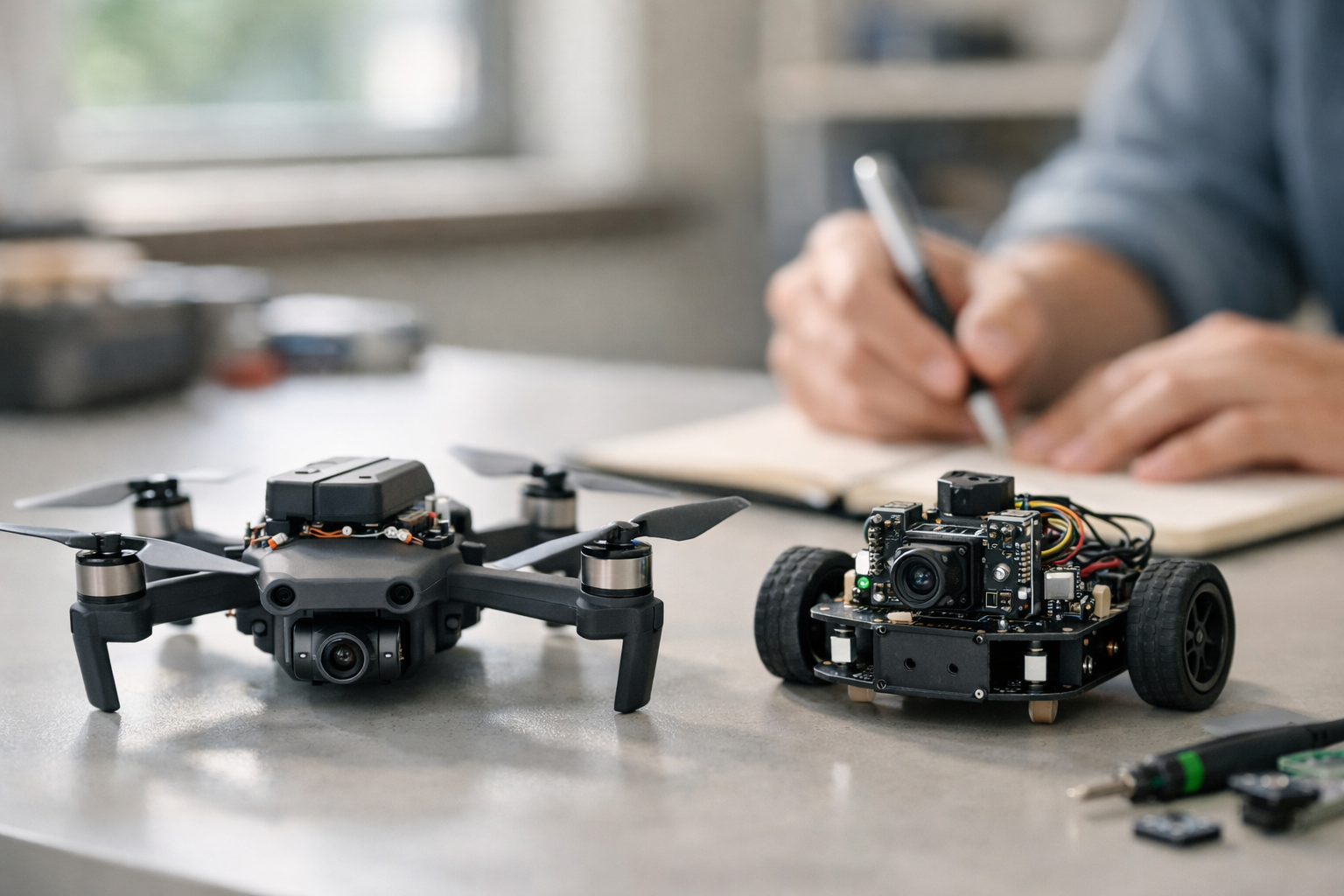
Understand how smart drones think, sense, and move
AI can sound intimidating, especially when it is connected to drones, robots, and autonomous machines. This course is designed to remove that fear. It teaches the topic as a short technical book for complete beginners, using plain language, simple examples, and a clear learning path. You do not need any background in coding, data science, electronics, or robotics. If you have ever wondered how a drone can stay stable, avoid an obstacle, follow a route, or make a basic decision on its own, this course will help you understand the ideas step by step.
The course focuses on first principles. That means you will not be asked to memorize difficult terms without context. Instead, you will learn how autonomous devices work by breaking them into simple parts: sensing, processing, deciding, and acting. Once you understand those building blocks, AI in robotics becomes much easier to follow.
Many introductions to robotics jump too quickly into code, formulas, or advanced engineering. This course does the opposite. It starts with the simple question of what makes a machine “smart” and builds from there. You will learn how drones and autonomous devices use sensors to collect data, how onboard systems interpret that data, and how basic AI methods help a device choose what to do next.
By the time you finish, you will have a strong beginner-level mental model of how drones and autonomous devices operate. You will know the main hardware parts, the role of sensors like cameras and GPS, and how AI helps transform input data into actions. You will also understand the difference between automation and autonomy, and why not all “smart” systems are equally independent.
Just as importantly, you will learn the limits of these systems. Beginners often hear bold claims about autonomous technology, but real devices must deal with uncertain environments, noisy sensor data, and safety concerns. This course explains those challenges in a simple and realistic way, helping you build useful knowledge rather than hype-driven confusion.
The six chapters follow a teaching sequence that makes sense for someone starting from zero. First, you will learn what AI means in the context of drones and autonomous machines. Next, you will explore the physical parts that make these devices work. Then you will move into perception, where machines collect and interpret data about the world. After that, you will see how AI supports decision-making, planning, and control. The final chapters bring everything together through navigation, mission design, safety, ethics, and a simple beginner project plan.
This structure helps you connect each idea to the next. Instead of learning isolated facts, you will build one complete picture of how autonomous systems function.
This course is ideal for curious learners, students, early-career professionals exploring robotics, and anyone who wants a practical introduction to AI in autonomous devices. It is also helpful for non-technical decision-makers who want to understand the basics before investing more time in advanced study.
If you are ready to start learning, Register free and begin with a simple, structured path into AI robotics. You can also browse all courses to explore related topics after completing this one.
This course does not try to turn you into an engineer overnight. Its goal is more important: to give you a clear, accurate, and beginner-friendly foundation. Once you understand how smart drones and autonomous devices sense, think, and move, you will be much better prepared for deeper study in robotics, computer vision, automation, or machine learning. If you want a calm, practical, and confidence-building introduction to the subject, this course is the right place to begin.
Autonomous Systems Engineer and AI Educator
Sofia Chen designs beginner-friendly learning programs in robotics, sensing, and practical AI. She has worked on autonomous device prototypes and helps new learners understand complex technical ideas using plain language and real-world examples.
When people hear the term AI, they often imagine futuristic robots that think like humans. In drones and autonomous devices, the idea is much simpler and much more practical. AI is the set of methods that helps a machine notice what is happening around it, make a useful choice, and carry out an action with limited or no direct human control. A drone that keeps itself stable in the air, avoids a tree, or follows a mapped route is using pieces of this idea. It is not “magical intelligence.” It is a system built from sensors, software, rules, learned models, and mechanical parts working together.
A helpful way to begin is to compare a regular machine with a smart autonomous one. A regular machine usually does exactly what it is told, in the same way each time, as long as conditions stay the same. A smart autonomous device still follows engineering rules, but it can respond to changing conditions. It can estimate its position, recognize objects, adjust speed, or stop when something unexpected appears. That ability to handle uncertainty is what makes AI and autonomy useful in the real world.
Drones are one of the easiest places to see these ideas in action because they combine many important systems in one small machine. A typical drone includes a frame, motors, propellers, battery, flight controller, communication links, and one or more sensors such as cameras, GPS, gyroscopes, accelerometers, depth sensors, or radar. Each part has a job. The motors create motion. The flight controller keeps the aircraft balanced. Sensors report what is happening inside the drone and around it. The onboard software turns data into decisions. In other autonomous devices, such as delivery robots, warehouse vehicles, or smart inspection crawlers, the parts are different in shape but similar in purpose.
To understand drones and smart devices as an engineer, it helps to build a simple mental model: sense, decide, act. First, the machine senses the world using cameras, GPS, inertial sensors, microphones, ultrasonic sensors, lidar, or other inputs. Second, it decides what those signals mean and what it should do next. Third, it acts through motors, wheels, servos, brakes, lights, or messages sent to a human operator. This loop repeats many times every second. The quality of the device depends on how well each step works and how well the whole loop stays reliable under changing conditions.
Engineering judgment matters from the beginning. New learners sometimes assume the smartest algorithm is always the best solution. In practice, autonomous systems succeed because the entire design is balanced. Good sensors with poor software can fail. Good software with weak power management can fail. A drone with excellent vision but no clear safety limits can still be dangerous. Real systems need enough intelligence to solve the task, but they also need robustness, clear constraints, testing, and fallback behavior.
Another common mistake is to think sensors “understand” the world directly. Sensors only produce measurements. A camera gives images. A GPS gives position estimates. A gyroscope reports rotation. AI and control software must interpret those measurements. This is where computer vision, navigation, obstacle avoidance, and state estimation begin. If the data is noisy, late, blocked, or misleading, the machine may make poor decisions. That is why autonomous engineering is not only about coding; it is about designing systems that cope with imperfect information.
Throughout this course, you will learn to explain AI in simple terms, identify the main parts of drones and autonomous devices, understand how sensors help machines detect the world, and describe how data becomes actions. You will also start to recognize the basics of computer vision, navigation, and obstacle avoidance, and you will compare human control, assisted control, and full autonomy. These are the core ideas behind modern robotics systems, from hobby drones to industrial autonomous platforms.
By the end of this chapter, you should be able to look at a drone or smart device and describe it as a complete loop of sensing, thinking, and acting. That mental model will make later topics easier, because every advanced feature in robotics is built on these same foundations.
A drone is a flying machine that can be controlled remotely and, in many cases, can also perform parts of its job automatically. A robot is a broader term for a machine that senses, computes, and acts in the physical world. An autonomous device is any machine that can complete part or all of a task on its own, often while reacting to changes around it. These categories overlap. A drone can be a robot, and a robot can be autonomous. What matters most is not the label, but the capabilities built into the system.
A simple remote-controlled toy responds only when a person gives commands. A smarter drone may hold its altitude, stabilize itself in wind, or return home if communication is lost. An autonomous ground rover may follow a route, detect obstacles, and stop safely without waiting for a human. The difference is the amount of sensing, computation, and decision-making inside the machine.
It is useful to identify the main parts of these systems early. Most drones and autonomous machines include sensors, a computing unit or controller, communication hardware, actuators such as motors or servos, a power source, and a physical structure. Sensors tell the machine what is happening. The controller processes inputs and chooses an action. Actuators carry out that action. Communication lets a human monitor or override the system. Power and structure make everything possible. Beginners often focus only on cameras or AI software, but a practical engineer looks at how all parts support the mission together.
A good beginner mental model is this: the machine is a body with senses, a brain, and muscles. That analogy is not perfect, but it makes the design easier to remember. If one part is weak, the whole system suffers. A drone with great motors but poor sensing can crash. A robot with smart software but weak batteries may stop before finishing its task.
In drones and autonomous devices, artificial intelligence means techniques that help machines handle situations that are too variable for simple fixed instructions alone. AI may include computer vision, pattern recognition, path planning, object detection, or learned models that estimate what is happening in the environment. In plain language, AI helps the machine make better guesses and better choices when the world is messy.
Everyday examples make this easier to understand. A phone that unlocks by recognizing your face uses AI. A map app that predicts traffic and suggests a route uses AI. A drone that identifies a landing marker from a camera image or a delivery robot that distinguishes a wall from a person is using AI in the same practical sense. It is not human-like thinking. It is task-specific intelligence built for a limited purpose.
There is also an important engineering truth here: not every smart feature requires advanced AI. Some drone functions rely on classical control and estimation rather than machine learning. For example, keeping a drone level often depends on fast sensor fusion and control loops. That is still “smart” behavior, even if it is not based on a neural network. Beginners often call everything AI, but a better habit is to ask what method is actually being used: rules, control theory, optimization, or learned models.
Common mistakes include expecting AI to be always correct or assuming more data automatically means better decisions. In real systems, data can be noisy, incomplete, delayed, or biased. A camera can fail in darkness. GPS can drift near buildings. A model trained in clear weather may struggle in fog. Practical AI design means understanding limits, measuring performance, and adding safeguards such as fallback modes, confidence thresholds, and human supervision when needed.
Automation and autonomy are related, but they are not the same. Automation means a machine performs a predefined action with limited decision-making. A washing machine follows a programmed cycle. A drone that flies a fixed route from waypoint A to waypoint B under ideal conditions is automated. Autonomy goes further. An autonomous system can adapt to changing conditions, such as avoiding a new obstacle, handling wind, or re-planning a route when part of the path becomes unsafe.
This distinction is important when comparing human control, assisted control, and full autonomy. Under human control, the operator makes nearly all important decisions. The machine mostly obeys commands. Under assisted control, the machine helps with stability, altitude hold, collision warnings, or route suggestions while the human still supervises. Under full autonomy, the machine performs the mission on its own within defined limits, though safety monitoring or emergency override is often still available.
Engineering judgment is critical here because people often overestimate autonomy. A drone may advertise autonomous flight, but perhaps it only follows GPS waypoints and lands automatically under certain conditions. True autonomy requires handling uncertainty, not just repeating a stored plan. The practical question is always: what happens when reality changes? If a bird flies across the route, if GPS weakens, or if lighting changes, can the system respond safely?
When designing or evaluating a system, ask which decisions remain with the human and which are delegated to the machine. That simple question helps you understand risk, complexity, and required testing. More autonomy can improve efficiency, but it also increases the need for reliable sensing, clear constraints, and strong safety behavior.
Drones and autonomous devices are useful because they can go where people cannot, work faster than manual methods, or perform repetitive tasks consistently. In delivery, small autonomous aircraft or ground robots can transport light packages over short distances. In inspection, drones can examine roofs, power lines, bridges, wind turbines, solar farms, and construction sites without requiring workers to climb dangerous structures. In agriculture, they can map fields, monitor crop health, and support targeted spraying. In warehouses, autonomous mobile robots move goods efficiently through structured indoor spaces.
These examples highlight an important idea: the form of AI depends on the job. A delivery robot may prioritize route planning, localization, and pedestrian awareness. An inspection drone may rely more heavily on camera imaging, stabilizing in wind, and collecting accurate visual data. A farm drone may need to combine GPS guidance, terrain awareness, and image analysis. There is no single AI package that solves every problem.
Real-world use also teaches practical constraints. Battery life limits range and mission time. Weather changes sensor quality and flight stability. Communication links can drop. Regulations may restrict where drones can fly or how autonomous they may be. New learners sometimes focus only on what the machine can do in perfect conditions, but professionals plan for the mission as it really happens: with uncertainty, interruptions, and safety requirements.
A strong engineering mindset asks not only “Can the device do the task?” but also “Can it do the task reliably, repeatedly, and safely enough to be useful?” That question separates impressive demos from systems that deliver practical value.
The simplest and most useful mental model for smart devices is the loop of sense, decide, and act. First, the machine senses the environment and its own internal state. A drone may use a camera to see obstacles, GPS to estimate position, an inertial measurement unit to track motion, and a barometer to estimate altitude. A ground robot may use lidar, wheel encoders, depth sensors, and bump sensors. These inputs are the raw data of the system.
Next, the machine decides. This stage may include filtering noisy measurements, combining multiple sensors, estimating where the device is, recognizing objects, choosing a route, or deciding whether to slow down, stop, turn, or continue. This is where navigation, obstacle avoidance, and computer vision start to connect. Vision helps identify what is in the scene. Navigation helps determine where the machine is going. Obstacle avoidance helps keep it safe along the way.
Finally, the machine acts. It changes motor speeds, turns wheels, tilts control surfaces, activates brakes, or sends alerts to a human. The action changes the machine’s state, which creates new sensor readings, and the loop starts again. In many systems, this cycle happens dozens or hundreds of times each second.
A common beginner mistake is to imagine these as separate blocks with no feedback. In reality, they are tightly connected. Bad sensing leads to bad decisions. Slow decisions can make good sensing useless. Weak actuators can prevent the right decision from being carried out effectively. Practical system design means checking the full loop, not just one algorithm. If you remember only one model from this chapter, remember this one.
This course is designed to give you a clear beginner foundation before moving into more technical topics. First, you will learn to describe AI in drones and autonomous devices in simple language. That matters because strong understanding begins with clear definitions. If you cannot explain what the system is doing in plain words, it is difficult to reason about design choices or safety limits.
Next, you will identify the main parts of a drone or autonomous machine and what each part does. This includes sensors, controllers, actuators, power systems, and communication links. From there, you will study how sensors detect the world and how different sensing methods have different strengths and weaknesses. A camera sees rich visual detail, but may struggle in low light. GPS is useful outdoors, but not always precise enough near buildings or indoors. Learning these trade-offs is essential engineering judgment.
You will then follow the path from data to decisions to actions. This gives you a working understanding of how perception, estimation, control, navigation, and obstacle avoidance fit together. Later lessons will build on that model rather than replacing it. That step-by-step approach helps you avoid a common trap: jumping into advanced AI terms without understanding the machine as a complete system.
By the end of the course, you should be able to compare human control, assisted control, and higher levels of autonomy with confidence. More importantly, you will be able to look at a real device and ask practical questions: What does it sense? How does it decide? What actions can it take? What are its limits? Those questions are the starting point for thinking like a robotics engineer.
1. What best describes AI in drones and smart devices according to the chapter?
2. What is a key difference between a regular machine and a smart autonomous one?
3. Which example best matches the chapter's 'sense, decide, act' mental model?
4. Why does the chapter say sensors do not 'understand' the world directly?
5. According to the chapter, what makes an autonomous system successful in practice?
This chapter is written as a guided learning page, not a checklist. The goal is to help you build a mental model for The Parts That Make an Autonomous Device Work so you can explain the ideas, implement them in code, and make good trade-off decisions when requirements change. Instead of memorising isolated terms, you will connect concepts, workflow, and outcomes in one coherent progression.
We begin by clarifying what problem this chapter solves in a real project context, then map the sequence of tasks you would follow from first attempt to reliable result. You will learn which assumptions are usually safe, which assumptions frequently fail, and how to verify your decisions with simple checks before you invest time in optimisation.
As you move through the lessons, treat each one as a building block in a larger system. The chapter is intentionally structured so each topic answers a practical question: what to do, why it matters, how to apply it, and how to detect when something is going wrong. This keeps learning grounded in execution rather than theory alone.
Deep dive: Name the core hardware parts inside a drone or autonomous device. In this part of the chapter, focus on the decision points that matter most in real work. Define the expected input and output, run the workflow on a small example, compare the result to a baseline, and write down what changed. If performance improves, identify the reason; if it does not, identify whether data quality, setup choices, or evaluation criteria are limiting progress.
Deep dive: Understand what sensors, processors, motors, and batteries do. In this part of the chapter, focus on the decision points that matter most in real work. Define the expected input and output, run the workflow on a small example, compare the result to a baseline, and write down what changed. If performance improves, identify the reason; if it does not, identify whether data quality, setup choices, or evaluation criteria are limiting progress.
Deep dive: See how software and hardware work together. In this part of the chapter, focus on the decision points that matter most in real work. Define the expected input and output, run the workflow on a small example, compare the result to a baseline, and write down what changed. If performance improves, identify the reason; if it does not, identify whether data quality, setup choices, or evaluation criteria are limiting progress.
Deep dive: Read a simple system map of an autonomous device. In this part of the chapter, focus on the decision points that matter most in real work. Define the expected input and output, run the workflow on a small example, compare the result to a baseline, and write down what changed. If performance improves, identify the reason; if it does not, identify whether data quality, setup choices, or evaluation criteria are limiting progress.
By the end of this chapter, you should be able to explain the key ideas clearly, execute the workflow without guesswork, and justify your decisions with evidence. You should also be ready to carry these methods into the next chapter, where complexity increases and stronger judgement becomes essential.
Before moving on, summarise the chapter in your own words, list one mistake you would now avoid, and note one improvement you would make in a second iteration. This reflection step turns passive reading into active mastery and helps you retain the chapter as a practical skill, not temporary information.
Practical Focus. This section deepens your understanding of The Parts That Make an Autonomous Device Work with practical explanation, decisions, and implementation guidance you can apply immediately.
Focus on workflow: define the goal, run a small experiment, inspect output quality, and adjust based on evidence. This turns concepts into repeatable execution skill.
Practical Focus. This section deepens your understanding of The Parts That Make an Autonomous Device Work with practical explanation, decisions, and implementation guidance you can apply immediately.
Focus on workflow: define the goal, run a small experiment, inspect output quality, and adjust based on evidence. This turns concepts into repeatable execution skill.
Practical Focus. This section deepens your understanding of The Parts That Make an Autonomous Device Work with practical explanation, decisions, and implementation guidance you can apply immediately.
Focus on workflow: define the goal, run a small experiment, inspect output quality, and adjust based on evidence. This turns concepts into repeatable execution skill.
Practical Focus. This section deepens your understanding of The Parts That Make an Autonomous Device Work with practical explanation, decisions, and implementation guidance you can apply immediately.
Focus on workflow: define the goal, run a small experiment, inspect output quality, and adjust based on evidence. This turns concepts into repeatable execution skill.
Practical Focus. This section deepens your understanding of The Parts That Make an Autonomous Device Work with practical explanation, decisions, and implementation guidance you can apply immediately.
Focus on workflow: define the goal, run a small experiment, inspect output quality, and adjust based on evidence. This turns concepts into repeatable execution skill.
Practical Focus. This section deepens your understanding of The Parts That Make an Autonomous Device Work with practical explanation, decisions, and implementation guidance you can apply immediately.
Focus on workflow: define the goal, run a small experiment, inspect output quality, and adjust based on evidence. This turns concepts into repeatable execution skill.
1. What is the main goal of this chapter?
2. Which group best matches the core parts emphasized in the chapter?
3. According to the chapter, how should software and hardware be understood?
4. When testing a small example in the workflow, what should you do after comparing the result to a baseline?
5. Why does the chapter encourage reading a simple system map of an autonomous device?
For a drone or autonomous device to act intelligently, it must first turn the real world into data. Humans do this naturally through sight, balance, hearing, and touch. Machines do it through sensors. A camera captures light, a GPS receiver listens to satellite signals, and motion sensors measure rotation and acceleration. By themselves, these sensors do not create understanding. They only produce numbers, images, and signals. AI and control software must interpret those signals and connect them to useful actions such as staying level, avoiding a tree, following a path, or recognizing a landing marker.
This chapter explains how sensing works at a beginner-friendly level while staying grounded in real engineering practice. You will see how different sensors describe different parts of the environment, why no single sensor is enough, and how autonomous devices estimate position and detect objects even when measurements are imperfect. This matters because drones rarely operate in ideal conditions. Sun glare can confuse a camera, GPS can drift, and vibration can distort motion readings. Good systems are built with the expectation that sensor data will be incomplete, noisy, or sometimes wrong.
A useful mental model is this: sensors collect evidence, software interprets it, and the device chooses an action. The workflow usually looks like this: measure the world, estimate the current state, compare it with the mission goal, decide what to do next, and send commands to motors or actuators. If the state estimate is poor, the decision will also be poor. That is why sensing is not a side topic in robotics. It is the foundation of safe and reliable behavior.
In this chapter, you will learn the basics of cameras, GPS, and motion sensors; see how devices estimate position, speed, and direction; understand the first steps of computer vision; and learn why sensor errors and noise matter so much in real deployments. You will also see an important engineering lesson: practical autonomy often comes from combining several imperfect sensors rather than trusting one source completely.
As you read the sections that follow, keep one idea in mind: autonomous behavior depends less on any single sensor and more on how the whole system reasons from uncertain information. A well-designed drone does not assume perfect knowledge. It continuously estimates, checks, corrects, and updates its understanding of the surroundings.
Practice note for Understand how sensors turn the physical world into data: document your objective, define a measurable success check, and run a small experiment before scaling. Capture what changed, why it changed, and what you would test next. This discipline improves reliability and makes your learning transferable to future projects.
Practice note for Learn the basics of cameras, GPS, and motion sensors: document your objective, define a measurable success check, and run a small experiment before scaling. Capture what changed, why it changed, and what you would test next. This discipline improves reliability and makes your learning transferable to future projects.
Practice note for See how devices estimate position and detect objects: document your objective, define a measurable success check, and run a small experiment before scaling. Capture what changed, why it changed, and what you would test next. This discipline improves reliability and makes your learning transferable to future projects.
Practice note for Understand why sensor errors and noise matter: document your objective, define a measurable success check, and run a small experiment before scaling. Capture what changed, why it changed, and what you would test next. This discipline improves reliability and makes your learning transferable to future projects.
The most common sensing package in a beginner drone or autonomous device includes a camera, a GPS receiver, and motion sensors such as an accelerometer and gyroscope. Each one measures a different aspect of reality. A camera records patterns of light as images or video frames. GPS estimates global position by timing signals from satellites. Motion sensors measure how the device rotates and accelerates over short time periods. Together, these sensors create the raw material from which awareness is built.
It is important to understand that sensors do not report meaning directly. A camera does not say, "there is a person near the landing pad." It gives pixels. GPS does not say, "you are safely centered over the field." It gives latitude, longitude, altitude estimates, and accuracy values. A gyroscope does not say, "the drone is unstable." It gives angular velocity around one or more axes. Software must interpret these readings into useful state information.
In practice, each sensor has strengths and weaknesses. Cameras are rich in detail and help with object detection, tracking, and visual navigation, but they depend heavily on lighting and scene quality. GPS is excellent for outdoor global location, but it can be inaccurate near buildings, trees, or indoors. Motion sensors react quickly and are essential for stabilization, but their readings drift if used alone over time. This is why engineers avoid asking one sensor to do every job.
A practical beginner workflow is to think in layers. The motion sensors support fast stabilization many times per second. GPS provides slower but important position updates. The camera helps identify features, targets, or obstacles. A drone hovering steadily, following waypoints, and avoiding an object is using these layers together. A common mistake is assuming the device “knows” the world simply because it has many sensors. In reality, sensors only provide clues, and the quality of those clues changes with the environment and motion.
Computer vision is the set of methods that help machines extract useful information from images or video. For beginners, the key idea is simple: the camera captures light, and software tries to find patterns that matter. These patterns might include edges, corners, colors, shapes, textures, motion between frames, or objects such as people, vehicles, signs, or landing markers. In a drone, computer vision is often used for tasks like following a target, recognizing a route marker, estimating movement relative to the ground, or helping avoid obstacles.
There are several levels of vision. At the simplest level, software may detect contrast changes or bright color regions. This can be enough for line following or marker detection in a controlled environment. At a more advanced level, feature detection finds repeatable visual points in an image and matches them across frames. This helps estimate how the device is moving. At a higher level still, object detection models identify known categories, such as a tree, a person, or a vehicle. AI methods, especially deep learning, are widely used for this stage.
Beginners should also know what vision does poorly. Cameras struggle in low light, strong glare, fog, heavy rain, or when scenes lack texture. A blank wall is hard to track. Fast motion can blur the image. A model trained on one environment may fail in another. This leads to an important engineering judgment: vision is powerful, but it should be used with realistic expectations and tested in the environments where the device will actually operate.
A common mistake is to think that object detection equals full understanding. Detecting a bicycle in an image is not the same as knowing whether it is moving toward the drone, whether it is safe to pass, or whether the confidence score is trustworthy. Computer vision becomes useful when its outputs are connected to decisions: slow down, stop, re-route, or continue. In real systems, vision is one contributor to situational awareness, not the entire story.
Autonomous devices need more than a picture of the world. They also need a sense of their own motion and position. This is called state estimation. A state estimate usually includes where the device is, how fast it is moving, which direction it is facing, and sometimes how quickly it is turning or climbing. If this estimate is wrong, navigation and control become unreliable.
Different sensors contribute different parts of the estimate. GPS gives a global position outdoors, often at a moderate update rate. A compass or magnetometer can help estimate heading, though magnetic interference can reduce accuracy. Accelerometers measure linear acceleration, and gyroscopes measure rotational velocity. By integrating these motion measurements over time, the system can estimate changes in speed and orientation. However, small errors accumulate, so the estimate slowly drifts if not corrected by other sensors.
This is why many devices combine short-term and long-term measurements. Motion sensors are fast and responsive, making them ideal for immediate control. GPS is slower but helps anchor the position to the real world. Cameras can estimate visual motion by comparing one frame to the next, which is helpful when GPS is weak or unavailable. Barometers are also often used in drones to estimate altitude changes.
From an engineering perspective, measuring location is not the same as measuring stability. A drone can know its approximate GPS location and still wobble badly if its motion sensors are poor. It can also be very stable in the air while having only rough global position knowledge. Beginners often mix these ideas together. A good system separates them: local stabilization handles fast balance and orientation, while navigation handles broader movement through space. Practical outcomes such as smooth hovering, accurate waypoint flight, and safe returns depend on both layers working together.
One of the most visible signs of autonomy is obstacle avoidance. To avoid hitting something, a device must detect that the object exists, estimate where it is, and choose a safe response. Obstacles may include walls, trees, poles, wires, furniture, vehicles, or people. Important objects may also include landing pads, visual markers, package drop zones, or the target that the device is meant to follow.
Several sensing approaches are used. Cameras can detect visible objects and, with the right models, classify them. Stereo cameras or depth cameras can estimate distance by comparing views or measuring reflected light. Ultrasonic sensors can detect nearby surfaces at short range. LiDAR measures distance very precisely by timing laser reflections, though it may increase system cost and complexity. In many products, the choice of obstacle sensor depends on budget, weight, operating range, and environment.
Detection alone is not enough. The system must decide whether an object is relevant. A branch directly ahead matters more than a cloud in the distance. A landing marker matters during descent but not necessarily during cruise. This is where AI and rules meet. The software may assign priorities, define safety zones, and trigger different responses such as braking, climbing, hovering, or planning a new path.
A common engineering mistake is to evaluate object detection only on clean test images. Real deployments involve shadows, clutter, moving backgrounds, partial visibility, and unexpected shapes. Another mistake is ignoring latency. If obstacle detection is slow, the drone may recognize a hazard too late. Practical systems therefore balance detection accuracy, speed, and safety margins. In autonomous devices, “good enough and fast enough” can be more valuable than a sophisticated method that is too slow for real-time use.
All sensors make mistakes. This is not a special failure case; it is a normal condition of engineering. Measurements are affected by noise, calibration errors, drift, vibration, temperature changes, poor lighting, signal blockage, and delays in processing. A gyroscope may slowly drift away from the true orientation. GPS may jump by several meters. A camera may misread a shadow as an obstacle. If a device treated every reading as perfectly correct, it would behave unpredictably and often unsafely.
Noise means small random variation in measurements. Bias means a consistent offset from the truth. Drift means the estimate slowly moves away from reality over time. Latency means the reading or decision arrives later than needed. Beginners should learn to recognize these different error types because they lead to different design choices. For example, noise may be reduced with filtering, while drift usually requires external correction from another sensor.
Systems cope through a mix of software design and engineering judgment. They filter raw data, reject impossible values, compare one sensor against another, and limit actions when confidence is low. If GPS suddenly reports a jump that conflicts with recent motion estimates, the system may smooth or ignore that update. If the camera is blinded by glare, the drone may rely more on inertial stabilization and reduce speed. If uncertainty grows too high, a safe action might be to hover, return home, or land.
One common mistake in beginner projects is tuning a system only in ideal conditions. Another is overreacting to every sensor fluctuation. Good design accepts that data will be messy and aims for stable behavior despite that mess. The practical lesson is simple: robustness comes not from perfect sensing, but from handling imperfect sensing intelligently.
Because every sensor has limits, autonomous systems often combine them. This process is called sensor fusion. The goal is to create a better estimate of the device and its surroundings than any single sensor could provide alone. For example, motion sensors give fast updates but drift over time, while GPS gives slower absolute position updates. Combining them produces a more useful position estimate. A camera may detect an object, while range sensing helps estimate how far away it is. Together they support better decisions.
Sensor fusion can be simple or advanced. At a basic level, software may use one sensor as the main source and another as a correction. At a more advanced level, statistical methods such as Kalman filters estimate the most likely state based on multiple noisy inputs. Beginners do not need the math yet, but they should understand the principle: the system weighs evidence from several measurements and continuously updates its belief about what is true.
This combined awareness improves practical outcomes. Hovering becomes steadier. Waypoint navigation becomes more accurate. Obstacle avoidance becomes more reliable because the system is less dependent on one failing sensor. It also supports transitions between human control, assisted control, and full autonomy. In assisted control, sensor fusion may stabilize the device while the human chooses direction. In full autonomy, the fused state estimate drives planning and action with little or no direct input.
The main engineering judgment is to choose combinations that match the mission. A low-cost indoor robot may use cameras and motion sensors without GPS. An outdoor delivery drone may add GPS, barometer, compass, and obstacle sensors. More sensors are not always better if they add noise, weight, cost, or software complexity without improving decisions. The best design is not the one with the most data. It is the one that turns the right data into dependable actions.
1. What is the main role of sensors in a drone or autonomous device?
2. Why is no single sensor usually enough for reliable autonomy?
3. According to the chapter, what happens if a device has a poor estimate of its current state?
4. Which example best shows why sensor data cannot always be trusted as perfect?
5. What is sensor fusion?
In the earlier parts of this course, you learned that drones and autonomous devices use sensors to observe the world and actuators to move or respond. This chapter connects those pieces into one practical story: how data becomes a decision, and how that decision becomes an action. For a beginner, this is one of the most important ideas in robotics. A smart device is not “intelligent” because it has one magic algorithm. It is useful because it can sense, interpret, decide, and act in a repeated cycle.
In drones and autonomous systems, this cycle often happens many times per second. A camera may provide an image, an IMU may report acceleration and rotation, a GPS receiver may estimate position, and a distance sensor may detect an obstacle. AI and control software take these signals, clean them up, compare them to goals, and decide what should happen next. Should the drone continue forward, slow down, climb, hover, or turn away? Every action depends on how the system changes raw data into useful information.
A beginner-friendly way to understand this is to break the process into four linked stages: perception, planning, decision, and control. Perception means understanding what the sensors are reporting. Planning means choosing a path or strategy. Decision means selecting the next action from available options. Control means sending precise motor or steering commands so the machine actually follows that action. If any one part is weak, the whole system struggles. A drone that sees well but cannot control its motors will drift. A drone that can stabilize perfectly but cannot detect obstacles may crash.
It is also important to separate three styles of decision-making that are often mixed together: rules, models, and learned behavior. A rule is a hand-written instruction such as “if obstacle distance is less than two meters, stop.” A model is a structured representation of the world or the system, such as a map, a motion equation, or a prediction of battery use. Learned behavior comes from training on data, such as recognizing a landing pad from camera images. Real autonomous devices usually combine all three. Engineers rarely trust one method alone for everything.
Good engineering judgment matters here. Beginners sometimes think the most advanced AI always gives the best result. In practice, the best system is usually the simplest one that is safe, reliable, and good enough for the task. For example, following a painted line on the floor may need only a camera threshold and a simple steering rule. Landing on a moving platform in wind may require learned vision, state estimation, motion planning, and strong control loops. The task decides the complexity.
This chapter will show how simple decision-making works inside autonomous systems, how rules differ from learned models, how a device chooses a path or response, and how perception, planning, and control fit into one complete flow. By the end, you should be able to describe what is happening inside a smart device when it turns sensor readings into meaningful action.
Practice note for Understand simple decision-making inside autonomous systems: document your objective, define a measurable success check, and run a small experiment before scaling. Capture what changed, why it changed, and what you would test next. This discipline improves reliability and makes your learning transferable to future projects.
Practice note for Learn the difference between rules, models, and learned behavior: document your objective, define a measurable success check, and run a small experiment before scaling. Capture what changed, why it changed, and what you would test next. This discipline improves reliability and makes your learning transferable to future projects.
Practice note for See how a device chooses a path or response: document your objective, define a measurable success check, and run a small experiment before scaling. Capture what changed, why it changed, and what you would test next. This discipline improves reliability and makes your learning transferable to future projects.
Sensors do not give a drone neat, human-friendly understanding. They produce raw measurements. A camera provides pixels. An IMU provides acceleration and angular velocity. GPS gives a position estimate with error. A lidar returns distances to nearby surfaces. On their own, these are just numbers. The first job of an autonomous system is to convert those numbers into information it can use.
This step is often called perception or state estimation. For example, a drone does not simply need accelerometer readings; it needs to know whether it is level, turning, climbing, or drifting sideways. It does not just need camera pixels; it may need to know that there is a tree ahead or that a landing marker is visible. To do this, the device filters noisy measurements, combines information from multiple sensors, and estimates the current state of the system and its surroundings.
A practical example is altitude. A barometer may estimate height from air pressure, but pressure changes can be noisy. A downward range sensor may measure distance from the ground accurately at low height, but only within a limited range. A good system combines these sources instead of trusting one completely. This is an example of engineering judgment: use each sensor where it is strongest.
Beginners often make the mistake of thinking that more data automatically means better decisions. But bad, delayed, or unfiltered data can make decisions worse. If a camera frame arrives too late, the drone may react to where an obstacle was rather than where it is now. If GPS jumps around, the path planner may make unnecessary corrections. This is why timing, filtering, and confidence estimates matter.
The practical outcome of good perception is simple: the machine gets a usable picture of itself and the world. Without that, later decisions are weak. In autonomous devices, smarter action starts with cleaner understanding.
Not all autonomous behavior requires complex AI. Many useful systems begin with rules. A rule-based decision is a direct instruction written by an engineer. For example: if battery is low, return home. If obstacle is too close, stop and hover. If the target line moves left in the camera image, steer left to re-center it. These rules are easy to understand, easy to test, and often very reliable in controlled conditions.
Rule-based logic is especially valuable for safety. Even when a drone uses machine learning for vision, engineers often keep simple hard rules around the edges. A flight controller may ignore a high-level navigation command if it would exceed safe tilt angle, motor limit, or altitude boundary. This layered design is common because rules are predictable.
However, rules also have limits. They work best when the environment is simple and the conditions are known in advance. If the world changes in ways the engineer did not anticipate, the rules may fail or conflict. A drone flying indoors with “if obstacle ahead, turn right” may get trapped in a corner where right turns keep leading to more obstacles. In that case, a more flexible planning method is needed.
A good beginner habit is to ask three questions about any rule: What input triggers it? What action does it command? What happens if the input is noisy or wrong? This helps reveal hidden problems. For example, if a distance sensor flickers between 1.9 m and 2.1 m, a rule with a 2.0 m threshold may make the drone rapidly switch between stop and move. Engineers solve this with hysteresis, smoothing, or timing conditions.
Rules are not “less intelligent” just because they are simple. They are often the right tool when the mission is narrow and safety matters. In many real devices, rules handle emergency behavior, boundary conditions, and fallback modes, while more advanced methods handle perception or path selection. That combination gives both clarity and capability.
Rules are useful, but some problems are too variable for hand-written instructions. A camera image is a good example. It is difficult to write a fixed rule that always identifies a person, a landing pad, or a road in every lighting condition and viewing angle. This is where pattern recognition and machine learning become helpful. Instead of writing every feature by hand, engineers train a model to recognize patterns from examples.
At a beginner level, it helps to think of machine learning as learning a mapping from inputs to outputs. The input might be an image, and the output might be “tree,” “building,” or “open path.” Or the input might be past motion and sensor data, and the output might be a prediction of future position. The model is not magic. It is a mathematical system adjusted using data so that it performs a task better over time.
In drones and autonomous devices, common uses include object detection, scene classification, visual tracking, and anomaly detection. For instance, a small delivery drone may use a vision model to recognize its landing marker, while still relying on ordinary control algorithms to descend smoothly. The learned part identifies the target; the control part carries out the motion.
A common beginner mistake is assuming a trained model understands the world like a human. It does not. It recognizes patterns similar to its training data. If lighting, weather, camera angle, or object appearance changes too much, performance can drop. That is why engineers test models in realistic conditions and combine them with rules, confidence checks, and fallback behaviors.
The practical lesson is that machine learning is best seen as one tool in a larger system. It is powerful for recognition and prediction, but it works best when supported by good sensor data, clear objectives, and safety constraints.
Once the device has useful information about itself and the environment, it must decide what to do next. This is the planning stage. Planning can be as simple as “go to the next waypoint” or as complex as finding a safe path through moving obstacles while conserving battery. The purpose of planning is to turn a mission goal into an immediate next step.
A drone does not usually jump directly from seeing an obstacle to changing motor speeds without some middle layer. That middle layer compares options. If the goal is straight ahead but a wall blocks the path, should the drone go left, right, over, or stop and wait? Planning answers this by considering goals, constraints, and estimated future outcomes.
In simple systems, planning may use a list of waypoints or a small decision tree. In richer systems, it may use maps, cost functions, or search algorithms. A cost function is a useful beginner concept: it is a way of scoring options. A path that is short, energy-efficient, and far from obstacles gets a better score than one that is risky or wasteful. The planner chooses the option with the lowest cost or highest reward.
Engineering judgment matters because the “best” path is not always the shortest one. A route through a narrow gap may be fast, but unsafe in windy conditions. A longer path through open space may be smarter. Good planners reflect the mission, the environment, and the limitations of the hardware.
Beginners often ignore uncertainty. If the map is incomplete or the obstacle detector is unreliable, the planner should act more cautiously. That is why many systems include safety margins. Planning is not only about reaching the goal. It is about reaching it safely, smoothly, and with enough confidence to continue operating.
Planning decides what should happen. Control makes it actually happen. This distinction is essential. A planner may choose “move forward 2 meters and turn 30 degrees,” but the motors and actuators still need constant adjustment to follow that command. Wind, vibration, uneven surfaces, and sensor noise continuously push the device away from its desired motion. Control loops correct those errors.
A control loop repeatedly measures the current state, compares it with the target state, and applies a correction. For a drone, one loop may hold roll level, another may maintain altitude, and another may track heading. These loops run very fast because stability depends on quick corrections. This is why drones can hover even when small disturbances are always present.
A practical example is holding altitude. Suppose the target is 10 meters. If the drone drops to 9.7 meters, the controller increases thrust slightly. If it rises to 10.3 meters, the controller reduces thrust. This may sound simple, but tuning matters. If the controller reacts too weakly, the drone drifts and feels sluggish. If it reacts too strongly, it overshoots and oscillates up and down.
Beginners sometimes confuse AI with control. In reality, many excellent controllers are not machine learning systems at all. They are carefully designed feedback systems. AI may help decide where to go or what object to follow, but control keeps the device physically stable enough to do it.
The practical outcome is clear: without strong control loops, smart decisions cannot be executed safely. An autonomous machine is only as capable as its ability to turn commands into precise, stable motion.
To connect everything together, imagine a small autonomous drone inspecting a field. Its mission is to fly to a marked location, avoid obstacles, and hover above a target area. The full decision cycle begins with perception. The GPS estimates position, the IMU reports orientation and motion, the camera looks for the target marker, and a forward distance sensor watches for obstacles. Software filters and combines these signals to estimate where the drone is, how it is moving, and what is nearby.
Next comes interpretation. The system decides that the target marker is not yet visible, the next waypoint is 20 meters ahead, and there is an obstacle slightly to the right. This is where raw sensor values become meaningful information. Then the planning layer compares options. Flying straight ahead is blocked, so the planner chooses a path that shifts slightly left while continuing toward the waypoint. A rule may also be active: if the obstacle gets within a minimum distance, stop forward motion completely.
Now the control system takes over the short-term execution. It adjusts motor outputs to yaw slightly left, maintain altitude, and keep forward speed within a safe range. As the drone moves, new sensor data arrives. The cycle repeats: perceive, estimate, plan, control. A few seconds later, the camera detects the target marker. The decision changes. Instead of navigating to a waypoint, the drone now centers the marker in the image and begins a hover routine.
This example shows the combined role of rules, models, and learned behavior. A learned vision model might recognize the marker. A model-based estimator might track position and velocity. A rule-based safety layer might stop descent if the ground distance suddenly changes. Together, they create useful autonomy.
The beginner lesson is that autonomy is not one step but a continuous flow. Perception tells the system what is happening. Planning chooses a response. Control carries it out. Good engineering connects these parts with safety checks, timing awareness, and realistic assumptions. When this flow works well, a device can turn data into decisions and decisions into action in a reliable, understandable way.
1. Which sequence best describes how an autonomous device turns sensor data into action?
2. What is the best example of a rule-based decision?
3. According to the chapter, what is a model in an autonomous system?
4. Why might a drone that detects obstacles well still fail in practice?
5. What engineering principle does the chapter emphasize when choosing AI complexity?
In earlier chapters, you learned that an intelligent drone or autonomous device senses the world, processes data, and turns that data into actions. This chapter brings those ideas together by focusing on navigation and mission behavior. Navigation is the practical skill of moving from one place to another while staying safe, efficient, and useful. In autonomous systems, navigation is not just about location. It also includes choosing how to move, when to slow down, when to avoid obstacles, and when to ask for human help.
A beginner-friendly way to think about navigation is to imagine three linked questions: Where am I? Where should I go? How do I get there safely? A human pilot answers these questions with vision, judgment, and experience. An autonomous machine answers them using sensors, software, maps, rules, and learned models. The quality of its behavior depends on how reliable those inputs are. Good autonomy is not magic. It is careful engineering built from many small decisions that must work together under real-world conditions.
This chapter also introduces autonomy levels. Not every smart drone is fully self-directed. Some systems are mostly human-controlled, while others can hold position, follow a route, or complete a task with minimal supervision. Comparing manual control, assisted control, and full autonomy helps you understand what AI is actually doing in the machine. In many products, the most useful mode is not full autonomy but shared control, where the system handles stabilization, route keeping, or collision warnings while the human remains responsible for the mission.
Mission planning is another key theme. A route on a map is only the beginning. A real mission includes takeoff conditions, speed limits, safety margins, battery planning, sensor limitations, and what to do if the environment changes. Engineering judgment matters because the fastest route may not be the safest, and the safest route may not deliver enough accuracy for the task. Designers and operators constantly balance speed, safety, accuracy, energy use, and mission success.
By the end of this chapter, you should be able to compare levels of autonomy, explain how drones follow goals and routes, understand simple mission planning, and recognize the trade-offs that appear in real deployments. These ideas are essential whether the device is a camera drone, a warehouse robot, a delivery vehicle, or an inspection platform.
Practice note for Compare manual control, assisted systems, and full autonomy: document your objective, define a measurable success check, and run a small experiment before scaling. Capture what changed, why it changed, and what you would test next. This discipline improves reliability and makes your learning transferable to future projects.
Practice note for Understand how drones and devices follow routes and goals: document your objective, define a measurable success check, and run a small experiment before scaling. Capture what changed, why it changed, and what you would test next. This discipline improves reliability and makes your learning transferable to future projects.
Practice note for Learn the basics of mission planning for simple tasks: document your objective, define a measurable success check, and run a small experiment before scaling. Capture what changed, why it changed, and what you would test next. This discipline improves reliability and makes your learning transferable to future projects.
Practice note for Recognize the trade-offs between speed, safety, and accuracy: document your objective, define a measurable success check, and run a small experiment before scaling. Capture what changed, why it changed, and what you would test next. This discipline improves reliability and makes your learning transferable to future projects.
Practice note for Compare manual control, assisted systems, and full autonomy: document your objective, define a measurable success check, and run a small experiment before scaling. Capture what changed, why it changed, and what you would test next. This discipline improves reliability and makes your learning transferable to future projects.
Practice note for Understand how drones and devices follow routes and goals: document your objective, define a measurable success check, and run a small experiment before scaling. Capture what changed, why it changed, and what you would test next. This discipline improves reliability and makes your learning transferable to future projects.
Autonomy is best understood as a spectrum rather than a yes-or-no feature. At one end is manual control. In manual mode, the human operator decides nearly everything: direction, speed, altitude, timing, and reactions to hazards. The machine still helps in basic ways, such as translating joystick inputs into motor commands, but the person carries most of the decision load. This mode is flexible, yet it demands training, attention, and fast reactions.
The next step is assisted control. Here, the device helps with stability, position hold, altitude hold, return-to-home, lane keeping, or collision alerts. The human still sets the mission goals, but the software reduces workload. This is often the most practical mode in real operations because it combines machine precision with human judgment. For beginners, assisted systems also improve safety by correcting common control errors such as drifting, oversteering, or unstable hovering.
At the highest level is full autonomy, where the system interprets mission goals and executes most actions by itself. A self-directed drone may take off, follow waypoints, avoid obstacles, inspect targets, and return to base without continuous steering. However, full autonomy does not mean perfect independence. It still depends on sensors, maps, algorithms, and operating assumptions. If GPS fails, lighting changes, or the environment is more complex than expected, performance can drop quickly.
A useful engineering view is to ask which decisions belong to the human and which belong to the machine. Consider these examples:
A common mistake is assuming more autonomy always means better results. In reality, the right autonomy level depends on the mission. A creative filming task may still benefit from human piloting. A repetitive crop survey may benefit from route automation. A safety-critical inspection near structures may need both autonomy and active human supervision. Good system design chooses the autonomy level that matches the environment, the risk, and the operator’s skill.
Most autonomous missions begin with a route. A simple route is often represented as a series of waypoints, which are target positions the drone or device should visit in order. Each waypoint can include more than location. It may also specify altitude, speed, camera action, hover time, or sensor behavior. In a field survey, for example, the route may follow a grid pattern. In an inspection mission, the route may move around a building while pausing at important features.
To follow a route, the system must know its current position and compare it with the planned path. Outdoors, this often uses GPS or GNSS along with inertial sensors. Indoors, where satellite signals are weak or unavailable, the system may rely on vision, lidar, markers, radio beacons, or simultaneous localization and mapping, often called SLAM. The map can be very simple, such as a list of coordinates, or more detailed, such as a 3D model containing walls, shelves, trees, or power lines.
Route following is not just about touching each waypoint. The device must move smoothly between them while staying stable and efficient. This involves path planning and control. Path planning decides the desired route. Control algorithms turn that route into motor commands or wheel motions. If wind pushes a drone sideways or the ground is uneven for a rover, the controller continuously corrects the motion to stay close to the path.
Mission planning for simple tasks usually includes these practical steps:
One beginner mistake is creating routes that are mathematically neat but operationally poor. A route with too many sharp turns may waste battery and reduce image quality. A route that is too fast may miss important data. A route that is too low may increase collision risk. Good engineers design routes for the mission outcome, not just for geometric simplicity.
Navigation becomes much more difficult when the world is not empty. Trees, walls, poles, vehicles, birds, and people can all interfere with a mission. Collision avoidance is the ability to detect hazards and change motion before impact. This may involve cameras, ultrasonic sensors, radar, lidar, depth sensors, or combinations of multiple sensors. Each sensor type has strengths and weaknesses. Cameras provide rich detail but may struggle in darkness or glare. Lidar is strong for distance measurement but adds cost and power use. Radar can work well in poor weather but often gives lower-detail information.
Avoidance has two parts: detection and response. First, the system must recognize that an object is present and estimate where it is. Then it must decide what to do. It may slow down, stop, go around, rise above the obstacle, or return to a safer area. The response must happen fast enough to matter. A drone moving quickly has less time to react, which is one reason speed, safety, and accuracy are always linked.
Staying on task means the device should continue toward the mission goal even while reacting to hazards. That sounds simple, but it is a hard engineering problem. If a drone avoids every uncertain object with a large detour, it may waste battery and miss deadlines. If it takes very aggressive shortcuts, it may collect poor data or create unsafe situations. Mission software therefore balances obstacle avoidance with route progress, data quality, and energy use.
Common mistakes include trusting a single sensor too much, flying too fast for the sensing range, and assuming obstacle avoidance works in every direction. Many systems have blind spots above, below, or behind the vehicle. Practical operators learn these limits and plan missions with buffers. In well-designed systems, collision avoidance is not treated as a special extra feature. It is part of the full mission workflow, from route planning to final landing.
Indoor and outdoor environments create very different navigation problems. Outdoors, a drone often benefits from satellite positioning, wider open spaces, and fewer close barriers. However, outdoor flight also brings wind, rain, changing sunlight, moving shadows, dust, and larger operating areas. GPS may be available, but it can still be inaccurate near buildings, cliffs, or dense trees. Long distances also make communication and battery planning more important.
Indoors, the system usually loses reliable GPS and must depend on local sensing. Hallways, warehouses, factories, and homes contain walls, ceilings, shelves, furniture, and narrow openings. These environments require precise position estimation and fine control. A small error that is harmless in an open field may cause a collision in a tight indoor corridor. Lighting can also be difficult. Some indoor spaces are dim, reflective, or repetitive, which makes camera-based localization harder.
Because of these differences, engineers rarely use the exact same navigation strategy everywhere. Outdoor systems often emphasize global positioning, broad route coverage, and weather robustness. Indoor systems often emphasize local mapping, close-range obstacle detection, and careful motion control. The mission goal also changes the design. A warehouse drone may need accurate shelf-to-shelf movement. An outdoor survey drone may need consistent overlap for image capture across a large field.
For beginners, a key lesson is that environment strongly shapes autonomy. If you test a drone successfully in a clear parking lot, that does not prove it is ready for a forest, a factory, or a cluttered office. Common planning mistakes include ignoring wind outdoors, assuming indoor lighting is stable, and forgetting that reflective or transparent surfaces can confuse sensors. Strong mission planning always starts with the environment, because navigation quality depends on where the system must actually work.
Real missions show why autonomy is useful. In farming, drones often fly planned routes over fields to capture images for crop health analysis, irrigation checks, or spraying support. These missions benefit from waypoint grids, steady altitude, and repeatable speed. Accuracy matters because the images or spray patterns must align with real field locations. Safety matters because trees, wires, and weather can affect flight. A farmer may prefer high automation for repetitive coverage but still want human oversight when wind changes or unexpected obstacles appear.
In delivery, the mission is more dynamic. The system must travel from origin to destination, manage battery use, avoid obstacles, and arrive within a time window. Speed is important, but safety is even more important because the drone may fly near roads, buildings, or people. Delivery platforms often need geofencing, no-fly zone awareness, and reliable landing or drop-off logic. A route that is shortest on a map may be poor in practice if it crosses difficult airspace or leaves too little reserve battery for a safe return.
Inspection missions focus on information quality. A drone inspecting a roof, bridge, tower, or solar farm must capture useful images or sensor readings. This usually requires slower movement, stable positioning, and careful camera angles. Full speed would reduce detail and increase risk near structures. Many inspection workflows therefore use assisted or semi-autonomous operation: the system holds position and follows a planned path, while the human confirms that important targets are actually seen.
These examples reveal a practical rule: mission success is defined by the task outcome, not by how autonomous the system appears. In farming, repeatability may matter most. In delivery, timing and safe arrival matter most. In inspection, data quality matters most. Good operators choose speed, path shape, sensing mode, and autonomy level based on the mission’s real objective.
Modern autonomous systems are impressive, but they still have clear limits. Sensors can be blocked, confused, or degraded by weather, dust, darkness, glare, reflective surfaces, and motion blur. Position estimates can drift. Maps can be outdated. Communication links can fail. AI models can misclassify objects or behave unpredictably in rare situations. These are not minor details. They are central reasons why engineers build safety layers, fallback modes, and human supervision into real systems.
One major limitation is that autonomy often works best inside known conditions. A drone trained and tuned for open farmland may perform poorly in an urban canyon. A robot that navigates a tidy warehouse may struggle after the layout changes. This is why robust systems use conservative design choices. They limit speed when uncertainty rises, maintain safety margins, and define mission boundaries clearly.
Another limit is trade-offs. Higher speed reduces reaction time. Higher safety margins can reduce efficiency. Greater accuracy may require slower motion, better sensors, or more computing power. Longer missions demand more battery capacity, which can increase weight and cost. Engineers constantly make compromises instead of chasing impossible perfection. Good judgment means choosing a solution that is reliable enough for the real mission, not the idealized mission.
For beginners, the most important mindset is to respect both the power and the limits of autonomy. Smart devices can reduce workload, improve repeatability, and complete dangerous tasks with less human exposure. But they are not human replacements in every situation. The best practical outcome often comes from shared autonomy, where machines handle routine control and humans provide oversight, context, and ethical judgment. Understanding these limits is what turns simple enthusiasm about AI into responsible engineering practice.
1. Which description best matches assisted control in a drone or autonomous device?
2. According to the chapter, which three questions are central to navigation?
3. Why does the chapter say a route on a map is only the beginning of mission planning?
4. What is the main trade-off highlighted in the chapter when designing or operating real missions?
5. Why does the chapter say good autonomy is 'not magic'?
By this point in the course, you have seen that AI in drones and autonomous devices is not magic. A smart machine uses sensors to observe the world, onboard software to interpret data, rules or learned models to make decisions, and motors or other actuators to carry out actions. That pipeline sounds simple when written in one sentence, but in the real world it carries risk. A small error in sensing, a weak design decision, or a careless test setup can quickly turn into damaged equipment, privacy problems, or unsafe behavior around people. For that reason, safety and ethics are not extra topics added after the engineering is finished. They are part of the engineering from the beginning.
This chapter brings together the major ideas from the course and turns them into practical judgment. You will learn the safety basics every beginner should follow, how privacy and fairness concerns appear in autonomous AI, and how to create a realistic concept for your first small AI-powered drone or autonomous device. The goal is not to build the most advanced system possible. The goal is to think clearly, choose a manageable scope, and understand how responsible design supports reliable performance.
A beginner often focuses on exciting features such as object tracking, obstacle avoidance, or autonomous navigation. Those features matter, but experienced builders ask different first questions: Where will this device operate? What could go wrong? Who could be affected? What should the machine do when it is uncertain? How will I test safely? These are engineering questions, not only ethical ones. A trustworthy autonomous system is usually one that has clear limits, simple goals, and well-planned fallback behavior.
As you read this chapter, keep a complete device picture in mind. A drone or robot is a combination of physical hardware, software logic, AI models, communication links, environmental assumptions, and human supervision. Safe and ethical design comes from understanding how all of those parts interact, especially when conditions become messy or unpredictable.
In the sections that follow, we will move from safe operation to privacy and accountability, then into a beginner-friendly project plan and a roadmap for what to learn next. If earlier chapters taught you what the parts of an autonomous device are, this chapter helps you think like a responsible builder who can use those parts wisely.
Practice note for Understand the safety basics every beginner should know: document your objective, define a measurable success check, and run a small experiment before scaling. Capture what changed, why it changed, and what you would test next. This discipline improves reliability and makes your learning transferable to future projects.
Practice note for Identify privacy, fairness, and ethical concerns in autonomous AI: document your objective, define a measurable success check, and run a small experiment before scaling. Capture what changed, why it changed, and what you would test next. This discipline improves reliability and makes your learning transferable to future projects.
Practice note for Create a simple concept for an AI-powered drone or device: document your objective, define a measurable success check, and run a small experiment before scaling. Capture what changed, why it changed, and what you would test next. This discipline improves reliability and makes your learning transferable to future projects.
Practice note for Finish with a clear roadmap for further learning: document your objective, define a measurable success check, and run a small experiment before scaling. Capture what changed, why it changed, and what you would test next. This discipline improves reliability and makes your learning transferable to future projects.
Practice note for Understand the safety basics every beginner should know: document your objective, define a measurable success check, and run a small experiment before scaling. Capture what changed, why it changed, and what you would test next. This discipline improves reliability and makes your learning transferable to future projects.
Practice note for Identify privacy, fairness, and ethical concerns in autonomous AI: document your objective, define a measurable success check, and run a small experiment before scaling. Capture what changed, why it changed, and what you would test next. This discipline improves reliability and makes your learning transferable to future projects.
Safety starts before the device is turned on. A beginner should assume that any flying or moving machine can fail suddenly because of battery problems, bad calibration, sensor noise, software bugs, poor radio links, or simple human mistakes. That is why responsible testing begins with reducing risk. Start in a controlled environment. For ground robots, this may be a clear indoor space with soft barriers. For drones, it means following local rules, using legal flying areas, keeping away from people, and beginning with the lowest-risk setup possible. In many cases, simulation or bench testing should come before live testing.
A practical safety workflow uses layers. First, inspect the hardware: battery health, propellers, frame, wires, sensors, and secure mounting. Second, verify software settings such as flight modes, speed limits, geofencing, or emergency stop behavior. Third, check the environment for obstacles, weather, reflective surfaces, pets, children, traffic, and weak GPS conditions. Fourth, define a stop condition before testing begins. If the device loses tracking, drifts, behaves unexpectedly, or reports uncertain sensor readings, what will happen? A good beginner answer is simple: stop, land, or return to manual control.
One common mistake is testing too many new features at once. For example, combining a new object detector, a new navigation script, and a new battery setup in one trial makes it hard to diagnose failures. Responsible engineers isolate variables. Test one subsystem at a time. Validate sensor readings before trusting autonomous decisions. Confirm that a command sent by software really matches the expected motion. If possible, log data during tests so that you can review what the machine sensed and decided.
Engineering judgment means accepting limits. If lighting is poor, if GPS is unreliable, or if the model has not been validated for a situation, do not pretend the system is ready. Safe operation is not about confidence; it is about evidence. A good beginner project succeeds when it behaves predictably under simple conditions and fails safely when conditions become uncertain.
Many autonomous devices use cameras, microphones, location data, or wireless connectivity. These features help the machine detect the world, but they also create privacy concerns. A drone camera may collect video of people who did not agree to be recorded. A delivery robot may log location traces that reveal routines and habits. Even if your project is technically legal, people may still feel uncomfortable if they do not understand what the device is doing. Public trust is built not only by performance but also by transparency and restraint.
For a beginner, the safest ethical habit is data minimization. Collect only the data needed for the task. If your device only needs to detect obstacles, do not store full-resolution video longer than necessary. If a line-following robot can work with processed edge information, you may not need to keep raw footage at all. Think carefully about where data goes: onboard storage, cloud upload, remote operator display, or training datasets. Each extra copy increases risk.
Privacy concerns are especially important for AI because machine learning can turn ordinary sensor data into sensitive information. A camera stream can become identity recognition. Location history can reveal patterns. Thermal imaging can expose private activity. This means the builder must think beyond the immediate feature and ask what else the system could infer. Responsible design includes notice, boundaries, and purpose limitation. People should not feel that autonomous devices are quietly watching them for unknown reasons.
Common mistakes include recording everything by default, sharing test footage casually, and assuming that public spaces have no privacy expectations. A stronger approach is to create a clear policy for your project: what is sensed, what is stored, how long it is kept, who can access it, and when it is deleted. If you demonstrate your project, explain these choices. That explanation itself helps build trust.
Public trust also depends on visible behavior. A device that moves unpredictably, hovers near windows, or follows people too closely can seem threatening even if it is technically functioning correctly. Ethical engineering therefore includes social awareness. Ask how the device appears to others, not just how it appears in your code. Good autonomous systems respect both physical space and personal boundaries.
AI systems make mistakes because sensors are imperfect, environments change, and models learn from limited data. In autonomous devices, those mistakes can become physical actions. If a vision model misclassifies an object, a drone may track the wrong target. If a navigation model fails to recognize a surface or obstacle, a robot may choose an unsafe path. That is why it is important to understand bias and error not as abstract topics, but as engineering realities that affect safety, fairness, and responsibility.
Bias often enters through data. A model trained mostly in bright daylight may perform badly at dusk. A detector trained on one style of object may miss variations in shape, color, or background. In practical terms, this means your device may work well in your test environment and poorly in someone else's. Beginners sometimes think a successful demo proves the AI is reliable. It does not. It only proves the AI worked under certain conditions. Good judgment requires asking where it might fail and who would be affected by those failures.
Accountability means a human remains responsible for the system's design, testing, and deployment. Saying "the AI decided" is never a complete explanation. Someone selected the sensors, the model, the thresholds, the fallback behavior, and the operating environment. If the device acts unfairly or unsafely, responsibility traces back to those choices. For a beginner, accountability can be practiced by documenting assumptions. Write down what the model is supposed to detect, what data it was based on, what conditions it was tested in, and when human override is required.
A practical outcome of this mindset is humility in system design. Instead of promising that your AI device always recognizes hazards or always tracks the correct object, define a narrow use case and a clear boundary for operation. Strong beginner projects are usually those that limit autonomy wisely rather than those that overclaim intelligence.
Your first project should be small enough to finish and structured enough to teach you how a complete autonomous system fits together. A good beginner concept is not "build a fully autonomous drone delivery platform." A much better concept is "build a simple indoor ground robot that uses a camera to detect colored markers and stops before obstacles." This kind of project still includes sensing, decision-making, action, and safety, but it stays manageable.
Start by writing a one-sentence mission. Example: "This device moves slowly in a marked indoor area, identifies a colored target, and stops when it reaches a safe distance." Next, break the mission into system parts. What sensors are needed? Perhaps a camera for target detection and an ultrasonic sensor for obstacle distance. What compute is needed? Maybe a small single-board computer or microcontroller. What actions are needed? Drive motors, a stop command, and perhaps a status light. What role does AI play? It might classify the target color or detect a simple visual pattern.
Now build a system map using a workflow you already know from this course: sense, interpret, decide, act. Under each step, list inputs and outputs. For example, the camera produces frames; the vision code outputs target position; the decision layer chooses turn left, turn right, move forward, or stop; the motor controller executes that command. Add safety checks beside the main flow. If obstacle distance is below a threshold, stop regardless of target detection. If the camera feed is lost, stop. If battery voltage falls too low, return to a safe idle state.
Beginners often make two planning mistakes. First, they skip success criteria. Second, they underestimate integration work. Define success in measurable terms: the robot detects the marker in normal room lighting, moves within a small test area, and stops reliably within a safe distance. Integration matters because a project is rarely blocked by one brilliant algorithm; it is usually blocked by mismatched assumptions between sensors, code timing, power supply, and mechanical behavior.
Finally, divide the project into milestones: manual movement, basic sensor readout, AI detection in isolation, decision logic, supervised autonomous behavior, and testing under variation. This roadmap makes the project realistic and gives you a practical way to learn without losing sight of safety and reliability.
Once you have a beginner project concept, the next question is which tools to learn. The answer depends on your goal. If you want to understand control and electronics, start with simple microcontrollers, motor drivers, distance sensors, and basic programmed behavior. If you want to explore AI perception, use a small computer capable of running Python and computer vision libraries. If you want to experiment safely before handling hardware, begin with simulators and recorded sensor data. There is no single correct path, but there is a helpful order: fundamentals first, complexity later.
A practical learning path usually combines four layers. First, learn device basics: power, wiring, calibration, sensor reading, and manual control. Second, learn software flow: how data moves from sensors into logic and then into commands. Third, learn simple AI perception, such as image classification, color detection, or object tracking. Fourth, study autonomy features like waypoint logic, obstacle avoidance, and state machines. This layered path mirrors how real systems are built. It also prevents a common beginner problem: trying to use advanced AI before understanding the hardware limitations underneath it.
When choosing tools, favor those with strong documentation, active communities, and examples you can reproduce. A modest, well-supported setup teaches more than an advanced but unstable stack. If your device behaves unpredictably, you need tools that help you inspect logs, visualize sensor data, and tune parameters. Learning resources should also include safety and ethics, not only coding tutorials. A mature engineer learns to ask not just "Can I build this?" but "Should this operate here, and under what rules?"
Your next steps should expand one capability at a time. Improve sensing, then decision logic, then autonomy range. Keep human supervision in the loop as your systems become more capable. That progression turns curiosity into disciplined skill.
This course began with a simple question: what does AI mean in drones and autonomous devices? You now have a full beginner answer. AI is one part of a larger system that helps a machine interpret sensor data, make limited decisions, and support actions in the physical world. But AI never works alone. A useful autonomous device depends on sensors, compute, control logic, actuators, power systems, communication, and human oversight. When any one of those parts is weak, the system becomes less reliable.
You also learned how the main parts of a drone or autonomous machine fit together. Sensors detect the world. Software transforms raw measurements into usable information. Decision layers compare that information against goals and rules. Motors and control systems turn decisions into movement. Computer vision helps the device understand images. Navigation and obstacle avoidance help it move through space. Different modes of control place different levels of responsibility on the human and the machine, from direct manual control to assisted operation to higher autonomy.
This chapter added the most important final lesson: capability must be matched by responsibility. Safe operation, privacy protection, fairness awareness, and accountability are not side topics. They are part of good engineering. A beginner who understands this is already thinking more like a real robotics practitioner. Instead of chasing the flashiest demo, you can now evaluate a system by asking whether it is understandable, testable, limited appropriately, and safe when it fails.
The practical outcome is clear. You are ready to design a small project with a defined mission, a system map, measurable success criteria, and a safe testing plan. You are also ready to continue learning in a structured way, building from simple sensing and control toward more advanced AI and autonomy. If you keep the complete device picture in mind and make responsible choices at each step, you will not only build smarter machines. You will build better ones.
That is the real foundation for work in drones and autonomous devices: understand the system, respect the risks, design within limits, and learn by testing carefully. From here, your next project becomes more than an experiment. It becomes your first example of thoughtful autonomous engineering.
1. According to the chapter, when should safety and ethics be considered in building autonomous devices?
2. What is the main goal of a beginner’s first AI-powered drone or device project in this chapter?
3. Which question best reflects how experienced builders think before adding exciting features?
4. Why does the chapter describe a drone or robot as a complete device picture?
5. What kind of autonomous system does the chapter suggest is usually more trustworthy?

- Learning Evolved.
- Intelligence Amplified.


