Computer Vision — Beginner
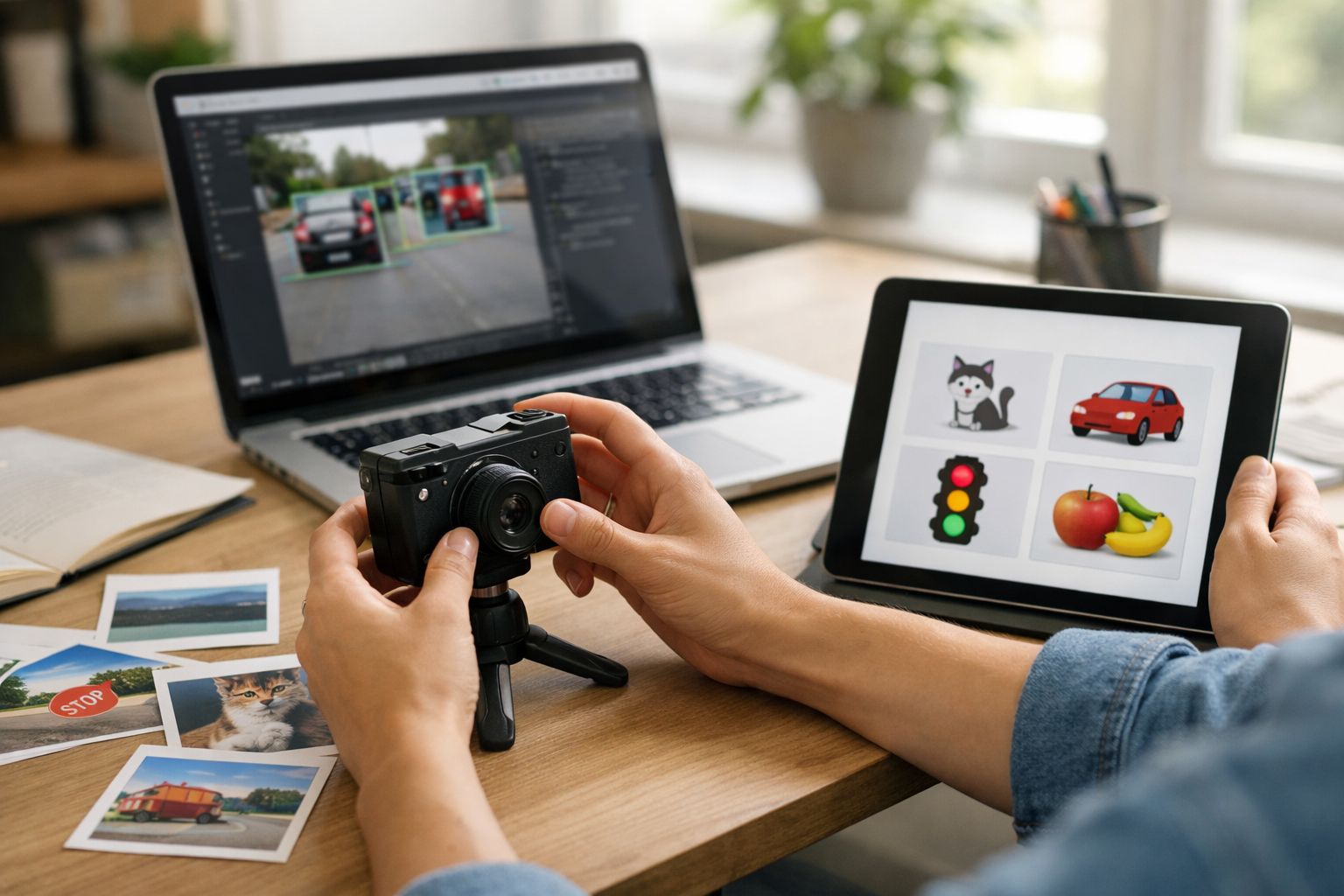
Learn how AI understands pictures, step by step.
AI can now recognize faces, count products, spot objects, read scenes, and help machines understand the visual world. If that sounds exciting but also confusing, this beginner course is designed for you. "AI for Complete Beginners with Cameras and Pictures" is a short, book-style course that explains computer vision in plain language. You do not need any coding, math, or data science background. We start at the very beginning and build each chapter carefully so you can understand how AI works with cameras and digital pictures.
This course treats computer vision as something practical, not mysterious. Instead of throwing technical words at you, it explains first how a computer stores an image, how pictures become numbers, and why quality matters. Once those basics are clear, you will learn the major tasks that visual AI can perform, such as image classification, object detection, and segmentation. By the end, you will be able to look at a camera-based AI system and understand what it is doing, what kind of data it needs, and where its limits are.
The course is organized into exactly six chapters, each one building on the previous chapter. Chapter 1 introduces AI, computer vision, cameras, and digital images in simple terms. Chapter 2 explains how computers read pictures through pixels, color, brightness, and resolution. Chapter 3 introduces the main jobs AI can do with images. Chapter 4 shows how AI learns from examples and why labeled data matters. Chapter 5 helps you think like a beginner project planner, moving from an idea to a simple vision workflow. Chapter 6 closes with real-world use, ethics, privacy, bias, and a roadmap for what to learn next.
This structure makes the course feel like a short technical book: focused, progressive, and easy to follow. If you have ever wondered how a phone recognizes a face, how stores count items on shelves, or how self-service systems read visual information, this course gives you the foundation to understand those ideas with confidence.
You will not be expected to train advanced models or write complex software. Instead, you will learn the language, logic, and workflow behind computer vision so you can speak about it clearly, evaluate simple use cases, and take your first steps into the field without feeling lost.
This course is ideal for curious beginners, students, professionals exploring AI, and anyone who wants a clear introduction to computer vision. It is especially useful if you have seen terms like image recognition, object detection, or visual AI and want to finally understand what they mean. It is also a strong starting point if you plan to later move into practical AI tools or beginner coding courses.
If you are ready to begin, Register free and start learning at your own pace. You can also browse all courses to continue your journey into AI, data, and technology topics after this one.
By the final chapter, you will understand the basic ideas behind picture-based AI systems and know how to think about a small computer vision project from start to finish. You will know the difference between common vision tasks, understand the role of training data, recognize why image quality matters, and appreciate the ethical issues around cameras and privacy. Most importantly, you will have a simple, solid mental model of how AI works with pictures.
If you want a friendly, structured, and practical introduction to computer vision, this course is the right place to start.
Computer Vision Instructor and Applied AI Specialist
Sofia Chen teaches beginner-friendly AI and computer vision courses for new learners entering tech. She specializes in turning complex topics like image recognition, object detection, and camera-based AI into simple, practical lessons that anyone can follow.
When people first hear the words artificial intelligence, they often imagine robots, science fiction, or machines that think exactly like humans. In everyday work, AI is usually much simpler and much more practical. It is a set of computer methods that help software find patterns in data and make useful predictions. In this course, the data we care about is visual data: camera feeds, photos, screenshots, scanned documents, and other images. The big idea of this chapter is that computers do not look at pictures the way people do. A person sees a face, a cup, a road sign, or a crack in a wall almost instantly. A computer starts with numbers. AI helps turn those numbers into decisions.
Computer vision is the branch of AI that works with pictures and video. It allows software to answer visual questions such as: Is there a cat in this image? Where are the cars in this street photo? Which pixels belong to the road and which belong to the sidewalk? These are not all the same task. Some vision systems classify an entire image with one label. Some detect several objects and place boxes around them. Some divide the whole picture into meaningful regions. Even at the beginner level, it helps to know the difference, because each task solves a different business or daily-life problem.
To understand how vision AI works, you need a simple mental model of cameras and digital pictures. A camera collects light from a scene. The camera sensor measures that light and stores the result as digital values. Once the scene becomes numbers, software can process it. A digital image is made of tiny picture elements called pixels. Each pixel stores color information, often as red, green, and blue values. That means a picture that looks smooth and natural to us is, inside the computer, a grid of numeric measurements. AI models learn patterns in those measurements. For example, they may learn that certain color and shape patterns often mean “dog,” “stop sign,” or “tumor.”
A practical vision workflow usually follows a small set of repeatable steps. First, define the problem clearly. You must decide what the system should recognize and what a useful answer looks like. Second, collect data that matches the real environment where the system will be used. Third, check quality: blurry images, poor lighting, wrong labels, or missing examples can weaken the system before training even starts. Fourth, train and test a model. Fifth, review the results with engineering judgment, not just excitement. A model that works on clean sample pictures may fail on real camera angles, bad weather, reflections, or unusual objects. Finally, deploy and monitor it, because real-world conditions change over time.
Data quality matters more than many beginners expect. If you teach a model with only bright daytime photos, it may perform badly at night. If your training pictures mostly show one type of product packaging, the system may struggle with damaged or redesigned packaging. If labels are inconsistent, the model learns confusion. In vision projects, people often want to jump straight to the model, but a weak dataset usually leads to weak results. Good engineering judgment means asking practical questions early: Are the images sharp enough? Do they represent different backgrounds, devices, seasons, distances, and lighting conditions? Are we solving the right task? Is a simple rule enough, or do we truly need AI?
Vision AI already appears in everyday life and business. Phones unlock with faces. Cars use cameras to help drivers stay in lanes. Stores count products on shelves. Farms monitor crop health. Hospitals analyze medical images. Factories inspect items for defects. Offices scan receipts and documents. Social apps suggest photo tags and organize albums. These systems are not magical eyes. They are pattern-recognition tools built from data, models, evaluation, and ongoing improvement.
By the end of this chapter, you should feel comfortable with a beginner-friendly view of what AI means, what computer vision is used for, how cameras turn scenes into data, why pictures become numbers, and why workflow and data quality are central to success. That foundation will make the rest of the course much easier, because advanced ideas in computer vision always build on these same basics.
Artificial intelligence, in simple words, means teaching computers to do tasks that normally require some human judgment. That does not mean computers become human. It means they can learn patterns from examples and use those patterns to make decisions. If a system has seen thousands of images labeled “apple” and “banana,” it can learn visual differences and guess which one appears in a new photo. In practice, AI is less about magic and more about pattern recognition, prediction, and automation.
For beginners, it helps to think of AI as software that becomes useful by learning from data instead of relying only on hand-written rules. Traditional programming says, “If this happens, do that.” AI says, “Here are many examples; learn the pattern.” Both approaches are valuable. A good engineer knows when a simple rule is enough and when a learned model is better. For example, if you only need to check whether a file exists, AI is unnecessary. But if you need to recognize many types of objects under changing lighting and angles, AI can help.
A common mistake is to assume AI always understands meaning the way people do. It does not. It finds statistical regularities in data. That is powerful, but it also means mistakes happen when the data is weak, narrow, or different from the real world. Good practical judgment starts with a clear problem statement, realistic expectations, and careful testing. In vision projects, AI is useful when visual patterns are too varied or complex for fixed rules alone.
Computer vision is the area of AI that helps computers work with pictures and video. The goal is not just to store images, but to extract meaning from them. A vision system can answer questions such as: What is in this image? Where is it located? Which parts of the picture belong to the object of interest? This makes computer vision useful in security, healthcare, retail, manufacturing, agriculture, transportation, and many everyday apps.
There are several common vision tasks, and beginners should learn to separate them clearly. Image classification gives one answer for the whole image, such as “contains a dog” or “this leaf looks diseased.” Object detection finds multiple items and marks their locations, such as detecting every person and bicycle in a street scene. Image segmentation goes further by labeling areas or pixels, such as identifying the exact shape of a tumor in a scan or the road surface in a self-driving view. Choosing the right task matters because it affects data collection, labeling effort, and the kind of results your system can deliver.
A practical mistake is starting with a harder task than needed. If the business only needs to know whether a package is present, classification may be enough. If the system must count items, detection may be more suitable. If it must measure exact boundaries, segmentation is the better fit. Good computer vision work begins by matching the problem to the simplest task that can solve it well.
A camera captures light from a scene. Light reflects from objects, passes through the camera lens, and reaches an image sensor. The sensor measures that light and converts it into electrical signals, which are then turned into digital values. This process is why cameras are so important in vision AI: they are the bridge between the physical world and the numeric world of software.
Several practical factors affect what the camera captures. Lighting changes the brightness and visibility of objects. Motion can create blur. Distance changes apparent size. Camera angle changes shape and visibility. Focus affects detail. Resolution determines how much visual detail is available. If the camera is dirty, low quality, or badly placed, the AI system may struggle no matter how advanced the model is. This is an important engineering lesson: hardware and setup matter as much as algorithms.
Beginners often assume more images automatically mean better results. But poor images can reduce performance. A thousand blurry photos may be less helpful than a smaller set of clear, varied, realistic examples. In real projects, teams often improve outcomes by adjusting the camera position, adding better lighting, cleaning lenses, or choosing a different frame rate before changing the model. A strong vision workflow starts at the camera, because the model can only learn from what the camera actually records.
A digital picture is a grid of tiny units called pixels. Each pixel stores numeric information about color and brightness. In many images, color is represented using red, green, and blue values. So when a computer “looks” at a photo, it does not see a smiling person or a parked car. It sees a structured table of numbers. Those numbers are the raw material for computer vision.
This idea is central for beginners: computers turn pictures into data by representing them numerically. A small image may have thousands of pixels, while a larger one may have millions. The arrangement of those numbers contains patterns. Nearby pixels can form edges, textures, corners, and shapes. AI models learn that certain patterns often belong to certain objects or regions. For example, repeated curved edge patterns and color contrasts may help a model identify a face, while long horizontal structures and lane markings may indicate a road scene.
There are practical consequences to this. Changing image size can remove useful detail. Heavy compression can introduce artifacts. Incorrect color formats can confuse a pipeline. Cropping can remove context. A beginner-friendly workflow includes checking image dimensions, file consistency, label quality, and whether the visual information actually supports the target task. If a defect is too tiny to be visible in the stored image, no model can reliably detect it. Understanding that pictures are numbers helps you reason clearly about what AI can and cannot learn.
Vision AI is already part of normal life, even for people who do not work in technology. Smartphones use it for face unlock, portrait effects, photo search, and organizing albums. Navigation and driving systems use cameras to watch lanes, signs, vehicles, and pedestrians. Shops use it to check inventory on shelves, monitor queues, and reduce losses. Factories use cameras to inspect products for missing parts, scratches, or wrong labels. Hospitals use image analysis to support doctors in reading scans and slides. Farms use cameras and drones to monitor plant growth and detect disease.
These examples show that computer vision is not one single product. It is a family of tools that solve different visual tasks in different environments. In business, practical success depends on matching the system to the use case. A warehouse may need object detection for counting boxes. A recycling line may need classification to sort materials. A medical team may need segmentation to outline areas of concern precisely. The expected output shapes the data, model, and evaluation method.
Common mistakes include copying an exciting demo without checking whether it fits the real workflow, ignoring privacy concerns around cameras, and underestimating edge cases like glare, darkness, and unusual object appearances. The most useful vision systems are usually the ones that save time, reduce errors, improve safety, or create new visibility into operations. Good outcomes come from practical fit, not just technical novelty.
This course is designed to give complete beginners a clear and usable foundation in AI for cameras and pictures. You will learn to explain, in simple language, what AI is and what computer vision means. You will understand how cameras capture scenes, how images become numbers, and how software works with those numbers to make predictions. You will also learn the difference between classification, detection, and segmentation so you can describe vision tasks accurately.
Just as important, this course will help you think like a practical builder. You will learn the basic computer vision workflow: define the problem, collect relevant image data, label or organize that data, train a model, test it carefully, and improve it with feedback. You will see why data quality matters so much and why many failures come from weak images, poor labeling, or unrealistic expectations rather than from the model alone. This is a key engineering habit: check the data and the setup before assuming the algorithm is the only issue.
By the end of the course, you should be able to look at a camera-based AI idea and ask smart beginner questions. What visual task is this really solving? Is the camera setup good enough? Are the images representative of the real environment? What would success look like in practice? That mindset is valuable whether you want to use existing AI tools, work with technical teams, or continue learning deeper computer vision topics.
1. According to the chapter, what does AI usually mean in everyday work?
2. How does a computer begin to process a picture?
3. What is computer vision?
4. Why is data quality so important in a vision project?
5. Which example best matches a real-world use of vision AI mentioned in the chapter?
When people look at a photo, they usually describe what it means: a face, a dog, a traffic sign, a damaged product, or a handwritten note. A computer does not begin with meaning. It begins with data. To a computer vision system, an image is a structured grid of tiny values that can be measured, stored, compared, and transformed. This chapter explains that idea in simple terms, because it is the foundation for everything that comes later in camera and picture AI.
If Chapter 1 introduced the big idea of computer vision, this chapter shows what an image really is inside a machine. That matters because AI does not work with magic. It works with numbers. A camera captures light. Software turns that light into digital image files. Those files are made of pixels. Pixels hold color and brightness values. Groups of pixels form edges, textures, shapes, and patterns. AI models learn from those patterns and use them for tasks such as image classification, object detection, and image segmentation.
It helps to connect these ideas to practical outcomes. In image classification, the system looks at a whole image and predicts one label, such as “cat” or “not cat.” In object detection, it finds where objects are and often draws boxes around them, such as locating several apples on a shelf. In image segmentation, it goes even deeper and decides which exact pixels belong to each object, such as separating road, sidewalk, and car in a driving scene. All three tasks depend on image quality and on how faithfully the picture has been turned into numbers.
A basic computer vision workflow usually follows a pattern. First, images are captured from cameras, phones, scanners, or existing datasets. Next, the images are checked, cleaned, labeled, resized, or otherwise prepared. Then a model is trained or applied to those images. After that, the results are measured against real examples to see what works and what fails. Finally, the system is improved by collecting better data, adjusting settings, or changing the model design. At every step, understanding image basics gives you better engineering judgment.
Beginners often make the same mistake: they focus only on the AI model and ignore the pictures going into it. In real projects, weak image data can destroy accuracy. A blurred photo, poor lighting, low resolution, bad camera placement, or inconsistent labeling can hurt performance more than a fancy model can fix. For that reason, this chapter will build your confidence with the core concepts behind digital images: how images are stored, what pixels represent, how color works, why resolution matters, and why data quality is so important for picture-based AI systems.
By the end of this chapter, you should be able to explain in plain language how computers read images, why visual data quality affects AI results, and how a camera-based system turns real-world scenes into useful numerical information. That understanding will make later topics feel much more natural.
Practice note for Learn how images are stored inside computers: document your objective, define a measurable success check, and run a small experiment before scaling. Capture what changed, why it changed, and what you would test next. This discipline improves reliability and makes your learning transferable to future projects.
Practice note for Understand pixels, color, and resolution: document your objective, define a measurable success check, and run a small experiment before scaling. Capture what changed, why it changed, and what you would test next. This discipline improves reliability and makes your learning transferable to future projects.
Practice note for See why image quality changes AI results: document your objective, define a measurable success check, and run a small experiment before scaling. Capture what changed, why it changed, and what you would test next. This discipline improves reliability and makes your learning transferable to future projects.
Practice note for Build confidence with core image concepts: document your objective, define a measurable success check, and run a small experiment before scaling. Capture what changed, why it changed, and what you would test next. This discipline improves reliability and makes your learning transferable to future projects.
A digital image is made from pixels, short for “picture elements.” You can think of pixels as tiny building blocks arranged in a grid. Each pixel stores information about one small area of the image. When many pixels are placed together, they form the complete picture you see on a screen. From far away, the image looks smooth and continuous. Up close, it is a mosaic of small values.
This idea is central to computer vision. A computer does not see a smiling person or a parked car at first glance. It sees rows and columns of pixel values. For example, a photo might be 1920 pixels wide and 1080 pixels tall. That means the computer is working with more than two million tiny locations. Each location contains data. The model studies patterns across those locations to learn useful features such as edges, corners, textures, and shapes.
Pixels also explain why editing an image changes AI behavior. Cropping removes some pixel information. Blurring smooths neighboring pixels and can hide important details. Sharpening increases contrast around edges. Resizing changes how much information is available. Even a simple rotation moves pixel patterns into new positions. To a person, the same object may still be obvious. To a model, those changes can matter a lot.
In practical workflows, engineers often inspect images at the pixel level when a system performs badly. If a model misses scratches on products, it may be because the scratches occupy very few pixels. If a face recognition system struggles, the face may be too small in the frame. If a medical imaging model gives unstable results, the images may have been saved with different pixel formats or scales.
A good beginner habit is to ask: what does the object of interest look like in pixels? If the answer is “tiny, blurry, or inconsistent,” the AI system will likely struggle. Strong computer vision starts by respecting the pixel grid.
Most digital images store color using channels. The most common format is RGB: red, green, and blue. Each pixel has three numbers, one for each channel. By combining different amounts of red, green, and blue, computers can represent many colors. For example, a pixel with high red and low green and blue may appear reddish. If all three values are high, the pixel appears close to white. If all three are low, it appears dark.
Brightness is closely related. A bright image has many pixels with higher values. A dark image has more low-value pixels. Contrast describes how much difference there is between bright and dark areas. These properties matter because AI models depend on visible patterns. If an image is too dark, features can disappear. If it is overexposed, bright areas may lose detail. If contrast is poor, object boundaries can become harder to detect.
Not every computer vision task needs full color. Some systems use grayscale images, where each pixel stores only one brightness value. This can simplify processing and reduce data size. Grayscale may work well when shape and texture are more important than color, such as reading printed text. But for tasks where color carries meaning, removing channels can hurt performance. A ripe fruit detector, a traffic light classifier, or a skin condition model may depend heavily on color information.
Engineering judgment matters here. Beginners sometimes assume more color data always helps. In reality, useful color depends on the problem. If factory lighting changes during the day, color may become unstable. If camera white balance shifts between devices, the same object can look different. In those cases, preprocessing or color normalization may be needed to make the data more consistent.
A common mistake is training on bright, clean sample images and then deploying on dim, uneven real-world images. The model appears good in testing but fails in practice. For camera AI, color and brightness are not decoration. They are part of the data itself.
Resolution describes how many pixels an image contains, often written as width by height, such as 640x480 or 3840x2160. Higher resolution usually captures more detail because the scene is sampled more finely. Lower resolution uses fewer pixels and therefore holds less information. This tradeoff appears in almost every computer vision project.
Image size matters for both accuracy and speed. Large images preserve small features such as cracks, labels, facial details, or distant objects. But they also take more memory, require more storage, and increase training and inference time. Smaller images are faster to process, easier to transmit, and cheaper to store. However, reducing resolution can erase the very signals the model needs.
Suppose you want to classify whether a fruit is fresh or bruised. If the bruise is large, a moderate image size may be enough. If the bruise is tiny, resizing images too aggressively may make the damage invisible. The same applies to object detection. A security camera may detect a person easily at low resolution, but it may fail to detect a small object in that person’s hand. Segmentation is even more sensitive because it needs precise pixel-level boundaries.
Another useful distinction is file size versus visual resolution. A compressed JPEG may have the same width and height as the original but still lose detail due to compression artifacts. So when people say an image is “high quality,” they may mean different things: more pixels, less compression, sharper focus, or cleaner lighting. AI systems care about all of these.
In practical workflows, teams often standardize image size before training. This makes batches easier to process and keeps the model input consistent. But standardization should be done thoughtfully. Stretching images can distort shapes. Cropping can remove important parts. Excessive downsampling can destroy fine detail.
A strong engineer asks not only, “Can the model run fast?” but also, “Does the image still contain the evidence needed to make the right decision?”
Two photos of the same object can look very different depending on lighting and camera angle. To a human, this is often easy to handle. We can recognize a cup on a sunny table and the same cup in a dim kitchen. Computers have a harder time because the pixel values may change dramatically, even when the object itself has not changed.
Lighting affects shadows, brightness, color balance, reflections, and contrast. A shiny package may reflect light and hide its label. A face under strong sunlight may have deep shadows across the eyes. A warehouse camera at night may produce noisy images. These changes can confuse AI systems if the training data does not include enough variety. In many failed vision projects, the model was not truly “bad”; the visual conditions changed beyond what it had learned.
Angle matters for similar reasons. A bottle photographed from the front may look different from one viewed from above. Objects can be partially hidden, stretched by perspective, or overlapped with other items. For object detection and segmentation, bad angles can reduce visible boundaries. For classification, an unusual viewpoint can make an object resemble a different category.
Good workflow design reduces these risks. In controlled environments, teams often fix camera position, lens choice, distance, and lighting setup. In uncontrolled environments, they collect more diverse examples so the model learns real-world variation. Data augmentation, such as rotations or brightness shifts, can help, but it cannot replace truly representative data.
A common beginner mistake is to collect images only in ideal conditions. The model looks accurate during development, then struggles in rain, at night, under fluorescent lights, or when the camera is bumped slightly out of place. That is why deployment testing matters. You must test where the system will actually live.
When results suddenly drop, inspect the visual environment before blaming the algorithm. In computer vision, camera setup is part of the engineering system, not a separate concern.
Data quality is one of the biggest predictors of AI success. Clean image data is clear, relevant, correctly labeled, and consistent with the problem you want to solve. Messy data is blurry, duplicated, mislabeled, poorly framed, heavily compressed, or collected under conditions that do not match real use. Computer vision systems learn from examples, so if the examples are weak, the model will learn weak patterns.
Consider a simple classification task: deciding whether a package is damaged. If the “damaged” folder includes a mix of torn boxes, crushed corners, dark photos, and unrelated items, the model may learn the wrong signals. It might associate damage with darkness instead of physical defects. In object detection, sloppy bounding boxes teach the system inaccurate object locations. In segmentation, poor pixel masks reduce boundary precision and can make training unstable.
Clean data does not mean perfect or unrealistically polished. It means useful, trustworthy, and representative. Real projects need a balance. The dataset should include normal variation, such as different backgrounds, distances, and lighting, but it should not be filled with noise that adds confusion without value. Good datasets are diverse on purpose, not chaotic by accident.
This is where engineering judgment becomes practical. You may need to remove unreadable images, fix labels, standardize naming, or group samples by camera source. You may discover that one class has thousands of examples while another has very few. You may find duplicates that make evaluation look better than reality. These are data problems, not model problems, and they deserve serious attention.
Many beginners hope the model will “figure it out.” Sometimes it can, but often it cannot. Better data usually beats more complexity. In picture-based AI, data quality is not a side issue. It is the core of reliability.
At the heart of computer vision is a simple transformation: pictures become numbers. A camera captures light from a scene. The image sensor measures that light at many tiny positions. Software converts those measurements into pixel values and stores them in a file. When an AI program loads the file, it reads an organized array of numbers. For an RGB image, each pixel has three values. A whole image becomes a large numerical structure that mathematics can process.
Once the image is numeric, the computer can perform operations on it. It can resize the array, normalize the values, detect edges, compare patterns, or pass the data into a neural network. During training, the model adjusts internal parameters so that certain numerical patterns become associated with outputs. In classification, the output may be a single label. In object detection, the output may include box coordinates and class labels. In segmentation, the output may be a class prediction for each pixel. Different tasks, same starting point: numerical image data.
This is why preprocessing matters. Images may be resized to a standard shape, pixel values may be scaled to a common range, and channels may be reordered depending on the software framework. If this preprocessing is inconsistent between training and deployment, performance can collapse even if the model itself is correct. A system trained on normalized images may behave poorly if real-time input is not normalized the same way.
It also explains why visual intuition should be paired with numerical thinking. If an image “looks fine” to a human but was saved with the wrong color channel order, the model may effectively see nonsense. If the input resolution changes unexpectedly, important patterns may shift or vanish. Reliable computer vision comes from treating images as both pictures and data structures.
The practical takeaway is powerful for beginners: AI with cameras is not mysterious. It is a workflow. Capture the scene. Store the image. Represent it as pixels and channels. Convert it into numbers. Feed those numbers into a model. Measure the result. Improve the data and setup when performance is weak. Once you understand this chain, you can reason clearly about why a system succeeds or fails.
This chapter gives you the mental model needed for the rest of the course. Computers read images by reading pixel values. Better images usually produce better numerical signals. Better numerical signals usually support better predictions. That is the bridge between cameras, digital pictures, and useful AI.
1. According to the chapter, what does a computer vision system see first when it reads an image?
2. What is the role of pixels in a digital image?
3. Which task goes furthest by deciding which exact pixels belong to each object?
4. Why can weak image data seriously reduce AI performance?
5. What is a typical early step in a basic computer vision workflow after images are captured?
In the last chapter, you saw that computers do not experience a picture the way people do. A computer receives a grid of pixel values, turns that grid into numbers, and then looks for patterns in those numbers. In this chapter, we move from the raw picture to the practical jobs that computer vision systems are built to perform. This is a key step for beginners, because many projects fail not from bad coding, but from choosing the wrong type of vision task in the first place.
At a high level, picture-based AI usually answers one of a few common questions. Is this image showing a cat or a dog? Where are the people in this photo? Which exact pixels belong to the road, the car, or the background? These questions may sound similar, but they belong to different task types. The three most important ones for beginners are image classification, object detection, and image segmentation. If you can clearly tell these apart, you will already think more like a computer vision engineer.
Image classification gives one or more labels to a whole image. Object detection finds objects and draws boxes around them. Image segmentation goes deeper and marks the exact region of each object or area. Each task asks for a different level of detail, needs different labeled data, and supports different real-world products. A wildlife camera that decides whether an animal is present may only need classification. A warehouse camera that must count boxes on a shelf may need detection. A self-driving system that must know exactly where the road ends and the sidewalk begins needs segmentation.
There are also related jobs such as face recognition, facial landmark detection, and feature matching. These are often built on the same core ideas but solve more specific problems. For a complete beginner, the smartest approach is not to learn every advanced model name first. Instead, learn to ask: what exactly do I want the AI to output? A label, a box, a pixel map, an identity, or key points? That one question often determines the right project design.
As you read this chapter, keep one practical idea in mind: the best task is not the most advanced one. The best task is the simplest one that gives enough information to solve the real problem. Teams often waste time collecting expensive segmentation labels when simple classification would have done the job. Other teams choose classification because it sounds easy, then discover too late that they actually needed object locations. Good engineering judgment means matching the task to the business or personal goal before building anything.
By the end of this chapter, you should be able to tell apart the main kinds of vision tasks, explain classification in simple terms, understand detection and segmentation clearly, and match these tasks to beginner project ideas. That skill matters because choosing the right task affects data collection, labeling cost, model complexity, hardware needs, and user expectations. It is one of the most practical decisions in all of computer vision.
Practice note for Tell apart the main types of vision tasks: document your objective, define a measurable success check, and run a small experiment before scaling. Capture what changed, why it changed, and what you would test next. This discipline improves reliability and makes your learning transferable to future projects.
Practice note for Understand classification in simple terms: document your objective, define a measurable success check, and run a small experiment before scaling. Capture what changed, why it changed, and what you would test next. This discipline improves reliability and makes your learning transferable to future projects.
Practice note for Understand detection and segmentation clearly: document your objective, define a measurable success check, and run a small experiment before scaling. Capture what changed, why it changed, and what you would test next. This discipline improves reliability and makes your learning transferable to future projects.
Image classification is the simplest and most common starting point in computer vision. The computer looks at the entire picture and outputs a label, such as cat, dog, banana, damaged product, or empty parking space. The important idea is that the AI is not telling you where the object is. It is only making a decision about the image as a whole, or sometimes returning a ranked list of likely labels with confidence scores.
For beginners, classification is often the best first project because the labels are easier to create. You can place images into folders such as ripe fruit and unripe fruit, or helmet and no helmet. That makes the workflow simpler: collect pictures, assign one label per image, train a model, test it on new images, and measure how often it predicts correctly. This is a good fit when the whole image mostly contains the thing you care about.
A classic beginner mistake is using classification when the image contains many objects or too much background clutter. Suppose you want to know whether a shelf contains any cereal boxes. If the shelf image is busy and the boxes are small, classification may struggle because the important signal is only a tiny part of the image. In that case, a detection task may work better. Another mistake is assuming a high accuracy score means the model truly learned the right concept. Sometimes it learns shortcuts, such as background color, camera angle, or lighting conditions, instead of the actual object.
Good engineering judgment with classification means asking simple questions early. Will there usually be one main object in the image? Is one label enough? Does the user only need a yes or no answer? If yes, classification may be ideal. Practical beginner project ideas include sorting recyclable materials by image, checking whether a plant leaf looks healthy, identifying handwritten digits, or deciding whether a meeting room is occupied. These are useful, achievable projects that teach the core workflow without requiring complicated annotations.
Object detection adds location to the answer. Instead of only saying there is a dog in this picture, the AI says there is a dog here and draws a bounding box around it. If there are multiple objects, the model can return several boxes, each with a label and a confidence score. This makes detection more informative than classification, especially when counting, tracking, or locating items matters.
Detection is used in many practical systems: finding people in security footage, locating vehicles in traffic cameras, identifying products on store shelves, and spotting defects on a production line. The key difference from classification is that the output is structured. You do not just receive a category. You receive coordinates that describe where the model believes an object is. That allows downstream systems to count objects, trigger alarms, guide robots, or crop and inspect detected regions more closely.
Because detection gives more detail, it also needs more detailed labels. During data preparation, someone must draw boxes around each object of interest. This takes more time than assigning a single image label. Beginners often underestimate this labeling effort. Another common mistake is drawing inconsistent boxes. If one person draws tight boxes around products and another leaves wide gaps, the training data becomes messy, and model quality suffers. Clear labeling rules matter.
Detection is a strong choice when objects can appear more than once, appear in different positions, or occupy only part of the scene. A beginner project might be a camera that counts apples on a table, detects cars in a parking lot, or finds packages on a conveyor belt. However, detection still has limits. A box is only an approximation. If you need the exact outline of a road, a tumor, or spilled liquid, a box may be too rough. That is when segmentation becomes the better tool. In practice, many teams start with detection because it gives a useful balance between effort and precision.
Image segmentation is the most detailed of the main beginner task types. Instead of assigning one label to the whole image or drawing a rough box around an object, segmentation labels the exact pixels that belong to each class or object. In simple terms, it colors in the picture with meaning. Pixels may be marked as road, sky, person, background, or tumor, depending on the application.
This extra detail makes segmentation powerful when boundaries matter. In medical imaging, doctors may need to know the exact shape of a region, not just that something is present. In agriculture, a system may need to measure the exact area of disease on a leaf. In autonomous driving, the software may need a precise understanding of drivable road versus sidewalk, lane markings, and obstacles. A simple box cannot describe these boundaries well enough.
Segmentation also brings extra cost and complexity. Pixel-level labels are expensive and slow to produce. Tools exist to help, but the work is still much harder than image-level labels or bounding boxes. Beginners sometimes choose segmentation because it sounds advanced, then get stuck in the data-labeling stage. A more practical mindset is to ask whether exact shapes are truly necessary. If the end user only needs to know whether an item is present, segmentation is often overkill.
There are two common forms. Semantic segmentation labels every pixel by class, such as all road pixels or all tree pixels. Instance segmentation goes further and separates individual objects, such as one person versus another person. For a beginner, the main lesson is not to memorize terminology but to understand the output. If your goal requires exact regions, area measurement, or fine boundaries, segmentation is the right family of tasks. A simple beginner idea could be separating foreground from background for portrait effects or marking the exact leaf area in plant photos. Just remember: more detail usually means more data work, more training complexity, and more chances for labeling inconsistency.
Face and feature recognition are related vision tasks that beginners often hear about early, especially because they appear in phones, cameras, and security systems. It helps to separate a few ideas clearly. Face detection answers whether a face is present and where it is. Face recognition tries to identify whose face it is by comparing it with known examples. Facial landmark detection finds important points such as eyes, nose, and mouth corners. These are different jobs, even though they are often used together.
Feature recognition in a broader sense means finding meaningful patterns or key points in an image that can be matched across images. For example, a phone camera may identify stable corner-like patterns to help with motion tracking or panorama stitching. A factory system may look for specific visual features on a part to verify alignment. These systems are less about naming the whole image and more about matching patterns, measuring similarity, or tracking known structures over time.
From an engineering point of view, these tasks introduce practical concerns beyond accuracy. Lighting, camera angle, occlusion, motion blur, and image resolution can strongly affect face and feature systems. Privacy is also a major issue with face recognition. Just because a task is technically possible does not mean it is appropriate or lawful in a given setting. Beginners should understand that responsible use matters as much as model performance.
A common mistake is to confuse recognition with detection. If a system draws a box around a face, that does not mean it knows who the person is. Another mistake is assuming a face model trained in one environment will work equally well everywhere. Different cameras, distances, skin tones, and lighting conditions can change results significantly. A practical beginner project is face detection for counting people in front of a kiosk, or landmark detection to place a virtual hat or glasses filter. These projects teach useful concepts without requiring identity recognition, which is usually more sensitive and more difficult to do responsibly.
Now that you have seen the main task types, it is useful to compare them directly. Classification, detection, and segmentation are not competing in the sense that one is always better. They are different tools for different questions. The real skill is understanding what information each one returns and what that means for data collection, model design, cost, and practical outcomes.
Classification is the lightest option when one label for the whole image is enough. It usually needs the least labeling effort and is the easiest place to begin. Detection adds boxes and supports counting and localization. It needs more careful annotations but gives richer outputs. Segmentation is the most detailed, often the most expensive to label, and best when exact shapes or areas matter. Face and feature tasks are more specialized and often combine with the main three.
Think about a grocery store camera. If the store only wants to know whether a shelf is empty, classification might be enough. If it wants to count how many bottles are visible, detection is better. If it wants to measure exactly how much shelf space each brand occupies, segmentation may be required. The physical world did not change, but the business question changed, so the right AI task changed too.
This comparison also shows why data quality matters. Poor labels harm every task, but the effect grows as the task gets more detailed. A wrong class label hurts classification. A badly placed box hurts detection. Messy pixel masks hurt segmentation even more. When beginners struggle, the issue is often not the model code but a mismatch between the chosen task, the data, and the real objective. Seeing these tasks side by side helps you make smarter choices from the start.
Choosing the right vision task is one of the most important decisions in a project. A practical way to start is to write the desired output in one sentence. If your sentence sounds like tell me what this image shows, that points to classification. If it sounds like show me where each object is, that points to detection. If it sounds like mark the exact shape or area, that points to segmentation. If it sounds like tell me which known person or pattern this is, that points to recognition or feature matching.
Next, think about what the user will do with the result. If the result is just a dashboard summary, a simple label may be enough. If a robot must pick up an object, location matters. If a doctor or quality inspector needs boundary measurements, exact pixels matter. This is the kind of engineering judgment that saves time and budget. Always ask what minimum level of detail is sufficient to solve the real problem.
Beginners should also match the task to available data and effort. Classification is usually the fastest first step because labels are easier to collect. Detection is a strong middle ground for many real applications. Segmentation should be chosen when its extra detail creates real value, not just because it sounds more advanced. A good workflow is often to start simple, validate that the idea is useful, and then move to a more detailed task only if needed.
Here are beginner-friendly project matches. A webcam that decides whether a room is occupied fits classification. A garden camera that counts ripe tomatoes fits detection. A photo editor that separates a person from the background fits segmentation. A phone filter that places effects on eyes and mouth fits landmark detection. The important practical outcome is confidence in matching the problem to the right task. Once you can do that, the rest of the computer vision workflow becomes far easier: collecting the right images, labeling them correctly, choosing suitable tools, and evaluating whether the system truly solves the intended goal.
1. Which task type gives one or more labels to a whole image?
2. If you need an AI system to count boxes on a shelf, which task is the best match?
3. What question does image segmentation answer?
4. According to the chapter, what is the smartest question a beginner should ask first when choosing a vision task?
5. Why do many computer vision projects fail, according to the chapter?
In the earlier chapters, you learned that computers do not see pictures the way people do. A computer receives a digital image as numbers, and then software tries to find useful patterns in those numbers. This chapter explains the next important idea: how we teach an AI system to recognize those patterns using examples. In computer vision, this usually means showing a model many pictures and telling it what each picture represents. Over time, the model adjusts itself so it can make better guesses on new images it has never seen before.
For beginners, the word training can sound mysterious, as if the computer is thinking like a person. It is better to imagine training as repeated practice with feedback. The model looks at an image, makes a prediction, compares that prediction with the correct answer, and then changes its internal settings a little. It repeats this process again and again across many examples. If the examples are clear, correctly labeled, and varied enough, the model can learn patterns that are actually useful in the real world.
This chapter also introduces an important engineering mindset. Building picture-based AI is not only about choosing a clever algorithm. It is also about making careful decisions about data, labels, testing, and error checking. A beginner might assume that success comes from having a lot of images. In practice, success depends on whether the images match the real problem, whether labels are consistent, and whether the model is tested honestly. A small, clean, well-planned dataset often teaches more than a large messy one.
As you read, keep a simple example in mind: teaching AI to tell whether a picture contains a cat or a dog. The same ideas apply to much larger tasks, such as detecting damaged products in a factory, identifying plants in agriculture, reading package labels in logistics, or checking whether a shelf in a shop is empty. The workflow stays familiar: gather examples, label them, divide the data into different sets, train a model, test it, examine mistakes, and improve the data or process.
By the end of this chapter, you should understand how AI learns from examples, why labels and training data matter so much, why testing is essential, and what common mistakes beginners make when starting a vision project. These ideas are practical, not theoretical. They help you judge whether a model is likely to work outside the lab, with real cameras, real lighting, and real users.
In other words, teaching AI with picture examples is less like magic and more like coaching. The coach needs clear goals, good practice material, honest feedback, and realistic trials. If any of those parts are weak, the final system will also be weak. In the next sections, we will break this process into practical pieces that complete beginners can understand and use.
Practice note for Understand how AI learns from examples: document your objective, define a measurable success check, and run a small experiment before scaling. Capture what changed, why it changed, and what you would test next. This discipline improves reliability and makes your learning transferable to future projects.
Practice note for See the role of labels and training data: document your objective, define a measurable success check, and run a small experiment before scaling. Capture what changed, why it changed, and what you would test next. This discipline improves reliability and makes your learning transferable to future projects.
Practice note for Learn why testing is important: document your objective, define a measurable success check, and run a small experiment before scaling. Capture what changed, why it changed, and what you would test next. This discipline improves reliability and makes your learning transferable to future projects.
Training is the process of adjusting a model so that its predictions become more useful over time. In simple terms, you show the model a picture, the model makes a guess, and then it is told whether that guess was right or wrong. Based on that feedback, the model changes its internal numerical settings. After repeating this on many images, it starts to detect patterns that match the task. It is not memorizing in the human sense, and it is not understanding the scene like a person. It is finding statistical relationships between image patterns and the labels you provide.
Imagine training a system to recognize apples and bananas. At first, the model may guess almost randomly. After seeing many examples, it may begin to notice common shapes, colors, textures, and edges. In reality, the model does not think in words like “curved yellow fruit.” It works with numerical features extracted from image pixels. But the result is similar: it becomes better at separating one category from another.
Training also depends on repetition. One pass through the dataset is usually not enough. The model often needs to see the examples multiple times, gradually reducing its errors. During this process, engineers watch whether performance improves or whether the model begins to learn the wrong things, such as background color instead of the object itself.
A practical way to think about training is as controlled trial and error. The model is not a finished product when you first create it. Training is where the raw model becomes specialized for a task. This is why choosing a good task definition matters. If your goal is unclear, training will also be unclear. For example, are you teaching the model to classify the whole image, detect where an object is, or separate every pixel into regions? The answer changes the training setup completely.
For beginners, the key lesson is this: training is the part where examples turn a general algorithm into a task-specific tool. Good training requires clear examples, correct answers, enough variety, and a realistic understanding that the model will only learn from the signals present in the data you give it.
Labels are the teaching signals for supervised computer vision. A label tells the model what the correct answer is for a given image. If you are building an image classification system, the label might be a category such as “cat,” “dog,” or “car.” If you are building an object detection system, the label includes both the category and the location of the object, often shown with a box. If you are building an image segmentation system, the label can mark which pixels belong to road, sky, person, or background.
Without labels, the model has no clear standard for what it should learn. This is why labeling is one of the most important and most time-consuming parts of an AI project. In beginner projects, people often rush through it, assuming labels are obvious. But small inconsistencies create major problems. For example, if one person labels a tomato as a vegetable and another labels it as a fruit, the model receives mixed instructions. It will struggle because the target itself is unclear.
Categories also need sensible boundaries. Suppose you want to classify pictures of drinks. Will “coffee with milk” and “black coffee” be the same category or different ones? Will a sealed bottle count as “drink” or “packaging”? These choices sound simple, but they shape the dataset and the final model behavior.
Good labeling requires written rules. Teams often create a short labeling guide with examples of what should and should not be included. This is especially important when more than one person labels images. A clear guide improves consistency, which improves training quality.
In practical terms, think of labels as instructions and categories as the structure of the problem. If your labels are wrong, vague, or inconsistent, the model cannot learn a clean pattern. In many real projects, improving labels gives a bigger performance gain than changing the model architecture. For a beginner, this is an important engineering lesson: better data definitions often beat fancier algorithms.
One of the most important habits in AI is separating your data into different groups. A common setup uses three parts: training data, validation data, and test data. Each has a different job. Training data is what the model learns from directly. Validation data is used during development to compare versions of the model and tune choices such as settings, image size, or learning rate. Test data is held back until the end to estimate how well the final system performs on truly unseen examples.
Why not use the same pictures for everything? Because that would give a misleading result. If the model is trained and judged on the same images, it may seem excellent simply because it has adapted too closely to those exact examples. That does not mean it will work on new camera images in the real world.
Think of it like school. Training data is homework and class practice. Validation data is a practice exam used to improve study methods. Test data is the real final exam. If you keep peeking at the final exam while preparing, you are no longer measuring honest performance.
In practical projects, a rough split might be 70% training, 15% validation, and 15% test, though the exact numbers can vary. More important than the percentages is the quality of the split. The sets should represent the same real-world task but remain separate. If nearly identical images appear in both training and test sets, the test score may look unrealistically high.
This matters a great deal in camera projects. For example, if you capture ten photos of the same product from almost the same angle and put some in training and some in test, you are not really testing generalization. You are mostly testing whether the model recognizes a repeated scene. Good testing means making sure the held-out data is different enough to challenge the model fairly. Beginners who learn this early avoid one of the most common mistakes in AI work.
Not all image examples are equally useful. Good examples help the model learn the true visual pattern related to the task. Bad examples confuse the model or push it toward shortcuts. A good dataset usually includes variety: different lighting conditions, camera angles, backgrounds, distances, object sizes, and levels of clutter. If your future system will operate in a supermarket, factory, street, or farm, your examples should reflect that environment rather than an idealized studio setup.
Consider a beginner project to detect ripe bananas. If all ripe bananas are photographed on a white table and all unripe bananas are photographed on a wooden table, the model may learn the table, not the fruit. It will seem to work during development but fail in a real kitchen or store. This is a classic example of a hidden shortcut in the data.
Bad examples can also come from low-quality labels, blurry images, duplicated files, wrong crops, or images that do not match the task definition. Sometimes the problem is imbalance. If 95% of your images show one category and only 5% show another, the model may become biased toward the majority class. It may achieve a seemingly high score while being poor at the minority class that actually matters.
That does not mean every imperfect image should be removed. Real systems often need to handle blur, glare, shadows, and partial views. Including some difficult cases is useful if they are realistic and correctly labeled. The goal is not perfect photos. The goal is representative photos.
A practical workflow is to inspect samples manually before training. Ask basic questions: Do these pictures look like what the camera will really see? Are the labels consistent? Are there repeated near-duplicate images? Does one class always appear in a special background? This kind of data review is simple, but it often catches major problems early. In computer vision, careful example selection is a form of engineering judgment, not busywork.
Overfitting happens when a model learns the training examples too specifically and does not generalize well to new images. In plain language, the model becomes too good at the practice material and not good enough at the real task. It may memorize tiny details, noise, or accidental patterns that appear in the training set but do not matter in general.
Imagine teaching a model to recognize employee badges. If every training photo is taken with the same camera, same office wall, and same lighting, the model might partly rely on those conditions. When a new badge photo comes from a phone camera in a hallway, performance drops. The model has learned a narrow version of the problem.
One sign of overfitting is when training performance keeps getting better, but validation performance stops improving or gets worse. That means the model is becoming more specialized to the training set rather than more broadly useful. This is why validation data is important. It gives an early warning.
There are several practical ways to reduce overfitting. You can collect more diverse data, simplify the task, improve labels, use data augmentation such as flipping or brightness changes when appropriate, or stop training when validation results stop improving. You can also remove obvious shortcuts in the dataset, such as category-specific backgrounds.
Beginners sometimes think overfitting means the model is “too smart.” It is better to think of it as the model learning the wrong lesson too well. A student who memorizes answers to old homework without understanding the topic may score well on familiar questions but poorly on a new exam. AI models behave similarly. The practical outcome is clear: a model is only valuable if it performs reliably on new images, not just on the examples it studied.
At some point, every AI project must answer a simple question: does the model actually work? The only reliable answer comes from measurement on data the model did not train on. For beginners, the most familiar metric is accuracy, which tells you how often the model is correct overall. Accuracy is useful, but it is not always enough. If one category is very common, a model can get high accuracy by mostly guessing that common category.
This is why engineers also look at more detailed results. For classification, they may inspect which classes are confused with each other. For detection, they care not only about the category but also whether the object location is correct. For segmentation, they examine whether the predicted regions match the object boundaries well enough for the application.
Equally important is error analysis. Instead of only reading one number, look at failed examples. Are mistakes happening in low light? On small objects? On one camera but not another? On certain backgrounds? This process often reveals that the problem is really about data coverage, label quality, or task definition rather than model complexity.
Testing should also reflect the practical goal. In a home photo app, occasional small mistakes may be acceptable. In a medical or safety setting, the standard is much higher. A model that is “pretty good” may still be unusable if the cost of errors is high. This is an engineering judgment, not just a mathematical one.
A strong beginner habit is to combine quantitative measurement with visual review. Check the scores, but also inspect real predictions. Ask whether the output would be useful to a person or business in the intended setting. A model works only when its measured performance and its real-world behavior both support the actual job it was built to do.
1. According to the chapter, what does training an AI model with pictures mostly mean?
2. What is the main role of labels in picture-based AI?
3. Which statement best matches the chapter's view of good training data?
4. Why is testing important in an AI vision project?
5. Which is a common beginner mistake described in the chapter?
By this point in the course, you know that computer vision is about helping computers work with pictures and video, and you have seen that images are really grids of numbers. Now comes a very important beginner step: turning a vague idea into a small, realistic project plan. This is where many people either make fast progress or get stuck. A good vision project does not begin with a complicated model. It begins with a clear question, a simple workflow, and a practical definition of success.
When beginners say, “I want to build an AI camera app,” that sounds exciting, but it is still too broad. A better project statement sounds like this: “I want a system that looks at a picture of fruit and says whether it is an apple, banana, or orange.” That is specific. It also suggests the task type. If the system gives one label for the whole image, that is image classification. If it must find and draw boxes around several fruits, that is object detection. If it must mark the exact pixels for each fruit, that is image segmentation. Choosing the right task early saves time and confusion.
A simple project workflow usually looks like this: define the problem, choose the task, gather pictures, check data quality, prepare the images, choose beginner-friendly tools, train or test a model, read the results, and improve step by step. Notice that this is a cycle, not a straight line. In real projects, you often go back and fix the data, simplify the goal, or change how you measure success. That is normal engineering judgment, not failure.
For beginners, the best projects are small and concrete. Good examples include classifying handwritten notes versus printed pages, detecting whether a parking space looks empty or occupied, sorting product photos into categories, or checking whether a plant leaf looks healthy or damaged. These projects are narrow enough to manage, but still teach the full computer vision workflow. They also help you practice an important habit: making decisions based on what the pictures actually show, not on what you hope the model will learn.
Success goals matter just as much as the idea itself. If you do not decide what “good enough” means, you cannot tell whether your project is working. For a toy project, success may mean “the model gets around 85% of test pictures right.” For a camera monitoring idea, success may mean “it misses very few important cases.” In one project, speed may matter more than perfect accuracy. In another, fairness across lighting conditions may matter most. A project plan gives you a way to balance these trade-offs in advance.
One common mistake is starting with tools instead of the problem. People ask, “Which model should I use?” before they ask, “What exactly should the model decide?” Another mistake is using random internet images that do not match the real-world situation. A model trained on neat, bright product photos may fail badly on messy phone-camera pictures. This is why data quality matters so much in picture-based AI systems. The pictures teach the model what “normal” looks like. If the data is unrealistic, the model learns unrealistic patterns.
In this chapter, you will learn how to move from idea to a simple project workflow, how to choose data, task, and success goals, which tools beginners can use, and how to plan a small camera or picture AI project without getting lost in advanced details. Think of this chapter as a bridge between understanding vision concepts and actually building something useful. The goal is not to create a perfect system on day one. The goal is to create a small plan that is clear, testable, and possible.
The first step in any vision project is to describe the problem in simple words. Imagine explaining it to a friend who has never used AI. If your explanation is fuzzy, your project plan will also be fuzzy. A clear problem has three parts: what image comes in, what answer should come out, and why that answer is useful. For example: “A phone picture of a recycling item comes in, and the system says paper, plastic, glass, or metal, so users know how to sort waste.” That is much better than saying, “I want an AI that understands trash.”
Next, connect the problem to a vision task. If one label describes the whole image, use classification. If you need to locate things, use detection. If exact shapes matter, use segmentation. This choice is practical engineering judgment. Beginners often choose a harder task than they need. If your goal is simply to tell whether a shelf image contains cereal or not, classification may be enough. You do not need segmentation unless exact object boundaries are important.
After that, define a success goal. A success goal should be measurable. You might decide that your model should correctly classify 8 out of 10 test images, or that it should work well on both daylight and indoor lighting. If people will rely on the system for a decision, think about what mistakes matter most. Is it worse to miss a damaged item, or to wrongly flag a healthy one? These questions shape your metrics and your data plan.
A good beginner project is narrow. Limit the number of classes, environments, and camera conditions. Instead of “recognize all animals,” try “distinguish cats from dogs in pet photos.” Instead of “understand street scenes,” try “detect whether a crosswalk is visible in daytime pictures.” A smaller problem is easier to finish, easier to debug, and better for learning the full workflow.
Common mistakes include choosing a problem without enough examples, solving a task nobody actually needs, or skipping the definition of success. Before moving on, you should be able to write one short project statement, one task type, one target user or purpose, and one success goal. If you can do that, your idea has become a project plan.
Once the problem is clear, the next question is: where will the pictures come from? In computer vision, data is often the most important part of the project. A simple model with good images can outperform a fancy model trained on poor images. For beginners, there are usually two choices. You can collect your own pictures with a camera or phone, or you can find an existing dataset. Both are useful, and each teaches different lessons.
Collecting your own pictures is excellent when your project is small and specific. If you want to classify ripe versus unripe bananas, taking your own photos gives you direct control. You can capture different angles, distances, backgrounds, and lighting conditions. This helps your future model learn what variation looks like. But you must be careful not to make all photos too similar. If every “ripe” banana is on the same table and every “unripe” banana is on a different table, the model may learn the background instead of the fruit.
Using public datasets can save time. Many beginner-friendly datasets exist for common tasks such as digit recognition, simple object categories, faces with permissions, traffic scenes, and basic medical image exercises for education. When choosing a dataset, ask practical questions. Does it match the type of camera or pictures you care about? Does it include enough examples per class? Are the labels reliable? Are there legal or ethical restrictions on use? A dataset that looks large is not always useful if it does not resemble your real problem.
Data quality matters more than people expect. Good data usually has clear labels, enough variety, and realistic examples. Try to include images with different lighting, orientations, backgrounds, and image quality. Also include difficult cases if they are likely in the real world. If your app will receive blurry phone photos, train with some blurry phone photos. If users may crop objects poorly, include some imperfect framing. This reduces surprise later.
For a small project, split your data into training, validation, and test sets. Training data teaches the model. Validation data helps you compare choices while building. Test data is held back until the end for a final check. Keep these sets separate. If the same or nearly identical images appear in both training and test sets, your results may look better than they really are. Strong project plans treat honest testing as part of the build, not as an afterthought.
Raw pictures are rarely ready for learning. Preparation is the stage where you make the data consistent enough for a computer to use well. This does not mean making every image look perfect. It means making sure the data is organized, correctly labeled, and suitable for the chosen task. For classification, each image needs the right class label. For detection, objects need bounding boxes. For segmentation, pixels need masks. Incorrect labels are one of the fastest ways to confuse a model.
Images often need resizing because models usually expect a fixed input size. A beginner tool may automatically resize images to a standard shape like 224 by 224 pixels. That is normal, but be aware of trade-offs. Very small images may lose important detail, while very large images can slow training. You should also watch out for distortions. Stretching images too much can change the shapes the model needs to learn. In some cases, cropping or padding is better than aggressive stretching.
Another useful preparation step is data cleaning. Remove broken files, duplicate images, irrelevant pictures, and mislabeled examples. Duplicates are a subtle problem. If the same image appears multiple times, the model may seem more confident than it should be. A small amount of cleaning can improve learning a lot. This is also where human judgment matters. Ask: does each image support the real goal of the project, or is it adding noise?
Data augmentation is a beginner-friendly way to create more variation from existing images. Common augmentations include flipping, slight rotation, brightness changes, zooming, or small shifts. These can help models handle normal real-world changes. But augmentation should match reality. Flipping text images can make no sense. Extreme color changes may create unrealistic examples. Good augmentation teaches robustness; bad augmentation teaches nonsense.
Finally, organize your files clearly. Use folders, labels, and naming rules that make sense. Keep notes on how images were collected and prepared. This sounds simple, but it saves enormous time later. Many project problems are not model problems at all; they are data organization problems. Preparation is where a beginner project becomes disciplined enough to build on.
Beginners do not need to start with the hardest tools. In fact, using simpler tools is often the smartest engineering choice because it lets you learn the workflow before fighting setup complexity. There are several categories of beginner-friendly vision tools. The first category is no-code or low-code platforms. These often let you upload labeled images, choose a task like classification or detection, train a model in the browser or cloud, and test predictions visually. They are great for understanding the end-to-end pipeline.
The second category is notebook-based tools and starter libraries. Platforms like beginner-friendly Python notebooks combined with common machine learning and vision libraries can help you train a simple classifier with only a modest amount of code. Pretrained models are especially useful here. Instead of training from scratch, you start with a model that already knows many general visual patterns and fine-tune it for your small task. This approach often works well even with limited data.
The third category includes image labeling tools. For classification, labeling may be as simple as placing images into folders. For detection and segmentation, dedicated annotation tools help you draw boxes or masks. Good tools reduce errors and make labeling faster. If labeling feels painful, that is a sign to simplify the project. Maybe your first version should use classification instead of segmentation.
When choosing tools, ask practical questions. Does the tool support your task type? Can you export your data and results? Does it show confusion between classes or only a final score? Is it easy to rerun after data changes? For learning, transparency matters. A tool that shows predictions, confidence scores, and misclassified images teaches more than a tool that only says “training complete.”
Common beginner mistakes include using too many tools at once, copying advanced code without understanding it, or spending days on environment setup before confirming the problem is meaningful. A sensible plan is to start with one simple platform, train a baseline model, inspect the results, and only then move to more advanced tools if necessary. Tools should support the project, not become the project.
After training or testing a model, beginners often jump straight to one number such as accuracy. Accuracy is useful, but it is not the whole story. Reading outputs well means understanding what the model predicts, where it succeeds, where it fails, and whether those results match the real goal. For classification, outputs often include a predicted class and a confidence score. For detection, you may see class names, boxes, and confidence values. For segmentation, you may see colored masks over the image.
Start by looking at real examples, not just summary metrics. Open correct predictions and incorrect predictions side by side. Ask what patterns appear. Are mistakes mostly happening in low light? Are two classes visually too similar? Is the model reacting to the background instead of the object? This type of inspection builds practical intuition. It also helps you decide whether the next improvement should focus on more data, cleaner labels, better class definitions, or a different task choice.
Simple evaluation tools like a confusion matrix are very helpful for classification. A confusion matrix shows which classes get mixed up. For example, if apples are often predicted as oranges, you may need more varied apple images or clearer labels. If one class has far fewer images than others, the model may underperform there. Looking at per-class results is better than trusting one average score.
You should also compare results against your original success goal. If your goal was 85% accuracy on realistic phone images, a high score on studio-quality pictures does not count. The test must match the real use case. This is where project honesty matters. A model is only useful if it performs well on the kind of data it will truly see.
Finally, remember that outputs are not decisions by themselves. They are signals. A confidence score is not a guarantee. In some projects, low-confidence predictions should be sent to a human for review. That is often a wise design choice. Good project plans include not only model outputs, but also what a person or application should do with those outputs.
Your first model will almost never be your best model, and that is completely normal. Improvement in computer vision usually comes from disciplined iteration, not from one magic change. The best approach is to change one thing at a time and observe the effect. If you change the data, labels, image size, augmentation, and model all at once, you will not know what actually helped. A small camera or picture AI project becomes manageable when you treat it like a series of experiments.
Start with the simplest baseline. Train a basic version using a limited dataset and straightforward settings. Then inspect the errors. If many mistakes come from poor labels, fix labels first. If the model struggles in dim lighting, collect more low-light examples. If two classes overlap too much, consider merging them or redefining the problem. This is engineering judgment: sometimes the right answer is not “use a bigger model,” but “make the task clearer.”
Another powerful improvement is to gather better data rather than just more data. Fifty high-quality, well-labeled images that match the real scenario can be more useful than hundreds of random ones. Also think about balance. If one class has far more examples, the model may favor it. Adding more examples to weaker classes often improves results quickly.
As you improve the project, keep notes. Write down what changed, what result you observed, and what you think it means. This turns trial and error into learning. It also prevents you from repeating failed ideas. A simple experiment log is one of the most useful habits in practical AI work.
Most important, know when a first version is good enough to demonstrate value. A beginner project does not need to be perfect to be useful. If it reliably solves a small task and you understand its limits, that is a strong outcome. You have moved from idea to workflow, chosen data and success goals, used beginner tools, and built a plan for a real vision system. That is exactly how many practical computer vision projects begin.
1. Why does the chapter say a beginner should start with a narrow project question instead of a broad idea like “build an AI camera app”?
2. If a system looks at a fruit photo and gives one label such as apple, banana, or orange, which vision task is that?
3. What does the chapter mean by saying a vision project workflow is a cycle, not a straight line?
4. Which choice best reflects a good success goal for a beginner vision project?
5. Why can using random internet images be a problem for a real picture-based AI project?
By this point in the course, you have learned what AI is, how computers treat pictures as numbers, and how common vision tasks such as classification, detection, and segmentation work. That technical foundation is important, but real-world success with camera-based AI depends on something else too: responsible use. A model can be impressive in a demo and still fail in practice if it invades privacy, treats people unfairly, or makes mistakes that no one notices until harm is done.
Computer vision often feels powerful because cameras capture rich information quickly. A single image can show people, products, roads, tools, documents, and environments all at once. That same richness is why vision systems require careful judgment. Cameras can collect private details. Datasets can miss important groups. Lighting, angle, blur, and weather can cause errors. A model that works on one test set may behave differently in a store, hospital, farm, warehouse, classroom, or street.
Responsible vision AI does not mean avoiding useful systems. It means using them with clear goals, limits, and safeguards. A beginner should learn to ask practical questions before building anything: What problem are we solving? Should a camera be used at all? Who might be affected? What happens if the model is wrong? How will we check quality over time? Who reviews edge cases? These questions are part of engineering, not separate from it.
In this chapter, we bring together the technical ideas from earlier lessons and connect them to real life. We will look at privacy and fairness basics, the limits of camera-based AI, common application areas across industries, and a simple roadmap for continuing your learning. Think of this chapter as the bridge between understanding how computer vision works and knowing how to use it wisely.
One of the biggest beginner mistakes is assuming that if a model has high accuracy, the project is ready. In reality, deployment adds many new concerns: legal rules, public trust, hardware quality, image drift, and operational cost. Another common mistake is treating camera AI as magic automation. In practice, the best systems usually support people rather than fully replace them. For example, a vision model might highlight damaged packages for a worker to verify, or count cars at a parking entrance while staff handle unusual cases.
As you read the sections in this chapter, focus on practical judgment. A strong computer vision practitioner is not only someone who can train a model. It is someone who can choose a suitable problem, gather better data, spot weak assumptions, communicate limits clearly, and design a system that is useful and safe in the real world.
Practice note for Understand privacy and fairness basics: document your objective, define a measurable success check, and run a small experiment before scaling. Capture what changed, why it changed, and what you would test next. This discipline improves reliability and makes your learning transferable to future projects.
Practice note for See the limits of camera-based AI: document your objective, define a measurable success check, and run a small experiment before scaling. Capture what changed, why it changed, and what you would test next. This discipline improves reliability and makes your learning transferable to future projects.
Practice note for Explore real-world uses across industries: document your objective, define a measurable success check, and run a small experiment before scaling. Capture what changed, why it changed, and what you would test next. This discipline improves reliability and makes your learning transferable to future projects.
Practice note for Finish with a practical beginner roadmap: document your objective, define a measurable success check, and run a small experiment before scaling. Capture what changed, why it changed, and what you would test next. This discipline improves reliability and makes your learning transferable to future projects.
Cameras can capture much more than the main subject of an image. A photo of a shelf may also include customer faces, payment screens, ID badges, computer monitors, or home addresses on packages. This is why privacy is one of the first questions to ask in any vision project. Just because a camera can collect data does not mean it should. Responsible use starts by deciding whether images are truly necessary, or whether another sensor or simpler process could solve the problem with less risk.
A practical rule for beginners is data minimization: collect the smallest amount of information needed for the task. If you only need to know whether a parking space is empty, you may not need to store full-resolution video all day. If you only need product counts, perhaps cropped shelf images are enough. If faces are irrelevant, blur them. If identity is irrelevant, avoid linking images to names. These choices reduce risk and often make systems easier to manage.
You should also think about storage and access. Who can view the images? How long are they kept? Are they sent to a cloud service? Are they encrypted? Even a simple classroom or office project benefits from basic discipline: document the purpose, limit access, and delete data when it is no longer needed. Many real-world failures happen not because the model is bad, but because data handling was careless.
Another important habit is transparency. If people are being recorded, there should be a clear reason and clear communication. In a business setting, that may include signs, policies, and internal training. In a product setting, it may include user consent and privacy settings. Trust matters. People are more willing to accept helpful AI when they understand what is being captured and why.
Common beginner mistake: collecting lots of images “just in case.” This often creates extra work, privacy risk, and annotation cost. A better engineering approach is to define the task first, then collect targeted examples. Good vision systems are not built from maximum surveillance; they are built from careful problem framing and respectful data practices.
Bias in image AI means the system performs better for some situations or groups than for others. This usually comes from the data. If a model is trained mostly on bright daytime photos, it may struggle at night. If a face-related system sees mostly one age group or skin tone, it may work unevenly across people. If a factory defect dataset contains only one camera angle, the model may fail when the angle changes. Fairness is about noticing these gaps and reducing them before the system is trusted.
Beginners sometimes think bias only applies to sensitive topics like faces. In reality, bias appears in many ordinary projects. A crop disease model may underperform on plants from one region. A retail detector may miss products on darker shelves. A road model may behave differently in rain than in sunshine. Fairness starts with asking: what important variations exist in the real world, and does the training data include them?
A practical workflow is to review the dataset by category. Look for balance across lighting, camera type, location, object size, background, season, and user population. Then evaluate performance separately for these groups instead of using only one overall score. A model with 95% average accuracy can still be unacceptable if it performs much worse in one setting that matters. Measuring slices of performance helps reveal hidden weakness.
It is also important to be careful with labels. Human annotators can make inconsistent decisions, especially on blurry or ambiguous images. If the labels are messy, the model may learn confusing patterns. Clear labeling rules, example cases, and spot checks improve quality. Better labels often improve fairness because they reduce random inconsistency.
Common mistake: assuming more data automatically fixes bias. More data helps only if it includes missing cases. Ten thousand similar images do not replace five hundred well-chosen examples from underrepresented conditions. Good engineering judgment means sampling for coverage, not only volume. Fairer systems come from thoughtful data collection, clear evaluation, and honest reporting about what the model does and does not handle well.
All camera-based AI systems make mistakes. The responsible question is not whether errors exist, but how dangerous they are and how the system handles them. In computer vision, common failures come from blur, glare, shadows, low resolution, unusual viewpoints, weather, occlusion, cluttered backgrounds, or objects that look similar. A model may detect the wrong item, miss an important object, or assign a confident label when it should really say “I am unsure.”
Safety depends on context. A wrong label on a flower photo is usually low risk. A missed pedestrian in a driving system is high risk. This means the design should match the stakes. For low-risk uses, automation may be acceptable. For higher-risk uses, human review should be built into the workflow. For example, a medical imaging tool can flag possible concerns, but a trained professional should make the final decision. A warehouse model can count boxes automatically, but unusual images can be sent to staff for confirmation.
One practical strategy is confidence thresholds. If the model is highly confident, allow the result to proceed. If confidence is low, route the image to a person. Another strategy is fallback rules. If the camera view is blocked or image quality is poor, the system should not pretend everything is normal. It should mark the case as unreadable, request another image, or switch to a manual process.
Real-world testing matters here. Do not evaluate only on neat sample images. Test under weak lighting, crowded scenes, reflections, motion, and camera movement. Monitor error types after deployment too, because environments change. A shelf layout changes, a new phone camera appears, or seasonal weather affects image quality.
Common mistake: treating the model as final truth. Better practice is to treat it as one tool in a process. Safe systems combine model outputs, quality checks, human review, and clear escalation paths. That is what makes vision AI dependable in real life.
Computer vision is already part of daily life, often in quiet ways. Phones organize photo libraries, unlock screens, scan documents, and improve image quality. Stores track inventory on shelves. Warehouses scan parcels and monitor package flow. Farms use cameras to inspect crop health. Factories check products for damage or missing parts. Hospitals use imaging tools to assist specialists. Cities count traffic, monitor parking, and study road conditions. These examples show that vision AI is not one single product category. It is a flexible set of tools for understanding pictures and video.
Different industries use different vision tasks. Image classification is useful when there is one main answer for a whole image, such as “healthy leaf” or “damaged leaf.” Object detection is useful when you need locations, such as finding helmets, boxes, vehicles, or defects. Segmentation helps when shape and exact area matter, such as outlining tumors, road lanes, flooded regions, or cracked surfaces. Choosing the right task saves time and leads to better results.
When evaluating business use cases, beginners should ask four practical questions. First, is there a clear business value, such as saving labor, improving safety, reducing waste, or speeding up inspection? Second, can the problem be defined visually in a consistent way? Third, is suitable image data available or collectable? Fourth, what happens when the model is wrong? Strong use cases usually have clear visual patterns, repeatable camera views, and manageable consequences for mistakes.
Not every task is a good fit. Some problems are too ambiguous, too sensitive, or too dependent on context outside the image. A camera may tell you what is visible, but not the full story. For example, a facial expression does not reliably reveal emotions, and a messy desk does not prove poor work quality. Good judgment means avoiding claims that go beyond what images can support.
Common beginner mistake: chasing futuristic ideas before solving simple problems. A smarter path is to start with narrow, practical applications: count items, detect visible defects, sort image categories, or check whether required equipment is present. These projects teach the real workflow of data collection, labeling, testing, and review while creating useful outcomes.
After a beginner course, the best next move is not to memorize more theory all at once. It is to build a small number of practical projects that deepen your intuition. Start with images before moving to live video. Work on narrow tasks with clear labels. For example, classify clean versus messy desk photos, detect cups on a table, or segment simple objects against a plain background. Small projects make it easier to see how data quality, labeling, and evaluation affect results.
As you continue learning, strengthen four areas together. First, improve your understanding of data: image resolution, lighting, augmentation, train-validation-test splits, and annotation quality. Second, improve model literacy: know the difference between a baseline model and a stronger model, but do not obsess over complex architectures too early. Third, improve deployment awareness: cameras, storage, latency, and monitoring matter in real use. Fourth, improve responsible practice: privacy review, fairness checks, and human oversight are part of the skill set.
A useful roadmap is to repeat the same workflow across several projects. Define a problem. Collect or choose a dataset. Inspect and clean it. Label carefully. Train a simple model. Evaluate not just overall accuracy but failure cases. Test with real images outside the training set. Write down limitations. This repetition teaches more than jumping immediately to advanced research topics.
You should also learn to read project results critically. If performance is high, ask why. Was the dataset too easy? Were near-duplicate images in train and test sets? Did the model learn background clues instead of the object itself? Strong learners become skeptical in a healthy way. They do not reject results; they verify them.
Common mistake: spending all your time on tools and too little on problem framing. Tools change quickly, but the core habits of careful data work, thoughtful evaluation, and responsible design stay valuable. That is the mindset that helps beginners become capable practitioners.
If you want one clear action after finishing this course, choose a tiny vision project and complete it end to end. Keep it small enough to finish in days, not months. A good beginner project should have a simple camera setup, an obvious label, and low risk. Examples include classifying ripe versus unripe fruit, detecting whether a parking spot is occupied, or identifying whether a handwritten note is present on a desk. The goal is not to build a perfect system. The goal is to practice the full workflow responsibly.
Here is a practical roadmap. First, write one sentence describing the problem and why images are the right input. Second, collect a modest dataset with variation in lighting, angle, and background. Third, review privacy: avoid capturing unnecessary personal information. Fourth, label consistently and keep a small document explaining the rules. Fifth, train a basic model and evaluate it on new images that were not used in training. Sixth, inspect mistakes one by one. Are they caused by blur, shadows, confusing backgrounds, or weak labels? Seventh, decide what a safe use of the model would look like. Maybe it can suggest an answer, but a person confirms uncertain cases.
When the project works, do not stop at accuracy. Write a short project note with these headings: purpose, data source, likely failure cases, privacy considerations, fairness concerns, and recommended human review. This habit turns a coding exercise into real computer vision practice.
The most important lesson of this chapter is simple: vision AI is useful when paired with good judgment. Cameras and models can help people work faster, see patterns at scale, and automate repetitive visual tasks. But good outcomes come from careful choices about data, privacy, fairness, safety, and scope. If you carry that mindset into your first project, you will already be learning computer vision the right way.
1. According to the chapter, what makes vision AI "responsible" in real-world use?
2. Why can a vision model that performs well in a demo still fail in practice?
3. What is one of the biggest beginner mistakes described in the chapter?
4. What does the chapter suggest about the role of camera AI in many practical systems?
5. Which action best matches the chapter's beginner roadmap for using vision AI wisely?

- Learning Evolved.
- Intelligence Amplified.


