AI In Healthcare & Medicine — Beginner
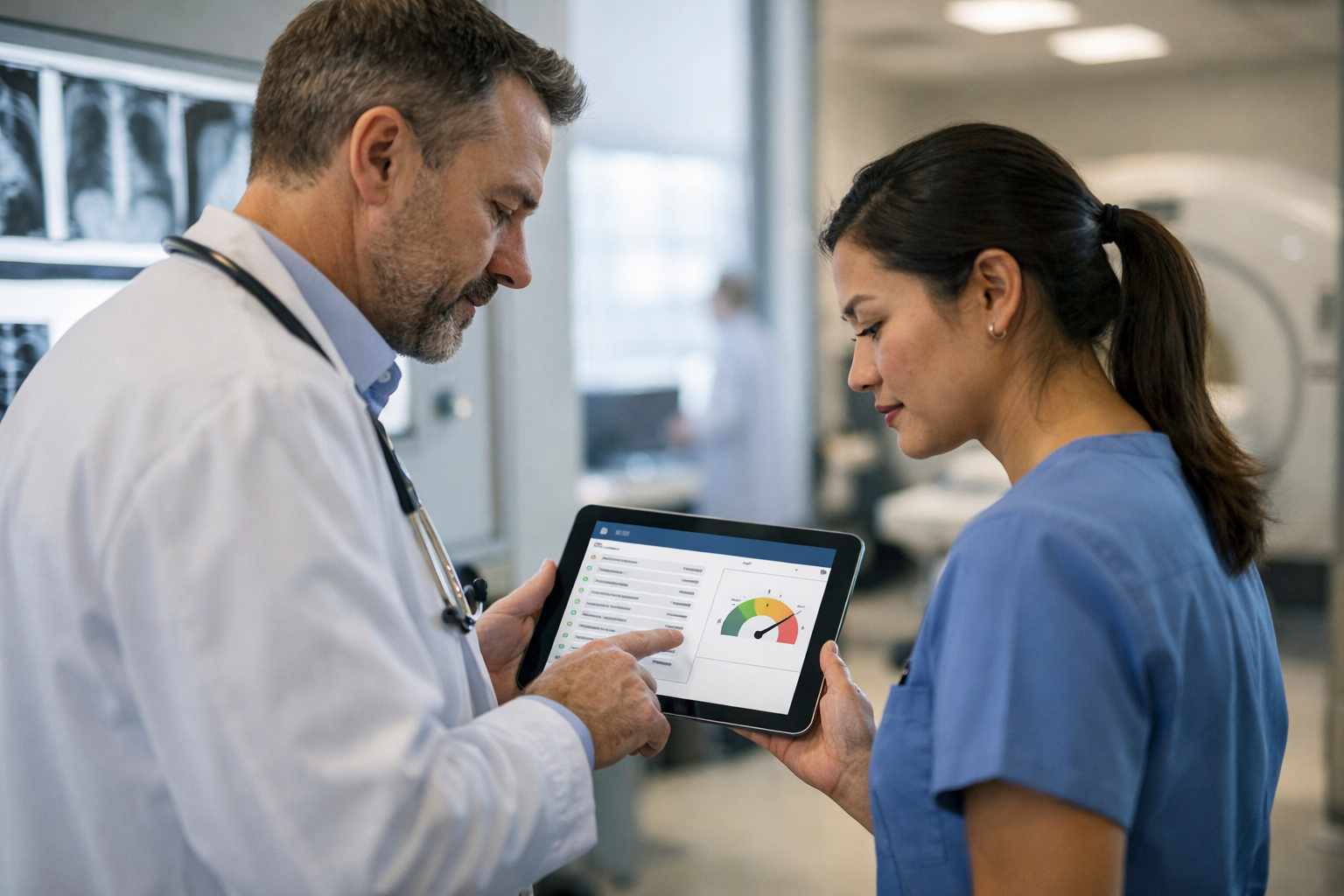
Understand hospital AI workflows in plain language—no tech background needed.
Hospitals use AI every day, but most explanations assume you already know coding, statistics, or medical jargon. This beginner course is a short, book-style guide that starts from zero and builds step by step. You’ll learn what “AI in healthcare” actually means, where it shows up in a modern hospital, and how to think clearly about benefits, limits, and safety.
Instead of focusing on algorithms, we focus on real workflows: what data goes in, what the tool outputs, who reviews it, and what action happens next. You’ll be able to read AI results (like risk scores or image flags) in plain language, understand what can go wrong, and ask the right questions before trusting an AI tool.
This course is designed for complete beginners. You do not need prior AI knowledge, coding skills, or a healthcare background. It’s useful for:
By the final chapter, you’ll be able to explain common hospital AI use cases (imaging, triage, documentation, and operations) and describe an AI workflow from input to action. You’ll also gain a practical safety mindset—how to spot bias, understand privacy constraints, and keep humans in control of high-stakes decisions.
You’ll move through exactly six chapters. First, you’ll learn what AI is and where it fits in hospital work. Next, you’ll learn the simplest version of how AI works (no math required). Then you’ll explore healthcare data, followed by the most common real-world use cases. Finally, you’ll learn safety, privacy, and how hospitals responsibly choose and roll out AI tools.
Each chapter includes milestones that help you practice: reading AI outputs, choosing the right data for a task, and making safer decisions about where AI belongs in a workflow.
If you’re ready to understand AI in healthcare without feeling overwhelmed, this course will guide you from first principles to practical confidence. Register free to begin, or browse all courses to compare related topics.
Healthcare AI Product Specialist
Sofia Chen designs and evaluates AI features used in clinical software, focusing on safe workflows and clear communication with care teams. She has helped hospitals pilot AI tools for imaging, triage, and documentation while prioritizing privacy, fairness, and real-world usability.
Hospitals are busy, data-heavy environments. Every patient generates a trail of information: triage notes, lab values, medication orders, imaging studies, vital signs, and discharge summaries. AI shows up wherever that information is too large, too fast, or too complex for humans to process reliably in real time. But “AI in hospitals” does not mean a robot doctor making independent decisions. In most real deployments, AI is a supporting tool that helps people notice patterns, prioritize work, and reduce clerical burden.
This chapter gives you a practical foundation: what AI is (in simple terms), what it is not, how AI tools fit into hospital workflows, and where you are likely to see them from check-in to discharge. You’ll also learn the basic AI workflow—data in, model, output, human review, action—and the common ways AI can fail (bias, false alarms, and outputs that sound confident but are wrong). Finally, you’ll leave with a short checklist you can use to evaluate whether an AI tool is safe, private, and fit for purpose.
A useful way to think about hospital AI is as a “team sport.” The tool is only one player. The rest of the team includes clinicians, IT, data engineers, compliance, and operational leaders—plus the workflows and policies that determine when the AI is used, what it can influence, and how errors are caught before they harm patients.
As you read the sections that follow, keep one practical question in mind: Where does the AI touch the patient journey, and what safety checks exist at that touchpoint? That question separates hype from reality and helps you spot the difference between a helpful assistant and a risky black box.
Practice note for Define AI using everyday examples from hospital life: document your objective, define a measurable success check, and run a small experiment before scaling. Capture what changed, why it changed, and what you would test next. This discipline improves reliability and makes your learning transferable to future projects.
Practice note for Separate hype from reality: what AI can and cannot do: document your objective, define a measurable success check, and run a small experiment before scaling. Capture what changed, why it changed, and what you would test next. This discipline improves reliability and makes your learning transferable to future projects.
Practice note for Meet the hospital AI “team”: people, software, and workflows: document your objective, define a measurable success check, and run a small experiment before scaling. Capture what changed, why it changed, and what you would test next. This discipline improves reliability and makes your learning transferable to future projects.
Practice note for Map where AI touches a patient journey from check-in to discharge: document your objective, define a measurable success check, and run a small experiment before scaling. Capture what changed, why it changed, and what you would test next. This discipline improves reliability and makes your learning transferable to future projects.
Practice note for Quick self-check: spot AI vs non-AI tools in a hospital scenario: document your objective, define a measurable success check, and run a small experiment before scaling. Capture what changed, why it changed, and what you would test next. This discipline improves reliability and makes your learning transferable to future projects.
Practice note for Define AI using everyday examples from hospital life: document your objective, define a measurable success check, and run a small experiment before scaling. Capture what changed, why it changed, and what you would test next. This discipline improves reliability and makes your learning transferable to future projects.
Practice note for Separate hype from reality: what AI can and cannot do: document your objective, define a measurable success check, and run a small experiment before scaling. Capture what changed, why it changed, and what you would test next. This discipline improves reliability and makes your learning transferable to future projects.
In plain language, AI in a hospital is software that finds patterns in data and uses those patterns to produce an output that helps someone do a job. The output might be a probability (“high risk of sepsis”), a ranked list (“these 10 patients need outreach first”), a highlighted region on an image (“possible bleed here”), or a draft summary (“here’s a discharge note based on the chart”).
Everyday hospital-life examples help make this concrete. If a radiology tool marks a suspicious nodule on a CT scan, that’s AI assisting detection. If an emergency department dashboard predicts which waiting-room patients are most likely to deteriorate, that’s AI assisting triage. If a documentation tool turns a clinician’s dictated assessment into a structured note, that’s AI assisting writing and coding. If bed management software forecasts discharge volume to plan staffing, that’s AI assisting operations.
Equally important is what AI is not. It is not “medical judgment in a box.” It does not understand like a clinician understands. Many AI systems do not “know” anatomy or physiology; they learn statistical associations. That means AI can be surprisingly good at narrow recognition tasks, yet fail in ways that feel odd to humans—especially when the situation differs from the training data.
When you evaluate an AI tool, replace the vague question “Is this intelligent?” with two practical questions: What specific task is it trained to do? and What decision will a human make differently because of its output? If you can’t answer those, you are dealing with hype, not an implementable hospital tool.
Hospitals have used automation for decades: rules, templates, order sets, and alerts. Automation follows instructions written by humans (“if potassium is low, display this warning”). AI is different: it learns patterns from examples and then generalizes those patterns to new cases. In practice, both can appear as pop-ups, flags, or scores, so it’s easy to confuse them.
The difference matters because it changes how you validate and govern the tool. A rules-based alert is usually predictable: you can inspect the rule, test it with sample inputs, and know exactly why it fired. An AI model may be less transparent: it can be accurate overall while still being wrong for certain subgroups, units, or imaging protocols. It can also drift over time as patient populations, devices, documentation habits, or clinical pathways change.
For engineering judgment, ask: is the problem best solved by a rule or by AI? For example, “don’t prescribe a drug if the patient has a documented allergy” is typically a rules problem. “Predict who will become septic in the next 6 hours” is often an AI problem because the signal is spread across many variables and time trends. Mixing these up causes harm: using AI where a rule is safer can add noise; using a rule where AI is needed can miss subtle deterioration.
Separating automation from AI also helps you spot “false sophistication.” If a vendor can’t explain the data used, how performance was measured, and how updates happen, you may be looking at a glorified rule set—or an ungoverned model—presented as advanced intelligence.
A model is the core component of most AI tools. Think of it as a function trained on historical examples: it takes inputs (data) and produces an output (a score, label, or text). In a hospital, inputs might include vitals over time, lab trends, medications, diagnoses, imaging pixels, or the words in clinical notes.
Training a model is like teaching by example. If you show the system many labeled cases—such as past chest X-rays marked “pneumonia” vs “no pneumonia”—it can learn the statistical patterns that separate the categories. For triage models, labels might be “ICU transfer within 24 hours” or “return to ED within 72 hours.” For documentation assistants, the “labels” can be human-written notes that the system learns to imitate as drafts.
This is where healthcare data types and data quality become central. Notes can contain abbreviations, copy-forward text, and contradictions. Labs may be missing or delayed. Vitals can be noisy (movement artifacts) or entered late. Imaging can differ by device, protocol, and patient positioning. A model trained on clean, consistent data may perform poorly when deployed into a different hospital where workflows and devices differ.
Engineering judgment in hospitals often starts with a “data readiness” check: do we have the right inputs reliably, in near real time, with consistent definitions? If not, the best model in the world will underperform. Many AI failures are not model failures—they are data pipeline failures.
Hospital AI outputs generally fall into three practical categories: predictions, recommendations, and summaries. Understanding the category helps you understand the risk and the right evaluation approach.
Predictions estimate the likelihood of something: deterioration, readmission, stroke on CT, no-show risk, or length of stay. These are often expressed as probabilities or risk scores. The key question is not “is it correct?” but “is it calibrated and useful at the threshold we intend to act on?” A model can be accurate overall yet produce too many false alarms if the action threshold is set poorly.
Recommendations suggest an action: “consider blood cultures,” “prioritize this patient for imaging,” or “route this chart to coding review.” Recommendations can be helpful, but they are also where bias can show up. If historical care patterns were uneven across populations, the model may learn those patterns and perpetuate them—such as systematically under-prioritizing certain groups.
Summaries compress information: auto-generated progress notes, discharge summaries, or imaging impressions. Summaries can reduce clerical burden, but they introduce a different risk: “confident wrong” text that sounds plausible. If the summary includes an incorrect diagnosis or medication dose, it can spread through copy-forward documentation and become hard to unwind.
A practical habit is to tie every output to a planned response: who sees it, how fast, what they do next, and what happens if it is wrong. If that chain is unclear, the output may be “interesting” but not safe or actionable.
In hospitals, “humans in the loop” is not a slogan—it is the safety mechanism. AI outputs must be interpreted within clinical context: the patient’s story, comorbidities, current medications, and goals of care. A model might flag sepsis risk, but only a clinician can weigh alternative explanations (post-op inflammation, steroid use, dehydration) and decide the right next step.
Humans are also responsible for detecting when the AI is operating outside its intended conditions. If the model was trained on adult data, using it on pediatrics is unsafe. If it expects continuous vital signs but the ward records intermittently, its score may be unstable. If imaging protocols change, a radiology model may degrade without obvious warning. Clinicians, radiologists, and nurses often notice these shifts first because they see the mismatch between output and reality.
Practically, an AI workflow in a hospital should look like: data in → model → output → human review → action. The “human review” step is not passive. It includes verifying inputs (is the data current?), sanity-checking outputs (does this fit the patient?), and documenting rationale when overriding the tool.
A practical evaluation checklist for any AI tool should include: (1) safety: defined intended use, validation results, and alert burden; (2) privacy: data access controls, audit logs, and vendor handling of PHI; (3) fit-for-purpose: workflow integration, latency, downtime plan, and measurable benefit; (4) equity: subgroup performance testing and bias monitoring. If a tool cannot meet these basics, it should not influence patient care decisions.
AI touches many points in a patient journey, often invisibly. Mapping those touchpoints helps you understand both the opportunity and the risk. Start at check-in: some systems use AI-assisted registration to detect duplicate patient records or suggest likely insurance fields based on partial entries. In the waiting room or triage, models may predict who needs rapid evaluation based on vitals and chief complaint text, helping staff prioritize attention when volumes surge.
During diagnosis, imaging support is one of the most common deployments: tools that flag possible intracranial hemorrhage on CT, highlight suspected pulmonary embolism, or prioritize worklists so critical studies are read sooner. On the floor, early warning systems use time-series vitals and labs to predict deterioration. In parallel, documentation tools draft note sections from structured data and clinician dictation, while coding and revenue cycle tools classify diagnoses and procedures.
Operations is another major area: forecasting admissions and discharges, predicting no-shows, optimizing staffing, or suggesting bed assignments. These uses don’t directly diagnose disease, but they can still affect patient outcomes by changing delays, workload, and throughput.
As a quick self-check in real hospital scenarios, look for whether a tool is merely displaying data (non-AI) versus producing a learned score, label, highlight, or generated text (likely AI). Then ask: what data does it use, where does it appear in the workflow, and what human review step prevents harm? If you can trace those answers from check-in to discharge, you are thinking like a safe, practical hospital AI user—not a hype-driven observer.
1. In this chapter, what is the most accurate description of how AI is usually used in hospitals?
2. Which situation best matches the chapter’s idea of when AI “shows up” in hospitals?
3. Which sequence best represents the basic AI workflow described in the chapter?
4. Which option is NOT listed in the chapter as a common way hospital AI can fail?
5. Why does the chapter call hospital AI a “team sport”?
Hospitals use “AI” every day, but in practice most tools are not science fiction. They are software systems that take clinical data as input, compute a prediction or suggestion as output, and then rely on people and policies to decide what to do next. This chapter gives you a simple mental model you can reuse: data in → model → output → human review → action. If you can trace that pipeline, you can understand what an AI tool is doing, where it can fail, and what must be checked before it is trusted.
In a hospital setting, AI is usually narrow. It does not “understand medicine” like a clinician does. It recognizes patterns in past data and produces a score, label, or ranking: “high risk of sepsis,” “possible intracranial hemorrhage,” “this note likely needs a diagnosis code update,” or “these patients should be prioritized for discharge planning.” The practical question is not whether the output sounds smart, but whether it is safe, private, fit for the workflow, and improves decisions without creating new harm.
Four common use cases show up repeatedly: imaging support (flagging studies for review), triage (risk scores in ED or inpatient units), documentation (summaries, coding assistance, drafting notes), and operations (staffing forecasts, bed management, no-show prediction). Across all of them, quality of inputs matters—notes, labs, vitals, and images can be missing, delayed, incorrect, or formatted differently across systems. AI will happily compute on low-quality data and may produce “confident wrong” results if guardrails are missing.
As you read the sections below, keep one practical habit: whenever you see an AI result, ask “What exactly went in, what came out, and what action will someone take because of it?” That habit catches many failure modes early—bias, false alarms, silent data shifts, and workflow mismatch—before they reach patients.
Practice note for Follow the simplest AI pipeline: input → output → action: document your objective, define a measurable success check, and run a small experiment before scaling. Capture what changed, why it changed, and what you would test next. This discipline improves reliability and makes your learning transferable to future projects.
Practice note for Understand training data with a beginner-friendly analogy: document your objective, define a measurable success check, and run a small experiment before scaling. Capture what changed, why it changed, and what you would test next. This discipline improves reliability and makes your learning transferable to future projects.
Practice note for Learn what “accuracy” means and why it’s not enough: document your objective, define a measurable success check, and run a small experiment before scaling. Capture what changed, why it changed, and what you would test next. This discipline improves reliability and makes your learning transferable to future projects.
Practice note for Read an AI output: scores, labels, and confidence: document your objective, define a measurable success check, and run a small experiment before scaling. Capture what changed, why it changed, and what you would test next. This discipline improves reliability and makes your learning transferable to future projects.
Practice note for Milestone quiz: interpret three common AI results correctly: document your objective, define a measurable success check, and run a small experiment before scaling. Capture what changed, why it changed, and what you would test next. This discipline improves reliability and makes your learning transferable to future projects.
Practice note for Follow the simplest AI pipeline: input → output → action: document your objective, define a measurable success check, and run a small experiment before scaling. Capture what changed, why it changed, and what you would test next. This discipline improves reliability and makes your learning transferable to future projects.
The simplest AI pipeline in healthcare can be followed like a lab order: input → output → action. Inputs are the data the tool can “see.” Outputs are what the tool produces (a score, label, text suggestion, or ranked list). Action is what the hospital does next—often through a human reviewer.
Common input types include:
Outputs typically look like one of three things: (1) a score (0–1 risk), (2) a label (“possible pneumonia”), or (3) a worklist ranking (“review these 10 cases first”). Increasingly, documentation tools output draft text and highlighted supporting evidence, but that text still needs clinical verification.
The most important step is what happens between output and action: human review. In safe deployments, AI does not directly order tests or administer treatments. Instead, it routes attention: a radiologist double-checks a flagged study; a nurse reviews a sepsis alert in context; a coder validates a documentation suggestion. If you are evaluating a tool, map the real workflow: who sees the output, where (EHR tab, pager, dashboard), how fast, and what they are expected to do. If the output arrives late, is hard to interpret, or produces too many false alarms, the “action” step breaks—even if the model is technically impressive.
AI tools have two distinct phases: training (learning from historical examples) and inference (using the trained model on today’s patients). Confusing these phases leads to poor expectations and unsafe assumptions.
A beginner-friendly analogy: imagine training a new staff member to recognize “high-risk” patients. During training, you show them many past cases with outcomes: who developed sepsis, who had a hemorrhage, who decompensated overnight. They learn patterns from the examples. That is training data. When they start a shift, they look at new patients and make judgments based on what they learned. That is inference.
In a model, training means adjusting internal parameters so that inputs (labs, vitals, note text, images) produce outputs close to the known labels (diagnoses, outcomes, clinician-confirmed findings). Inference means the model is “frozen” and simply computes outputs for new inputs. Inference is what happens inside the hospital day-to-day.
Why does this matter operationally? Because training data may not match your reality. If a tool was trained on a tertiary academic center’s ICU population, it may behave differently in a community hospital, a pediatric unit, or a system with different documentation habits. Also, training labels can be messy: diagnoses coded for billing, radiology reports that vary in wording, outcomes influenced by local practice. A model can learn the quirks of the training environment rather than true clinical signals.
When evaluating a vendor, ask: What population was used for training? What years? What units (ED, ICU, inpatient)? What definition of the “truth” label was used? And during inference, what data is available at the time the prediction is made? Many failures occur when a tool appears accurate in a retrospective study but in real time lacks key lab results or relies on documentation that is entered hours later.
AI does not reason like a clinician. It operates on features: measurable clues extracted from the input data. A feature can be as simple as “latest heart rate” or as complex as patterns inside an image. Thinking in features helps you anticipate what the model might latch onto—and what it might miss.
In structured data, features often include values and trends: rising creatinine, decreasing blood pressure, temperature spikes, or the variability of respiratory rate over time. Time is critical: “lactate within the last 2 hours” is different from “lactate sometime today.” In text, features can be words, phrases, or embeddings that represent meaning; the model may associate “SOB,” “rales,” and “CXR ordered” with respiratory illness even if the note is incomplete. In imaging, features might correspond to shapes, textures, or subtle intensity changes that correlate with pathology.
Feature pitfalls in hospitals are practical, not theoretical. A model might learn that a certain scanner type correlates with a diagnosis because that scanner is used more often in a specific unit. It might treat the presence of a lab order as a signal of disease severity—because clinicians order certain labs when they are worried. That means the model may be predicting clinician behavior rather than patient physiology.
When you read an AI output, it helps to ask “What features could be driving this?” If a sepsis score rises sharply, is it responding to a true physiologic change, or did a nurse finally chart overdue vitals? If an imaging model flags a study, is it seeing anatomy or an artifact from motion blur? Good tools provide explanations appropriate to the modality: trend graphs for vitals/labs, highlighted regions on an image, or cited sentences in a note. Explanations are not perfect, but they enable engineering judgment: you can see whether the tool is reacting to clinically meaningful clues.
“Accuracy” is a tempting metric because it sounds simple. In healthcare, it is rarely enough. Many conditions are uncommon, and a model can be highly “accurate” by mostly predicting “no problem” while missing the patients who matter. Performance must be understood through errors and trade-offs.
Two error types dominate:
Most AI outputs are a score (for example, 0.82 risk). To turn that into action, the hospital sets a threshold (for example, alert if ≥ 0.70). Lowering the threshold catches more true cases but increases false alarms. Raising the threshold reduces noise but risks misses. There is no universally correct threshold; it must match the clinical context, staffing, and the cost of each error.
Reading the output correctly is a safety skill. A “confidence” value may reflect the model’s internal certainty, not the probability of disease. Some tools output class labels (“positive/negative”) plus a score; others output categories (“low/medium/high”) based on a chosen threshold. In documentation tools, an output may be fluent text that sounds confident while still being wrong. Treat generated text as a draft, not a finding.
Practical evaluation questions include: How many alerts per shift will this create? Who will respond? What is the expected time-to-review? What evidence is shown to support the alert? And what happens if the alert is ignored? A tool with slightly lower headline performance but a well-designed threshold and workflow integration can be safer and more useful than a “more accurate” tool that overwhelms staff.
Generalization means a model trained in one setting still works in another. This is one of the hardest problems in healthcare AI because hospitals differ in patient populations, clinical practices, equipment, and documentation culture. A model can perform well in its original environment and quietly degrade after deployment elsewhere.
Common reasons for failure include:
Generalization problems often show up as bias and uneven performance. A tool may work better for groups well represented in training data and worse for others (for example, different skin tones affecting some imaging, different baseline lab ranges, or different access-to-care patterns). Another common issue is “confident wrong” outputs: the model produces high scores in situations it has never seen before (new device, new protocol, new documentation template).
Operationally, treat AI as a clinical instrument that needs local calibration. Before broad rollout, test it on your own data, in your own workflow, with your own patient mix. After rollout, monitor for drift: changes in performance over time due to new protocols, seasonal disease patterns, or EHR upgrades. A safe program plans for updates, revalidation, and a clear process for clinicians to report suspicious outputs.
Validation is the disciplined testing that answers: “Will this tool be safe and useful here, for this purpose, in this workflow?” In healthcare, validation must match reality—real-time data availability, real user behavior, and real consequences of errors.
Strong validation usually includes multiple layers. First is technical validation (does it run reliably, with correct data mappings?). Next is clinical validation on local data (does it identify the right patients, with acceptable false alarms?). Then comes workflow validation (does the right person see it at the right time, and do they know what to do?). Finally, there is outcome and safety monitoring after go-live.
A practical checklist you can use when evaluating an AI tool:
Validation is also about engineering judgment: deciding what evidence is sufficient before relying on the tool. A retrospective AUC or accuracy number is not enough if the tool will be used in a fast-paced ED, where incomplete data and high alert burden are the norm. The best teams test with shadow mode (running silently), compare against clinician judgments, and confirm that the tool improves prioritization without creating new risk. The goal is not to “prove AI is good,” but to ensure that when humans use AI outputs, the combined system—people plus software—behaves safely.
1. Which sequence best matches the chapter’s reusable mental model for how hospital AI tools work?
2. A tool flags a CT scan as “possible intracranial hemorrhage” with a confidence score. In the chapter’s framing, this is best described as:
3. Why does the chapter warn that “accuracy” alone is not enough to judge an AI tool in a hospital?
4. What is a likely failure mode when inputs (notes, labs, vitals, images) are missing, delayed, incorrect, or formatted differently across systems?
5. When you see an AI result, which habit does the chapter recommend to catch failure modes early?
Hospitals run on data, and AI systems succeed or fail based on how that data is captured, stored, moved, and interpreted. In a hospital, “data” rarely means a single clean spreadsheet. It is a living record built from bedside devices, clinician documentation, laboratory analyzers, imaging machines, pharmacy systems, and billing workflows—often produced under time pressure. This chapter gives you a practical map of the major healthcare data types (notes, labs, vitals, images), how they travel through hospital systems, and why quality and labeling are the hardest parts of building reliable AI.
As you read, keep an “AI workflow” in mind: data goes in, a model computes an output, humans review that output, and the hospital takes action. If the input data is missing, delayed, biased, or inconsistent, the model can look “confident” while being wrong—leading to false alarms, missed detections, or unfair performance across patient groups. The best hospital AI projects start with engineering judgment: choosing the right data for the task, verifying its provenance, and designing guardrails for human oversight.
You will see that the same clinical concept can appear in multiple places: a diagnosis might be coded for billing, described in a physician note, implied by medication choices, and visible in an imaging report. AI tools must decide which “source of truth” to use—or how to reconcile them. That choice determines what the model learns and how safely it can be used in daily care.
Practice note for Identify the major data types used in hospitals: document your objective, define a measurable success check, and run a small experiment before scaling. Capture what changed, why it changed, and what you would test next. This discipline improves reliability and makes your learning transferable to future projects.
Practice note for Understand data quality: missing, messy, and biased records: document your objective, define a measurable success check, and run a small experiment before scaling. Capture what changed, why it changed, and what you would test next. This discipline improves reliability and makes your learning transferable to future projects.
Practice note for Learn why labeling data is hard (and expensive): document your objective, define a measurable success check, and run a small experiment before scaling. Capture what changed, why it changed, and what you would test next. This discipline improves reliability and makes your learning transferable to future projects.
Practice note for See how data moves: EHRs, devices, and imaging systems: document your objective, define a measurable success check, and run a small experiment before scaling. Capture what changed, why it changed, and what you would test next. This discipline improves reliability and makes your learning transferable to future projects.
Practice note for Milestone exercise: choose the right data for a given AI task: document your objective, define a measurable success check, and run a small experiment before scaling. Capture what changed, why it changed, and what you would test next. This discipline improves reliability and makes your learning transferable to future projects.
Practice note for Identify the major data types used in hospitals: document your objective, define a measurable success check, and run a small experiment before scaling. Capture what changed, why it changed, and what you would test next. This discipline improves reliability and makes your learning transferable to future projects.
Practice note for Understand data quality: missing, messy, and biased records: document your objective, define a measurable success check, and run a small experiment before scaling. Capture what changed, why it changed, and what you would test next. This discipline improves reliability and makes your learning transferable to future projects.
Practice note for Learn why labeling data is hard (and expensive): document your objective, define a measurable success check, and run a small experiment before scaling. Capture what changed, why it changed, and what you would test next. This discipline improves reliability and makes your learning transferable to future projects.
Practice note for See how data moves: EHRs, devices, and imaging systems: document your objective, define a measurable success check, and run a small experiment before scaling. Capture what changed, why it changed, and what you would test next. This discipline improves reliability and makes your learning transferable to future projects.
The Electronic Health Record (EHR) is the central hub for most clinical data. Think of it as the hospital’s “system of record” for patient identity, encounters, orders, results, documentation, and care team activity. In practice, an EHR is not one database but a collection of modules (orders, medications, labs, notes, scheduling, billing) plus interfaces to external systems such as bedside monitors and imaging archives.
For AI, EHR data is attractive because it is broad (many patients), longitudinal (across time), and close to clinical decisions (orders and documentation). But it is also messy. Workflows differ by unit and specialty, and the same event can be recorded in multiple ways. For example, oxygen support might be captured as a device setting in an ICU flow sheet, a respiratory therapy note, a medication order, and a diagnosis code—each with different timing and completeness.
Data movement matters. EHRs exchange information via interfaces (often HL7/FHIR messages) that may arrive late, be overwritten, or be corrected after the fact. AI builders must ask: when does the data become available, and in what form? A sepsis alert that relies on a lab value is only useful if that lab value arrives before the clinical deterioration—not hours later.
Practical takeaway: when evaluating an AI tool, ask what EHR fields it reads, how frequently they update, and whether it uses “real-time” device feeds versus charted values. Many failures are integration failures: the model may be fine, but the inputs arrive too late or from the wrong module.
Structured data is information stored in predefined fields: lab results (e.g., creatinine), vital signs (e.g., heart rate), medication administrations (e.g., heparin given at 10:00), and codes (diagnosis and procedure codes used for billing and reporting). Structured data is often the easiest starting point for AI because it is consistent enough to aggregate across patients and time.
Still, “structured” does not mean “simple.” Labs have units, reference ranges, and assay changes over time. Vitals can come from continuous monitors or intermittent nurse entry; the two differ in noise and frequency. Medications have orders, holds, discontinuations, substitutions, and delays between ordering and administration—important distinctions if an AI model tries to infer severity of illness from treatment patterns.
Codes (like ICD and CPT) are especially tricky: they are not purely clinical truth; they are shaped by documentation and billing incentives, and may be finalized after discharge. If you train a model to predict a diagnosis using codes as labels, you may be teaching it to predict “what got coded,” not “what was present in real time.” That can create confident wrong outputs when the tool is used during care.
Practical workflow tip: when choosing structured data for an AI task, match the data’s timestamp and meaning to the decision you want to support. If the goal is early warning, prefer near-real-time vitals and early labs. If the goal is post-discharge quality reporting, codes may be acceptable. Engineering judgment here prevents “label leakage,” where the model accidentally learns from information that would not be available at the moment of prediction.
Unstructured data includes free-text clinician notes (history and physical, progress notes, nursing notes), operative notes, discharge summaries, and narrative reports (radiology and pathology). These documents contain nuance: symptoms, reasoning, differential diagnoses, social context, and plans. That richness is why many modern AI systems use natural language processing (NLP) to extract signals that structured fields miss.
The challenge is variability. Notes differ by author, specialty, and even time of day. They include abbreviations, copy-forward text, templates, and negations (“no chest pain”). A model that reads notes must handle that complexity and avoid common mistakes like interpreting “rule out pneumonia” as “pneumonia present.” Notes also often contain references to past history that should not be treated as a current problem.
Labeling is hard here. If you want to train an NLP model to identify conditions or adverse events, you need “ground truth” labels. That typically requires clinician reviewers to read notes and annotate them, which is expensive and slow. Even experts disagree, especially when documentation is ambiguous. This is one reason hospital AI projects can stall: the data exists, but converting it into reliable labels is a major operational effort.
Practical outcome: unstructured text is powerful for tasks like documentation support, coding assistance, and triage, but only if the project invests in annotation guidelines, inter-rater checks, and clear definitions of what counts as a positive case. When evaluating a tool, ask how it was labeled, who labeled it, and how disagreements were handled.
Imaging data includes X-ray, CT, MRI, and ultrasound, typically stored in a Picture Archiving and Communication System (PACS) using the DICOM standard. Imaging is a common area for hospital AI because the data is high-dimensional and pattern-rich, and many tasks align with visual detection: finding a pneumothorax on a chest X-ray, identifying hemorrhage on a head CT, or estimating fracture risk.
However, imaging workflows introduce their own constraints. A model might perform well in the lab but fail when deployed because of differences in scanner manufacturers, imaging protocols, patient positioning, contrast usage, or resolution. Even subtle changes—like a new reconstruction algorithm—can shift the data distribution and degrade performance. Ultrasound adds another layer: it is operator-dependent, so the same exam can look very different across technologists.
Labeling imaging data is also expensive. “Ground truth” can come from radiology reports, but reports are not perfect labels: they can be uncertain, hedged, or focused on the clinical question rather than exhaustive findings. High-quality labels often require radiologists to re-review images, which is costly and time-consuming. Many projects use a hybrid approach: weak labels from reports plus targeted expert review for a smaller set.
Practical integration point: imaging AI must connect to PACS/RIS and return results in a way clinicians can act on (worklist prioritization, structured findings, or viewer overlays). When choosing data for an imaging AI task, confirm that you have both the images and the right “time-to-action” pathway—an alert after the radiologist has already finalized the report adds little value.
Most hospital AI failures start with data quality issues, not exotic modeling problems. Common issues include missingness (a lab not ordered), measurement error (a faulty sensor), duplication (copied notes), inconsistent units, and timing problems (documentation entered after the event). Importantly, missing data is often meaningful: a test not ordered may indicate lower clinical concern, limited access, or a different practice pattern—signals that can inadvertently become “shortcuts” for a model.
Bias enters when data reflects uneven care patterns or unequal representation. If certain groups receive fewer diagnostic tests, an AI model trained on test results may perform worse for those patients. If documentation differs by language, socioeconomic status, or care setting, NLP systems can underperform in predictable ways. Imaging bias can occur if a dataset over-represents one scanner type or one hospital’s protocol.
False alarms are a practical harm. A model that triggers too often can create alert fatigue, causing clinicians to ignore even high-risk warnings. Another failure mode is the “confident wrong” output: high probability scores that are incorrect because the model latched onto confounders (for example, learning that ICU patients are “sicker” without truly recognizing the condition of interest).
Engineering judgment means testing the full pipeline: verify data completeness by unit and shift; audit performance across patient subgroups; and simulate real-time availability (what was known at 2 a.m., not what was charted at noon). A reliable AI tool comes with clear inclusion criteria, monitoring for drift, and a plan for recalibration when workflows or devices change.
Healthcare data is sensitive, and access is governed by privacy laws, hospital policy, and ethical norms. In practice, AI work must answer two questions: who is allowed to see the data, and what form of the data is necessary for the task? De-identification (removing direct identifiers like name and MRN) is commonly used for research and development, but it is not a universal solution. Some projects require identifiable data to link records across systems, to validate outcomes, or to run a model within the live EHR.
De-identification itself is challenging. Free-text notes can contain names, addresses, and other identifiers; DICOM images can embed patient information in metadata; even “anonymous” combinations of dates and rare conditions can re-identify someone. Practical teams use layered controls: minimum necessary data, role-based access, audit logs, secure environments, and data use agreements that prohibit re-identification attempts.
Data movement affects risk. When data flows from the EHR to a vendor system or cloud service, you need clarity on storage, retention, encryption, and incident response. For bedside-device feeds and imaging, ensure the integration does not create new “shadow copies” of data without governance.
Milestone exercise (practical decision): for a proposed AI task, choose the least sensitive dataset that still supports safe performance. For example, a staffing-forecast model may only need aggregated census and acuity scores, not identifiable notes. An imaging triage model might need images and timestamps but not full demographics. The habit to build now is “fit-for-purpose access”: the right data, for the right people, for the right time window—nothing more.
1. Why can a hospital AI model appear “confident” but still be wrong in real use?
2. Which description best matches how “data” typically exists in a hospital?
3. What is the key implication of the same clinical concept appearing in multiple places (billing codes, notes, meds, imaging reports)?
4. In the chapter’s AI workflow framing, what role do humans play after the model produces an output?
5. Which starting approach is most aligned with how the chapter says successful hospital AI projects begin?
Hospitals rarely “use AI” as one big, magical system. Instead, they use many small tools that fit into existing workflows: imaging worklists, triage dashboards, reminder pop-ups in the EHR, message routing in the patient portal, and staffing forecasts in operations. The best way to understand hospital AI is to follow the path of work: data is collected, an algorithm produces an output, clinicians review it, and the organization decides what action (if any) should happen next.
This chapter walks through the most common everyday AI use cases you will see in real hospitals. For each, keep a simple mental model: data in → model → output → human review → action. The “human review” step is not decoration—it is where safety lives. Many failures happen when a tool is placed in the wrong step (too early, too late, or without a clear owner) or when the output is treated as truth rather than a clue.
Along the way, we will connect each use case to practical realities: what data types it consumes (notes, labs, vitals, images), why data quality matters, where bias and false alarms show up, and how to choose the safest point in the workflow to insert AI. Think like an engineer and a clinician at the same time: you are not asking “Is the model accurate?” in the abstract; you are asking “Does this output help the next person make a better decision, reliably, without causing new harms?”
In the sections that follow, you will see realistic workflows and the common mistakes that can occur: biased training data, “confident wrong” outputs, alarms that trigger too often, and mismatches between what the tool optimizes and what the hospital actually needs. By the end, you should be able to point to the safest place to apply AI in a given process and explain why.
Practice note for Walk through AI-assisted medical imaging from scan to report: document your objective, define a measurable success check, and run a small experiment before scaling. Capture what changed, why it changed, and what you would test next. This discipline improves reliability and makes your learning transferable to future projects.
Practice note for Understand triage and early-warning scores in the ER and wards: document your objective, define a measurable success check, and run a small experiment before scaling. Capture what changed, why it changed, and what you would test next. This discipline improves reliability and makes your learning transferable to future projects.
Practice note for See how AI helps with documentation and patient messaging: document your objective, define a measurable success check, and run a small experiment before scaling. Capture what changed, why it changed, and what you would test next. This discipline improves reliability and makes your learning transferable to future projects.
Practice note for Explore hospital operations: scheduling, beds, and supply needs: document your objective, define a measurable success check, and run a small experiment before scaling. Capture what changed, why it changed, and what you would test next. This discipline improves reliability and makes your learning transferable to future projects.
Practice note for Milestone case study: pick the safest place to insert AI into a workflow: document your objective, define a measurable success check, and run a small experiment before scaling. Capture what changed, why it changed, and what you would test next. This discipline improves reliability and makes your learning transferable to future projects.
AI in medical imaging is one of the most common hospital use cases because the workflow is already digital and standardized. A realistic path looks like this: a CT or X-ray is acquired, the image is stored in PACS (the imaging system), and the radiologist reads it from a worklist. An AI model can be inserted in two relatively safe places: worklist prioritization (flagging studies that may be urgent) and second-read support (highlighting regions of interest after the radiologist has reviewed the scan).
Data in: DICOM images plus metadata (body part, modality, timestamps). Model: computer vision that detects patterns such as intracranial hemorrhage, pneumothorax, or pulmonary embolism. Output: a probability score and/or visual overlay. Human review: the radiologist confirms, rejects, or ignores. Action: report wording, critical-result call, or expedited care pathway.
Common engineering and clinical judgment issues: false positives can flood the worklist and create alert fatigue; false negatives can be worse because users may assume “AI didn’t flag it, so it’s fine.” Image quality and protocol variation matter: motion blur, low-dose scans, portable X-rays, and unusual anatomy can break model assumptions. Even “good” models can be biased if they were trained mostly on one scanner brand, one patient population, or one hospital’s imaging protocol.
Done well, imaging AI reduces time-to-read for urgent cases and decreases missed findings, especially in high-volume settings. Done poorly, it shifts attention away from unflagged cases and increases cognitive load. The goal is not to replace radiologists; it is to make the imaging pipeline more reliable under real-world pressure.
Risk prediction tools are common in the emergency department and inpatient wards because clinicians need early signals when a patient is quietly getting worse. These systems often resemble “early warning scores,” but with machine learning that combines more variables: vitals trends, lab changes, age, comorbidities, medication orders, and sometimes nursing notes. The workflow usually runs continuously in the background.
Data in: time-stamped vitals (heart rate, blood pressure, oxygen saturation), labs (lactate, WBC, creatinine), and EHR events (antibiotic orders, fluids, prior diagnoses). Model: a predictive model that estimates risk of sepsis, ICU transfer, rapid response, or readmission. Output: a score, tier (low/medium/high), and sometimes a “top factors” explanation. Human review: nurse, charge nurse, or physician evaluates the patient. Action: reassessment, labs, fluids, antibiotics, escalation of monitoring, or discharge planning changes.
The main pitfall is false alarms. If a model triggers too often, staff stop responding, which defeats the purpose and can delay care for the few true positives. Another pitfall is confounding: if the model learns that “getting a lactate test” predicts sepsis, it may be detecting clinician suspicion rather than patient physiology. Similarly, a readmission model might learn patterns tied to insurance type or zip code, which can amplify inequities if used to ration services.
Practical outcome: risk prediction is most helpful when it clearly answers “who should we look at next?” and when the response is lightweight but consistent. Hospitals that succeed define ownership (who gets the alert), define response (what to do), and measure net benefit (fewer ICU transfers, faster antibiotics, or safer discharges) rather than chasing model accuracy alone.
Clinical decision support (CDS) is the everyday “AI-adjacent” tool clinicians often experience as EHR prompts. Not all CDS is machine learning; much of it is rules-based. But the workflow concepts are the same: a system ingests patient data, produces a recommendation, and a human decides whether to act. CDS is powerful because it sits directly in the clinician’s path—but that also makes it risky if it is noisy or poorly designed.
Data in: problems, meds, allergies, labs, vitals, and orders in progress. Model: either rules (if A and B then suggest C) or a predictive model (risk-based suggestions). Output: reminders like VTE prophylaxis, renal dose adjustment, duplicate therapy warnings, or guideline prompts (e.g., diabetes care gaps). Human review: the ordering clinician confirms relevance. Action: accept, override with reason, or defer.
Common mistakes include alert fatigue (too many interruptions), bad triggering logic (firing in the wrong context), and workflow mismatch (prompting after the decision is already made). Another subtle issue is “automation bias”: when a reminder is correct most of the time, clinicians may accept it without thinking during busy shifts. Conversely, if it is often wrong, clinicians override everything—including the rare critical warning.
When CDS works, it standardizes care and reduces preventable harm (wrong doses, missed prophylaxis, contraindicated meds). The best systems are humble: they assume clinicians are the final decision-makers and treat prompts as decision aids, not mandates.
Generative AI has entered hospitals primarily through documentation support: drafting clinic notes, summarizing hospital stays, generating discharge instructions, or turning a clinician’s bullet points into structured prose. This can save time, but it introduces a new category of risk: the model can generate fluent text that is wrong, incomplete, or copied from irrelevant context. In healthcare, “sounds right” is not the same as “is right.”
A realistic workflow: the encounter happens (in person, phone, or telehealth), data is recorded (conversation, orders, vitals, labs), and the generative tool creates a draft note or after-visit summary. Data in: transcript, problem list, meds, labs, and prior notes. Model: large language model with clinical prompting and guardrails. Output: draft HPI, assessment/plan, or patient instructions. Human review: clinician edits and signs. Action: note becomes part of the legal medical record and may drive billing, handoffs, and future care.
Key limits: hallucination (inventing symptoms, exam findings, or test results), copy-forward amplification (repeating outdated diagnoses), and privacy (sending PHI to external services without proper agreements). Quality depends on clean inputs: noisy transcripts, missing context, and ambiguous abbreviations lead to confident mistakes. Also, the “best” note is not always the longest note—extra text can hide important facts.
The practical outcome to aim for is time saved without trust lost. Hospitals that succeed treat generative AI like a junior assistant: helpful at first drafts, unsafe for final facts unless supervised, and always accountable to the clinician who signs.
Patient-facing AI shows up in chatbots, symptom checkers, appointment scheduling assistants, and portal message triage. The value proposition is access: patients get faster answers and easier navigation of a complex system. The risk is mis-triage (telling a patient to wait when they need urgent care), privacy issues, and inequity if the tool works better for certain languages or literacy levels.
A realistic portal workflow: a patient sends a message (“I’m short of breath”), the AI suggests clarifying questions, categorizes urgency, drafts a reply for staff, and routes the thread to the right pool (nurse line, scheduling, pharmacy). Data in: free-text messages, demographics, problem list, recent visits. Model: NLP classifier and/or generative model for drafts. Output: urgency label, suggested next steps, and/or a drafted response. Human review: clinical staff confirm triage and send the final message. Action: home care instructions, same-day visit, ED referral, medication refill, or escalation.
Common failure modes: over-reassurance (“likely benign”) when a worst-case scenario must be ruled out, and understanding gaps (slang, typos, second-language phrasing). Another is “silent drop”: if routing is wrong, a message can sit in the wrong queue. Because patient-facing tools operate outside the hospital, they must be extremely clear about what they are and are not: they cannot replace emergency evaluation.
When implemented thoughtfully, patient-facing AI reduces call volume, speeds up scheduling, and helps patients find the right care channel. The safest systems focus on logistics and triage support while keeping clinical decisions under clinician control.
Operations AI is less visible to patients, but it affects daily hospital function: bed management, operating room scheduling, staffing forecasts, and supply needs (e.g., IV pumps, PPE, blood products). These tools often use predictive analytics rather than deep learning, and the “human review” step usually involves operational leaders rather than clinicians.
Data in: admissions/discharges/transfers (ADT), surgery schedules, historical length of stay, ED arrivals, staffing rosters, and sometimes local events (flu season, holidays). Model: forecasting and optimization models that predict census, discharge probability, or bottlenecks. Output: predicted bed availability, suggested staffing levels, or schedule changes. Human review: bed manager, nursing supervisor, OR coordinator. Action: open overflow units, adjust staffing, prioritize discharges, reorder supplies, or change elective surgery timing.
Common mistakes include optimizing the wrong objective (e.g., maximizing utilization at the cost of ED boarding), and hidden bias (e.g., predicting longer stays for certain groups due to historical delays in placement). Data quality is a practical barrier: timestamps can be messy, discharge orders may be entered late, and “ready for discharge” status may not be standardized. Models can also become self-fulfilling: if predictions drive staffing cuts, performance may worsen and feed back into future forecasts.
Operations AI succeeds when it reduces chaos without hiding trade-offs. The best implementations make uncertainty visible, support human judgment during surges, and are monitored like any other critical system—because in a hospital, operational decisions quickly become clinical consequences.
1. Which sequence best matches the chapter’s recommended mental model for how hospital AI fits into work?
2. Why does the chapter say the “human review” step is not just decoration?
3. A hospital wants AI to help radiology teams avoid missing urgent findings. Where does the chapter suggest imaging support usually sits in the workflow?
4. Which pairing correctly matches an AI use case with where it typically fits, according to the chapter?
5. When evaluating whether to insert an AI tool into a workflow, what question does the chapter recommend asking (beyond abstract accuracy)?
In earlier chapters, you saw how hospitals use AI to support imaging reads, triage, documentation, and operations. This chapter focuses on the “guardrails” that keep those tools helpful instead of harmful. In healthcare, AI is rarely a fully autonomous decision-maker. It is typically one component in a workflow: data goes in, a model produces an output, a human reviews it, and then a clinical or operational action follows. Safety, bias, privacy, security, and transparency all live inside that workflow—not as afterthoughts.
A useful way to think about safe hospital AI is to separate two questions. First: “Is the model accurate enough in the real world for this specific unit and patient population?” Second: “Is the system designed so that when it’s wrong—as all models sometimes are—the harm is limited and detectable?” A tool can be technically impressive but unsafe if it creates avoidable downstream errors, encourages over-trust, or mishandles sensitive data.
Throughout this chapter, you will learn common failure modes (false alarms and missed cases), how bias appears in realistic hospital examples, privacy basics (consent, data sharing, minimum necessary), what “explainable” means for everyday users, and a practical milestone checklist you can use to evaluate an AI tool before adoption in a unit.
Practice note for Recognize common failure modes: false alarms and missed cases: document your objective, define a measurable success check, and run a small experiment before scaling. Capture what changed, why it changed, and what you would test next. This discipline improves reliability and makes your learning transferable to future projects.
Practice note for Understand bias with simple, real-world healthcare examples: document your objective, define a measurable success check, and run a small experiment before scaling. Capture what changed, why it changed, and what you would test next. This discipline improves reliability and makes your learning transferable to future projects.
Practice note for Learn privacy basics: consent, data sharing, and minimum necessary: document your objective, define a measurable success check, and run a small experiment before scaling. Capture what changed, why it changed, and what you would test next. This discipline improves reliability and makes your learning transferable to future projects.
Practice note for Identify what “explainable” means for trust and accountability: document your objective, define a measurable success check, and run a small experiment before scaling. Capture what changed, why it changed, and what you would test next. This discipline improves reliability and makes your learning transferable to future projects.
Practice note for Milestone checklist: evaluate an AI tool for safe use in a unit: document your objective, define a measurable success check, and run a small experiment before scaling. Capture what changed, why it changed, and what you would test next. This discipline improves reliability and makes your learning transferable to future projects.
Practice note for Recognize common failure modes: false alarms and missed cases: document your objective, define a measurable success check, and run a small experiment before scaling. Capture what changed, why it changed, and what you would test next. This discipline improves reliability and makes your learning transferable to future projects.
Practice note for Understand bias with simple, real-world healthcare examples: document your objective, define a measurable success check, and run a small experiment before scaling. Capture what changed, why it changed, and what you would test next. This discipline improves reliability and makes your learning transferable to future projects.
Practice note for Learn privacy basics: consent, data sharing, and minimum necessary: document your objective, define a measurable success check, and run a small experiment before scaling. Capture what changed, why it changed, and what you would test next. This discipline improves reliability and makes your learning transferable to future projects.
Practice note for Identify what “explainable” means for trust and accountability: document your objective, define a measurable success check, and run a small experiment before scaling. Capture what changed, why it changed, and what you would test next. This discipline improves reliability and makes your learning transferable to future projects.
Hospitals are high-stakes environments where a “small” AI error can cascade into a major clinical risk. The most common failure modes are false alarms (the model flags a problem that isn’t there) and missed cases (the model fails to flag a real problem). Both matter, but in different ways depending on the workflow.
False alarms create alert fatigue. If a sepsis early warning tool triggers too often, nurses and physicians may begin to ignore it, even when it is correct. Missed cases can be worse: if an imaging support model fails to highlight a subtle intracranial hemorrhage, the delay can change outcomes. In engineering terms, you are balancing sensitivity (catch more true positives) and specificity (avoid false positives). In clinical terms, you are balancing “don’t miss dangerous cases” and “don’t overwhelm staff with noise.”
Risk also depends on where the AI sits in the workflow. A documentation assistant that suggests ICD codes has a different risk profile than a triage model that influences who gets seen first. The closer the AI output is to immediate patient harm, the more conservative the deployment should be: tighter thresholds, stronger human review, and clearer escalation rules.
Safe use starts with matching the model to a fit-for-purpose task and then designing the surrounding process so that predictable errors are caught early and handled consistently.
Bias in healthcare AI usually shows up as uneven performance across groups—by age, sex, race/ethnicity, language, disability status, insurance type, or even by which clinic someone uses. Often this is not “intentional prejudice.” It is a consequence of training data that reflects historical care patterns, missing data, or measurement differences.
Consider a simple example: a model predicts “needs intensive care soon” using prior healthcare utilization. If certain communities have historically faced barriers to access, they may have fewer recorded visits and fewer labs, even when equally sick. The model can under-predict risk for those patients because it learned that “less data” looks like “less illness.” Another example: dermatology image models trained mostly on lighter skin tones may miss rashes or melanomas on darker skin. Or an NLP tool that extracts symptoms from notes may perform worse when notes contain more non-standard phrasing, translation artifacts, or abbreviations from specific departments.
Fairness work is practical, not philosophical. You are asking: who is helped, and who is missed? This requires subgroup evaluation during validation and ongoing monitoring after deployment. A model can have excellent overall accuracy while failing a minority subgroup—an especially dangerous pattern in a hospital, where “rare” groups can still represent many patients over time.
In practice, fairness means building systems that do not systematically deliver worse care to the same patients who already face disparities.
Privacy in hospital AI is about respecting patients and complying with laws and policies that protect health information. You do not need to memorize legal terms to act safely. A “HIPAA-style” way to think is: collect and use only what you need, share only with approved parties, and ensure patients’ data is handled for legitimate care or approved purposes.
Consent is not always the same as “permission for everything.” Many hospitals can use patient data for treatment, payment, and operations without additional consent, but using data for research, marketing, or external model training may require specific approvals. The key practical question is: What is the purpose of this AI use, and is that purpose permitted under policy?
Data sharing is where mistakes happen. If a vendor is involved, clarify whether they are a “business associate” with a signed agreement, what data leaves the hospital, whether data is de-identified, and whether the vendor can reuse data to improve their product. “De-identified” does not always mean “risk-free,” especially when datasets are rich or can be linked.
Minimum necessary is a powerful everyday rule: only use the least amount of identifiable data needed to perform the task. If a model needs vitals trends, it may not need full narrative notes. If an operational model needs timestamps and locations, it may not need names or diagnoses.
Privacy is not anti-innovation. It is how you keep trust while using powerful tools.
Privacy answers “who should be allowed to use or share data,” while security answers “how we technically prevent unauthorized access and detect misuse.” In hospital AI, security failures can expose sensitive data, corrupt models, or allow inappropriate use of AI outputs.
Access control should follow the same principle as minimum necessary: users and systems get only the permissions they need. For example, a radiology AI tool may need access to imaging studies and limited demographics, but it may not need full medication lists. Strong access control includes role-based access (different privileges for nurses, physicians, data scientists, and vendors), multi-factor authentication where appropriate, and secure service accounts for automated processes.
Audit trails are the hospital’s “black box recorder.” They log who accessed data, when, from where, and what was done. For AI systems, auditing should cover not only raw data access but also model outputs: who viewed an alert, whether it was acknowledged, and what action followed. This helps in quality improvement (why did the model fail here?) and compliance (was data accessed appropriately?).
Security also includes protecting the integrity of the AI pipeline. If data feeds are wrong (e.g., mislabeled units, delayed lab results, duplicated vital signs), the model can produce confident wrong outputs. Treat interfaces as clinical equipment: they need maintenance, monitoring, and change control.
Security is what makes privacy enforceable and makes clinical performance reliable over time.
Transparency is about making an AI tool understandable enough that frontline staff can use it appropriately and leaders can hold it accountable. “Explainable” does not mean showing the math. It means answering the practical questions a clinician would naturally ask: What is this output? How confident is it? What data did it use? What should I do next? When should I distrust it?
Different tools need different levels of explainability. For an imaging triage tool that flags “possible pulmonary embolism,” users should see the reason in a clinically meaningful way, such as highlighting regions of interest or listing key findings. For a deterioration risk score, it may be enough to show the main contributing factors (e.g., rising respiratory rate, hypotension, abnormal lactate) and the time window considered. For documentation assistants, transparency includes showing sources (which note section or lab value) so users can verify quickly.
Transparency also requires limits. A model trained on adult patients may not apply to pediatrics. A model validated at one hospital may drift at another due to different documentation practices or patient mix. An explainable interface should communicate intended use, exclusions, and known failure patterns. This reduces over-reliance and helps clinicians apply judgment.
When people understand what a tool is doing and what it is not doing, trust becomes calibrated rather than blind.
Human oversight is the final safety layer: the system must be designed so that a person can intervene when outputs are uncertain, wrong, or missing. Oversight is not merely “a clinician glances at it.” It includes clear responsibilities, escalation paths, and safe fallbacks.
Start by defining who responds to the AI output and within what time. If a model flags possible stroke on imaging, does it page the on-call neurologist, the ED attending, or radiology? If a deterioration model triggers on the floor, does it activate a rapid response nurse review, or does it only add a banner in the chart? Ambiguity creates gaps where alerts are generated but no one acts.
Next, plan for safe fallbacks. Systems go down. Data feeds lag. Models can be paused if performance drops. The unit needs a “revert to standard practice” plan that is documented and rehearsed. This is similar to downtime procedures for the EHR: paper workflows, manual checklists, or alternative screening methods.
Finally, build a feedback loop. Oversight is strongest when the team can report “bad calls” and see improvements. That includes tracking false alarms, missed cases discovered later, and situations where clinicians disagreed with the model for good reasons. This is how you prevent recurring harm and how you detect drift.
Well-designed oversight acknowledges a simple truth: AI will sometimes be confidently wrong. Safety comes from anticipating that reality and building processes that keep patients protected anyway.
1. In this chapter’s view of hospital AI, what role does AI most often play in care delivery?
2. Which pair of questions best captures the chapter’s approach to evaluating safe hospital AI?
3. Which situation best illustrates a common AI failure mode discussed in the chapter?
4. According to the chapter, why can a technically impressive AI tool still be unsafe?
5. Which option best reflects the chapter’s privacy basics for using healthcare data with AI?
In hospitals, “using AI” is rarely a single purchase or a single model. It is a process of matching a real clinical or operational problem to a tool, proving that the tool works in your environment, and then supporting it like any other safety-relevant system. This chapter gives you the practical path hospitals use: define the job-to-be-done, assess whether to buy or build, run a pilot with clear metrics, set lightweight governance, roll out with training and support, and then monitor for drift and incidents. The goal is not to “install AI,” but to improve outcomes and reduce burden without creating new risk.
Two principles will guide everything you do. First, AI outputs are not actions; they are inputs to human decisions, workflows, and policies. Second, evidence beats enthusiasm: if you cannot measure improvement and safety, you do not really know what you deployed. Keep those principles in mind as you work through the sections and the final milestone: a simple adoption plan for a clinic scenario.
Practice note for Understand buying vs building and what hospitals actually do: document your objective, define a measurable success check, and run a small experiment before scaling. Capture what changed, why it changed, and what you would test next. This discipline improves reliability and makes your learning transferable to future projects.
Practice note for Learn the steps of a pilot: goals, metrics, and monitoring: document your objective, define a measurable success check, and run a small experiment before scaling. Capture what changed, why it changed, and what you would test next. This discipline improves reliability and makes your learning transferable to future projects.
Practice note for Know what good governance looks like (without bureaucracy): document your objective, define a measurable success check, and run a small experiment before scaling. Capture what changed, why it changed, and what you would test next. This discipline improves reliability and makes your learning transferable to future projects.
Practice note for Practice talking about AI with patients and colleagues: document your objective, define a measurable success check, and run a small experiment before scaling. Capture what changed, why it changed, and what you would test next. This discipline improves reliability and makes your learning transferable to future projects.
Practice note for Final milestone: build a simple AI adoption plan for a clinic scenario: document your objective, define a measurable success check, and run a small experiment before scaling. Capture what changed, why it changed, and what you would test next. This discipline improves reliability and makes your learning transferable to future projects.
Practice note for Understand buying vs building and what hospitals actually do: document your objective, define a measurable success check, and run a small experiment before scaling. Capture what changed, why it changed, and what you would test next. This discipline improves reliability and makes your learning transferable to future projects.
Practice note for Learn the steps of a pilot: goals, metrics, and monitoring: document your objective, define a measurable success check, and run a small experiment before scaling. Capture what changed, why it changed, and what you would test next. This discipline improves reliability and makes your learning transferable to future projects.
Practice note for Know what good governance looks like (without bureaucracy): document your objective, define a measurable success check, and run a small experiment before scaling. Capture what changed, why it changed, and what you would test next. This discipline improves reliability and makes your learning transferable to future projects.
Practice note for Practice talking about AI with patients and colleagues: document your objective, define a measurable success check, and run a small experiment before scaling. Capture what changed, why it changed, and what you would test next. This discipline improves reliability and makes your learning transferable to future projects.
Practice note for Final milestone: build a simple AI adoption plan for a clinic scenario: document your objective, define a measurable success check, and run a small experiment before scaling. Capture what changed, why it changed, and what you would test next. This discipline improves reliability and makes your learning transferable to future projects.
Hospitals succeed with AI when they start with a concrete “job-to-be-done,” not with a shiny model. A job-to-be-done is a specific workflow pain point with a measurable outcome. For example: “Reduce time from ED arrival to sepsis bundle start,” “Lower no-show rates for imaging,” or “Cut radiology report turnaround time for overnight cases.” Each has a clear user (nurse, physician, scheduler), a trigger (patient arrival, appointment booking), and an action the team wants to take.
This is where buying vs building becomes a practical decision. Most hospitals buy AI tools because building requires data engineering, model expertise, security review, regulatory strategy, and ongoing maintenance. Building can make sense when your data is unique (e.g., local protocols), your workflow is highly specialized, or the value is strategic enough to justify a long-term team. A simple rule: if a vendor tool already solves 80% of the job safely and integrates with your EHR and PACS, buy; if the last 20% is the difference between safe/useful and unsafe/ignored, consider building or partnering.
Common mistake: aiming for “higher accuracy” without linking it to a workflow action. If nobody changes behavior because of the output, accuracy doesn’t matter. Another mistake: choosing a metric that is easy to compute but irrelevant (e.g., model AUC) rather than a clinical outcome or operational throughput measure.
Vendor evaluation is where engineering judgment meets clinical realism. You are not only asking “Does it work?” but “Does it work for us, on our patients, in our workflow, with our data quality?” Start by separating marketing claims from evidence. A strong vendor can show peer-reviewed studies, prospective evaluations, and real-world performance monitoring—not just retrospective “we tested on a dataset” results.
Ask for the model’s intended use and limitations in plain language. If the tool flags stroke on CT, does it work for all scanners and protocols you use? Does it exclude pediatrics, pregnant patients, or uncommon presentations? What is the expected false-positive rate per shift, not just sensitivity?
Red flags include “black box” refusal to discuss failure modes, no plan for post-market monitoring, performance claims based on a narrow or outdated dataset, and pricing tied to volume that incentivizes overuse. Another red flag is unclear responsibility: when the model is wrong, who is notified, who investigates, and who fixes it?
Practical outcome: by the end of vendor review, you should be able to write a one-page statement: the job-to-be-done, the tool’s intended use, expected benefits, known limitations, and what conditions would cause you to stop using it.
A pilot is not a demo. A demo proves the software runs; a pilot proves the tool improves care or operations in your setting without unacceptable risk. Set the pilot up like a small clinical study: clear goals, defined metrics, and continuous monitoring. Decide whether you are testing for clinical outcomes (e.g., fewer missed findings), process outcomes (e.g., faster routing), or documentation outcomes (e.g., fewer clicks and less overtime).
Local validation matters because your hospital differs from the vendor’s training environment. Your imaging protocols, patient mix, documentation habits, and lab ranges may shift performance. Test with representative cases, including edge cases: low-quality images, complex comorbidities, non-English notes, and unusual workflows (night shifts, weekends).
Common mistake: validating only the model and not the workflow. For example, a triage model may be statistically strong, but if it triggers an interruptive alert in the EHR every five minutes, it can degrade care through alert fatigue. Another mistake is ignoring “confident wrong” outputs: high-confidence errors are more dangerous because they can over-influence decisions. Your pilot should track not only overall performance but also the worst-case failures and how clinicians respond.
Practical outcome: a pilot report with a go/no-go decision, including safety findings, subgroup performance, and the exact workflow changes needed for deployment.
Deployment is where many “successful pilots” fail. The model may be fine, but the organization is not ready. Treat AI like any new clinical system: define roles, train users, update procedures, and plan support. Good governance does not mean bureaucracy; it means someone is accountable and decisions are documented.
Start with a rollout plan that names owners: a clinical champion, an operational owner, IT/security, and a data/analytics lead. Establish a lightweight governance group that meets briefly but regularly, with authority to pause the tool if safety concerns arise. Create a clear policy for how the AI output should be used: advisory only, requires confirmation, or triggers a standardized pathway.
Common mistake: turning on alerts for everyone on day one. A staged rollout (one unit, one shift, or one service line) reduces risk and helps you tune thresholds and messaging. Another mistake is failing to adjust local workflows: if AI shortens image triage time, radiology staffing and reading queues may need to change to realize the benefit.
Practical outcome: a deployment packet containing training materials, updated SOPs, escalation paths, and a clear statement of responsibility.
AI tools can degrade over time. Patient populations change, scanners are upgraded, clinical guidelines evolve, and documentation patterns shift. This is “drift,” and hospitals must monitor for it. Monitoring is also how you detect unintended consequences: extra testing, inequitable performance, or new bottlenecks created by the tool.
Set up a monitoring dashboard that matches your job-to-be-done and your safety concerns. Track operational metrics (alert volume, time saved), quality metrics (miss rate, overrides, downstream outcomes), and equity metrics (performance differences across patient groups where measurable and appropriate). Monitoring should include qualitative feedback: short check-ins with frontline staff often reveal failure modes before the numbers do.
Common mistake: assuming a cleared/approved tool is “set and forget.” Another is overreacting to a single anecdote without investigating the full context. Use a balanced approach: investigate incidents quickly, but make decisions based on patterns, severity, and whether the tool is being used as intended.
Practical outcome: an “AI operations” routine—monthly monitoring review, clear thresholds for escalation, and a change-management process for updates.
Responsible communication prevents confusion and builds trust. Patients and colleagues do not need technical details, but they do deserve clarity about what the tool does, what it does not do, and how humans stay in charge. The safest framing is: AI provides decision support; clinicians remain responsible for diagnosis and treatment.
With patients, aim for plain language and relevance. If AI helped prioritize a scan or draft a note, explain the benefit (speed, double-checking) and the safeguards (human review, privacy protections). Avoid implying the AI is infallible. A practical script: “We use software that can highlight patterns in images to help the team review cases faster. Your clinician still reviews everything and makes the final decision.”
With staff, address workflow impact and professional concerns. Be explicit about what the tool changes: who sees the output, when, and what actions are expected. Encourage “speak up” culture: reporting questionable outputs should be rewarded, not punished. Make room for skepticism; it often points to real safety issues.
Final milestone: build a simple AI adoption plan. Choose a clinic scenario (e.g., an outpatient cardiology clinic struggling with documentation and follow-up). Write a one-page plan that includes: the job-to-be-done, buy vs build rationale, pilot metrics and duration, governance owners, rollout/training steps, monitoring signals, and a short communication script for patients and staff. If you can produce that page, you understand how hospitals actually adopt AI safely and effectively.
1. Which sequence best reflects the practical path hospitals use to adopt an AI tool safely?
2. In this chapter, what is the central goal of “using AI” in a hospital?
3. What does the principle “AI outputs are not actions” mean in hospital workflows?
4. Why does the chapter insist on a pilot with clear goals and metrics before broad rollout?
5. Which statement best describes “good governance” as presented in the chapter?

- Learning Evolved.
- Intelligence Amplified.


