Computer Vision — Beginner
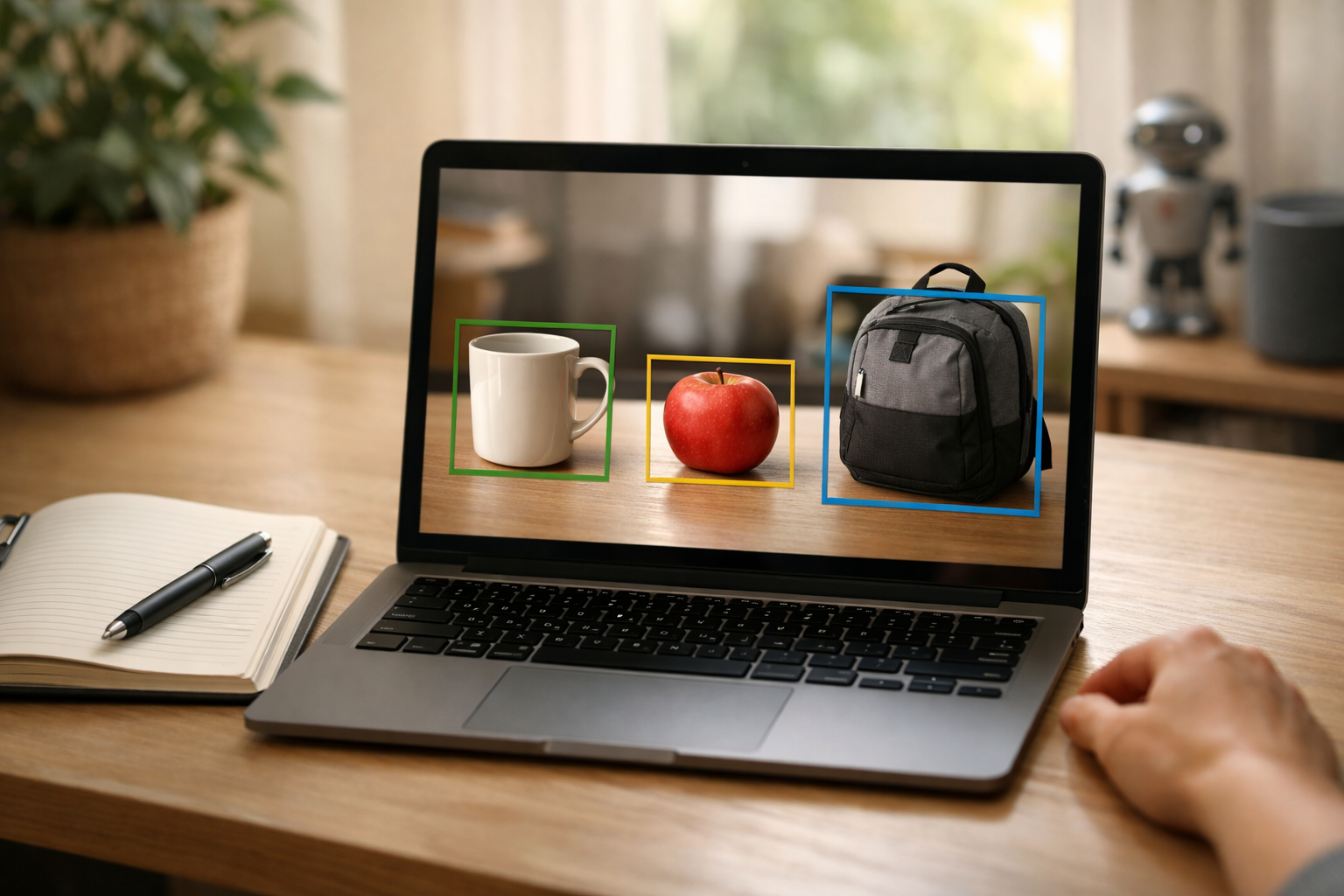
Learn how computers spot and name objects in images
This beginner course explains one of the most exciting parts of artificial intelligence: how computers recognize objects in images. If you have ever wondered how a phone camera can identify a face, how a shopping app can search by photo, or how a car can notice a stop sign, this course is built for you. You do not need any background in AI, coding, mathematics, or data science. Everything is explained in plain language, step by step, as if you are opening this topic for the first time.
The course is designed like a short technical book with six connected chapters. Each chapter builds naturally on the one before it, so you never feel lost. Instead of throwing complex terms at you, the course starts with the most basic question: what does a picture look like to a computer? Once that foundation is clear, you will learn how AI systems study examples, find patterns, make predictions, and improve through training.
Many AI courses assume you already know programming or machine learning. This one does not. The teaching style focuses on simple explanations, familiar examples, and clear progress. You will learn the core ideas behind object recognition without needing to write code or solve advanced equations. By the end, you will understand the main parts of the process and be able to talk about computer vision with confidence.
In Chapter 1, you will learn what it means for a computer to see. You will explore pixels, images as data, and the basic goal of object recognition. Chapter 2 introduces the idea of learning from examples, including labels, training, and testing. This gives you the first clear picture of how AI systems improve over time.
In Chapter 3, the course moves into the building blocks of recognition. You will learn about visual features such as edges, shapes, textures, and colors, along with a gentle explanation of neural networks. Chapter 4 then helps you understand results: what predictions mean, what confidence scores are, why mistakes happen, and why better data often leads to better performance.
Chapter 5 expands your knowledge beyond simple image labels. You will see the difference between image classification and object detection, and learn how AI can find multiple objects in one image or track them through video. Chapter 6 brings everything together with a full recap, practical uses, limitations, and responsible thinking about privacy, fairness, and safety.
This course is ideal for curious learners, students, non-technical professionals, and anyone who wants a clear introduction to computer vision. It is especially useful if you want to understand AI in a practical way before moving on to coding or more advanced study. If you are exploring the field for work, study, or personal interest, this course gives you a strong starting point.
If you are ready to begin, Register free and start learning today. You can also browse all courses to continue your AI journey after this introduction.
By the end of the course, you will understand how computers turn pictures into data, how AI models learn from examples, and how systems produce object predictions with varying levels of confidence. You will also know the difference between recognition and detection, understand why data quality matters, and be able to explain common AI strengths and weaknesses in everyday language.
This course does not promise instant mastery. Instead, it gives you something more valuable for a beginner: a clear mental model of how object recognition works. With that understanding, future learning becomes easier, less confusing, and much more meaningful.
Machine Learning Educator and Computer Vision Specialist
Sofia Chen teaches artificial intelligence in simple, practical language for new learners. She has designed beginner courses in machine learning and computer vision for online education platforms and small business teams.
When people say a computer can “see,” they do not mean it sees the world the way a person does. A person looks at a dog and instantly connects shape, fur, movement, past memories, and meaning. A computer starts with something much simpler: a grid of values. Those values come from an image, and the job of computer vision is to turn those values into useful decisions. In this chapter, you will build the beginner’s mental model for how that happens.
Object recognition is one of the most common tasks in computer vision. It means teaching a system to look at an image and decide what object is present, such as a cat, bottle, car, or apple. This sounds simple on the surface, but it involves several distinct parts. First there is the image itself. Then there may be a label, which is the correct answer attached by a human, such as “dog.” A model learns from many labeled examples. Later, when the model sees a new image, it produces a prediction, often with a confidence score such as 92%. That score is not a guarantee. It is the model’s estimate of how likely its answer is to be correct.
For complete beginners, one of the most important ideas is that seeing and understanding are not the same thing. A camera can capture an image. Software can store it. But understanding that the image contains a stop sign partly hidden by rain, or a shirt wrinkled on a bed, is much harder. AI systems do not “know” objects the way humans do. They detect patterns that often match examples they have seen before. This is why training data matters so much. If the examples are narrow, blurry, biased, or incorrectly labeled, the model will learn weak or misleading patterns.
A useful way to think about the workflow is as a pipeline. An image is captured, prepared, and turned into numbers. Those numbers are passed into a model. The model compares the patterns in the image to what it learned during training. It then outputs a prediction, perhaps “banana” with 0.87 confidence. Engineers review the results, measure errors, improve the data, retrain the model, and test again. This cycle is practical engineering, not magic. Better data, clearer labels, and realistic testing usually matter as much as model choice.
As you read this chapter, focus on six basic outcomes. You will learn how computers turn pictures into data, how AI learns from examples, and how to separate the ideas of images, labels, models, and predictions. You will also see the basic steps in an object recognition workflow, learn how to read common results like confidence and accuracy, and understand why data quality strongly affects performance. By the end of the chapter, you should be able to describe object recognition in simple, correct language without needing advanced math.
Computer vision becomes easier to understand when you stop imagining a machine with eyes and instead imagine a system that is very good at comparing patterns. In the sections that follow, you will connect this idea to everyday products, simple image data, practical workflows, and common mistakes beginners should watch for.
Practice note for Understand what object recognition is: document your objective, define a measurable success check, and run a small experiment before scaling. Capture what changed, why it changed, and what you would test next. This discipline improves reliability and makes your learning transferable to future projects.
Practice note for See how images become numbers: document your objective, define a measurable success check, and run a small experiment before scaling. Capture what changed, why it changed, and what you would test next. This discipline improves reliability and makes your learning transferable to future projects.
Computer vision is the field of AI that helps machines use images or video to make decisions. In everyday life, this often appears in quiet, familiar ways. When your phone unlocks with your face, when a photo app groups pictures of pets, or when a package scanner reads an address, computer vision is doing work behind the scenes. The system is not “looking” with awareness. It is processing visual input and matching patterns to tasks.
For beginners, it helps to separate computer vision from general intelligence. A vision system can be good at one narrow task and still fail in a slightly different setting. A phone camera may detect a face well in daylight but struggle in shadows. A shopping app may recognize a cereal box from the front but fail if the box is turned sideways or partly covered. This happens because AI learns from examples. If its examples do not include enough variety, the model becomes brittle.
Object recognition is one specific part of computer vision. It answers questions like: “Is there a cat in this image?” or “Which object is this?” In practical systems, object recognition supports useful actions. A warehouse robot might identify packages. A recycling machine might sort plastic bottles. A quality-control camera in a factory might flag damaged products. In each case, the goal is not just to see but to support a decision.
Engineering judgment matters early. Before building a vision system, you must ask what problem you are truly solving. Do you need to classify one object per image, detect multiple objects, or simply check whether something is present? Beginners often jump to advanced models before defining the task clearly. Real progress starts by narrowing the goal, understanding the environment, and deciding what “good enough” performance means in that setting.
To a human, a photo feels whole and meaningful. To a computer, an image is data arranged in a grid. Each tiny square in that grid is called a pixel. Every pixel stores numeric information about brightness or color. So when we say a computer receives an image, what it actually receives is a large table of numbers. That is the starting point of all computer vision.
A black-and-white image may store one number per pixel, often representing brightness from dark to light. A color image usually stores three numbers per pixel, commonly for red, green, and blue. This means that a simple image can contain thousands or millions of values. A model does not begin with concepts like “tree” or “cup.” It begins with these numeric patterns.
This is a key beginner insight: computers do not directly see objects. They process numeric representations. If two images look similar to you, they may still differ significantly at the pixel level because of lighting, blur, angle, or background. That is one reason object recognition can be hard. The same object can produce many different pixel arrangements.
In practice, engineers often prepare images before training or prediction. They may resize them to a standard shape, normalize pixel values, remove corrupt files, or check that color channels are consistent. These steps sound basic, but they strongly affect results. A model trained on clear, correctly formatted images usually performs better than one trained on mixed, messy inputs. Many beginner problems come not from the AI model itself, but from confusion about what image data actually looks like inside the system.
Pixels are the smallest visible units in a digital image, but object recognition depends on more than single pixels. One pixel alone tells very little. Meaning begins to appear when pixels form patterns. Edges, corners, textures, curves, and repeated shapes are more useful than isolated dots. A model learns to respond to these patterns across many examples.
Consider a simple image of an orange. No single pixel says “orange fruit.” Instead, many nearby pixels together may suggest a round boundary, a certain color range, and a texture. A trained model combines these clues. This is one reason image recognition works even when an object is not perfectly centered. The system learns which visual patterns often travel together.
Color helps, but it is not enough. A red object is not always an apple, and a banana under blue lighting may not look yellow. Good models learn from multiple signals at once: shape, contrast, structure, and context. Beginners sometimes assume recognition is mostly about color matching, but that would fail quickly in the real world.
It is also important to understand the difference between seeing detail and understanding meaning. A high-resolution image has more pixels, but more pixels do not automatically create understanding. If the training examples are poor or labels are wrong, the model may still perform badly. Practical computer vision is about learning useful patterns, not just collecting more visual data. That is why thoughtful data collection, balanced classes, and realistic image conditions matter so much.
Object recognition follows a workflow, and beginners benefit from seeing the parts clearly. First, images are collected. These may come from phones, cameras, websites, machines, or existing datasets. Next, people add labels, such as “cat,” “car,” or “empty shelf.” The image is the input. The label is the known answer. During training, the model studies many image-label pairs and adjusts itself so its predictions become more accurate over time.
After collection and labeling, the data is usually cleaned. Engineers remove duplicates, fix wrong labels, standardize image sizes, and split the dataset into training, validation, and test sets. This split is important. The model learns from the training set, gets tuned on the validation set, and is judged on the test set. Without this separation, it is easy to fool yourself into thinking the model is better than it really is.
Once trained, the model can make predictions on new images. It might output “dog: 0.91” and “fox: 0.06.” This means the model thinks “dog” is the best match with 91% confidence. Confidence is useful, but it should be read carefully. A high confidence score can still be wrong, especially if the new image is unlike the training data.
Results are then measured using metrics such as accuracy. Accuracy tells you how often predictions are correct overall, but it does not tell the whole story. If one class is much more common than another, accuracy can look strong while rare but important cases are missed. Good engineering means checking mistakes, not just celebrating one number. Review the failures. Are dark images a problem? Are side views harder? Are labels inconsistent? Improvement often comes from this careful inspection.
At its core, object recognition tries to connect visual patterns to meaningful categories. The system is shown many examples, each with labels, and learns which image patterns tend to belong to which object names. Later, when it sees a new image, it predicts the most likely label. This is the basic learning idea behind many computer vision systems.
It is helpful to keep four terms separate. An image is the visual input. A label is the correct category name given by a person or trusted source. A model is the trained pattern-finding system. A prediction is the model’s answer for a new image. Beginners often mix these together, but clean thinking leads to better debugging. If results are bad, ask: is the image poor, are the labels wrong, is the model weak, or is the prediction threshold poorly chosen?
Object recognition does not truly understand the world in a human sense. It finds regularities in data. This is powerful, but limited. If the background is strongly linked to a class in training images, the model may accidentally learn the background instead of the object. For example, if boats always appear on water and cars always appear on roads, the model may rely too much on scene context. Then it can fail when a toy boat appears indoors.
Practical outcomes depend on data quality. Clear labels, enough variety, realistic conditions, and balanced examples usually improve performance. Poor data creates common mistakes: overconfident wrong answers, weak performance in unusual lighting, and confusion between similar objects. A beginner should remember this rule: when an AI vision system makes strange mistakes, the data is often the first place to investigate.
Many of the clearest examples of object recognition come from products people already use. On phones, camera apps may detect faces, separate people from backgrounds, or help organize galleries by object type. These features feel simple, but they rely on models trained on large numbers of examples. The practical goal is convenience: faster search, cleaner photos, and more intuitive tools.
In shops, object recognition appears in self-checkout systems, shelf monitoring, and inventory tools. A camera may help identify products, detect missing items, or estimate whether stock levels are low. But real store environments are messy. Packaging changes, lighting varies, products overlap, and people block the view. This is why engineering judgment matters. A model that works in a clean demo may struggle badly in a busy store unless the training data reflects that reality.
Cars use computer vision for tasks such as reading road signs, spotting lane markings, and detecting nearby vehicles or pedestrians. These systems show why confidence scores and error analysis matter. In a safety-related setting, one wrong prediction can matter more than many correct ones. Engineers must understand not only average accuracy but also failure cases, edge conditions, and whether the model behaves reliably in rain, darkness, glare, or unusual road scenes.
Across all these examples, the lesson is the same: computer vision creates practical value when image data, labels, models, and evaluation are aligned with the real-world task. A beginner does not need advanced math to understand this. If you know what the system sees as data, how it learns from examples, how to read predictions, and why data quality matters, you already understand the foundation of AI object recognition.
1. What does object recognition mean in this chapter?
2. How does a computer begin working with an image?
3. Why are seeing and understanding described as different?
4. What is a label in an object recognition workflow?
5. What does a confidence score like 92% mean?
In the previous chapter, you likely saw the big idea of object recognition: a computer looks at a picture and tries to say what is in it. In this chapter, we focus on how that ability is built. The key idea is simple: AI learns from examples. Instead of giving a computer a long list of exact rules such as “a cat has two ears, whiskers, and fur,” we usually show it many pictures and tell it the correct answer for each one. Over time, the system finds useful patterns that help it make future guesses.
This learning process is easier to understand if you keep four words separate in your mind: image, label, model, and prediction. An image is the picture itself. A label is the human-provided answer, such as “apple,” “car,” or “dog.” A model is the trained AI system that has learned from many examples. A prediction is the model’s output when it sees a new image. Beginners often mix these up, but keeping them separate makes the whole workflow much clearer.
Object recognition is a practical engineering process, not magic. First, you collect pictures. Then you organize them with labels. Next, you train a model so it can connect patterns in the pictures to the labels. After that, you test it on images it has not seen before. Finally, you look at results such as confidence scores, correct answers, mistakes, and overall accuracy. If performance is poor, you improve the data, adjust the training setup, or gather more examples. This cycle of train, evaluate, and improve is at the heart of modern AI work.
A useful way to think about training is to compare it with practice in real life. A child learns to recognize a bicycle after seeing many bicycles from different angles, in different colors, and in different places. The child does not memorize one exact bicycle. Instead, the child notices common features across many examples. AI works in a similar way. It learns from repetition, variation, and feedback. The more representative the examples are, the better the model can handle real-world pictures.
At the same time, AI can also learn the wrong lessons. If all training images of dogs are outdoors and all training images of cats are indoors, the model may start using the background as a shortcut. Then it may fail when it sees a dog inside a house. This is why data quality matters so much. Good datasets are varied, correctly labeled, and close to the situations where the AI will be used. In engineering, better performance often comes not from a fancier algorithm, but from better examples.
As you read this chapter, focus on how each piece fits into one workflow. Labeled images teach the system. The model stores patterns from that teaching. Training is the repeated practice process. Testing shows whether learning is real. Mistakes reveal what needs fixing. Confidence scores tell you how sure the model is, though not always how correct it is. By the end of the chapter, you should be able to describe in plain language how AI learns to recognize objects, why some predictions succeed or fail, and why many good examples are essential for reliable results.
In the sections that follow, we will look closely at each step in this learning process. We will stay practical and use plain language, because understanding the workflow matters more than memorizing technical jargon. Once these ideas feel natural, later topics in computer vision will make much more sense.
Practice note for Understand training with labeled images: document your objective, define a measurable success check, and run a small experiment before scaling. Capture what changed, why it changed, and what you would test next. This discipline improves reliability and makes your learning transferable to future projects.
Teaching a computer to recognize objects starts with examples, not with hard-coded rules. In older styles of programming, a developer might try to write detailed instructions for every situation. That approach breaks down quickly with images, because pictures vary too much. A banana can be bright yellow or slightly green. A car can be close, far away, partly hidden, or seen at night. Instead of writing one rule for every possible case, we show the AI many labeled images and let it learn patterns from them.
This is called training with labeled images. Each example has two parts: the picture and the correct answer. If the image contains a cup, the label might be “cup.” During training, the system compares its guess with the correct label and adjusts itself a little. It does this over and over again across many examples. You can think of it as guided practice. The label tells the AI when it is right and when it is wrong, and those corrections gradually shape its behavior.
In practical projects, the training set should include variety. If you only train on neat studio photos of fruit, the model may struggle with messy kitchen photos taken on a phone. Good examples cover different lighting, sizes, backgrounds, camera angles, and object appearances. This is an engineering judgment call: the data should resemble the real conditions where the model will later be used. If the application is a recycling sorter, include crumpled cans, dirty bottles, and overlapping items, not just perfect product photos.
A common beginner mistake is to think the computer “understands” an object the way a person does. It does not. It is learning statistical patterns from examples. That means the quality and range of the examples strongly affect the results. If labels are wrong, the AI learns from wrong feedback. If examples are too few or too similar, the AI may memorize instead of learning useful general patterns. Teaching with examples works well, but only when the examples are chosen with care.
To understand object recognition, you need a clear mental model of images and labels. An image is a picture, but inside a computer it is stored as data. At a basic level, a digital image is a grid of tiny dots called pixels. Each pixel has numeric values that describe color or brightness. So when we say a computer “looks” at a photo, what really happens is that it processes a large table of numbers.
A label is the answer attached to the image by a human or another trusted source. If the picture shows a bicycle, the label might be “bicycle.” In more advanced tasks, labels can also include locations, such as boxes around objects, but for beginners it is enough to think of a label as the known correct answer. The image is the input. The label is the teaching signal. Together, they create a training example.
It is important not to confuse labels with predictions. A label is the ground truth used during learning or evaluation. A prediction is what the model says after looking at an image. If the label is “dog” and the model predicts “wolf,” that difference is a mistake we can measure. This comparison is how we know whether the model is improving. Without labels, we would have no clear way to tell the system what counts as correct.
In real projects, label quality matters just as much as image quality. If one person labels a tomato as a vegetable and another labels it as fruit, the dataset becomes inconsistent. The model then receives mixed messages. Another practical issue is unclear images. Blurry, cropped, or low-light pictures are not always bad, because real-world images are often imperfect, but they should be labeled carefully. The central lesson is simple: the computer learns from whatever data you give it. Clean, consistent, realistic images and labels lead to more trustworthy models.
Beginners often hear the word model and imagine a folder of saved pictures or a lookup table of answers. That is not quite right. A model is a mathematical system that has adjusted itself based on many training examples. It does not usually store whole images in the way a photo album does. Instead, it stores learned settings that help it respond to patterns in new images. In plain language, a model is the trained part of the AI that remembers what it has learned from practice.
What does it store, then? It stores internal values that represent useful visual relationships. For example, after training, the model may respond strongly to certain edges, shapes, textures, or combinations of features that often appear together in specific object classes. It is not storing a sentence like “cats have whiskers.” It is storing numerical patterns that make “cat” more likely when certain visual evidence appears.
This distinction matters because it explains both the power and the limits of AI. A good model can recognize a new cat it has never seen before because it has learned general patterns, not just memorized one training photo. But if the model has learned weak or biased patterns, its predictions can fail in surprising ways. For example, if it has relied too heavily on grassy backgrounds to recognize cows, it may struggle with a cow indoors or in snow.
From a practical viewpoint, a model is the result of training and the tool you later deploy. Once trained, you can feed it a new image and it will produce a prediction, often with a confidence score such as 0.92 for “car.” That score reflects how strongly the model leans toward a choice, not a guarantee of truth. Engineering judgment is needed here: a high-confidence answer can still be wrong if the training data was limited, biased, or inconsistent.
The basic object recognition workflow has a rhythm: train, test, inspect, improve, and repeat. During training, the model studies labeled images and updates itself many times. During testing, you check how well it works on images it did not use for learning. This separation is important. If you test on the same images used in training, the result can look excellent even when the model has not truly learned to generalize. It may just remember details from the training set.
After testing, you examine the results. One simple measure is accuracy, the percentage of predictions that are correct. If a model classifies 90 out of 100 test images correctly, its accuracy is 90%. Accuracy is useful, but it does not tell the whole story. You should also look at which classes are confused, where confidence scores are too high or too low, and whether mistakes happen under specific conditions like darkness, clutter, or unusual angles.
This leads to the “trying again” part. AI development is iterative. If performance is weak, you do not just give up. You ask practical questions. Are some labels wrong? Do we need more examples of rare objects? Are all training images too similar? Is the model seeing enough variation? Often, improvement comes from fixing the dataset rather than making the software more complicated. For beginners, this is an important engineering lesson: better data beats guesswork.
A common mistake is judging the model by one number alone. A model with decent overall accuracy might still fail badly on the exact cases that matter most. For example, it may identify apples well in bright light but miss them in grocery store shelves where objects overlap. Good workflow means reading results carefully, understanding why mistakes happen, and making targeted improvements. Training is not a one-time event. It is a cycle of practice and feedback, much like learning any human skill.
When AI learns from pictures, it is searching for patterns that help separate one object class from another. At a simple level, these patterns may include edges, corners, curves, colors, textures, and repeated shapes. In a face, there are often relationships between eyes, nose, and mouth. In a bicycle, there may be wheel-like circles and frame-like lines. The model combines many small clues rather than relying on one perfect feature.
These patterns are not always the same as what humans consciously notice. A person may say, “That is a mug because it has a handle.” A model may use the rim, shading, side shape, and handle-like structure together. Sometimes it may even use clues that humans overlook, such as common lighting or background patterns. This is why some predictions are right and some are wrong. If the useful object features are strong, the prediction may be correct. If distracting clues dominate, the model may guess incorrectly.
Confidence scores help us read predictions, but they must be interpreted carefully. If a model says “cat: 0.88,” it means the model is fairly confident in that choice compared with other choices. It does not mean there is an 88% guarantee in the everyday sense. Models can be confidently wrong, especially when they see unfamiliar images. For example, a strange toy animal might be labeled “dog” with high confidence simply because it shares enough learned visual patterns.
Practically, this is why reviewing mistakes matters. Wrong predictions often reveal hidden shortcuts. Maybe the model identifies boats mainly by water in the background. Maybe it thinks snowboards are skis because it has not seen enough side views. By looking at errors, you learn what patterns the model depends on. This helps you decide what new examples to collect and where the model needs more balanced teaching.
AI usually improves when it learns from many examples because real-world objects appear in many forms. A chair may be wooden, metal, large, small, modern, broken, partly hidden, or photographed from above. If the model only sees one type of chair, it may think that narrow version is what all chairs look like. Many examples help the model separate the essential patterns from the accidental details.
But “many” does not just mean a high number. It also means enough diversity. One thousand nearly identical images are less useful than a smaller set that captures true variation. Good data includes different lighting conditions, camera qualities, backgrounds, distances, and object positions. It should also include difficult cases. If your future users will upload phone photos taken in a hurry, train on realistic phone photos, not only polished images from the internet.
This is where data quality becomes central to AI performance. A large dataset full of wrong labels, duplicates, or one-sided examples can produce a weak model. A smaller but cleaner and better-designed dataset may work better. Engineers often spend a great deal of time curating data because the model can only learn from what it is shown. If some classes have many examples and others have very few, the model may become much better at the common classes and weaker at the rare ones.
The practical outcome is clear: reliable object recognition depends on representative examples. More practice usually helps AI improve, but only when that practice reflects the real world. When predictions are poor, one of the first things to inspect is the dataset itself. Are there enough examples? Are they varied enough? Are the labels trustworthy? Understanding this connection between data and performance is one of the most important beginner insights in computer vision.
1. In this chapter, what does it mean to say that AI learns from examples?
2. Which choice correctly matches the term with its meaning?
3. Why is it important to test a model on images it has not seen before?
4. What problem can happen if all dog images are outdoors and all cat images are indoors during training?
5. According to the chapter, what usually helps object recognition improve the most when performance is poor?
Object recognition may sound mysterious, but the core idea is simple: a computer looks at a picture, turns it into numbers, searches those numbers for useful patterns, and then makes a best guess about what object is present. In earlier chapters, you learned that images are data and that AI systems learn from examples. In this chapter, we go one level deeper into the machinery. We will look at the building blocks that help a model move from raw pixels to a final prediction such as cat, car, or banana.
The most important beginner idea is that computers do not begin with human understanding. They begin with measurements. Every image is a grid of pixel values. Those values by themselves are not meaningful in the way people see meaning, so the model must learn patterns that are useful for telling one object apart from another. These useful patterns are often called features. Features can be simple, such as a sharp edge between light and dark areas, or more complex, such as a round wheel, a furry face, or the rough texture of tree bark.
Once features are found, a model can combine them to make a prediction. If the image contains long straight lines, circular wheels, windows, and a car-like outline, the model may assign a high confidence score to the label car. If some features are missing, blurry, or misleading, the model may be less confident or may predict the wrong object. This is why data quality matters so much. Clear images, correct labels, and enough variety in training examples help the model build more reliable feature detectors.
In practice, object recognition is a workflow. First, images are collected. Then labels are attached. Next, a model is trained to connect image patterns with labels. After training, the model makes predictions on new images. Finally, people examine the results using measures such as confidence scores, mistakes, and accuracy. Throughout that workflow, engineering judgment matters. You must decide whether the data is balanced, whether the classes are too similar, whether poor lighting is causing errors, and whether the model is learning real object features or only shortcuts from the background.
This chapter focuses on the parts inside the model. You will learn what features are, how neural networks can be understood without heavy math, how layers build from simple patterns to more complex ones, and how all those internal pieces connect to the final object name that appears as the prediction. By the end, the model should feel less like a black box and more like a tool with understandable parts.
Practice note for Learn how features help identify objects: document your objective, define a measurable success check, and run a small experiment before scaling. Capture what changed, why it changed, and what you would test next. This discipline improves reliability and makes your learning transferable to future projects.
Practice note for Understand neural networks at a beginner level: document your objective, define a measurable success check, and run a small experiment before scaling. Capture what changed, why it changed, and what you would test next. This discipline improves reliability and makes your learning transferable to future projects.
Practice note for See how layers find simple to complex patterns: document your objective, define a measurable success check, and run a small experiment before scaling. Capture what changed, why it changed, and what you would test next. This discipline improves reliability and makes your learning transferable to future projects.
Practice note for Connect model parts to final predictions: document your objective, define a measurable success check, and run a small experiment before scaling. Capture what changed, why it changed, and what you would test next. This discipline improves reliability and makes your learning transferable to future projects.
Practice note for Learn how features help identify objects: document your objective, define a measurable success check, and run a small experiment before scaling. Capture what changed, why it changed, and what you would test next. This discipline improves reliability and makes your learning transferable to future projects.
A feature is any visual clue that helps separate one object from another. For a person, this happens almost automatically. You see pointy ears, whiskers, and fur, and you think of a cat. A computer does not start with those concepts. It starts with pixel values, and during training it learns which combinations of values often appear when a certain label is present. Those useful combinations become features.
At a beginner level, it helps to think of features as hints. A single feature usually is not enough to identify an object perfectly. A round shape could be a ball, an orange, a plate, or a clock. But several features together become more informative. Round shape plus orange color plus dimpled texture may suggest an orange. Round shape plus numbers and hands may suggest a clock. Good object recognition depends on finding many features that work together.
Features can be small or large. Some are tiny local details, like a corner, an edge, or a repeated pattern. Others are bigger arrangements, like a face shape, a bicycle frame, or the outline of a bottle. In image recognition systems, these features are often learned automatically from examples instead of being written by hand. This is one reason modern AI performs better than older rule-based systems in many image tasks.
From an engineering point of view, feature quality depends strongly on data quality. If your training images always show dogs on grass, the model may accidentally learn that green background is a dog feature. Then it may struggle when the dog is indoors. This is a common mistake: the model learns shortcuts instead of object-specific clues. To reduce that problem, collect images with varied backgrounds, angles, lighting conditions, and object sizes.
When you inspect model mistakes later, ask practical questions: What features might the model be using? Are the labels correct? Are there enough examples for each object class? Thinking in terms of features gives you a concrete way to understand why a model succeeds or fails.
Many image features fall into a few intuitive groups: edges, shapes, textures, and colors. These are the raw materials that help models describe what is in an image. Understanding them helps complete beginners see how pictures become data the model can use.
Edges are places where pixel values change sharply, such as the border between a dark object and a bright background. Edges are useful because they often reveal boundaries. A model can use edges to trace the outline of an object, locate corners, and detect parts like door frames, leaf borders, or facial features.
Shapes are built from arrangements of edges and curves. A triangle, circle, rectangle, or long cylinder can provide strong clues. Wheels are often circular. Books often look rectangular. Bottles often have tall narrow shapes. Shape alone is not always enough, but it is a powerful part of recognition.
Textures describe repeated surface patterns. Fur, brick, grass, denim, and tree bark all have different textures. Texture can help a model tell apart objects that share a similar shape. For example, a tennis ball and a lime may both be small and round, but their textures are different.
Colors can also help, especially when certain objects tend to appear in typical color ranges. Bananas are often yellow, stop signs are often red, and leaves are often green. But color can also mislead. Lighting changes, shadows, camera settings, and unusual object colors can reduce reliability. For this reason, a strong model does not depend on color alone.
In practice, a model that combines all four usually works better than one that relies too heavily on one cue. When reviewing failures, check whether blur removed edges, resizing distorted shape, compression damaged texture, or poor lighting changed color. These are common reasons why predictions become uncertain or wrong.
A neural network is a system that learns patterns from examples. You do not need advanced math to understand the big picture. Imagine a very large decision-making machine with many small parts. Each part looks at numbers from the image and passes along a signal about whether it notices something useful. One part may respond strongly to a vertical edge. Another may respond to a curve. Another may react when several lower-level clues appear together.
During training, the network sees many images and their correct labels. At first, its guesses are poor. It compares its prediction with the correct answer and adjusts itself slightly. Over many examples, it becomes better at responding to the right patterns. In simple words, it learns what to pay attention to.
This helps explain the difference between images, labels, models, and predictions. The image is the input. The label is the correct answer during training. The model is the trained pattern-learning system. The prediction is the model’s output on a new image, often with a confidence score attached.
Neural networks are powerful because they can learn features automatically instead of requiring a person to manually define every rule. In older systems, engineers might have had to specify exact formulas for corners, circles, or color thresholds. A neural network can discover many useful combinations on its own if the training data is good enough.
Still, this does not mean the network understands images the way humans do. It is matching patterns, not reasoning like a person. That is why mistakes happen. A model may be highly confident and still wrong if it has learned the wrong clues from the training set. Practical users should always test on fresh images and inspect errors before trusting results in a real application.
One of the most helpful beginner ideas in deep learning is that layers build understanding gradually. Early layers often detect very simple patterns. Middle layers combine those simple patterns into larger parts. Later layers combine parts into object-level ideas. This step-by-step process is what allows a model to move from raw pixels to a final recognition result.
For example, imagine an image of a bicycle. An early layer may respond to short lines, edges, and contrast changes. A middle layer may combine those into circles, spokes, and frame-like angles. A later layer may combine those parts into something that strongly matches the concept of a bicycle. No single layer needs to understand the whole image at once.
This layered design matters because real images are complex. Objects can appear rotated, partly hidden, small, large, bright, dark, near, or far. By building from simple to complex, the model has a better chance of recognizing stable patterns even when the exact pixels change. A wheel is still a useful clue whether the bike is blue or red, centered or off to the side.
From a workflow perspective, this is why training takes many examples. The model needs to see enough variation to learn that some changes matter and some do not. If all training bikes are photographed from the same angle, later layers may become too narrow in what they recognize. Then accuracy drops on real-world images.
A common beginner mistake is to think more layers automatically solve everything. In reality, deeper models need suitable data, enough computing power, and careful evaluation. More complexity can help, but only when matched with clean labels and realistic examples. Good engineering judgment means choosing a model and data setup that fit the task rather than assuming bigger is always better.
Once a model has detected many useful patterns, it must turn them into a final answer. This is the stage where internal signals become object names such as dog, car, or cup. You can think of it as a scoring process. The model weighs the evidence for each possible label and decides which label fits best.
If the image contains features strongly associated with dogs, the score for dog rises. If it contains more clues associated with cats, the score for cat rises instead. The model then outputs a prediction, often with confidence scores showing how strongly it leans toward each option. A confidence score is not a guarantee of correctness. It is the model’s estimate based on what it has learned.
This is where practical interpretation matters. A prediction of car: 0.92 means the model is very confident, but it can still be wrong. Maybe the image contains only part of a car, or maybe the background resembles common car scenes. A lower score, such as car: 0.54, suggests uncertainty. In real systems, teams often set thresholds. For example, predictions below a chosen threshold may be sent to a human reviewer.
Reading results well is part of object recognition work. You should look beyond a single prediction and examine patterns in the mistakes. Which classes are confused most often? Are similar objects mixed up, like wolves and dogs? Are small objects missed? Are unusual viewpoints causing failures? These questions connect model outputs back to data collection and labeling quality.
The full workflow becomes clear here: images go in, learned features are detected, scores are computed, and predictions come out. Evaluation then checks how often those predictions match the true labels. Accuracy is one useful summary, but it should always be paired with error analysis so you understand why the model behaves the way it does.
Deep learning works especially well for images because images contain rich patterns at many levels. There are tiny details such as edges and corners, medium-level parts such as eyes and wheels, and larger structures such as faces, cars, and buildings. A deep model is good at learning these levels together. Instead of needing hand-written rules for every possible object, it can learn useful features directly from many labeled examples.
Another reason deep learning is effective is that real-world images vary constantly. Objects appear under different lighting, scales, positions, and backgrounds. A strong deep model can learn to recognize important patterns even when the exact pixel values change. This flexibility is one of its greatest strengths.
However, deep learning is not magic. It works well when the training data is relevant, varied, and correctly labeled. If labels are wrong, the model learns the wrong associations. If one class has thousands of examples and another has very few, the model may become biased toward the larger class. If all examples are taken in the same environment, the model may fail in new settings. These are data problems, not just model problems.
For beginners, the practical takeaway is simple: deep learning succeeds because it can automatically learn simple-to-complex features from image data. But the quality of those learned features depends on the quality of the examples you provide. Better data usually leads to better pattern detectors, better predictions, and better real-world performance.
As you continue through object recognition, keep this mental model: pictures become numbers, numbers reveal features, layers combine features into object parts, and the model turns those parts into predictions. With that foundation, confidence scores, mistakes, and accuracy reports become easier to read and more meaningful in practice.
1. What is a feature in object recognition?
2. Why does data quality matter for object recognition?
3. How does the chapter describe neural-network layers at a beginner level?
4. What happens after a model is trained in the object-recognition workflow?
5. What best explains how a model reaches a final prediction like 'car'?
In the earlier parts of this course, you learned that an object recognition system looks at pictures, turns them into numbers, and uses a trained model to make a guess about what is in the image. In this chapter, we move from the idea of recognition to the practical question that every beginner eventually asks: how do you read the result, and how do you know whether it is any good?
When people first try an object recognition model, they often focus only on whether the top answer is correct. That is a useful starting point, but real AI work requires a little more judgment. A model does not simply say “cat” or “not cat.” It usually gives a prediction, a confidence score, and sometimes a list of other possible answers. Those outputs help you understand not just what the model guessed, but how certain it seems, where it struggles, and whether its behavior is reliable enough for your task.
This chapter ties together several important ideas: the difference between a prediction and the real label, how confidence scores should be interpreted, how accuracy and mistakes are measured, and why data quality has such a strong effect on results. You will also see that many poor results are not caused by “bad AI” alone. They often come from weak training examples, messy labels, unbalanced classes, or unfair data collection. Beginners who learn to inspect data carefully usually improve their models faster than beginners who only adjust settings.
Think of object recognition as a workflow rather than a single magic step. First you gather images. Then you label them. Then you train a model. Then you test it on images it has not seen before. Finally, you examine predictions, confidence scores, and mistakes to decide what to improve next. This process is part technical and part practical judgment. A model can be acceptable for one use and unacceptable for another. For example, a toy app that guesses fruit types can tolerate occasional mistakes, but a system used to check safety equipment needs much more dependable results.
As you read this chapter, keep one core idea in mind: model results are not just numbers on a screen. They are clues. They tell you how your data, labels, and training choices are shaping the model’s decisions. If you learn to read those clues, you will be able to judge whether a model is useful, notice common beginner mistakes early, and improve performance in a sensible way.
By the end of this chapter, you should be able to look at a simple object recognition output and explain what it means in plain language. You should also be able to make a basic decision about whether the model is useful, what kinds of errors it makes, and what data changes are most likely to help. That skill is one of the first big steps from “using AI” to actually understanding AI.
Practice note for Understand confidence scores and predictions: document your objective, define a measurable success check, and run a small experiment before scaling. Capture what changed, why it changed, and what you would test next. This discipline improves reliability and makes your learning transferable to future projects.
Practice note for Learn how to judge if a model is useful: document your objective, define a measurable success check, and run a small experiment before scaling. Capture what changed, why it changed, and what you would test next. This discipline improves reliability and makes your learning transferable to future projects.
Practice note for See how data quality changes outcomes: document your objective, define a measurable success check, and run a small experiment before scaling. Capture what changed, why it changed, and what you would test next. This discipline improves reliability and makes your learning transferable to future projects.
When an object recognition model examines an image, the result usually comes back as a small set of outputs rather than a single word. A beginner might expect the model to return something simple like “dog,” but in practice the output often includes the predicted label, a confidence score, and sometimes several alternative labels ranked from most likely to least likely. Learning to read this format is the first step in understanding model behavior.
Imagine you give a model a photo of an apple on a kitchen table. The model might return something like: apple 0.91, tomato 0.06, orange 0.02. This means the model predicts “apple” and assigns a stronger score to that choice than to the other options. The predicted label is the model’s best guess. The correct label, if you know it from your test data, is the truth you compare against. If the true label is also apple, the prediction is correct. If the true label is tomato, then even a high-confidence answer would still be wrong.
In object recognition projects, prediction results may also include bounding boxes if the system is finding objects inside an image rather than classifying the whole image. In that case, each detected object can have its own label and score. For complete beginners, it is enough to remember that every result should answer two questions: what object does the model think it sees, and how strongly does it prefer that answer?
A practical habit is to inspect results one image at a time before jumping to summary statistics. Look at a few correct predictions and a few incorrect ones. Ask simple questions. Is the object clear? Is the image blurry? Is the object partly hidden? Is the background confusing? This kind of manual review helps you connect the model’s output to the actual data. It also reveals whether the errors feel random or whether there is a pattern, such as confusing apples with tomatoes whenever the lighting is dim.
Beginners sometimes make the mistake of treating prediction results as final truth. A model output is not a fact. It is a decision made from patterns in data. Your job is to compare that decision with reality and decide whether it is good enough for your purpose.
A confidence score tells you how strongly the model favors its prediction compared with other choices. In plain English, it is a signal of the model’s certainty, not a promise that the answer is correct. This difference matters a lot. A model can be highly confident and still be wrong. It can also be uncertain and still accidentally be right.
If a model says “bicycle, 0.98,” that usually means the internal calculation strongly points to bicycle. If it says “bicycle, 0.52” and “motorcycle, 0.44,” the model is telling you the image is harder to judge. The scores are close, so the model sees evidence for both classes. For a beginner, this is useful because confidence scores help separate easy images from difficult ones.
One practical use of confidence is setting a decision threshold. Suppose your model recognizes products on store shelves. You might choose to accept predictions only above 0.80 and send lower-confidence images for human review. This can reduce obvious mistakes. However, using a threshold also means some images will be left undecided, so there is always a trade-off between automation and caution.
Confidence should be interpreted in context. A score of 0.90 may sound excellent, but if the model was trained on poor or narrow data, that confidence may be misleading. For example, a model trained mostly on bright studio images of shoes may be overconfident when shown a dark outdoor photo. The number alone cannot tell you whether the training data truly matched the real-world situation.
A good beginner practice is to look at many examples in confidence bands: above 0.90, between 0.60 and 0.90, and below 0.60. Check whether high-confidence predictions are usually correct and whether low-confidence ones are where the confusion appears. This teaches you to use confidence as a practical tool rather than a magical score. Confidence helps with decisions, but it does not replace human judgment.
Accuracy is one of the most common results shown after training a model. It is the percentage of predictions that match the correct labels. If your model tests 100 images and gets 87 right, the accuracy is 87%. This is a helpful first summary, but it is only one view of performance. A useful model is not judged by one number alone.
To understand results better, you should also examine errors. An error is any prediction that does not match the true label. Some errors are more serious than others. If a model confuses two similar dog breeds, that may be acceptable in a casual app. If it confuses a stop sign with a speed limit sign, that is much more serious. So engineering judgment means asking not just “how many mistakes?” but also “what kind of mistakes?”
Another important beginner idea is the false guess. In a simple example, if the model says an image contains a helmet when there is no helmet, that is a false positive. If there is a helmet but the model misses it, that is a false negative. These two error types matter differently depending on the task. A warehouse safety system may care more about missing helmets than about occasionally raising extra warnings.
A confusion matrix is a common tool for seeing where mistakes happen. It shows which true classes are confused with which predicted classes. Even without using advanced math, you can read it as a map of the model’s misunderstandings. If your model often predicts “cat” when the correct label is “fox,” that suggests the training examples may not be diverse enough or the visual difference is not well learned.
To judge whether a model is useful, combine summary numbers with practical inspection. Ask: does it perform well on the images that matter most? Does it fail in predictable ways? Are errors rare enough for the intended use? A model with lower overall accuracy but safer mistakes may be more useful than one with a higher score but dangerous errors. That is real-world model evaluation.
Data quality is one of the biggest reasons object recognition models succeed or fail. A model learns from examples, so if the examples are messy, misleading, or incomplete, the model learns the wrong lessons. Clean data means images are relevant, labels are correct, and the examples actually represent the problem you want to solve.
Label mistakes are especially harmful. If many photos of bananas are labeled as lemons, the model receives conflicting information. It starts connecting the wrong visual patterns to the wrong names. Even a powerful model cannot learn well from incorrect teaching. This is why checking labels is not boring cleanup work. It is one of the most important parts of the workflow.
Balance also matters. Suppose you train a model with 5,000 images of cats and only 200 images of rabbits. The model will see far more cat examples and may become much better at recognizing cats than rabbits. In extreme cases, it may start predicting the common class too often simply because it has learned that it appears more frequently. A high overall accuracy can hide this problem if the test set has the same imbalance.
Image quality matters too. Blurry images, strange crops, tiny objects, heavy shadows, and inconsistent camera angles can all change model behavior. That does not mean all images should look perfect. In fact, a practical dataset often needs variety. But the variety should be meaningful and labeled correctly. You want examples that reflect the real conditions in which the model will be used.
A strong beginner habit is to sample your dataset visually. Open random images from each class and inspect them. Look for duplicates, wrong labels, missing objects, mixed classes, and unusual backgrounds. Many “model problems” are discovered this way before any advanced tuning begins. Clean and balanced data gives the model a fair chance to learn the right patterns.
Bias in AI means the model performs unevenly because the data does not represent the world fairly or completely. For beginners, the simplest way to think about bias is this: the model becomes better at recognizing what it sees often and worse at recognizing what it rarely or never sees. That can produce unfair or unreliable results for certain groups, settings, or object types.
Consider a model trained to recognize faces, hats, or safety gear. If most training images come from one lighting condition, one camera style, one skin tone range, or one type of workplace, the model may perform well there and poorly elsewhere. This is not because the model “wants” to be unfair. It is because its learning examples did not cover enough variation. The same issue appears in non-human tasks too. A plant model trained mostly on healthy green leaves may fail badly on leaves photographed in dry weather or under different lighting.
Bias often hides behind decent average accuracy. The model may look good overall while still failing on a smaller subgroup. That is why it is useful to test performance across different conditions, such as indoor versus outdoor images, bright versus dim scenes, or different product packaging styles. If one group consistently gets worse results, you have found a fairness or coverage issue in the data.
For beginners, the practical response is not to panic but to investigate. Ask what kinds of examples are missing. Ask whether labels were created consistently across all groups. Ask whether the training and testing data match the people or situations where the model will actually be used. Bias is often reduced by better collection, better balancing, and more thoughtful evaluation.
Responsible AI starts with honest observation. If a model works well only for some cases, say so clearly. Recognizing unfair results early is part of building trustworthy systems, even in small beginner projects.
When beginners see weak model results, they often assume they need a more advanced algorithm. Sometimes that is true, but very often the fastest improvement comes from better examples. Since object recognition models learn from data, improving the training set is one of the most practical ways to improve predictions.
Start by reviewing the mistakes. If the model confuses mugs with bowls, gather more images that clearly show the visual differences between those classes. If it fails when objects are partly hidden, add labeled examples of partial views. If it struggles in dim lighting, include more images from dim scenes. This is targeted data improvement: using actual errors to decide what new examples are needed.
It also helps to remove or fix harmful examples. Delete duplicates if they dominate the dataset. Correct mislabeled images. Remove irrelevant photos where the object is absent or too small to identify. Make class definitions clearer if labels overlap too much. For example, if one person labels “sneakers” and another labels the same kind of shoe as “running shoes,” the model may receive mixed signals unless the classes are defined carefully.
Another practical method is to make the dataset more representative of real use. If users will take phone pictures from many angles, do not train only on centered product images with plain white backgrounds. Include the variety the model will face after deployment. The goal is not just to perform well in training, but to perform usefully in the real world.
Finally, improve in cycles. Train, test, inspect errors, update examples, and test again. This workflow builds intuition. Over time you will see that better results usually come from clearer labels, more balanced classes, and more realistic image coverage. Better examples teach the model better decisions, and better decisions produce more useful predictions.
1. What is the main difference between a prediction and a label in object recognition?
2. What does a confidence score tell you?
3. Why is looking only at accuracy often not enough to judge a model?
4. According to the chapter, what often improves a beginner’s model more than random setting changes?
5. Why might a model be acceptable in one project but not in another?
In earlier chapters, you learned the basic idea of object recognition: a computer looks at an image, turns that image into numbers, and uses a trained model to predict what is in the picture. That is the foundation. But many real-world tasks need more than a single label for a whole image. If a photo contains a dog, a ball, and a person, it is not enough to say only “dog” or only “person.” We often want the AI system to point to each object and say where it is.
This is where object detection becomes important. Classification answers the question, “What is in this image?” Detection answers a richer question: “What objects are in this image, and where are they located?” That extra location information makes computer vision much more useful for cameras, robots, safety systems, retail systems, and phone apps.
As a beginner, it helps to think of this as a step forward, not a totally different field. The model still learns from examples. The data still matters. Predictions still come with confidence scores. Mistakes still happen. But now the output includes positions, often shown as rectangles called bounding boxes. These boxes help humans and machines act on the result. A camera can count people entering a store. A car can notice a pedestrian in a specific part of the road. A phone app can draw a box around a face or a product.
Understanding this chapter will help you connect simple image labels to practical computer vision systems. You will see how AI finds object locations, how recognition works in video and live camera streams, and why real-world conditions such as lighting and motion make the problem harder. Most importantly, you will build engineering judgment: when a simple classifier is enough, when detection is necessary, and what kinds of mistakes matter in actual applications.
In practice, a detection workflow still follows familiar steps: collect examples, label the data, train a model, test it, and read the results carefully. The difference is that labels are now more detailed. Instead of only saying “cat,” the training data may say “cat at these coordinates.” Better labels usually lead to better models. Poorly placed boxes, missing objects, or inconsistent labeling can confuse the system.
By the end of this chapter, you should be able to describe the difference between classification and detection in simple words, explain how bounding boxes represent object locations, and recognize why live video is harder than a single still image. These ideas prepare you for reading more advanced outputs and for understanding how beginner computer vision projects grow into real products.
Practice note for Differentiate classification and detection: document your objective, define a measurable success check, and run a small experiment before scaling. Capture what changed, why it changed, and what you would test next. This discipline improves reliability and makes your learning transferable to future projects.
Practice note for Understand how AI finds object locations: document your objective, define a measurable success check, and run a small experiment before scaling. Capture what changed, why it changed, and what you would test next. This discipline improves reliability and makes your learning transferable to future projects.
Practice note for Explore recognition in videos and live cameras: document your objective, define a measurable success check, and run a small experiment before scaling. Capture what changed, why it changed, and what you would test next. This discipline improves reliability and makes your learning transferable to future projects.
Practice note for Connect beginner concepts to real applications: document your objective, define a measurable success check, and run a small experiment before scaling. Capture what changed, why it changed, and what you would test next. This discipline improves reliability and makes your learning transferable to future projects.
Image classification and object detection are closely related, but they solve different problems. In image classification, the model looks at the entire image and predicts a label such as “cat,” “car,” or “banana.” The output usually describes the whole picture, even if the object is small or mixed with other items. This works well when each image has one main subject, such as photos in a simple beginner dataset.
Object detection goes further. Instead of only saying what is present, the model also identifies where each object appears. A detection result might say “person” with one box on the left side of the image and “bicycle” with another box near the center. This is more useful whenever position matters. A robot picking up parts, a store camera counting products, or a road safety system spotting pedestrians all need location information, not just a global label.
A practical way to remember the difference is this: classification answers “what,” while detection answers “what and where.” That “where” changes the value of the system. If a classifier says “dog” for a park photo, that may be interesting. If a detector says “dog at the lower right corner,” that becomes actionable for another system.
Engineering judgment matters here. Beginners sometimes choose detection when classification is enough, which adds complexity, more labeling work, and slower models. For example, if you only need to sort images into folders like “contains fruit” and “does not contain fruit,” classification may be simpler and cheaper. But if you need to count apples on a conveyor belt, detection is the better fit.
Common mistakes include expecting a classifier to separate multiple objects or assuming a detector is always correct just because it draws boxes. In reality, both models depend on training data quality, clear labels, and realistic examples. A detection system trained on centered product photos may struggle in cluttered scenes. Choosing the right approach begins with the task, not the model trend.
The most common way an AI system shows object location is with a bounding box. A bounding box is a rectangle drawn around an object. It gives a simple way to describe position using coordinates, often the top-left and bottom-right corners, or a center point plus width and height. The model predicts both the object class and the box location.
Bounding boxes are not perfect outlines. They do not trace the exact shape of a dog, bottle, or person. Instead, they provide a practical approximation. This simplicity makes them easier to label and faster for models to learn. For many beginner and real-world uses, that is enough. If a warehouse camera needs to know where a package is, a rectangle is often good enough to guide the next step.
To train a detector, people or tools annotate images by drawing boxes around target objects and assigning labels. This means labeling takes more effort than in classification. A single image might contain many objects, each with its own box. Good labeling habits matter a lot. Boxes should be reasonably tight, consistent, and complete. If one labeler draws very loose boxes and another draws very tight ones, the model receives mixed signals.
Confidence scores remain important. A detector may output “cat, 0.93” for one box and “book, 0.41” for another. The lower-confidence prediction may be filtered out depending on the application. This is an engineering decision. In a toy app, you might accept more uncertain guesses. In a safety-related system, you may prefer caution and stronger review of uncertain results.
A common beginner misunderstanding is thinking the box itself proves the model understands the object perfectly. It does not. The box is just the predicted location. It can be shifted, too large, too small, or placed on the wrong object. When reading results, look at both the label and the box quality. Good detection means the class is right and the position is useful.
One of the biggest advantages of object detection is that it can handle multiple objects in a single image. A kitchen photo may contain a cup, spoon, plate, and banana at the same time. A classifier usually compresses the whole scene into one overall prediction or a short list of labels. A detector can return several separate results, each with its own box and confidence score.
This matters because many real scenes are crowded and messy. Real applications rarely see clean studio images with one centered object. Store shelves, sidewalks, traffic scenes, and home environments often contain overlapping objects, background clutter, and items at different sizes. A useful AI system must deal with this complexity.
In workflow terms, this means your training data should reflect the number and variety of objects expected during use. If your system needs to detect three fruits in one basket, the dataset should include many examples of multiple fruits together, not just isolated fruit photos. Data quality matters twice here: the images should be realistic, and the labels should include every important object. Missing labels can teach the model the wrong lesson. If a visible orange is left unlabeled, the model may be penalized for detecting something that is actually present.
Another practical issue is overlapping detections. Models may produce several boxes around the same object before final filtering removes duplicates. Beginners often see many predicted boxes and assume the model found many objects, when it may actually be repeating one guess. Detection systems use rules to keep the strongest box and discard similar weaker ones.
When evaluating results, do not ask only “Did it find something?” Ask more precise questions: Did it find all objects? Did it miss small ones? Did it confuse similar items such as a wolf and a dog, or a cup and a bowl? These practical checks help you understand whether a model is ready for a real task or still only works on easy examples.
Video recognition often begins with a simple idea: a video is a fast sequence of still images called frames. If a detector can process one image, it can also process many frames one after another. This is why beginners can understand video detection as repeated image detection over time. A live camera feed works in a similar way, except the frames arrive continuously.
Even though the concept is simple, video introduces new challenges. Objects move, the camera may shake, lighting can change from frame to frame, and motion blur can reduce image quality. A person turning around or a car moving quickly may look very different across nearby frames. As a result, predictions may flicker. One frame may detect an object strongly, the next may miss it, and the next may find it again.
Practical systems often add tracking or smoothing. Tracking helps the system follow the same object across frames so it does not treat each frame as a completely separate event. This is useful for counting, surveillance, sports analysis, and robots. For example, if a store camera wants to count customers entering a door, it should not count the same person again in every frame.
Speed is also a major engineering issue. A slow model may work fine on saved photos but struggle on live video. If a camera runs at 30 frames per second and your system processes only 5 frames per second, it may miss important events. Designers must balance accuracy and speed. Sometimes a smaller, faster model is more useful than a larger, more accurate one if the application requires immediate response.
As a beginner, remember that video detection is not magic. It extends image detection into time. The same basics still apply: clear data, realistic training examples, confidence scores, and careful testing. But now you must also ask whether the system is stable from frame to frame and fast enough for the real environment.
Object detection is not just a lab exercise. It appears in many everyday systems, often quietly in the background. Phone cameras can detect faces to focus correctly. Retail systems can monitor shelves and count products. Traffic systems can detect cars, bicycles, and pedestrians. Home security cameras can distinguish people from pets or moving shadows. Agricultural tools can locate fruit, weeds, or plant diseases in images from drones or field cameras.
These applications connect beginner ideas to practical outcomes. A face detection feature on a phone is still using the same core concept: find an object and mark its location. A warehouse robot locating boxes uses the same basic workflow you have already learned: collect examples, label object positions, train the model, test it, and review mistakes. The tools become more advanced, but the foundations remain the same.
In real applications, success depends on matching the system to the job. A classroom demo may work with one front-facing object in good lighting. A real deployment must handle clutter, unusual angles, and different camera qualities. This is where engineering judgment becomes essential. You must define what “good enough” means. Is the goal to alert a human, to count objects, or to control a machine? Each goal has different tolerance for mistakes.
Data quality is especially important in applied systems. If a detector for safety helmets is trained only on bright outdoor photos, it may fail indoors or at night. If a checkout system is trained only on new packaging, it may struggle after product labels change. Good teams update datasets over time and monitor failure cases instead of assuming the first model will solve everything forever.
For beginners, the key lesson is encouraging: the same ideas you learn on simple examples scale into useful systems. The outputs become more practical because they show where objects are, not only what they might be.
Object detection can be impressive, but it has clear limits. Real-world conditions often reduce performance. Three common trouble areas are speed, lighting, and viewing angle. Understanding these limits helps you read results honestly and avoid unrealistic expectations.
Speed affects both the camera image and the model. If an object moves quickly, the frame may be blurry. A blurry object contains less clear detail, which makes recognition harder. At the same time, if the model itself is too slow, it may skip useful moments in a live stream. This can create missed detections even when the object was visible briefly.
Lighting is another major factor. Models often perform best under conditions similar to their training data. Bright daylight, indoor fluorescent light, shadows, glare, nighttime scenes, and backlighting can all change how objects appear. A red apple in a well-lit kitchen can look very different in a dark warehouse. If those conditions were missing in training, confidence may drop or predictions may become wrong.
Angle changes also matter. A chair viewed from the front, side, above, or partly blocked by another object may look surprisingly different to a model. Beginners sometimes assume AI “knows” an object in the same way a human does. In reality, the model recognizes patterns from examples. If it has not seen enough variation, unusual views can confuse it.
The practical response is not to give up, but to design better workflows. Collect more varied data. Test in realistic conditions, not only on easy sample images. Review false positives and false negatives separately. Ask whether misses are caused by poor labels, poor image quality, or conditions the model never learned. Strong systems come from careful iteration, not from one training run.
This is an important bridge from beginner learning to real engineering. Good object detection is not only about picking a model. It is about understanding the task, preparing high-quality data, and respecting the limits of cameras and environments. That mindset will help you build better recognition systems in every later chapter.
1. What is the main difference between image classification and object detection?
2. What do bounding boxes represent in object detection?
3. Why is object detection more useful than simple classification in many real-world systems?
4. According to the chapter, why is live video recognition harder than recognizing objects in a single still image?
5. How can poor training labels affect an object detection system?
This chapter is written as a guided learning page, not a checklist. The goal is to help you build a mental model for Using Object Recognition Wisely so you can explain the ideas, implement them in code, and make good trade-off decisions when requirements change. Instead of memorising isolated terms, you will connect concepts, workflow, and outcomes in one coherent progression.
We begin by clarifying what problem this chapter solves in a real project context, then map the sequence of tasks you would follow from first attempt to reliable result. You will learn which assumptions are usually safe, which assumptions frequently fail, and how to verify your decisions with simple checks before you invest time in optimisation.
As you move through the lessons, treat each one as a building block in a larger system. The chapter is intentionally structured so each topic answers a practical question: what to do, why it matters, how to apply it, and how to detect when something is going wrong. This keeps learning grounded in execution rather than theory alone.
Deep dive: Review the full object recognition pipeline. In this part of the chapter, focus on the decision points that matter most in real work. Define the expected input and output, run the workflow on a small example, compare the result to a baseline, and write down what changed. If performance improves, identify the reason; if it does not, identify whether data quality, setup choices, or evaluation criteria are limiting progress.
Deep dive: Understand where beginners can go next. In this part of the chapter, focus on the decision points that matter most in real work. Define the expected input and output, run the workflow on a small example, compare the result to a baseline, and write down what changed. If performance improves, identify the reason; if it does not, identify whether data quality, setup choices, or evaluation criteria are limiting progress.
Deep dive: Explore ethical and privacy questions. In this part of the chapter, focus on the decision points that matter most in real work. Define the expected input and output, run the workflow on a small example, compare the result to a baseline, and write down what changed. If performance improves, identify the reason; if it does not, identify whether data quality, setup choices, or evaluation criteria are limiting progress.
Deep dive: Build confidence discussing AI in everyday settings. In this part of the chapter, focus on the decision points that matter most in real work. Define the expected input and output, run the workflow on a small example, compare the result to a baseline, and write down what changed. If performance improves, identify the reason; if it does not, identify whether data quality, setup choices, or evaluation criteria are limiting progress.
By the end of this chapter, you should be able to explain the key ideas clearly, execute the workflow without guesswork, and justify your decisions with evidence. You should also be ready to carry these methods into the next chapter, where complexity increases and stronger judgement becomes essential.
Before moving on, summarise the chapter in your own words, list one mistake you would now avoid, and note one improvement you would make in a second iteration. This reflection step turns passive reading into active mastery and helps you retain the chapter as a practical skill, not temporary information.
Practical Focus. This section deepens your understanding of Using Object Recognition Wisely with practical explanation, decisions, and implementation guidance you can apply immediately.
Focus on workflow: define the goal, run a small experiment, inspect output quality, and adjust based on evidence. This turns concepts into repeatable execution skill.
Practical Focus. This section deepens your understanding of Using Object Recognition Wisely with practical explanation, decisions, and implementation guidance you can apply immediately.
Focus on workflow: define the goal, run a small experiment, inspect output quality, and adjust based on evidence. This turns concepts into repeatable execution skill.
Practical Focus. This section deepens your understanding of Using Object Recognition Wisely with practical explanation, decisions, and implementation guidance you can apply immediately.
Focus on workflow: define the goal, run a small experiment, inspect output quality, and adjust based on evidence. This turns concepts into repeatable execution skill.
Practical Focus. This section deepens your understanding of Using Object Recognition Wisely with practical explanation, decisions, and implementation guidance you can apply immediately.
Focus on workflow: define the goal, run a small experiment, inspect output quality, and adjust based on evidence. This turns concepts into repeatable execution skill.
Practical Focus. This section deepens your understanding of Using Object Recognition Wisely with practical explanation, decisions, and implementation guidance you can apply immediately.
Focus on workflow: define the goal, run a small experiment, inspect output quality, and adjust based on evidence. This turns concepts into repeatable execution skill.
Practical Focus. This section deepens your understanding of Using Object Recognition Wisely with practical explanation, decisions, and implementation guidance you can apply immediately.
Focus on workflow: define the goal, run a small experiment, inspect output quality, and adjust based on evidence. This turns concepts into repeatable execution skill.
1. What is the main goal of Chapter 6?
2. According to the chapter, what should you do before spending time on optimisation?
3. When reviewing the full object recognition pipeline, what is a useful way to judge whether a change helped?
4. If performance does not improve, which explanation does the chapter suggest investigating?
5. What reflection practice does the chapter recommend before moving on?

- Learning Evolved.
- Intelligence Amplified.


