AI In Finance & Trading — Beginner
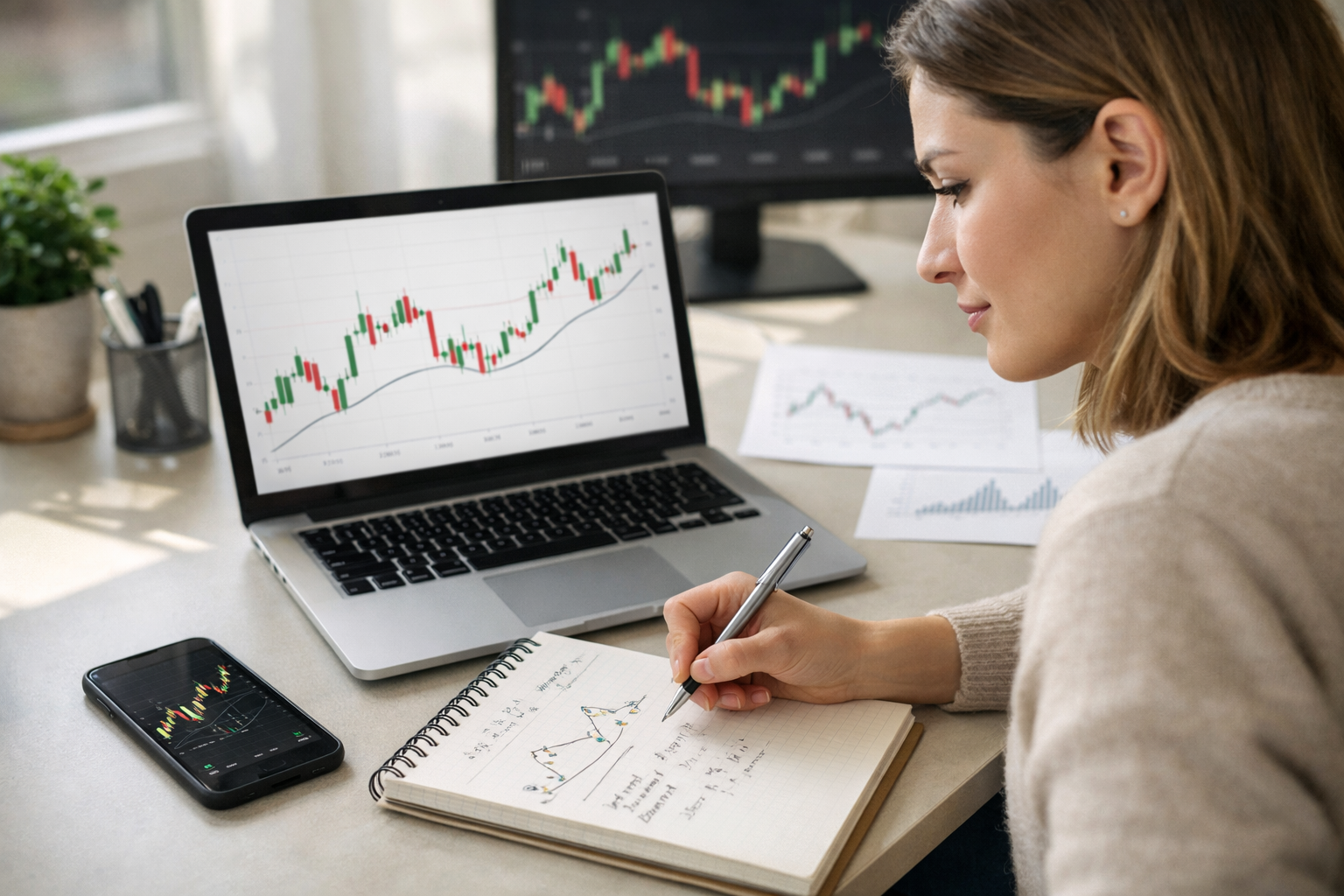
Start understanding how AI can support beginner trading decisions
AI for Complete Beginners Who Want to Explore Trading is a short, book-style course designed for people who are curious about artificial intelligence in finance but have no technical background. If words like machine learning, market data, signals, or automation feel confusing right now, that is completely fine. This course starts from zero and explains each idea in plain language, step by step.
The goal is not to turn you into a professional trader overnight. Instead, this course helps you understand how AI is used in trading, what these tools can and cannot do, and how to explore them responsibly. You will learn the core ideas behind AI-assisted trading without needing to code, build models, or study advanced math.
AI is becoming more visible in finance. Many apps, platforms, and services now promise smart alerts, automated decisions, price predictions, and market insights. For a beginner, this can be exciting, but it can also be overwhelming. Some tools are helpful. Others are exaggerated. Many are misunderstood.
This course gives you a practical foundation so you can tell the difference. You will learn how market data works, how AI looks for patterns, and why risk matters just as much as opportunity. By the end, you will have a clearer way to think about AI in trading and a better sense of what to explore next.
This course is organized like a short technical book with six connected chapters. Each chapter builds on the previous one. First, you will understand the basics of AI and trading. Next, you will learn how market data is collected and read. Then you will see how AI systems learn from patterns and where those systems can go wrong.
After that, the course introduces common AI tools used in trading, such as alerts, signal engines, bots, and sentiment tools. You will not be asked to build or code these systems. Instead, you will learn how to understand them as a beginner and how to ask smart questions before using them.
The final chapters focus on risk, ethics, common mistakes, and a realistic next-step plan. This makes the course practical and grounded, not just theoretical. It is designed to help you think clearly before spending time or money on AI trading products.
This course is ideal for complete beginners who want a simple introduction to AI in finance and trading. It is a strong fit for curious learners, new investors, career explorers, and non-technical professionals who want to understand the topic without getting lost in advanced language.
If you want a beginner-friendly starting point before trying more advanced courses, this is the right place to begin. You can Register free to start learning, or browse all courses if you want to compare related topics first.
One of the most important lessons in this course is that AI does not remove uncertainty from markets. It can help organize information, identify patterns, and support decisions, but it does not guarantee profit. Good learning starts with clear expectations, careful thinking, and strong habits around risk.
By the end of this course, you will not just know a few buzzwords. You will understand the basic logic behind AI trading tools, the limits of their predictions, and the steps beginners should take to explore this field more responsibly. That makes this course a solid first step for anyone who wants to enter the world of AI in finance with confidence and clarity.
Financial AI Educator and Data Analytics Specialist
Sofia Chen teaches beginners how to understand AI in practical business and finance settings. She has worked on data-driven decision tools and specializes in turning complex technical ideas into clear, step-by-step learning experiences.
Welcome to the starting point of your journey into AI trading. If you are completely new, this chapter is designed to give you a calm, practical foundation before you ever look at a charting tool, a trading bot, or a platform that promises “smart” automation. In finance, beginners often get overwhelmed by two things at the same time: market language and technology language. The goal here is to make both simpler. You do not need to be a programmer, mathematician, or professional trader to understand the basic ideas. You only need a clear mental model of what AI does, what trading is, and where the two connect.
At a basic level, trading means making decisions about buying or selling something that has a changing price. That “something” could be a stock, currency, commodity, exchange-traded fund, or even a digital asset. AI, in simple terms, refers to computer systems that look for patterns in data and use those patterns to help make decisions or predictions. When people combine AI and trading, they are usually trying to answer practical questions such as: Is the price likely to rise or fall? Is the market becoming more risky? Is trading volume changing in a meaningful way? Should a system wait, buy, sell, or do nothing?
This chapter introduces the language you will keep using throughout the course: price, trend, volume, volatility, data, prediction, and risk. You will also begin building the most important habit for safe learning: skepticism. Good traders and good engineers do not ask, “Can this system make money?” first. They ask, “What data is it using? What assumptions does it make? In what conditions does it fail? How much risk does it hide?” That mindset matters because AI trading tools are often marketed as if they are magic. They are not. They are tools built on historical data, human choices, and imperfect models.
As you move through this chapter, keep one idea in mind: beginner success does not mean quickly finding an automated system that never loses. Beginner success means understanding enough to evaluate claims carefully, avoid obvious mistakes, and build a realistic path toward more advanced learning. By the end of this chapter, you should be able to explain AI in everyday language, describe how markets move at a basic level, recognize common types of data used in AI trading tools, and understand why past market patterns can be useful without being guarantees. You should also start seeing why careful judgment matters more than excitement.
In other words, this is not a chapter about shortcuts. It is a chapter about building the right first layer of understanding. That layer will support everything else in the course, from reading indicators to evaluating platforms and recognizing risks that many beginners overlook.
Practice note for Understand what AI is in everyday language: document your objective, define a measurable success check, and run a small experiment before scaling. Capture what changed, why it changed, and what you would test next. This discipline improves reliability and makes your learning transferable to future projects.
Practice note for See how trading works at a basic level: document your objective, define a measurable success check, and run a small experiment before scaling. Capture what changed, why it changed, and what you would test next. This discipline improves reliability and makes your learning transferable to future projects.
Practice note for Connect AI ideas to market decisions: document your objective, define a measurable success check, and run a small experiment before scaling. Capture what changed, why it changed, and what you would test next. This discipline improves reliability and makes your learning transferable to future projects.
Practice note for Build a beginner mindset for learning safely: document your objective, define a measurable success check, and run a small experiment before scaling. Capture what changed, why it changed, and what you would test next. This discipline improves reliability and makes your learning transferable to future projects.
Artificial intelligence is a broad term, but for beginners, the simplest useful definition is this: AI is a way for computers to find patterns in data and use those patterns to support decisions. In trading, that usually means feeding a system large amounts of market information and asking it to learn what tends to happen before certain price moves, volatility spikes, or changes in trading activity. AI does not “think” like a human trader with intuition. It processes examples, measures relationships, and generates outputs based on what it has learned from data.
A practical way to understand AI is to compare it with an experienced shop owner. Imagine someone who has watched customer behavior for ten years. Without writing equations, that person notices patterns: rainy days reduce foot traffic, holidays increase demand, and certain promotions attract repeat buyers. AI works in a similar pattern-based way, except it uses computers to process much more information much faster. In trading, the “customers” are buyers and sellers, and the “shop signals” are price changes, volume, volatility, news flow, and other measurable inputs.
Not every automated system is advanced AI. Some tools use simple rules such as “buy when this moving average crosses that moving average.” That is automation, but not necessarily machine learning. Machine learning is a subset of AI where the system learns relationships from historical examples instead of relying only on fixed rules coded by a human. For example, a machine learning model might examine years of past prices, trading volume, and volatility to estimate the probability of an upward move over the next day. It is not certain knowledge. It is pattern-based estimation.
One of the biggest beginner mistakes is treating AI like a black box that must be trusted because it sounds sophisticated. In reality, AI systems are only as useful as their data, design choices, and testing process. If the training data is poor, the model can learn noise instead of useful patterns. If the market changes, a model that once worked may weaken. If the platform hides how decisions are made, the user may not know when the system is becoming unreliable. So the right beginner mindset is not fear or blind trust. It is informed curiosity. Ask what data goes in, what prediction comes out, and how performance is evaluated.
In everyday language, then, AI in trading is best understood as pattern-recognition software that helps convert market data into decision support. Sometimes it is simple. Sometimes it is complex. But it is never magic, and it always depends on assumptions that should be examined carefully.
Trading is the act of buying and selling financial assets in order to benefit from price changes. Unlike long-term investing, which often focuses on owning assets for years, trading usually pays more attention to shorter-term opportunities. A trader might hold an asset for months, days, hours, or even minutes. The exact timeframe varies, but the core idea remains the same: if you expect the price to rise, you may buy first and try to sell later at a higher price. In some markets, traders can also try to profit from falling prices by selling first and buying later.
People trade for different reasons. Some want income. Some want to grow capital faster than traditional savings methods. Some are hedging, which means protecting another position or business exposure. Institutions trade to manage portfolios, rebalance risk, or respond to economic events. Beginners often enter trading because they are attracted by flexibility and the possibility of data-driven decision-making. That attraction is understandable, but it becomes dangerous when people confuse possibility with consistency. Trading can offer opportunity, but it also involves uncertainty, losses, and psychological pressure.
At the heart of trading are a few basic concepts. Price is the amount buyers and sellers currently agree on. A trend is the general direction of price over time, such as upward, downward, or sideways. Volume measures how much of an asset has been traded in a given period. Volatility describes how much and how quickly prices move. These ideas matter because AI tools often use them as inputs. A system may notice, for example, that a strong upward trend with rising volume behaves differently from a weak upward move with low participation. Or it may detect that a period of unusually high volatility requires more caution.
Another important beginner idea is that trading is not only about predicting direction. Good trading also involves timing, position size, and risk control. Even a system that is “right” slightly more than half the time can fail if it takes oversized losses or enters trades in unstable conditions. This is where engineering judgment begins to matter. A practical workflow does not start with asking, “What should I buy?” It starts with, “What market am I looking at? What data do I trust? What is the expected behavior? What happens if I am wrong?”
So why do people trade? Because prices move, data is available, and patterns sometimes repeat often enough to create opportunity. But trading is never just buying and hoping. It is a structured activity built on observation, decision-making, and risk management. That is exactly why AI became interesting in this field: markets generate large amounts of data, and computers are good at processing data at scale.
To understand AI trading, you first need a simple picture of how markets work. A market is a place, physical or digital, where buyers and sellers meet to exchange assets. Every trade happens because one side wants to buy and another side is willing to sell at a certain price. Price movement is not random in the sense of appearing from nowhere. It happens because supply and demand are constantly shifting. If more buyers are eager than sellers, price may rise. If sellers become more aggressive, price may fall.
Prices move in steps as orders enter the market. News, earnings reports, interest rates, economic data, and trader behavior can all influence those orders. But even when a visible reason is not obvious, price still reflects competition between participants with different goals. Some are speculating. Some are hedging. Some are rebalancing large portfolios. Some are reacting emotionally. This is important because AI systems do not need to understand human motives in a personal way. They only need measurable traces of behavior in the data.
Several types of data are commonly used in AI-driven trading tools. The most basic is price data, often represented as open, high, low, and close values over time. Volume data shows how active the market was. Volatility data measures how widely price is moving. Some systems use order book data, which shows bids and offers waiting in the market. Others include news sentiment, macroeconomic releases, company fundamentals, or social-media signals. A beginner does not need to master every data type yet, but should understand that AI systems learn from inputs, and different inputs lead to different strengths and weaknesses.
A key lesson here is that data is never automatically useful just because there is a lot of it. More data can improve a model only if the data is relevant, clean, and connected to the decision being made. For example, using delayed or low-quality data in a fast-moving market can produce poor predictions. Likewise, using too many noisy signals may make a model look smart in historical testing but weak in live conditions. Beginners often underestimate this issue. In practice, selecting and understanding inputs is one of the most important parts of building or evaluating an AI trading system.
When you see prices changing on a chart, think of it as the visible result of many buyers and sellers expressing opinions through orders. AI tries to learn from those visible results and the data surrounding them. That is the bridge between market mechanics and machine learning.
Many beginners imagine AI trading as a robot that simply receives money and starts making perfect decisions. Real workflows are much more structured. AI usually fits into one or more stages of the trading process rather than replacing everything. A typical workflow starts with data collection: price history, volume, volatility, news, or other indicators. Then the data is cleaned and organized so the model can use it. After that, a prediction or classification model may be trained on historical examples. The system is tested, adjusted, and only then considered for use in live decisions.
In a practical trading setup, AI can help in several ways. It can generate signals, such as predicting whether short-term price direction is more likely up or down. It can rank opportunities, for example sorting assets by momentum strength or anomaly score. It can estimate risk by identifying unusual volatility conditions. It can also support execution, helping decide how to place orders efficiently. Notice that not all of these jobs involve predicting the future directly. Some involve filtering, organizing, or monitoring information faster than a human can.
Here is a beginner-friendly way to think about how a simple prediction system learns from past market patterns. First, it receives examples from history. Each example includes inputs, such as recent price changes, volume, and volatility, plus an outcome, such as whether price rose over the next day. The system then adjusts itself to reduce errors across many examples. In effect, it learns which combinations of inputs were often followed by certain outcomes. After training, it can analyze new data and output a probability, score, or classification. But this does not mean it understands causes with certainty. It means it has found statistical relationships that may or may not hold in the future.
Engineering judgment matters at every stage. Was the model trained on enough data? Was the testing period separate from the training period? Were transaction costs considered? Was the system tuned so aggressively that it only fits the past? This last problem, called overfitting, is one of the most common reasons AI trading systems disappoint. A model can appear excellent on old data simply because it memorized historical noise. Good workflow design tries to prevent that by using disciplined validation and realistic assumptions.
For a beginner evaluating AI platforms, a useful framework includes five questions: What data does it use? What task is the AI performing? How is performance measured? What risks are disclosed? How much control does the user keep? Platforms that avoid these questions deserve caution. The safest mindset is to treat AI as a decision-support layer inside a broader workflow that still requires human oversight.
One reason this subject attracts so many beginners is that AI sounds powerful, modern, and profitable. Unfortunately, that also makes it easy to market unrealistic promises. A very common myth is that AI can remove risk from trading. It cannot. Risk is built into markets because the future is uncertain, prices react to new information, and participant behavior changes. AI may help measure or manage risk better, but it cannot eliminate it. Any platform that suggests otherwise should be treated skeptically.
Another myth is that more complexity always means better performance. Beginners often assume that a deep neural network must be superior to a simpler model because it sounds more advanced. In reality, the best model is the one that works reliably for the task, data quality, timeframe, and market conditions involved. Sometimes a simple system is more stable, easier to monitor, and less likely to overfit. Complexity without understanding can become a liability rather than an advantage.
A third myth is that strong past results prove future success. Historical backtests are useful, but they are not guarantees. Markets evolve. Regulations change. Costs matter. Crowd behavior shifts. A model trained on one environment may struggle in another. Many poor systems look excellent because they were tested under unrealistic assumptions, such as perfect trade execution, zero slippage, or data that would not have been available in real time. Beginners should learn to ask whether a result is realistic, not just whether it is impressive.
Perhaps the most dangerous myth is that AI trading is an easy path for people who do not want to learn the basics. In truth, AI makes understanding more important, not less. If you do not understand market concepts like trends, volume, and volatility, you will struggle to judge whether an AI system is behaving sensibly. If you do not understand risk, you may hand control to a platform that hides losses behind attractive marketing. The practical lesson is simple: use AI to support disciplined decision-making, not to escape responsibility.
The best way to begin learning AI trading safely is to set expectations that match reality. Your first goal is not to build a profitable bot immediately. Your first goal is to understand the environment well enough to ask better questions. That means learning what market data represents, what AI models actually do, and what kinds of failure are common. A beginner who learns slowly but clearly is in a much stronger position than someone who rushes into live trading after watching a few promotional videos.
A practical beginner mindset includes four habits. First, focus on concepts before tools. Learn what price, trend, volume, and volatility mean before comparing platforms. Second, separate prediction from certainty. Even a useful model only provides probabilities, not guarantees. Third, evaluate systems as workflows, not slogans. Ask how the system gets data, makes decisions, sizes trades, and handles losses. Fourth, protect capital by starting with observation, simulation, or paper trading before risking real money.
You should also expect that mistakes will happen. In fact, one of the safest ways to learn is to study common beginner errors before making them. These include trusting backtests without understanding assumptions, using too many indicators at once, changing strategies too quickly, ignoring fees, and believing that recent success proves long-term reliability. Another common error is treating AI outputs as instructions instead of inputs. A model signal should be one part of a decision process, especially early in your learning.
When evaluating AI trading platforms, use a simple checklist. Does the platform explain what data it uses? Does it show how it measures performance beyond raw return? Does it discuss drawdowns, risk limits, and failure conditions? Can you control settings, or is everything hidden? Is the marketing educational or overly emotional? These questions help you move from being impressed by technology to judging it responsibly.
By the end of this chapter, your most important practical outcome is not technical mastery. It is a safer mental framework. You now know that AI in trading is about pattern recognition, that markets move because buyers and sellers interact through price, that data quality matters, that models learn from past examples without guaranteeing the future, and that risk never disappears just because a system is automated. That understanding is the right first step. From here, you can continue learning with confidence, caution, and much better judgment.
1. In everyday language, what does AI mean in this chapter?
2. At a basic level, what is trading?
3. Which question reflects the safe beginner mindset encouraged in the chapter?
4. How does the chapter describe the connection between AI and trading?
5. Why can past market patterns be useful but not guaranteed?
If AI trading tools are the engine, market data is the fuel. Beginners often focus on predictions first, but strong predictions only come after learning what information the market produces every day. Before any model can suggest a trade, it must read records of price changes, trading activity, market events, and sometimes even public opinion. In practice, this means that understanding market data is one of the most important early skills in AI-assisted trading.
This chapter gives you a beginner-friendly map of the data world. You will learn how to read the most common types of market information, understand price charts without heavy technical jargon, and recognize the simple signals traders often watch. Just as importantly, you will see why data quality matters so much for AI. A system trained on weak, incomplete, delayed, or messy data can look intelligent on the surface while making poor decisions underneath.
Think of market data as a stream of observations collected over time. At the most basic level, you have price and time: what an asset traded at, and when. Then you add volume, which tells you how much activity happened. Then you may add context such as company news, economic events, analyst reports, and market sentiment from headlines or social platforms. AI tools combine some or all of these inputs to search for patterns that repeat often enough to be useful.
Engineering judgment matters here. A beginner may assume that “more data” always means “better results,” but that is not automatically true. Useful data should be relevant, timely, clean, and connected to the question being asked. If your goal is to predict short-term price movement, a delayed daily dataset may be much less helpful than a properly timestamped minute-by-minute feed. If your goal is to understand long-term investor behavior, too much short-term noise may distract the model rather than help it.
As you read this chapter, keep one practical idea in mind: every AI trading platform is built on inputs. When evaluating a tool, ask simple questions. What data does it use? How recent is that data? Is the source reliable? Does the tool explain whether it uses price only, or also volume, news, and sentiment? These questions help you look past marketing language and judge the system more carefully.
By the end of this chapter, you should be able to read common market information more confidently and understand why data quality is a serious issue in AI-driven trading. That foundation will make later lessons on signals, prediction systems, and platform evaluation much easier to understand.
Practice note for Read the most common types of market information: document your objective, define a measurable success check, and run a small experiment before scaling. Capture what changed, why it changed, and what you would test next. This discipline improves reliability and makes your learning transferable to future projects.
Practice note for Understand price charts without technical jargon: document your objective, define a measurable success check, and run a small experiment before scaling. Capture what changed, why it changed, and what you would test next. This discipline improves reliability and makes your learning transferable to future projects.
Practice note for Learn what signals traders look for: document your objective, define a measurable success check, and run a small experiment before scaling. Capture what changed, why it changed, and what you would test next. This discipline improves reliability and makes your learning transferable to future projects.
Practice note for See why data quality matters for AI: document your objective, define a measurable success check, and run a small experiment before scaling. Capture what changed, why it changed, and what you would test next. This discipline improves reliability and makes your learning transferable to future projects.
The simplest market record answers a small set of questions: what was the asset, what price did it trade at, when did the trade happen, and how much was traded? These details form the basic language of trading data. Whether you are looking at a stock, cryptocurrency, currency pair, or commodity, AI systems usually begin with these raw records before creating any higher-level signals.
Price is the value buyers and sellers agree on at a moment in time. Time is just as important, because prices mean very little without knowing when they occurred. A stock at $100 today is not the same story as a stock at $100 six months ago. AI models learn by comparing sequences over time, so proper timestamps are essential. A missing or misaligned time record can distort what the system thinks happened first and what happened next.
Many platforms also store open, high, low, and close values for a chosen time period such as one minute, one hour, or one day. These are often called OHLC records. Even as a beginner, you do not need to memorize jargon to use them. Just remember that they summarize where price started, where it went, and where it ended during a period. This gives AI systems a compact way to understand movement without processing every individual trade.
In real workflows, these records are collected from exchanges, brokers, or data vendors. Good engineering judgment means checking whether the source is trustworthy and whether the timing matches your strategy. If a platform claims fast AI trading but relies on delayed data, that is a warning sign. Another common mistake is mixing data from different markets without checking if the timestamps use the same time zone or trading session. Clean records of price and time are the first step toward any reliable trading analysis.
Charts are visual tools that turn rows of market data into something humans can read quickly. For beginners, the goal is not to become a chart expert overnight. The goal is to understand what a chart is showing in plain language. A line chart usually connects closing prices over time. This makes it easy to see the general direction of the market. If the line rises steadily, price has generally moved up. If it falls, price has generally moved down. If it moves sideways, the market may be undecided.
Candlestick charts show more detail. Each candle represents a time period and shows where price opened, how high it went, how low it went, and where it closed. You do not need complicated pattern names to get value from candles. A large candle often means strong movement in that period. A small candle often means limited movement. A candle with a long upper or lower wick suggests price moved away from one level and then came back.
For AI, charts are not magic pictures. They are simply visual summaries of underlying data. Traders often look for repeated behaviors in charts because the shape reflects buying and selling pressure. An AI system may translate those same chart structures into numbers and use them as input features. For example, it may measure whether the last few candles were mostly rising, whether price is near a recent high, or whether movement has slowed down.
A common beginner mistake is assuming a chart pattern guarantees what comes next. It does not. Charts help you organize information and spot possible signals, but they cannot remove uncertainty. In practice, simple chart reading means asking: Is price generally rising, falling, or ranging? Has movement become faster or slower? Is the market behaving calmly or suddenly? These basic observations are much more useful than memorizing dozens of pattern names without understanding what they represent.
Price alone does not tell the full story. Traders also pay attention to volume, volatility, and trend because these help explain the character of market movement. Volume is the amount of trading activity during a period. High volume often means many participants are active and interested. Low volume can suggest limited participation and weaker conviction. If price moves sharply upward on strong volume, traders may view that move as more meaningful than the same move on very low volume.
Volatility describes how much price swings up and down. Some markets move smoothly for long periods, while others jump rapidly. For AI systems, volatility matters because it changes the difficulty of prediction. In calm periods, small patterns may be easier to detect. In wild periods, noise can overwhelm signals. A model trained only on quiet market conditions may perform poorly when volatility suddenly rises.
Trend is the broader direction of movement. An uptrend means prices have generally been moving higher over time. A downtrend means the opposite. A sideways market has no clear direction. Beginners often search for perfect turning points, but in practice many systems are simply trying to estimate whether the current environment is more likely to continue or reverse. That is why trend matters so much in both human trading and AI-driven tools.
These three ideas often work together as practical signals. Rising prices with rising volume can show strength. A trend that continues while volatility stays controlled may look healthier than one driven by erratic spikes. But there are no guaranteed formulas. One common mistake is using volume or volatility from one market as if it means the same thing everywhere. Another is ignoring the timeframe. A strong trend on a daily chart may still contain noisy pullbacks on a five-minute chart. Always match the signal to the timeframe and strategy you are using.
Not all useful market data comes from charts. Markets also react to company earnings, interest rate decisions, inflation reports, product launches, regulation changes, and unexpected world events. This information is often called fundamental or event-driven data. For an AI system, such inputs can provide context that price history alone may miss. A sudden price jump might look random if you only read the chart, but it may make more sense if a major earnings surprise or policy announcement happened at the same time.
Sentiment data is another layer. This refers to an attempt to measure the mood of the market using headlines, analyst commentary, financial news, forums, or social media posts. A basic AI system may classify text as positive, negative, or neutral and look for patterns between market mood and future price moves. This sounds powerful, but it comes with difficulty. Human language is messy. Sarcasm, rumor, repetition, and emotional overreaction can all confuse a model.
A practical workflow is to treat news and sentiment as supporting evidence, not as perfect truth. For example, if price is already weakening and negative headlines begin to increase, an AI tool might see that as confirming pressure. But if a news source is unreliable or slow, the signal may be too noisy to help. Timing is critical. In fast markets, information that arrives even a little late may already be reflected in price.
Beginners should also know that more context can create more complexity. It is easy to be impressed by platforms that claim to scan millions of articles, but the important question is whether that information improves decisions. Good engineering judgment asks whether the text source is relevant, whether the timestamps are accurate, and whether the market actually responds to that kind of information in a measurable way. Useful context is valuable. Unfiltered chatter is not the same as high-quality data.
Data quality is one of the biggest hidden factors in AI trading. Clean data is accurate, complete, correctly timed, and formatted in a consistent way. Noisy data includes errors, gaps, duplicates, strange spikes, missing timestamps, or information that has little real connection to the prediction task. A beginner might assume the model will automatically fix these problems, but in reality poor inputs often produce misleading outputs.
Imagine a price feed that occasionally skips values or records a wrong trade far above the real market. A human might notice the mistake by glancing at the chart. An AI system may instead treat that error as an important event and learn the wrong lesson from it. The same issue appears in sentiment data when spam posts or copied headlines make a topic look far more important than it really is. If the dataset is not cleaned, the model may learn patterns that do not exist in live trading.
Data cleaning usually includes checking for missing values, aligning timestamps, removing duplicates, filtering obvious errors, and making sure records from different sources match correctly. This is not glamorous work, but it is essential. In professional workflows, a large amount of effort goes into preparing data before any model training begins. That is because bad preparation can ruin even a well-designed algorithm.
One common beginner mistake is overtrusting a platform because its charts look polished. Attractive design does not guarantee clean data underneath. Another mistake is mixing different data frequencies carelessly, such as combining daily news labels with minute-level prices without thinking about timing. Practical outcome: when evaluating AI trading tools, ask how they handle missing data, corrections, and source reliability. If a provider cannot explain its data process clearly, be cautious. Strong AI starts with disciplined data handling, not just clever marketing claims.
AI models learn from examples. If the examples are relevant and well prepared, the model has a better chance of discovering useful patterns. If the examples are weak, inconsistent, or misleading, the model may still produce predictions, but those predictions can be unreliable. This is why people often say “garbage in, garbage out.” In trading, better inputs do not remove risk, but they improve the foundation on which decisions are made.
Think about a beginner prediction system trying to estimate whether tomorrow’s price will be higher or lower. If it only receives random fragments of price history, it may struggle. If instead it receives correctly ordered price records, volume, recent volatility, and properly timed event data, it has a clearer picture of market conditions. The model still cannot see the future with certainty, but it can learn from better evidence. Better inputs create a better learning environment.
This idea also helps you evaluate AI trading platforms more carefully. A useful beginner framework is simple. First, ask what data goes in. Second, ask how that data is cleaned and updated. Third, ask whether the inputs fit the platform’s stated purpose. Fourth, ask how the system behaves when conditions change, such as during major news or extreme volatility. A platform that cannot answer these questions may be relying more on presentation than substance.
There is also an important limit to remember: better inputs do not guarantee profits. Markets change, patterns fade, and unexpected events break historical relationships. AI-assisted trading is not about certainty. It is about improving the quality of decisions under uncertainty. The practical outcome of this chapter is that you should now see market data as the raw material behind every signal, chart, and prediction. If you learn to inspect that raw material carefully, you will make better judgments about both trading ideas and the AI tools that claim to support them.
1. Why is understanding market data considered an important early skill in AI-assisted trading?
2. Which combination best describes the most basic market data mentioned in the chapter?
3. What is the main warning about assuming that more data always leads to better AI trading results?
4. According to the chapter, how should beginners think about charts?
5. Why can bad data be especially harmful in AI-driven trading?
In the previous parts of this course, you learned that markets produce streams of data such as price, volume, and volatility, and that AI in trading is really about using that data to help make decisions. This chapter moves one step deeper. We will look at how simple prediction systems learn from examples, why that is different from a fixed rule system, and why not every pattern that looks impressive is actually useful.
For complete beginners, the most important idea is this: AI does not magically know what a market will do next. It studies past examples, measures relationships between inputs and outcomes, and builds a model that tries to estimate what may happen in the future. In trading, those inputs might include recent price changes, average volume, trend direction, or volatility. The outcome might be a simple label such as “price moved up tomorrow” or “price moved down.”
That sounds straightforward, but the real skill is in judging whether the system has learned something meaningful or whether it has simply memorized noise. This is where practical engineering judgment matters. A beginner can easily be impressed by a platform showing high historical accuracy, but a more careful user asks: What data was used? Was the model tested fairly? Does the pattern make economic sense? Can it survive changing market conditions?
As you read, keep one mental picture in mind. Imagine teaching a new employee to recognize setups on a chart. You would show examples, explain what happened next, and hope the employee learns the underlying pattern rather than memorizing only a few screenshots. AI learning works in a similar way. The quality of the examples, the clarity of the target, and the realism of the testing process all affect the final result.
By the end of this chapter, you should be able to describe how a beginner-level AI trading model is trained, explain why overfitting is dangerous, and evaluate AI trading claims with more caution. That understanding will help you use AI tools more responsibly and avoid one of the most common mistakes in trading education: confusing pattern recognition with certainty.
Practice note for Understand learning from examples: document your objective, define a measurable success check, and run a small experiment before scaling. Capture what changed, why it changed, and what you would test next. This discipline improves reliability and makes your learning transferable to future projects.
Practice note for Compare rules-based tools and AI models: document your objective, define a measurable success check, and run a small experiment before scaling. Capture what changed, why it changed, and what you would test next. This discipline improves reliability and makes your learning transferable to future projects.
Practice note for Explore simple prediction ideas: document your objective, define a measurable success check, and run a small experiment before scaling. Capture what changed, why it changed, and what you would test next. This discipline improves reliability and makes your learning transferable to future projects.
Practice note for Know the difference between useful patterns and random noise: document your objective, define a measurable success check, and run a small experiment before scaling. Capture what changed, why it changed, and what you would test next. This discipline improves reliability and makes your learning transferable to future projects.
Practice note for Understand learning from examples: document your objective, define a measurable success check, and run a small experiment before scaling. Capture what changed, why it changed, and what you would test next. This discipline improves reliability and makes your learning transferable to future projects.
Practice note for Compare rules-based tools and AI models: document your objective, define a measurable success check, and run a small experiment before scaling. Capture what changed, why it changed, and what you would test next. This discipline improves reliability and makes your learning transferable to future projects.
A useful way to begin is to compare two styles of trading systems: rules-based tools and machine learning models. A rules-based tool follows explicit instructions created by a human. For example, a trader might say: “Buy when the 10-day moving average crosses above the 20-day moving average, and sell when it crosses back below.” The computer is not learning in this case. It is simply executing a recipe.
A machine learning model works differently. Instead of being told the exact rule, it is shown many examples. It receives inputs such as recent returns, trend strength, trading volume, and volatility, along with the known outcome that happened after those conditions. The model then tries to estimate a relationship between those inputs and the later result. In simple terms, it learns what combinations of signals have often come before a rise, a fall, or no meaningful move.
Neither approach is automatically better. Rules-based systems are often easier for beginners to understand, test, and explain. Machine learning can be more flexible because it can combine many inputs and detect interactions that are hard to express as one clean rule. But that flexibility also creates risk. A model can appear smart while quietly learning patterns that do not generalize well.
In practice, many trading platforms mix both ideas. They may use human-designed features such as moving averages or momentum indicators, then feed those into an AI model. This matters because when a company advertises “AI trading,” the product may not be fully autonomous or mysterious. Often it is a structured workflow: collect market data, calculate indicators, train a model, score new market conditions, and produce a prediction.
A common beginner mistake is assuming AI means the machine thinks like a person. It does not. It calculates. It searches for statistical relationships in historical examples. Your job as a user is to understand what kind of system you are looking at. Ask whether the tool follows fixed rules, learns from data, or combines both. That simple distinction helps you judge claims more clearly and keeps you grounded when marketing language becomes exaggerated.
If machine learning learns from examples, then the examples matter enormously. In trading, training data usually comes from historical market records. These records may include open, high, low, and close prices, volume, volatility measures, economic releases, news sentiment scores, or basic company metrics. The model studies these past observations and compares them with what happened next.
Think of each training example as one row in a spreadsheet. The columns on the left are the inputs: for instance, the last five days of returns, average volume, and recent volatility. The column on the right is the target outcome: perhaps whether the price closed higher over the next day or the next week. By seeing many rows, the model tries to learn patterns that link the left side to the right side.
Good pattern learning depends on three practical choices. First, the data must be relevant. If you are trying to forecast short-term price movement, then stale annual data may be less useful than recent price and volume behavior. Second, the data must be clean. Missing values, bad timestamps, split-adjustment errors, or incorrect labels can quietly damage the entire model. Third, the examples must cover different market conditions, including trends, crashes, sideways periods, and high-volatility environments.
This is where engineering judgment enters. A beginner may think “more data is always better,” but that is not always true. More low-quality data can produce worse results than less high-quality data. Also, patterns from one asset class or one market period may not transfer well to another. A model trained only during a bull market may look excellent until the regime changes.
Another common mistake is using future information by accident. For example, if a dataset includes the full-day high while pretending to make a prediction at the market open, the model is cheating. This is called data leakage. It creates inflated results and false confidence. When evaluating AI tools, one of the smartest beginner questions is: “What information was truly available at the moment the prediction was made?”
Useful patterns usually have a logic behind them. Rising volume during a breakout may reflect stronger participation. Expanding volatility may signal uncertainty. A sudden acceleration after a long trend may suggest exhaustion or continuation depending on context. AI can help measure these effects, but it still depends on whether the training examples reflect a real and repeatable market behavior.
At a beginner level, a prediction model can be understood as a mapping from inputs to outputs. Inputs are the information the model receives. Outputs are the prediction it produces. In trading, the output does not need to be complicated. It might be a probability that tomorrow closes higher, an estimate of the next day’s return, or a classification such as bullish, neutral, or bearish.
Suppose a simple model takes three inputs: the last three days of price change, average volume over ten days, and recent volatility. It then outputs a probability, such as 62%, that the next day will close above today’s close. Notice what this means. The model is not promising a profit. It is not saying the market must rise. It is estimating based on similar examples in the past.
This small distinction is important because beginners often misunderstand predictions as commands. A trading decision still requires judgment. If a model predicts a small edge but the market is highly volatile, transaction costs are high, or a major news event is approaching, acting on that prediction may not make sense. Good trading systems connect predictions to risk management, position sizing, and execution rules.
Simple forecasting workflows usually look like this: gather historical market data, choose a target such as next-day direction, create input features, divide the data into training and testing periods, train the model, and then evaluate how it performs on unseen data. If the results remain reasonable, the model can be used to generate new predictions on incoming market data.
Practical beginners should also understand that not all outputs are equally useful. A direction forecast may be easier to interpret than a precise price target. For many trading tasks, estimating the chance of an up move versus a down move is already enough. Simpler targets can reduce confusion and make it easier to judge whether the model is adding real value.
When reviewing an AI trading platform, ask what the model actually predicts. Does it forecast direction, return size, volatility, or something else? How far ahead is the forecast horizon? A system built for one-hour moves may be useless for a long-term investor. Matching the output to the trading objective is one of the most practical habits you can develop.
Overfitting is one of the most important ideas in AI trading, and it explains why many systems look brilliant in the past and disappointing in live use. A model is overfitted when it learns the training data too closely, including accidental quirks and random noise, instead of learning the broader pattern that is likely to repeat.
Imagine a student memorizing the answers to one practice test without understanding the subject. That student may score perfectly on the same questions but perform poorly on a new exam. An overfitted model behaves the same way. It can appear highly accurate on historical data it has effectively memorized, then fail when market conditions shift even slightly.
Overfitting often happens when the model is too complex for the amount or quality of data available. It can also happen when a trader tests too many strategies until one happens to look good by luck. The more combinations, filters, and indicators you try, the greater the chance you will discover a pattern that is only random chance wearing a convincing disguise.
Beginners can watch for warning signs. Extremely high historical accuracy is not automatically impressive. A strategy that performs well only in one short period, or only after many tweaks, deserves skepticism. If the explanation for why the pattern works is vague or changes every time results weaken, that is another warning sign.
A basic defense against overfitting is to separate training data from testing data. Train the model on one period, then evaluate it on later unseen periods. Better still, test it across different market environments. Keep the design simple enough to explain. Fewer variables and clearer logic often generalize better than a complex black box built from dozens of weak signals.
Engineering judgment matters here more than raw software skill. The goal is not to build the most complicated model. The goal is to build one that survives contact with reality. In trading, modest but stable performance is usually more valuable than a glamorous backtest created by overfitting noise.
You will often hear the phrase “past performance does not guarantee future results.” In AI trading, this is not legal language only; it is a practical truth. Machine learning depends on historical examples, but markets are adaptive systems. Participants react to news, regulation changes, technology improves, liquidity shifts, and once-profitable patterns can weaken as more traders exploit them.
A model may learn that under certain combinations of momentum and volume, prices tended to rise over the next day. That pattern might work for a while, then fade. Why? Maybe market structure changed. Maybe transaction costs increased. Maybe the pattern became crowded. Maybe it was partly luck from the start. Historical success is useful evidence, but it is never proof.
This is why a serious evaluation goes beyond asking whether a model worked in the past. You should also ask whether the pattern makes sense, whether it has been tested across multiple periods, and whether the expected edge is large enough to survive trading friction. A tiny advantage in a clean spreadsheet can disappear after slippage, fees, and delays are included.
Another practical issue is regime change. Markets do not behave the same way in every environment. Trend-following signals may work better in sustained directional markets. Mean-reversion ideas may work better in quieter ranges. During crisis periods, correlations can change quickly and old assumptions may break. A model trained on yesterday’s regime may misread today’s one.
For beginners, the right mindset is to treat historical results as a starting point for investigation, not a final verdict. Strong backtests can earn attention, but they should trigger more questions, not less. How stable were the results? Were there long losing periods? Did the model handle different volatility conditions? Was the testing process realistic?
This cautious mindset helps you evaluate AI trading platforms more carefully. If a provider highlights only impressive charts and hides methodology, assume the picture is incomplete. Responsible users look for transparency, realistic limitations, and evidence that the developers understand uncertainty instead of pretending to eliminate it.
By now, you can see that an AI prediction is best treated as one input into a decision process, not as an oracle. If a platform says there is a 70% chance of an upward move, that still leaves a meaningful chance of being wrong. In trading, even a model with a genuine edge can lose repeatedly over short periods. Beginners who expect constant correctness often abandon good discipline or chase risk after a few losses.
Interpreting predictions well means asking practical questions. What is the confidence level? What is the forecast horizon? How often is the model updated? Does it perform similarly across different assets, or only on a narrow set? Is the prediction linked to an explanation, such as momentum strengthening or volatility expanding, or is it presented as a mystery number?
It also means understanding the difference between signal quality and decision quality. A decent signal can still lead to a poor trade if position size is too large or if you enter during a chaotic news event. Likewise, a weak signal may not be worth trading at all. The model may suggest a slight edge, but if the reward-to-risk profile is poor, the smart action may be to do nothing.
One of the best habits for beginners is to keep a structured evaluation framework. Look at the data source, the target being predicted, the testing method, the costs assumed, and the conditions where performance weakens. This framework helps you separate credible tools from polished marketing. It also keeps you from making a common mistake: trusting the output without understanding the process.
In the real world, good users of AI in trading stay humble. They recognize that models can support analysis, highlight patterns, and improve consistency, but they also accept the limits. Random noise exists. Market conditions change. Human judgment is still needed to manage risk, question assumptions, and decide when not to trade.
The practical outcome of this chapter is simple but powerful: you now have a beginner’s mental model for how AI learns from market patterns and why caution matters. That understanding does not make you a quantitative expert yet, but it gives you the right foundation. You can now look at AI trading claims with sharper eyes, ask better questions, and avoid confusing a historical pattern with a dependable future truth.
1. How does a beginner-level AI trading model mainly learn?
2. What is the key difference between a rules-based tool and an AI model?
3. Which example best describes simple forecasting in trading?
4. Why is overfitting dangerous in AI trading?
5. When evaluating a strong AI trading claim, what is the most careful response?
When beginners hear the phrase AI trading, they often imagine a mysterious machine that knows the future. In practice, most AI tools in trading are much more ordinary and much more useful than that. They help traders sort large amounts of market data, notice patterns faster, send alerts, rank possible opportunities, and in some cases automate simple actions. A good beginner mindset is this: AI usually does not replace judgement; it changes how information is collected, organized, and acted on.
In real trading workflows, AI tools often sit between raw market data and a trader's final decision. Prices, volume, volatility, earnings reports, chart patterns, economic releases, news headlines, and even social media posts can be turned into inputs. The AI system then scores, classifies, filters, or predicts something about those inputs. The output may be a dashboard, an alert, a buy or sell signal, a ranked list of assets, or an automated order sent to a broker. Understanding that chain helps beginners evaluate what a platform truly does instead of being impressed by marketing language.
This chapter introduces the most common AI tools used in trading and explains what they are actually doing behind the scenes. You will learn to recognize practical features such as screeners, smart alerts, recommendation engines, sentiment tools, and trading bots. You will also see the difference between alerts, signals, and full automation. That distinction matters because each step adds convenience, but also adds risk if the tool is poorly designed or blindly trusted.
Another goal of this chapter is to build engineering judgement. A beginner does not need to know advanced math to ask smart questions. What data does the tool use? How often is it updated? Does it explain why it made a recommendation? Can it be tested in a demo account? Does it promise guaranteed profits? Tools that are transparent, limited, and testable are usually safer than tools that sound magical. In trading, the more certain a platform sounds, the more careful you should become.
As you read, keep one practical idea in mind: a useful AI trading tool should improve your process, not shut down your thinking. The strongest beginner outcome is not finding a robot to copy. It is learning how to evaluate tools, recognize exaggeration, and use automation only where the logic is clear.
Practice note for Recognize common AI tools and features: document your objective, define a measurable success check, and run a small experiment before scaling. Capture what changed, why it changed, and what you would test next. This discipline improves reliability and makes your learning transferable to future projects.
Practice note for Understand alerts, signals, and automation basics: document your objective, define a measurable success check, and run a small experiment before scaling. Capture what changed, why it changed, and what you would test next. This discipline improves reliability and makes your learning transferable to future projects.
Practice note for Learn what trading bots actually do: document your objective, define a measurable success check, and run a small experiment before scaling. Capture what changed, why it changed, and what you would test next. This discipline improves reliability and makes your learning transferable to future projects.
Practice note for Evaluate promises made by AI platforms: document your objective, define a measurable success check, and run a small experiment before scaling. Capture what changed, why it changed, and what you would test next. This discipline improves reliability and makes your learning transferable to future projects.
Practice note for Recognize common AI tools and features: document your objective, define a measurable success check, and run a small experiment before scaling. Capture what changed, why it changed, and what you would test next. This discipline improves reliability and makes your learning transferable to future projects.
Practice note for Understand alerts, signals, and automation basics: document your objective, define a measurable success check, and run a small experiment before scaling. Capture what changed, why it changed, and what you would test next. This discipline improves reliability and makes your learning transferable to future projects.
Many beginners first encounter AI in trading through screeners and dashboards. A screener filters a large market into a smaller list based on rules. Traditional screeners might look for stocks above a certain price or with high volume. AI-enhanced screeners go one step further by ranking or grouping opportunities based on patterns learned from historical data. For example, instead of simply showing all stocks with unusual volume, the tool may score which ones most resemble past breakout setups.
Dashboards bring multiple signals together in one place. A good dashboard might combine price trend, recent volatility, earnings calendar, news activity, and market sentiment. The AI element often appears in how those pieces are summarized. Rather than forcing you to read ten charts, the tool might label an asset as high momentum with elevated event risk. This can save time, but it can also hide detail, so beginners should always be able to drill down and inspect the raw information behind the summary.
Smart alerts are one of the most practical features for new traders. An alert is simply a notification triggered when something important happens. That event could be a price crossing a level, volume suddenly increasing, or a news topic appearing. AI-based alerts may be more adaptive. Instead of using a fixed rule, they may learn what counts as unusual behavior for a specific asset. A 2% move might be normal for one market and dramatic for another, so a smarter alert tries to account for context.
In workflow terms, these tools are useful for monitoring many instruments without watching screens all day. A beginner might set a dashboard to track a watchlist, use a screener to narrow candidates, and rely on alerts to know when conditions change. The practical benefit is focus. The common mistake is assuming that being alerted means a trade should be taken immediately. Alerts are attention tools, not automatic proof that an opportunity is good.
If a platform claims its alert system catches every winning move, that is a warning sign. Real markets are messy. Good alert tools improve awareness; they do not remove uncertainty.
Recommendation engines and trade signals are often where AI marketing becomes most aggressive. A recommendation engine takes market inputs and produces a judgment such as bullish, bearish, hold, or a ranked list of assets that may deserve attention. A trade signal is more specific. It may say to buy a certain asset, sell it, or watch for a precise entry and exit level. The difference matters because the more specific the output, the more responsibility the tool is taking on.
These systems are usually trained on past market patterns. They may use technical indicators, price history, volatility, order flow, macro data, or sentiment data. Some tools combine many features and assign probabilities. For example, a platform might estimate a 62% chance that an asset rises over the next day. That sounds scientific, but beginners should remember that a probability is not a promise. Even a good model can be wrong many times in a row, especially when market conditions change.
A practical way to interpret signals is to ask three questions: what is the time horizon, what inputs are being used, and what conditions cause the signal to fail? A short-term signal built on intraday momentum is very different from a weekly signal built on earnings trends and news sentiment. If the platform does not explain this, then the signal is less useful because you cannot judge whether it fits your own trading style.
Another important distinction is between a signal and a strategy. A single signal may tell you when to enter, but a strategy also needs position size, stop-loss logic, profit-taking rules, and rules for sitting out. Beginners often make the mistake of buying access to signals without understanding risk management. In real trading, a mediocre signal with disciplined risk rules can outperform an impressive signal used carelessly.
Recommendation engines are most helpful when they narrow choices and explain factors clearly. They are least trustworthy when they use vague phrases like institutional AI edge without showing logic or testing results. If you cannot understand the source, time frame, and limits of a signal, then you should not treat it as reliable.
A trading bot is software that follows predefined rules to monitor markets and, in some cases, place trades automatically. This is one of the most misunderstood topics in beginner trading. Bots do not think like humans. They do not feel confidence, fear, or intuition. They simply execute logic. That logic may be very simple, such as buying when one moving average crosses another, or more complex, such as combining predictions from several models with risk controls.
To understand what bots actually do, imagine a basic pipeline. First, the bot collects data from a market feed. Next, it calculates indicators or receives model outputs. Then it checks whether conditions match its programmed rules. If they do, it decides whether to send an order. After the trade is entered, it may monitor stop-loss levels, take-profit targets, and exposure limits. Every step can fail if the inputs are wrong, delayed, or misunderstood.
Automation exists on a spectrum. The simplest form is notification only: the system finds a setup and tells you. The next level is semi-automation: the system prepares the order, but you approve it. Full automation means the tool places and manages orders without asking. For beginners, starting with alert-based or semi-automated systems is usually wiser than jumping into full automation. It lets you observe how the logic behaves before real money is at risk.
Engineering judgement matters here. Good bots need more than entry rules. They need guardrails. Examples include maximum position size, daily loss limits, trading hour restrictions, and protection against duplicate orders. They also need to handle practical issues such as internet outages, broker API errors, missing data, and sudden volatility spikes. Many beginner bot failures happen not because the core idea was terrible, but because these operational details were ignored.
One common mistake is believing a bot removes emotion completely. In reality, emotion often reappears in how the human owner interferes. People turn bots off after a losing streak, increase risk after a winning streak, or change settings constantly. A bot can enforce discipline only if the underlying plan was sensible to begin with. The best beginner lesson is simple: a bot is a tool for consistent execution, not a shortcut to guaranteed profit.
Another popular category of AI trading tool is sentiment analysis. These tools scan text from news articles, company announcements, analyst reports, blogs, and social media posts to estimate whether the overall tone is positive, negative, or uncertain. In trading, this matters because markets respond not only to facts, but also to how participants interpret those facts. A strong earnings report may still lead to a price drop if expectations were even higher.
Sentiment tools use language models and text classification methods to label content, detect topics, and sometimes measure intensity. A platform might report that sentiment around a stock has shifted from neutral to strongly negative over the last two hours, or that a cryptocurrency is suddenly receiving a spike in online attention. This can be useful as an additional layer of context, especially around major events.
However, sentiment data has serious limits. Online posts can be noisy, sarcastic, manipulated, or simply wrong. News headlines can be repeated many times, which may make an event look larger than it is. A model may misunderstand jokes, regional language, or mixed statements. Sentiment also moves fast. By the time a beginner sees a flashy red or green score, the market may already have reacted.
The practical way to use sentiment is as a filter, not a decision-maker by itself. For example, if a price breakout appears on your chart and sentiment is also improving, that alignment may strengthen your interest. But if a platform tells you to buy only because social mood is positive, that is too weak on its own. Sentiment can help explain movement; it rarely explains everything.
Beginners should also ask whether the platform reveals its sources. Is it scanning high-quality financial news, random social accounts, or both? Does it separate trusted reporting from rumors? A good tool should be clear about the source mix and update frequency. If not, the sentiment score may look precise while being built on unreliable information. In markets, text data can be valuable, but only when its quality is understood.
One of the safest ways to learn AI-assisted trading is through demo accounts and paper trading environments. A demo account simulates trading conditions without using real money. Paper trading means testing a strategy by recording pretend trades or using a simulator connected to live market data. For beginners, this is not just a practice area. It is an evaluation lab where you can test whether an AI tool behaves as advertised.
Suppose a platform claims its signals improve entries and exits. In a paper environment, you can check that claim systematically. How many signals appear per week? Are they tradable after fees and slippage? Do they fit your time availability? How large are the drawdowns? Does performance change when markets become choppy? These are more useful questions than simply asking whether the win rate looks high.
Demo testing is also where you can examine workflow friction. Maybe the dashboard is clear but the alerts arrive too late. Maybe the bot follows rules correctly but overtrades during volatile hours. Maybe a recommendation engine gives strong ratings but does not explain why, making it difficult to trust. These practical observations matter because real trading success depends not only on model quality, but on usability and consistency.
There is a limit, though. Simulated trading is not emotionally identical to live trading. When no real money is at risk, it is easier to follow rules calmly. Also, some demo environments do not fully capture liquidity problems, execution delays, or partial fills. That means strong paper results are encouraging, but not final proof.
A practical beginner approach is to use a staged process: first observe signals, then paper trade them, then if results and understanding are both solid, move to very small live positions. This sequence teaches patience and reduces expensive mistakes. If an AI platform discourages testing and pushes you to fund an account immediately, that is poor practice. Trustworthy tools welcome careful evaluation before real capital is used.
The most valuable beginner skill is not predicting markets. It is learning how to evaluate claims. AI platforms often use impressive language because most customers cannot inspect the model directly. That means you need a simple framework for judging promises. The goal is not to become cynical about every tool. The goal is to separate realistic assistance from exaggerated marketing.
Start with transparency. What does the tool actually do: filter, score, alert, recommend, or trade automatically? What data does it use? How often is that data updated? Is the time horizon intraday, daily, or longer? Can the platform explain the reasons behind a signal, even in simple terms? Black-box systems are not automatically bad, but unexplained systems should never be trusted quickly.
Next, ask about testing. Has the tool been backtested on historical data? If so, was the test done fairly, with costs included? Can it be paper traded? Are there examples of performance across different market conditions, not just the best months? A chart that only goes up is often a sign that important details were hidden. In trading, honest tools show both strengths and weak periods.
Then ask about risk controls. Does the platform discuss drawdowns, stop-loss logic, position sizing, and maximum exposure? If an AI seller talks only about returns and never about losses, that is a major red flag. Risk is not a side topic in trading; it is part of the product.
Finally, ask whether the tool helps you become more disciplined or more dependent. Good tools support a better process. Bad tools encourage blind copying, urgency, and overconfidence. The practical outcome of this chapter is not choosing a specific platform. It is knowing how to inspect AI tools with calm, beginner-friendly skepticism. That habit will protect you far more than any flashy promise ever will.
1. According to the chapter, what is the best beginner mindset about AI trading tools?
2. Which sequence best describes how many AI trading tools work in practice?
3. Why does the chapter emphasize the difference between alerts, signals, and full automation?
4. Which question reflects the engineering judgment the chapter wants beginners to develop?
5. What is the strongest beginner outcome described in this chapter?
By this point in the course, you have seen that AI in trading is not magic. It is a set of tools that looks at past data, detects patterns, and helps a trader make decisions. That sounds powerful, but it also creates a new kind of danger: beginners may trust the tool more than they understand it. In trading, risk does not disappear because software is involved. In many cases, risk becomes harder to notice because the system looks professional, automated, and confident.
This chapter focuses on the practical side of staying safe. You will learn the main risks in AI-assisted trading, how bias and false confidence can lead to bad decisions, and how to build safer habits before using real money. You will also learn to spot common beginner mistakes, including trusting unrealistic claims, ignoring basic risk controls, and confusing short-term luck with skill. These are not small details. For beginners, most losses happen not because a market was impossible to predict, but because the trader used poor judgment around tools, data, and position size.
A useful way to think about AI trading is to separate three layers: the market, the model, and the user. The market can move unexpectedly. The model can be wrong or outdated. The user can misunderstand signals or take oversized trades. Strong trading behavior means respecting all three. A beginner framework should always ask simple questions: What is this tool actually predicting? What data is it using? How often is it wrong? What happens during volatile conditions? How much money could I lose if the tool fails?
Ethics also matter. AI trading systems can encourage overconfidence if they are marketed as effortless profit machines. Some platforms hide risks behind flashy dashboards, simulated results, or selective performance data. Responsible use means treating AI as decision support, not as a replacement for judgment. It also means using automation carefully, understanding the limits of historical data, and remembering that financial decisions affect real savings and real lives.
As you read this chapter, keep one core idea in mind: safe trading is not about predicting perfectly. It is about surviving mistakes, reducing avoidable errors, and making decisions that remain sensible even when the tool, the market, or your emotions are working against you.
If you only remember one practical rule from this chapter, let it be this: never give an AI trading tool more trust than you can explain in plain language. If you cannot describe how it works, when it fails, and how you will control losses, then you are not ready to rely on it with real money.
Practice note for Identify the main risks in AI-assisted trading: document your objective, define a measurable success check, and run a small experiment before scaling. Capture what changed, why it changed, and what you would test next. This discipline improves reliability and makes your learning transferable to future projects.
Practice note for Understand bias, false confidence, and errors: document your objective, define a measurable success check, and run a small experiment before scaling. Capture what changed, why it changed, and what you would test next. This discipline improves reliability and makes your learning transferable to future projects.
Practice note for Learn safe habits before using real money: document your objective, define a measurable success check, and run a small experiment before scaling. Capture what changed, why it changed, and what you would test next. This discipline improves reliability and makes your learning transferable to future projects.
Practice note for Avoid the most common beginner mistakes: document your objective, define a measurable success check, and run a small experiment before scaling. Capture what changed, why it changed, and what you would test next. This discipline improves reliability and makes your learning transferable to future projects.
In AI-assisted trading, risk comes from more than one source. Beginners often blame the market for every loss, but that misses an important point. Some losses come from normal market movement, some come from the prediction system itself, and some come from the way a human uses the tool. Separating these risks helps you make better decisions.
Market risk is the basic risk that prices move against you. Even a strong company, a popular currency pair, or a major index can drop suddenly. Trends can reverse, volatility can increase, and news can change trader behavior in minutes. AI does not remove this. At best, it tries to estimate probabilities from past patterns. The market still has the final say.
Model risk means the AI system may be wrong, incomplete, or poorly designed. A model may have been trained on old conditions that no longer apply. It may look accurate in testing but fail in live markets. It may use limited data, ignore trading costs, or react too slowly. Many beginner tools do not explain these weaknesses clearly, so users assume the model is more reliable than it really is.
User risk is often the biggest problem. A beginner may take signals too literally, trade too often, increase position size after a win, or ignore stop-loss rules because the tool “usually works.” These are human mistakes, not AI mistakes, but they still lead to losses. In practice, user risk grows when the platform looks polished and makes trading feel easy.
A practical workflow is to review every trade through these three lenses. Ask: Did the market behave unusually? Did the model give a poor signal? Did I break my own rules? This simple review process helps you improve. It also stops you from becoming blindly loyal to a platform or unfairly blaming one bad trade on luck. Good engineering judgment in trading means understanding where failure can happen before money is lost, not after.
AI systems learn from data, so poor data creates poor learning. This is one of the most important limits for beginners to understand. If the training data is too short, too clean, too selective, or taken only from favorable periods, the model may learn a misleading picture of reality. For example, a tool trained mostly during a strong bull market may appear excellent at “predicting” upward movement. When market conditions change, that same tool may struggle badly.
Bias in trading data can appear in several ways. Historical data may exclude failed assets, creating a more optimistic result than real markets would allow. Testing may ignore slippage, spreads, and trading fees. A platform may highlight only its best-performing examples. Some tools are also built using indicators that indirectly repeat the same information, giving the impression of depth without adding real insight.
There is also human bias. Beginners often notice the predictions they like and ignore the ones they do not. This is a form of confirmation bias. If a trader already wants to buy, they may treat an AI signal as proof rather than as one input among many. Another common issue is recency bias: after a few wins, the trader starts believing the tool is “locked in” and increases risk at exactly the wrong time.
A practical defense is to slow down your decision process. Before using any signal, ask: What data might be missing here? Was this tool tested in both calm and volatile periods? Are costs included? Am I agreeing with this prediction because it is strong, or because I already wanted it to be true? These questions reduce false confidence.
Good judgment means accepting that AI can inherit the weaknesses of its data and the weaknesses of its user. The goal is not perfect objectivity. The goal is to create habits that make your decisions less biased over time. That includes reviewing losing trades honestly, keeping notes, and avoiding the trap of treating one good week as proof that a system is dependable.
Even a useful AI trading system will produce false signals. A false signal is a prediction that looks convincing but leads to a poor trade. This happens because markets are noisy. Short-term price movement contains random behavior, sudden reversals, and conflicting signals. Beginners often expect AI to separate clean patterns from bad ones every time. Real systems do not work like that.
Another issue is delay. Many AI tools process data after it is published, after a candle closes, or after indicators update. By the time the signal reaches you, the market may already have moved. In fast conditions, even a small delay can change the quality of the trade. A prediction that looked attractive at one price may be risky a few seconds or minutes later. This is especially true in volatile assets or around major news.
Unexpected events create a third layer of difficulty. Earnings surprises, economic announcements, political shocks, exchange outages, and sudden liquidity drops can break normal market patterns. A model trained on ordinary behavior may react badly during these moments. It may freeze, keep giving stale signals, or confidently predict based on conditions that no longer exist.
Safe practice means planning for these failures before they happen. Do not assume the tool will protect you automatically. Use small position sizes. Avoid trading when you do not understand the event risk. Check whether the signal is based on old data. If a market is moving unusually fast, stepping aside is often smarter than forcing a trade because the screen says “buy” or “sell.”
A good beginner rule is this: every signal is only a possibility, not an instruction. You still need context. You still need a plan for exits. And you still need to accept that some losses will come from normal uncertainty, not from a broken tool. The mistake is not that AI sometimes gives false signals. The mistake is acting as if it never will.
The rise of AI has made financial marketing more aggressive. Many platforms, bots, and signal services use the word “AI” mainly as a sales tool. For beginners, this is dangerous because technical language can make a weak or dishonest product sound advanced. You should assume that some services are overselling, hiding risk, or operating as outright scams.
Common red flags are easy to recognize once you know what to look for. Be cautious if a service promises guaranteed returns, near-perfect win rates, or “set and forget” profits with no learning required. Be skeptical if performance is shown only with screenshots, selected trades, or simulated examples. If the company cannot explain what data the model uses, how often it updates, or how it performs in bad conditions, that is a warning sign.
Another red flag is pressure. Scam-style products often use countdown timers, affiliate links, copy-trading hype, or emotional phrases such as “don’t miss this opportunity.” They want fast deposits, not careful evaluation. Some platforms also make withdrawing money difficult or hide fees inside spreads, subscriptions, or execution costs.
A practical evaluation workflow helps. First, ask for plain-language explanations. Second, check whether results include realistic costs and losing periods. Third, look for transparency about limitations, not just strengths. Fourth, test with paper trading or a very small amount before trusting the system. Fifth, never deposit money you cannot afford to lose just because a dashboard looks professional.
Ethically, responsible platforms should help users understand risk rather than exploit beginner excitement. The best tools do not promise certainty. They explain uncertainty clearly. If a product makes you feel rushed, dazzled, or embarrassed to ask basic questions, step back. In finance, honest systems usually sound more careful than fake ones. That is not weakness. It is credibility.
Automation can be helpful, but it changes the kind of mistakes a trader makes. Instead of manually entering poor trades one by one, a user can now allow a bad rule to repeat automatically across many trades. That is why responsible use of automation matters. The purpose of automation should be to improve consistency, speed, or monitoring, not to remove human responsibility.
For beginners, the safest use of automation is limited and supervised. Examples include alerts, watchlists, signal summaries, or rules that help you review setups more consistently. Fully automated live trading should come later, if at all, and only after you understand how the strategy behaves in different conditions. A beginner who automates too early may not notice when the system starts failing.
Engineering judgment is important here. Every automated system should have boundaries. That means position limits, stop-loss rules, maximum daily loss levels, and a way to pause trading. You should know who is responsible for each action: the model produces a signal, the platform sends an order, and the user remains accountable for the result. If you cannot monitor the process or stop it quickly, your setup is not responsible enough for real money.
There is also an ethical side. Automation can create emotional distance from money. Losses may feel abstract because the computer placed the trades. That can lead to carelessness. A healthy mindset is to treat every automated decision as if you had clicked it yourself. Review logs. Check fills. Look at exceptions. Learn from mismatches between expected and actual behavior.
The best practical outcome is not maximum automation. It is appropriate automation. Use software to support discipline, not to escape thinking. If a task can be automated safely, do it with controls. If it cannot be explained or supervised, keep a human in the loop.
Good habits protect beginners more than clever predictions do. Most new traders lose money because they risk too much, trade too quickly, and learn too little from their mistakes. AI does not fix this. In fact, it can make bad habits worse if the tool creates false confidence. Risk management is the daily practice that keeps small mistakes from turning into large losses.
Start with a simple rule: use small size until you have evidence that your process is stable. That means not just one winning trade, but a repeated workflow you can follow without panic or guessing. Before using real money, practice on paper or with the smallest possible trade size. This lets you test how signals, delays, fees, and emotions affect your decisions.
Create a checklist before every trade. What is the setup? Why is the AI signal relevant? What is your entry, exit, and maximum loss? Are you trading during a high-risk event? What would make you ignore the signal? This checklist turns risk management into a habit instead of an afterthought.
Keep a trading journal. Record what the model suggested, what you did, and what happened. Note whether the loss came from the market, the model, or your own mistake. Over time, this helps you see patterns such as overtrading, chasing performance, or ignoring weak conditions. Journaling may feel simple, but it is one of the most practical ways to reduce repeated errors.
Finally, define stop conditions for yourself. If you hit a daily loss limit, stop. If you do not understand the market, stop. If the platform is behaving strangely, stop. If you feel excited, angry, or desperate to recover losses, stop. These habits may seem boring compared with AI predictions, but they are exactly what allow a beginner to survive long enough to learn. In trading, staying in the game safely is a success.
1. According to the chapter, what is the safest way to view an AI trading tool?
2. Which set of risks does the chapter say beginners should separate and respect?
3. What is a common beginner mistake highlighted in the chapter?
4. Why can AI-assisted trading risk be harder to notice?
5. What practical rule does the chapter say to remember before using real money?
By this point in the course, you have seen that AI trading is not magic, and it is not a shortcut that removes risk from markets. In simple terms, AI trading means using software systems to study market data, detect patterns, and support decisions such as when to watch, buy, sell, or avoid a trade. For a complete beginner, the most useful next step is not to chase a high-tech strategy. It is to build a roadmap that is slow, structured, and responsible.
This chapter turns the ideas from earlier lessons into a practical beginner plan. You will create a personal learning path, choose tools that are easy to understand, and practice evaluating systems before trusting them in any real-world setting. You will also learn when AI support can be helpful and when a manual decision is still the better choice. This matters because good trading judgment is not only about finding signals. It is about knowing the limits of those signals, understanding the quality of the data behind them, and recognizing that markets change.
A beginner roadmap should be simple enough to follow without feeling lost. Start with clear goals, use tools that match your skill level, test ideas on historical or simulated data, and keep notes on what works and what fails. That process may sound less exciting than automated profits, but it is how people develop discipline. In trading, discipline is often more valuable than speed. A basic system that you understand is safer than a complex platform that makes decisions you cannot explain.
As you read this chapter, think like both a learner and a careful evaluator. You are not trying to become a machine learning engineer overnight. You are learning how to ask sensible questions: What is this tool trying to predict? What data does it use? How would I check whether it helps? What risks remain if the prediction is wrong? Those questions form the foundation of a responsible next-step roadmap.
In the sections ahead, we will connect technical ideas with practical habits. That includes engineering judgment: choosing manageable inputs, avoiding overconfidence, checking whether a system is understandable, and knowing when not to automate. These are the habits that protect beginners from common mistakes such as trusting impressive charts without context, using too many indicators at once, or risking money before they have tested a process. A strong beginner roadmap is less about prediction and more about learning how to learn safely.
Practice note for Create a simple personal learning plan: document your objective, define a measurable success check, and run a small experiment before scaling. Capture what changed, why it changed, and what you would test next. This discipline improves reliability and makes your learning transferable to future projects.
Practice note for Choose beginner-friendly tools and resources: document your objective, define a measurable success check, and run a small experiment before scaling. Capture what changed, why it changed, and what you would test next. This discipline improves reliability and makes your learning transferable to future projects.
Practice note for Practice evaluation before real-world use: document your objective, define a measurable success check, and run a small experiment before scaling. Capture what changed, why it changed, and what you would test next. This discipline improves reliability and makes your learning transferable to future projects.
Practice note for Leave with a responsible next-step roadmap: document your objective, define a measurable success check, and run a small experiment before scaling. Capture what changed, why it changed, and what you would test next. This discipline improves reliability and makes your learning transferable to future projects.
The first step in exploring AI trading is deciding what you are actually trying to learn. Many beginners say they want to "use AI to trade," but that goal is too broad to guide action. A better starting point is a narrow learning goal such as: understand how an AI tool identifies trends, compare two alert systems, or practice reviewing predictions without risking money. A clear goal helps you choose the right tools, data, and pace. It also prevents a common mistake: jumping into advanced software before understanding basic market behavior.
Your risk comfort matters just as much as your learning goal. Even if you are only paper trading or simulating trades, risk still exists in the form of poor habits. For example, a beginner who becomes comfortable acting on every signal may later carry that behavior into a live account. That is why you should define both financial risk and emotional risk. Financial risk means how much money, if any, you can afford to lose while learning. Emotional risk means how you react to uncertainty, delays, and losing streaks. If a small market move makes you uncomfortable, that is useful information. It tells you to keep your practice environment simple and slow.
A practical way to start is to write a short personal statement. It can be as simple as: "For the next 30 days, I will learn how AI tools summarize market trends in one market, using only simulated trading and no real money." This statement gives you boundaries. It reduces distraction and helps you evaluate progress honestly. Good learning plans are specific, measurable, and limited in scope.
Engineering judgment begins here. A tool is not useful just because it is advanced. It is useful if it matches your current skill level and helps you answer a clear question. By defining your learning goal and risk comfort first, you make every later decision easier and more responsible.
Once your learning goal is clear, the next step is choosing a market and a set of beginner-friendly tools. Beginners often make the mistake of trying to watch stocks, crypto, forex, and options at the same time. That creates noise instead of understanding. Pick one market to start with, preferably one that has accessible data, simple charting, and plenty of educational material. For many beginners, large well-known stocks or major crypto pairs are easier to follow than highly complex products.
Your tools should support learning, not overwhelm you. A good beginner setup might include a charting platform, a paper trading account, a market news source, and one AI-assisted feature such as signal summaries, trend classification, pattern detection, or market sentiment dashboards. The key is to choose tools that explain their inputs and outputs in plain language. If a platform shows predictions but cannot tell you what data it uses, what time frame it is built for, or how often it is updated, treat that as a warning sign.
When evaluating beginner tools, look for clarity over complexity. You do not need a platform with dozens of dashboards if you cannot interpret the basic chart, volume, and trend information. Simple tools are often better because they let you trace the workflow from data to output. For example, if an AI tool says a market is bullish, ask: is that based on recent price momentum, news sentiment, volume changes, or a combination? If the answer is hidden, your learning becomes weaker.
Practical beginners also benefit from stable routines. Use the same few tools for a while before switching. Constantly changing platforms makes it hard to compare results fairly. A small, understandable toolset teaches more than a large confusing one. The goal is not to find the most powerful software immediately. The goal is to build confidence in reading data, understanding outputs, and spotting the difference between helpful support and marketing language.
Before using any AI trading idea in the real world, even in a small way, you need a simple test and review process. This is where many beginners skip ahead. They see a promising signal on a chart and assume the system works because it was right a few times. That is not evaluation. Evaluation means checking whether a tool behaves consistently across different situations and whether its output helps decision-making more than chance or guesswork.
A beginner-friendly process can be straightforward. First, define what the tool is supposed to do. For example, maybe it identifies short-term trend direction. Second, review a sample of historical cases. Look at what the tool signaled and what happened next. Third, practice in paper trading or simulation using fixed rules. Fourth, review the outcomes at the end of the week rather than judging from one trade. This process slows you down in a good way.
Testing is not only about win rate. Engineering judgment means looking at several dimensions. Did the tool perform better in trending markets than in sideways markets? Did it produce too many alerts to use realistically? Were losses small and understandable, or large and surprising? Did you follow the method consistently, or did you ignore it when it became inconvenient? These questions help you separate tool quality from user behavior.
Common mistakes include changing rules halfway through a test, testing too many variables at once, or trusting screenshots instead of repeatable evidence. Keep your process simple enough that you can explain it to another beginner. If you cannot describe how you tested a tool, you probably have not tested it well enough. Responsible use begins with repeatable review, not excitement.
One of the most underrated habits in trading education is keeping notes. Beginners often believe the important part is the signal itself, but long-term improvement usually comes from reviewing decisions and outcomes. A simple journal turns random experiences into usable lessons. It does not need to be complicated. You can use a spreadsheet, notebook, or document. What matters is consistency.
Your notes should capture the reason for the observation or trade idea, the AI tool output, the market context, and the result. For example, write down the date, market, time frame, signal type, whether volume supported the move, whether news was active, and what happened afterward. Also include your own interpretation. Did you understand why the tool produced the signal, or did you follow it blindly? This distinction matters. Learning improves faster when you record both the market result and your own thinking process.
Over time, a journal reveals patterns that are not obvious day to day. You may notice that certain tools are useful only in calm trending conditions, or that you make poor decisions when you check signals too often. You may also discover that your mistakes are less about the AI output and more about impatience, fear of missing out, or changing rules after a losing signal. Those are valuable insights because they point to behaviors you can improve.
Do not use notes to prove that you were right. Use them to understand what happened. That mindset creates honest feedback. In practical terms, note-taking helps you build a responsible next-step roadmap because your future decisions will be based on evidence from your own learning process, not on memory or emotion. For beginners, this is one of the strongest ways to become more careful and less reactive.
AI can be helpful in trading, but it should not replace human judgment in every situation, especially for beginners. One of the best skills you can develop is knowing when to stay manual and when to use AI support. AI is often useful for tasks that involve scanning large amounts of data, summarizing patterns, identifying unusual behavior, or ranking possible opportunities. These are areas where software can reduce workload and help you notice things you might miss.
Manual judgment is often better when context matters heavily. For example, sudden breaking news, unclear market conditions, low-liquidity assets, or unusual economic events may produce signals that look strong in historical patterns but are weak in the present situation. A beginner should be cautious about allowing automation or strong AI recommendations to dominate decisions during these periods. If you do not understand the market context, the safest choice is often to observe rather than act.
A useful rule is this: use AI for support, not authority. Let it help you narrow attention, organize information, and compare scenarios. Then ask whether the output makes sense based on price action, trend, volume, volatility, and current conditions. If the tool's recommendation is clear but your understanding is weak, that is a sign to pause. Good practice is not to obey the system faster. It is to ask better questions before trusting it.
Common beginner mistakes include overtrusting predictions, copying social media claims about bots, and believing that automation removes emotional risk. In reality, bad automation can increase risk by making errors happen faster. Responsible use means matching the tool to the task and keeping a human review step where uncertainty is high. That balance is a core part of safe AI-assisted trading.
You do not need to master coding, quantitative finance, and machine learning all at once to continue making progress. The most effective next steps are gradual. Build on what you now understand: markets produce data, AI systems learn from past patterns, those patterns can be useful but limited, and evaluation matters before trust. From here, your roadmap should focus on strengthening the basics while slowly increasing technical depth.
A strong next phase might begin with a 30- to 60-day practice plan. In that plan, continue using one market, one or two tools, and one review routine. Learn to read charts more confidently. Study how volatility changes the usefulness of signals. Compare AI outputs with your own manual observations. If you are curious about the technical side, start learning very basic concepts such as features, training data, overfitting, and model drift in simple language. These ideas help you judge tools more carefully even if you never build a model yourself.
You should also expand your resource choices carefully. Good beginner resources include reputable charting tutorials, platform documentation, educational material from regulated brokers or exchanges, and simple explainers on AI concepts. Be cautious with content that focuses only on profits, urgency, or hidden systems. Reliable education teaches process, risk, and limits, not only upside.
The practical outcome of this chapter is a responsible roadmap: define your goal, choose simple tools, test before trusting, keep notes, use AI as support, and continue learning in small deliberate steps. That approach will not promise instant results, but it will give you something more valuable as a beginner: a foundation you can actually build on.
1. According to the chapter, what is the most useful next step for a complete beginner in AI trading?
2. Why does the chapter recommend testing ideas on historical or simulated data before real-world use?
3. What does the chapter suggest is safer for a beginner?
4. Which habit is part of a responsible beginner roadmap?
5. How should AI be used according to this chapter?

- Learning Evolved.
- Intelligence Amplified.


