AI Robotics & Autonomous Systems — Beginner
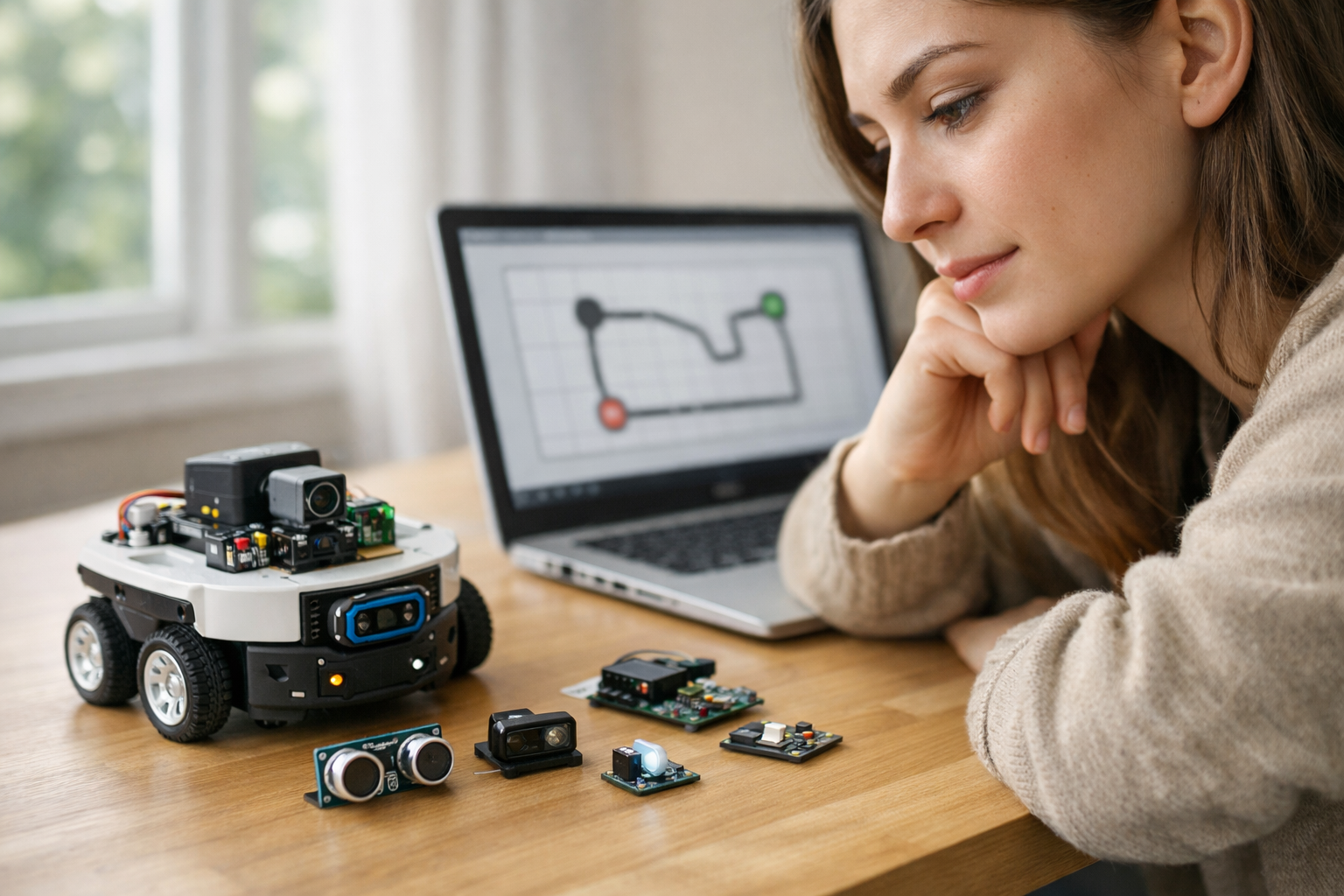
Understand robots, sensors, and autonomy without the math fear
Autonomous machines can seem mysterious at first. People hear words like robotics, AI, sensors, and self-driving systems, then assume the topic is too technical to understand without coding or advanced math. This course is designed to prove the opposite. If you are curious about how machines can sense their surroundings, make decisions, and move through the world, this short book-style course gives you a clear starting point in plain language.
You will begin with the biggest question of all: what makes a machine autonomous? From there, the course builds chapter by chapter, showing how robots use sensors, control systems, and simple decision processes to act in the real world. Instead of drowning you in jargon, each chapter explains one layer at a time so you can build a mental model that actually sticks.
Many beginner resources jump too quickly into technical details. This course does the opposite. It starts with simple ideas you already know from everyday life: machines that follow rules, machines that respond to feedback, and machines that adjust when the world changes. Once those foundations are clear, topics like perception, navigation, and safety become much easier to understand.
By the end, you will know how an autonomous machine typically works as a complete system. You will understand the role of sensors, controllers, motors, maps, and feedback loops. You will also see where AI fits in, where it does not, and why many real-world robots rely on a mix of simple rules and smarter software.
After completing the course, you will be able to explain how autonomous machines sense, decide, and act. You will know the difference between automation, remote control, and real autonomy. You will understand why robot perception is difficult, how navigation works at a basic level, and why reliability and safety matter so much in real environments.
You will also be better prepared to read news stories, product claims, and industry discussions about autonomous systems. Rather than getting lost in hype, you will have a simple framework for judging what a machine can truly do, what it cannot do yet, and what trade-offs are involved.
This course is ideal for curious beginners, students exploring technical fields, professionals moving into AI-adjacent roles, and anyone who wants a solid explanation of robotics without needing to become an engineer first. If you have ever wondered how delivery robots, warehouse robots, self-driving systems, or smart service machines operate, this course will help you make sense of them.
It is also useful for readers who want a gentle introduction before taking more advanced robotics or AI classes. If that sounds like you, Register free and start building your understanding today.
Autonomous systems are becoming more common in transportation, logistics, manufacturing, healthcare, agriculture, and home technology. Understanding the basics is no longer only for specialists. It is becoming a valuable form of digital literacy. This course gives you that foundation in a manageable, friendly format that respects the beginner mindset.
When you finish, you will not just know a few terms. You will have a connected picture of how the pieces fit together, where the challenges are, and what learning path you might take next. If you want to continue exploring related topics after this course, you can also browse all courses on Edu AI.
Robotics Educator and Autonomous Systems Specialist
Nina Patel has spent years teaching robotics and AI concepts to first-time learners in schools, startups, and online programs. She specializes in turning complex technical ideas into clear, practical lessons that beginners can follow with confidence.
When people hear the word robot, they often imagine a human-shaped machine walking around and making its own plans. In real engineering, the idea is both simpler and more useful. An autonomous machine is a system that can sense what is happening around it, make decisions based on goals or rules, and then act with limited or no step-by-step human guidance. It does not need to be magical, intelligent in a human way, or fully independent in every situation. It only needs enough ability to handle part of its job on its own.
This chapter gives you a practical beginner's view of autonomy. You will learn how to tell autonomy apart from simple automation, how to recognize autonomous machines in everyday life, and how to use a simple mental model to understand how robots work. That mental model is one of the most important ideas in robotics: machines sense, decide, and act in a loop. Once you understand that loop, many confusing devices become easier to explain.
Autonomous machines appear in homes, hospitals, warehouses, farms, roads, factories, and space systems. Some are highly advanced, while others are modest but effective. A robot vacuum that avoids stairs, a drone that holds its position in the air, a warehouse cart that follows routes and avoids obstacles, and a car with lane-keeping support all sit somewhere on the broad spectrum of autonomy. They differ in skill, safety requirements, and complexity, but they share a common structure: they gather information, process it, and produce movement or other actions.
As you read, focus on four basic building blocks. First, sensors collect information such as distance, speed, location, images, pressure, or temperature. Second, control and decision systems turn that information into choices. Third, actuators and movement systems do the physical work, such as turning wheels, moving arms, opening valves, or changing direction. Fourth, feedback connects action back to sensing so the machine can correct itself. A machine that cannot check the results of its actions is usually fragile and unreliable.
Good engineering judgment starts with asking the right questions. What is the machine trying to achieve? What can it sense well? What happens when the world changes? What are the limits of its map, rules, and software? How does it fail safely? Beginners often assume autonomy means a machine can do everything alone. In practice, autonomy is usually partial, task-specific, and carefully bounded. A machine may be autonomous in navigation but not in maintenance. It may plan a route on its own but still require a person to approve difficult actions.
By the end of this chapter, you should be able to describe an autonomous machine in plain language, identify the main parts of a robot, explain the sense-think-act process step by step, and understand why safety, reliability, and ethics matter from the very beginning. That foundation will support every later topic in this course.
Practice note for Tell autonomy apart from simple automation: document your objective, define a measurable success check, and run a small experiment before scaling. Capture what changed, why it changed, and what you would test next. This discipline improves reliability and makes your learning transferable to future projects.
Practice note for Recognize autonomous machines in daily life: document your objective, define a measurable success check, and run a small experiment before scaling. Capture what changed, why it changed, and what you would test next. This discipline improves reliability and makes your learning transferable to future projects.
Practice note for Understand the sense-think-act loop: document your objective, define a measurable success check, and run a small experiment before scaling. Capture what changed, why it changed, and what you would test next. This discipline improves reliability and makes your learning transferable to future projects.
Practice note for Build a simple mental model of how robots work: document your objective, define a measurable success check, and run a small experiment before scaling. Capture what changed, why it changed, and what you would test next. This discipline improves reliability and makes your learning transferable to future projects.
A machine becomes autonomous when it can carry out part of a task by itself in a changing environment. The key idea is not that it acts without humans forever, but that it can respond to real conditions instead of following one fixed script. If a machine can detect what is happening, compare that information with its goal, and adjust its behavior, it has some level of autonomy.
Consider a simple timed sprinkler and a robotic lawn mower. The sprinkler turns on at 6:00 every morning whether it is raining or not. The mower, by contrast, may detect boundaries, estimate where it has already traveled, avoid obstacles, and return to charge when its battery is low. The mower is not just doing a prewritten sequence. It is making local decisions based on sensor input and current state.
Three practical features usually define autonomy. First, the machine has goals, such as reach a destination, keep a temperature range, inspect an area, or move objects. Second, it has awareness, even if limited, through sensors and internal estimates. Third, it has decision logic that chooses actions when conditions change. This logic may be simple rules, control equations, maps, or learning-based software.
Beginners often make two mistakes. One is thinking a machine is autonomous only if it uses advanced AI. In reality, many autonomous systems use basic engineering methods very effectively. The other mistake is thinking autonomy means total freedom. In good design, autonomy is constrained. Engineers define operating limits, safe states, and fallback behaviors so that the machine knows what to do when conditions are uncertain or unsafe.
A useful test is to ask, if the environment changes slightly, can the machine still continue the task without a person guiding every step? If yes, it likely has some autonomy. If no, it may be automated, but not truly autonomous.
These three terms are often mixed together, but separating them clearly will help you understand the rest of robotics. Automation means a machine performs a predefined task with little variation. Remote control means a human makes the decisions and the machine carries them out from a distance. Autonomy means the machine makes at least some decisions for itself while pursuing a goal.
A washing machine is mostly automation. It runs through programmed cycles: fill, wash, drain, spin. It may have sensors for water level or imbalance, but its job is structured and predictable. A radio-controlled toy car is remote controlled. The human sees the environment, decides where to go, and sends commands. The car itself does not interpret the world in a meaningful way. A delivery robot that follows a route, detects people in its path, slows down, and chooses a safe way around them shows autonomy.
In real systems, these categories can overlap. A modern drone may be remotely supervised, but it can stabilize itself automatically and hold altitude autonomously. A factory arm may be highly automated in a fenced area, yet not autonomous outside that controlled setup. A car may switch between driver control, cruise automation, and partial autonomy depending on road conditions.
Engineering judgment matters here because labels can mislead users. Calling a system autonomous when it still depends heavily on human attention can create unsafe expectations. A common mistake is assuming that if a machine can do one thing by itself, it can handle everything nearby. For example, lane keeping is not the same as full self-driving. Autonomy is specific to tasks and conditions.
This distinction is important not just for vocabulary, but for safety, legal responsibility, and user trust. To use autonomous systems well, we must know exactly which decisions belong to the machine and which still belong to the person.
Autonomous machines are easier to understand when you stop looking only for humanoid robots. Many familiar devices contain elements of autonomy. A robot vacuum can detect walls, furniture, edges, and sometimes room layouts. It chooses paths, changes direction, and returns to its dock. An elevator is another helpful example. It is not autonomous in the broad mobile-robot sense, but it senses requests, checks door status, tracks position, and decides how to serve floor calls efficiently and safely.
Cars also provide familiar examples. Parking assistance, adaptive cruise control, automatic emergency braking, and lane keeping are forms of bounded autonomy. Each one handles a narrow task under certain assumptions. The car senses distance, lane markings, speed, or obstacles, then applies steering or braking. The driver may still be responsible overall, but some decision-making has moved into the machine.
Outside the home, warehouses use autonomous carts that move shelves or bins from one station to another. Farms use tractors that follow planned paths across fields with very high precision. Drones can keep themselves stable in wind by constantly adjusting motor speeds using sensor feedback. Hospitals use mobile robots to carry supplies through hallways while watching for people and obstacles.
Seeing these examples helps build a practical habit: always ask what the machine senses, what it is allowed to decide, and what action it can take. This habit turns impressive-looking products into understandable systems. It also reveals limitations. A robot vacuum may perform well on flat floors but fail with clutter. A drone may hold position well outdoors yet struggle when GPS signals are weak. A warehouse robot may navigate efficiently in a mapped building but not on an open city street.
Recognizing everyday autonomy is useful because it removes the mystery. Autonomous machines are not one single type of invention. They are a family of systems built for specific jobs, each combining sensors, control, movement, and feedback in different ways.
The most important beginner model in robotics is the loop often described as sense, decide, act. Many engineers also add feedback, making it a continuous cycle rather than a one-time sequence. A robot senses the world and itself, decides what to do next, acts through motors or other outputs, then senses again to see what changed. This loop may run many times per second.
Start with sensing. Sensors may include cameras, lidar, radar, ultrasonic range finders, GPS, wheel encoders, microphones, touch switches, force sensors, or temperature probes. No sensor is perfect. Cameras struggle in poor lighting. GPS can be inaccurate or blocked. Wheel encoders drift if wheels slip. Good systems often combine several sensors because each one covers weaknesses in another.
Next comes deciding. Here the machine interprets sensor data, estimates its situation, and chooses an action. It may ask questions such as: Where am I? What is near me? What is my goal? Is anything unsafe? Decision-making can be simple rule-based logic or more advanced planning and machine learning. For navigation, the robot may use a map, a set of rules, and feedback from current motion. For control, it may constantly correct steering or speed to reduce error between desired and actual behavior.
Finally comes action. Actuators create movement or physical change. Wheels turn, arms lift, brakes apply, valves open, propellers spin. Action is where plans meet reality, and reality is often messy. Floors are slippery, loads vary, batteries weaken, and people move unpredictably. That is why feedback matters so much. The robot does not just command a motion once. It checks whether the motion worked and corrects if needed.
A common beginner mistake is imagining a robot as mostly thinking. In practice, robotics is deeply about dealing with imperfect sensing and imperfect action. The control system sits between the goal and the messy real world, constantly reducing error. If you remember one practical sentence, make it this: robots work by repeatedly sensing conditions, choosing a response, acting, and using feedback to adjust the next step.
Autonomy is valuable because it can improve speed, consistency, safety, and scale. Machines can repeat tedious tasks without fatigue, monitor conditions continuously, and operate in places that are dangerous, distant, or hard for people to reach. In warehouses, autonomous carts reduce wasted travel time. In agriculture, autonomous guidance can improve field coverage. In hazardous inspection, robots can enter areas with heat, chemicals, radiation, or structural risk.
Autonomy is also useful when fast reaction is needed. A drone stabilizing itself cannot wait for a human to send every correction. A car's emergency braking system may react faster than a person in some situations. Feedback control lets the machine make many small adjustments very quickly.
But autonomy struggles whenever the world becomes uncertain, unusual, or poorly sensed. Rain, glare, dust, clutter, moving crowds, damaged maps, weak signals, and unexpected objects can all reduce performance. Machines are often strong in the situations they were designed for and weak outside them. This is why testing conditions, edge cases, and failure modes matter so much.
Safety and reliability must be built in from the start. Engineers define safe speeds, emergency stops, restricted zones, battery limits, and fallback behaviors. If localization confidence drops, the machine may slow down or stop. If a sensor disagrees with others, the system may ask for human help. These are not signs of failure in design; they are signs of mature engineering.
Ethics also enters early. Autonomous systems affect people around them, so designers must think about fairness, privacy, transparency, and responsibility. A delivery robot should not create hazards for pedestrians. A camera-equipped machine should not collect more personal data than necessary. A system should not encourage users to trust it beyond its actual abilities.
The practical outcome is simple: autonomy is powerful when matched carefully to the task, environment, and safety requirements. It is not about replacing humans everywhere. It is about deciding which decisions machines can make reliably and which still require human oversight.
To build a simple mental map of autonomous machines, imagine five connected layers. The first layer is the job: what the machine is supposed to achieve. The second is sensing: how it gathers information about the environment and its own condition. The third is understanding and decision-making: how it estimates what is happening and chooses actions. The fourth is movement or execution: how it changes the world through motors, wheels, arms, brakes, or other actuators. The fifth is supervision and safety: how it handles faults, limits, alerts, and human interaction.
You can also picture autonomy as a chain of questions. What do I need to do? Where am I? What is around me? What should I do next? Did my action work? Do I need to correct or stop? This chain captures goals, maps, rules, feedback, and safe operation in a form that beginners can reuse across many robot types.
Different fields of robotics emphasize different parts of the map. Mobile robots focus heavily on localization, path planning, and obstacle avoidance. Industrial robots emphasize precision, repeatability, and safe coordination. Drones depend on rapid stabilization and navigation. Self-driving vehicles combine perception, prediction, planning, and strict safety controls. Service robots often need to work around people and handle unstructured environments.
When learning this field, avoid the common mistake of treating software alone as the robot. Real autonomy sits at the intersection of hardware, sensors, control, environment, and human expectations. A brilliant algorithm cannot rescue poor sensors or unsafe mechanical design. Likewise, strong hardware without good decision logic produces rigid systems that fail when conditions change.
As a beginner, your best practical framework is this: every autonomous machine has inputs, decisions, outputs, and feedback, all shaped by goals and safety limits. If you can identify those pieces, you can explain how most robots work at a useful level. That is the foundation for everything that follows in this course.
1. What best distinguishes an autonomous machine from simple automation?
2. Which example from the chapter is part of the autonomy spectrum?
3. What is the basic loop used to understand how many robots work?
4. Why is feedback important in an autonomous machine?
5. Which statement best reflects the chapter's view of autonomy in practice?
When people first see a robot, they often focus on the outer shape: wheels, arms, lights, or a camera on top. But a robot is more than its shell. Inside, it is a system made of parts that must work together in the right order. To understand autonomous machines, it helps to break them into simple building blocks. A useful beginner view is this: a robot needs a body, a way to sense the world, a way to make decisions, a way to move or do work, and a source of power. If any one of these is weak or missing, the whole machine struggles.
This chapter explains the core parts every robot needs and shows how they connect into one practical system. You will see how sensors turn the world into signals, how controllers process those signals, and how motors create movement. You will also learn an important engineering lesson: robot design is about trade-offs. A bigger battery gives longer runtime but adds weight. A better camera may improve perception but needs more computing power. Stronger motors can move more load but draw more energy. Engineers are always balancing capability, cost, safety, and reliability.
A simple way to picture a robot is to compare it to a person. Sensors are like eyes, ears, and skin. The controller is like the brain and nervous system. Motors and actuators are like muscles. The frame is like the skeleton. The battery is like stored food energy. This comparison is not perfect, but it helps explain the workflow. First the robot senses. Then it decides. Then it acts. After it acts, it senses again and checks whether the action had the intended effect. That repeating loop is called feedback, and it is one of the most important ideas in robotics.
Not every machine with a motor is autonomous. A remote-controlled toy car moves because a human gives every command. A factory conveyor may be automated because it repeats the same sequence. An autonomous machine, by contrast, uses sensors and onboard decision-making to respond to changing conditions. That means the parts inside the robot must do more than simply move. They must support sensing, reasoning, and control under real-world limits.
Beginners often make a common mistake: they think of each part separately and assume that if each part works alone, the robot will work as a whole. In practice, integration is the real challenge. A motor may work perfectly on a bench but fail once the battery voltage drops. A camera may detect objects in bright light but struggle in shadows. A controller may make good decisions in simulation but respond too slowly on real hardware. Building robots means learning how parts interact, not just what each part does alone.
Another practical lesson is that engineering judgment matters as much as technical knowledge. The best design is not always the most advanced design. For a simple indoor delivery robot, a basic distance sensor and careful speed limits may be better than an expensive sensor suite that is hard to maintain. For a beginner project, fewer parts often lead to better reliability. Good robot design starts with the task, then chooses the simplest set of parts that can do that task safely and dependably.
In the sections that follow, we will look closely at the robot body and frame, the sensing system, the controller, movement hardware, power supply, and finally the complete sense-decide-act loop. By the end of the chapter, you should be able to look at a robot and identify the main internal building blocks, understand what each one contributes, and explain how they form one autonomous system.
Every robot, from a small vacuum cleaner to a warehouse vehicle, needs four basic groups of parts: a body, a brain, a power source, and a way to move or act on the world. The body is the physical structure that holds everything together. It may be a metal frame, a plastic shell, or a combination of plates, brackets, and protective covers. Its job is not just to look neat. It must place sensors where they can see, support motors without bending, protect electronics from bumps, and survive the environment where the robot will operate.
The brain is the control system. In simple robots, this might be a microcontroller that reads a sensor and turns a motor on or off. In more advanced systems, it may include a small computer running software that processes images, plans routes, and checks safety rules. The power system keeps all of this alive by providing the correct voltage and current. The movement system includes the parts that create action, such as wheels, joints, grippers, or tracks.
These groups are easy to list, but they are tightly linked. A heavy body needs more powerful movement hardware. More powerful motors demand a larger power supply. A larger battery adds weight, which again affects movement. This is why robot design is a systems problem. You cannot choose parts one at a time without thinking about the rest.
Practical engineers often begin with a simple set of questions. What job must the robot do? How fast must it move? How long must it run before charging? What obstacles or surfaces will it face? Does it need to carry a load? Does it need to work near people? These questions shape the body, the computing needs, the power budget, and the movement method. A robot designed for smooth indoor floors may fail badly outdoors because the body clearance is too low and the wheels are too small.
A common beginner mistake is to build the body last, as if it is only a container for the “real” parts. In reality, the body affects sensing, cooling, balance, cable routing, and maintenance. If a battery is hard to reach, charging becomes inconvenient. If wires run near moving joints, they can wear out. If the controller has poor airflow, it may overheat. Good robot bodies are not just strong; they are practical to assemble, inspect, and repair.
When you identify the core parts every robot needs, start by asking: what holds it together, what tells it what to do, what gives it energy, and what lets it act? That simple checklist provides a strong foundation for understanding any autonomous machine.
Sensors are the robot's connection to reality. Without sensors, an autonomous machine cannot tell where it is, what is around it, or whether its actions are working. Sensors turn physical conditions into electrical signals that software can read. Light becomes image data. Distance becomes numbers. Pressure becomes force readings. Battery charge becomes voltage measurements. In short, sensors translate the world into information.
Cameras are one of the most familiar sensors. They capture visual scenes and can help a robot detect lines, doors, objects, or people. But cameras do not “understand” by themselves. They produce raw image data that must be processed. Lighting conditions, shadows, glare, and motion blur can make camera-based sensing difficult. This is why engineers often combine cameras with other sensors rather than relying on vision alone.
Distance sensors are common because they directly support safe movement. Ultrasonic sensors send out sound waves and measure the echo. Infrared sensors estimate distance using reflected light. LiDAR measures distances using laser pulses and can create a map-like picture of nearby objects. Each type has strengths and weaknesses. Ultrasonic sensors are simple and cheap but can be noisy. Infrared sensors may struggle with certain surface colors or sunlight. LiDAR can be very useful for navigation but costs more and still has environmental limits.
Touch sensors and bump switches are simple but practical. A robot vacuum may use them to detect contact with furniture. Force sensors in a robot gripper can help it hold an object gently instead of crushing it. Wheel encoders are another important sensor type. They measure how much a wheel has turned, helping the robot estimate its speed and distance traveled. Inertial sensors, such as accelerometers and gyroscopes, measure motion and rotation. These help the robot track changes in movement even when the environment is hard to see.
Beginners often assume that more sensors always mean better performance. In practice, too many poorly chosen sensors can increase cost, complexity, and confusion. A better approach is to ask what information the robot truly needs. If the task is to avoid walls in a hallway, a full 3D vision system may be unnecessary. If the task is to pick up delicate items, touch and force sensing may matter more than long-range vision.
Another common mistake is trusting sensor readings as perfect truth. Real sensors are noisy, delayed, and sometimes wrong. Good engineering uses filtering, cross-checking, and sanity limits. For example, if a distance sensor suddenly reports an impossible jump, the controller should treat that reading with caution. Reliable robots do not merely read sensors; they judge sensor quality and react carefully when uncertainty is high.
If sensors are the robot's eyes and skin, the controller is where information becomes action. Controllers range from tiny microcontrollers to full onboard computers. A microcontroller is well suited to fast, repeatable tasks such as reading switches, controlling motor speed, or monitoring battery voltage. A more powerful onboard computer can run operating systems, handle maps, process camera images, and plan routes. Many robots use both: a small controller for low-level real-time control and a larger computer for higher-level decision-making.
The key job of a controller is to run the sense-decide-act loop. It reads sensor signals, interprets them, chooses an action, and sends commands to actuators. Then it repeats this process many times per second. A robot that moves too slowly in thought can become unsafe in motion. For example, if obstacle detection runs too infrequently, the robot may continue driving after a person steps into its path. This is why timing matters so much in robotics.
Controllers also manage rules. Some rules are simple, like “stop if the bumper is pressed.” Others are more complex, like “follow the planned path unless a closer obstacle appears, then slow down and re-route.” In autonomous systems, the controller often combines several goals at once: complete the task, stay stable, avoid collisions, conserve power, and recover from errors when possible.
Practical engineering judgment is important here. Beginners are often tempted to use the most powerful computer available, assuming that more computing solves everything. But powerful computers require more energy, create more heat, and add software complexity. If the task can be done reliably with simpler control, that is often the better design. At the same time, using a controller that is too weak can cause delays, dropped sensor data, or unstable behavior.
Another common mistake is confusing decision-making with autonomy. A device can contain software and still not be autonomous in a meaningful way. A washing machine has control logic, but it does not sense and adapt to a changing environment in the same way a mobile robot does. Remote-controlled systems may include onboard electronics, but the human still makes the main decisions. An autonomous robot uses its controller to respond to the world with at least some independence.
Good controllers are not only intelligent; they are dependable. They should handle startup safely, detect faults, and move to a safe state when something goes wrong. In real systems, reliability often matters more than cleverness. A robot that makes slightly simpler decisions consistently is usually more useful than one that makes advanced decisions only under perfect conditions.
Actuators are the parts that turn electrical energy into physical action. In many robots, the main actuators are motors. A motor can spin a wheel, drive a belt, rotate a joint, open a gripper, or lift an arm. Without actuators, the robot may be able to sense and think, but it cannot do useful work. In autonomous machines, movement is not only about speed. It is about controlled force, precision, and repeatability.
Wheels are common because they are efficient on smooth surfaces. A wheeled robot can travel far using relatively little energy compared with a walking machine. However, wheels are less effective on stairs, deep gravel, or highly uneven ground. Tracks can handle rougher terrain but may be slower and less energy-efficient. Legs offer flexibility but require much more complex control. The movement method must match the environment, not just the designer's preference.
Arms and grippers allow a robot to interact with objects. A warehouse robot may lift bins. A factory robot arm may repeat the same path with high precision. A service robot may press buttons or carry items. Here, actuator choice matters greatly. Some motors are good for continuous spinning. Others, such as servos, are useful when you need to move to a target position. Gearboxes can increase force but reduce speed. Mechanical design and control software must be chosen together.
One of the most important ideas in movement is feedback. If a robot tells a wheel motor to spin, how does it know the wheel actually turned? If a robotic arm moves toward a position, how does it know it arrived? Encoders and position sensors provide this information. With feedback, the controller can correct errors. Without feedback, the system is “open loop” and may drift, slip, or miss its target.
Beginners often focus only on top speed or motor size. This leads to common problems. Oversized motors can waste power and make control jerky. Undersized motors may stall or overheat. Poor wheel choice can reduce traction. A robotic arm may look strong but become unstable if the weight is too far from the base. Good engineering asks practical questions: how much force is needed, what precision is required, how often will the actuator move, and what happens if it gets stuck?
Safety matters too. Moving parts can pinch, collide, or tip the robot over. For that reason, many autonomous systems include speed limits, current limits, emergency stops, and soft materials around contact areas. Effective movement is not just motion. It is motion that is controlled, useful, and safe.
Power is easy to overlook because it is less visible than cameras or motors, yet it controls what the robot can do and for how long. Most mobile robots use batteries because they need to move freely without a cable. The battery stores energy, but the power system does more than that. It must deliver the right voltage to different components, protect against faults, and handle sudden changes in demand. Motors may draw high current when starting or climbing, while computers and sensors need stable, clean power to avoid crashes or bad readings.
Battery choice creates some of the most important trade-offs in robot design. A larger battery can extend runtime, but it adds mass. More mass means the motors need more energy to move, especially during acceleration. This can reduce some of the benefit of the larger battery. A smaller battery makes the robot lighter and cheaper, but may lead to short operating time and voltage drop under load. Engineers must balance endurance, weight, size, cost, and safety.
Beginners often estimate runtime too simply. They might divide battery capacity by average current and assume that is enough. In reality, power use changes constantly. A robot uses more power when turning sharply, driving uphill, carrying a load, or processing heavy sensor data. Cold temperatures can also reduce battery performance. Good design includes margin rather than running the battery near its limit.
Power quality matters as much as total energy. If the motors and computer share power poorly, a sudden motor load can cause a voltage dip that resets the controller. This is frustrating because the robot may seem fine on the workbench but fail during movement. Careful wiring, voltage regulation, fuses, connectors, and grounding are part of a reliable robot. These details are not glamorous, but they are critical.
Safety is especially important with batteries. Rechargeable packs can overheat, swell, or become hazardous if damaged, overcharged, or short-circuited. Autonomous machines should monitor battery state, reduce activity when power gets low, and shut down safely if needed. Some robots return to a charging station before the battery becomes critical. This is a good example of autonomy depending on basic engineering: smart behavior is impossible if the machine cannot manage its own energy responsibly.
In practice, power limits shape the robot's personality. They influence speed, payload, sensing choices, and how long the robot can work. A well-designed autonomous machine respects these limits instead of pretending they do not exist.
A robot becomes useful only when its parts operate as one coordinated system. The simplest way to understand this is through the sequence sense, decide, and act. Sensors observe the world and the robot's own condition. The controller processes those signals and selects an action. Actuators carry out the action. Then sensors measure the result, creating feedback for the next cycle. This loop may run dozens, hundreds, or even thousands of times each second depending on the task.
Consider a small indoor delivery robot. Its distance sensors detect a wall ahead. Wheel encoders report current speed. The controller compares this information with the route plan and a safety rule that says the robot must stop before getting too close. It sends a command to slow the motors. The motors respond, and the encoders confirm the robot is decelerating. If the wall is actually a person who moves away, the controller may allow motion again once the path is clear. That is a practical example of hardware parts connected into one simple system.
This also shows the difference between automation, remote control, and autonomy. A remote-controlled machine would wait for a human to decide when to stop. A fixed automated system might stop at a preset point every time whether an obstacle is present or not. An autonomous machine uses its own sensors and control logic to react to the current situation. It still follows rules, but it applies them based on real measurements.
Maps, rules, and feedback often work together. A map gives the robot a general idea of where to go. Rules define safe behavior, such as maximum speed near people. Feedback tells the robot whether it is actually following the plan. If wheel slip causes the robot to drift, feedback helps correct the error. If a corridor is blocked, sensor input may cause the controller to abandon the original route and choose another. This is why autonomy is not a single component. It emerges from cooperation among sensing, computing, movement, and power systems.
Integration brings many common mistakes. Cables can loosen under vibration. Sensor update rates may not match control timing. A motor may create electrical noise that affects readings. Software may assume a perfect sensor that does not exist in real life. These problems remind us that building robots is as much about reliability as intelligence. Strong systems are tested in realistic conditions, not only in ideal demos.
The practical outcome of understanding robot building blocks is confidence. When you look at a robot, you can now ask meaningful questions. What is it sensing? What controller is making decisions? How is movement produced? Where are the power limits? How does it recover when something goes wrong? Those questions help you understand not just what the robot is, but how it behaves as an autonomous machine.
1. Which set best describes the core building blocks a robot needs according to the chapter?
2. In the chapter's comparison between a robot and a person, what is the controller most like?
3. What does the chapter mean by feedback in robotics?
4. Why is integration described as a major challenge in building robots?
5. According to the chapter, what is usually the best starting point for good robot design?
An autonomous machine cannot act wisely unless it has some way to sense what is happening around it. Before a robot can avoid a wall, follow a path, pick up a box, or stop for a person, it must gather signals from the world and turn those signals into something useful. This process is often called perception. In simple terms, perception is how a machine moves from raw sensor readings to a usable picture of its surroundings. That picture is never perfect, but it can be good enough to support safe and reliable action.
In beginner robotics, it helps to think in layers. At the lowest layer, sensors produce raw data: numbers, images, distances, angles, speeds, temperatures, and many other measurements. At the next layer, the machine cleans, groups, and interprets those measurements. It may detect edges in an image, estimate the distance to an obstacle, or decide whether an object is moving. At a higher layer, the robot combines this information with memory, rules, and goals. Only then does it choose an action such as slowing down, turning, grasping, or asking for help.
This chapter explains that middle part: how machines sense and understand their world without advanced math. You will see why sensor data is often messy, how robots detect objects and obstacles, how machines estimate position and direction, and why engineers must design for uncertainty instead of pretending it does not exist. In practice, good perception is not about magic. It is about choosing suitable sensors, checking whether the readings make sense, combining evidence from more than one source, and knowing when the machine should become more cautious.
A useful mental model is the same one people use every day. Human senses are powerful, but they are also limited. Eyes can be fooled by shadows. Ears can miss quiet sounds in a noisy room. Balance can feel strange in the dark. Machines face similar problems. A camera may struggle in glare. A distance sensor may return unreliable readings on shiny surfaces. A wheel encoder may report motion even when the wheel slips on dust or ice. Because of this, autonomous systems must treat sensing as an ongoing estimation process, not as a perfect report from reality.
As you read, keep this practical workflow in mind: sense, filter, detect, estimate, check, and then act. That order matters. If a machine skips the checking step, it may trust bad data. If it skips estimation, it may react to every small fluctuation as if it were a major event. Real engineering judgement comes from knowing that the world is messy and that a robust machine must handle ambiguity gracefully.
In the sections that follow, we will build this idea step by step. We begin with raw signals, move through uncertainty and sensing technologies, and finish with the real-world challenges that make perception one of the hardest parts of autonomous systems.
Practice note for Understand what sensor data is and why it can be messy: document your objective, define a measurable success check, and run a small experiment before scaling. Capture what changed, why it changed, and what you would test next. This discipline improves reliability and makes your learning transferable to future projects.
Practice note for Learn how robots detect objects and obstacles: document your objective, define a measurable success check, and run a small experiment before scaling. Capture what changed, why it changed, and what you would test next. This discipline improves reliability and makes your learning transferable to future projects.
Practice note for See how machines estimate position and direction: document your objective, define a measurable success check, and run a small experiment before scaling. Capture what changed, why it changed, and what you would test next. This discipline improves reliability and makes your learning transferable to future projects.
Practice note for Explain basic perception without advanced math: document your objective, define a measurable success check, and run a small experiment before scaling. Capture what changed, why it changed, and what you would test next. This discipline improves reliability and makes your learning transferable to future projects.
A sensor does not usually deliver understanding directly. It delivers measurements. A camera produces pixels. A microphone produces changing sound levels. A wheel encoder produces counts as the wheel rotates. A GPS receiver gives position estimates. An inertial sensor reports acceleration and turning rate. None of these readings, by themselves, tell the robot, “there is a chair ahead” or “you are drifting left.” The machine must transform raw signals into information that supports decisions.
This transformation often happens in stages. First, the robot collects data at regular time intervals. Next, it may remove impossible values, smooth sudden spikes, or align readings from different sensors so they refer to the same moment. Then it extracts features that are easier to reason about, such as edges, corners, motion, distance, or heading. Finally, it uses those features to make practical conclusions: obstacle ahead, path clear, object detected, turning too fast, or robot near its goal.
Consider a simple cleaning robot. Its front distance sensor returns a number such as 42 centimeters. That number alone is not yet a decision. The controller compares it to safety thresholds. If the number drops quickly from 60 to 30 to 18 centimeters, the system may infer that the robot is approaching an obstacle. If left and right sensors disagree, the robot may infer that the obstacle is off-center and should steer around it. The useful information is not the raw number but the interpreted meaning of the changing pattern.
Beginners often make the mistake of treating every reading as equally important. In practice, context matters. A single odd measurement may be ignored if surrounding values look normal. A repeating pattern is often more meaningful than one isolated spike. Engineers also decide how much detail is actually needed. A warehouse robot may not need to identify the exact type of box in front of it. It may only need to know that something occupies space in its path and how far away it is.
Good perception design asks a practical question: what information is required for the next action? If the task is lane keeping, the machine may focus on road edges and heading. If the task is indoor delivery, it may care more about doors, walls, people, and position in a map. This task-centered view prevents unnecessary complexity and helps keep autonomous systems efficient, understandable, and safer.
One of the most important ideas in robotics is that sensor data is messy. Sensors are affected by lighting, temperature, vibration, dust, reflective materials, electrical interference, and timing delays. Even a high-quality sensor may produce small errors every second. Sometimes the error is random, like tiny fluctuations around the correct value. Sometimes it is systematic, such as a sensor that is always slightly biased in one direction. Both types matter.
Noise is the unwanted variation in a measurement. Uncertainty is the broader idea that the robot never knows the world perfectly. For example, a distance sensor may say an object is 1.2 meters away, but the real distance may be 1.1 or 1.3 meters. A vision system may detect a person with high confidence, but not absolute certainty. A robot may believe it is facing north, yet actually be turned a few degrees east. Perception systems must operate successfully even with these uncertainties.
A common engineering response is filtering. Filtering means reducing the impact of bad or unstable readings. A simple moving average can smooth noisy values. More advanced methods can combine multiple sensors and account for how errors change over time. At a beginner level, the key idea is easy to grasp: do not overreact to every tiny change. Let the system gather enough evidence before making a major decision.
Another important response is redundancy. If one sensor is weak in a certain condition, another may help. A camera may struggle in darkness, but a lidar or sonar sensor may still detect nearby obstacles. A wheel encoder may be misleading on a slippery floor, but an inertial sensor can reveal unexpected motion. Combining sensors is often called sensor fusion. It does not eliminate uncertainty, but it usually produces a more stable estimate than any single sensor alone.
The biggest beginner mistake is assuming that the latest reading is true. A better mindset is to ask, “How trustworthy is this reading right now?” Good autonomous machines track confidence, compare inputs against expectations, and slow down or switch modes when confidence drops. This is practical safety, not just theory. In the real world, robust systems are built by respecting uncertainty rather than ignoring it.
Cameras are one of the most familiar sensors because they work in a way that resembles human sight. A standard camera captures color or brightness across an image. From that image, software can look for lines, shapes, textures, motion, or known object patterns. Cameras are useful because they provide rich information. A robot can use them to follow a marked path, detect signs, recognize pallets, identify people, or inspect parts on a factory line.
However, a regular camera does not directly measure depth. It sees appearance, not distance. To estimate how far away something is, the system may compare changes across frames, use two cameras like stereo vision, or rely on machine learning models trained to infer depth from visual cues. These methods can work well, but they are sensitive to conditions such as poor lighting, glare, blur, fog, and shadows.
Depth sensors solve part of this problem by measuring distance more directly. Examples include stereo depth cameras, structured light sensors, and time-of-flight cameras. Instead of only seeing color and shape, they estimate how far each visible point is from the robot. This makes it easier to separate foreground objects from the background and to detect free space for navigation. In indoor robots, depth data is often more useful than raw images for immediate obstacle avoidance.
In practical engineering, the choice between a simple camera and a depth sensor depends on the task and environment. A low-cost home robot may use a camera for line following and basic object detection. A warehouse robot moving among shelves may benefit from depth sensing to avoid collisions in narrow spaces. Designers also consider computing cost. Rich vision processing can require significant processing power, and delays in perception can reduce safety.
Beginners should remember that seeing is not the same as understanding. A camera may capture a clear image of a chair, but the robot still needs software to decide that the shape matters, that it blocks the path, and that the safest response is to slow down and steer away. Perception is always a chain: sensing, interpreting, and acting.
Not every robot needs detailed visual understanding. Many useful autonomous machines mainly need to know what is near them, whether something is moving, and whether the path ahead is safe. For this reason, obstacle detection is one of the core jobs of perception. Common sensors for this job include ultrasonic sensors, infrared sensors, lidar, radar, bump sensors, and wheel encoders combined with motion estimates.
Ultrasonic sensors send out sound waves and measure how long the echo takes to return. They are often inexpensive and useful for short-range detection, but they can struggle with soft materials or angled surfaces that reflect sound away. Infrared sensors can detect nearby objects but may be affected by lighting or surface properties. Lidar scans distance using light and can create a detailed picture of nearby space, making it popular in mobile robotics. Radar is especially valuable in outdoor settings because it can work well in poor weather and detect motion over longer ranges.
Obstacle detection is not only about finding objects. It is also about classifying space as free, occupied, or unknown. That third category matters. If the robot cannot sense a region clearly, it should not assume the area is safe. This is a key point of engineering judgement. Safe systems treat unknown space cautiously, especially when people may be nearby.
Motion detection adds another layer. A stationary obstacle can often be avoided with a simple path adjustment. A moving obstacle, such as a walking person or another robot, requires prediction. The machine does not need advanced math to behave reasonably. It can compare repeated measurements over time and ask: is the object getting closer, moving sideways, or staying still? Even simple motion estimates can greatly improve safety and comfort.
A common mistake is tuning a robot to react too aggressively. If every slight distance change causes sudden braking or turning, the machine becomes jerky and unreliable. If thresholds are too loose, it reacts too late. Engineers balance caution with stability. Good obstacle detection supports smooth behavior, not constant panic.
To move intelligently, a robot must estimate where it is and which way it is facing. These two ideas are often called position and orientation. Together they help answer practical questions: Am I still on the planned path? Did I already pass the doorway? Am I turning left or right? Can I return to the charging dock? This part of perception connects closely to navigation.
There are several ways machines estimate location. Outdoors, GPS can provide a useful global position, though not always with enough precision for close maneuvers. Indoors, robots often rely on wheel encoders, inertial measurement units, cameras, lidar, known markers, or maps of the environment. Wheel encoders estimate movement by counting wheel rotation. This is simple and useful, but small errors accumulate over time, especially when wheels slip. This gradual drift is one reason robots often combine encoders with other sensors.
Orientation is commonly estimated using gyroscopes, compasses, or visual cues from the environment. If a robot knows it has turned 90 degrees and moved forward two meters, it can roughly estimate its current pose, meaning its position plus orientation. This estimate is never exact, so the robot continually updates it as new sensor information arrives. If it sees a known landmark or matches current scans to a map, it can correct its earlier drift.
At a beginner level, you can think of this as a best guess that improves with feedback. The machine predicts where it should be based on movement, then checks the world to see whether that prediction still fits. If not, it adjusts. This same idea appears throughout autonomous systems: estimate, compare, correct, repeat.
Good engineering judgement means choosing an approach that matches the job. A toy indoor robot may only need rough room-level position. A delivery robot crossing a busy walkway needs much more reliable estimates. In all cases, position is not a fact printed by one magical sensor. It is an ongoing estimate built from evidence.
In a laboratory, sensors can appear reliable because the environment is controlled. Floors are clean, lighting is stable, backgrounds are simple, and obstacles are placed carefully. The real world is different. People move unpredictably. Surfaces shine, absorb, or scatter signals. Weather changes. Objects are partly hidden. Rooms are cluttered. Data arrives late or goes missing. This is why perception is one of the hardest parts of building autonomous systems.
Many failures come not from a complete lack of sensing, but from incorrect interpretation. A shadow may look like a drop-off. A glass door may be hard for certain sensors to detect. A parked bicycle may be mistaken for part of the background until the robot gets too close. A map created yesterday may not match today’s layout. The machine must work through incomplete and changing evidence, often in real time.
Practical teams address this challenge by designing for graceful failure. If perception confidence drops, the robot may reduce speed, stop, request human help, or switch to a simpler behavior. This is especially important for safety. It is better for a machine to pause than to continue confidently on the basis of poor information. Reliability is not about never making mistakes; it is about limiting the consequences when conditions become difficult.
Another real-world issue is overfitting. A system may work well in one building, one weather condition, or one camera angle, then perform badly elsewhere. Engineers test across varied conditions because true autonomy requires general behavior, not success in a narrow demo. They also monitor practical outcomes: missed obstacles, false alarms, drifting position estimates, and delayed reactions. These measures are often more useful than impressive technical language.
The main lesson of this chapter is simple but powerful. Machines do not directly “know” the world. They collect imperfect clues and build the best understanding they can. Good autonomous behavior comes from managing uncertainty, combining sensing with feedback, and making careful decisions when the picture is incomplete. That is how machines sense, understand, and act responsibly in the world around them.
1. What does perception mean in this chapter?
2. Why must autonomous machines treat sensor data carefully?
3. According to the chapter, what usually happens after sensors produce raw data?
4. Why is the 'check' step important in the workflow sense, filter, detect, estimate, check, and then act?
5. What is a main idea of good perception in autonomous systems?
An autonomous machine does more than move. It must sense what is happening, decide what to do next, and act in a way that helps it reach a goal. This chapter explains that decision process in clear, practical steps. In simple terms, the machine asks: What is my goal? What do I know right now? What actions are possible? Which action is safest and most useful? Then it checks the result and repeats. This cycle happens again and again, sometimes many times each second.
Beginners often imagine robot decision making as a kind of mystery or human-like thinking. In most real systems, the process is more structured. Engineers define goals, set limits, use sensor data, and apply rules or control methods to choose actions. Some machines use advanced AI, but many useful robots rely on simple logic, planning, and feedback. A warehouse robot may follow marked routes, avoid blocked aisles, and stop if a person comes close. A robotic vacuum may choose a cleaning direction, detect walls, adjust speed, and return to its charger when the battery is low. These are decisions, but they are usually built from clear steps rather than magic.
A helpful way to understand this is to see the machine as working in a loop: sense, decide, act, and check. Sensors provide information such as distance, speed, battery level, and location. The decision part compares that information to goals, rules, and plans. The machine then sends commands to motors or steering systems. After moving, it checks whether the action helped or created a new problem. This is where feedback becomes important. Without feedback, the machine cannot tell if it is drifting, blocked, or heading in the wrong direction.
Engineering judgment matters because decision making is never only about choosing what is possible. It is about choosing what is appropriate under real limits. The machine may need to save power, protect equipment, avoid people, follow laws, or complete a task within time limits. Good design balances speed, safety, simplicity, and reliability. A system that is clever but unpredictable is often less useful than one that is simple and dependable.
In this chapter, you will learn how robots choose actions step by step, how planning and control fit together, and how common decision methods compare in real systems. You will also see why uncertainty matters. Real environments are messy. Sensors can be noisy, paths can be blocked, and people do not move in perfectly predictable ways. Autonomous machines succeed not because they know everything, but because they keep updating their decisions as conditions change.
A practical lesson to remember is that decision making is not one single module. It is a combination of goals, rules, planning, and feedback working together. If one part is weak, the whole machine becomes less reliable. A robot that plans well but cannot react quickly may crash. A robot that reacts well but never plans may wander or waste energy. Good autonomy comes from connecting these parts into one consistent workflow.
Practice note for Understand rules, goals, and feedback: document your objective, define a measurable success check, and run a small experiment before scaling. Capture what changed, why it changed, and what you would test next. This discipline improves reliability and makes your learning transferable to future projects.
Practice note for Learn how robots choose actions step by step: document your objective, define a measurable success check, and run a small experiment before scaling. Capture what changed, why it changed, and what you would test next. This discipline improves reliability and makes your learning transferable to future projects.
Practice note for See the basics of planning and control: document your objective, define a measurable success check, and run a small experiment before scaling. Capture what changed, why it changed, and what you would test next. This discipline improves reliability and makes your learning transferable to future projects.
Every autonomous machine begins with a goal. A delivery robot may need to carry a package to a room. A lawn robot may need to cut grass across an entire yard. A drone may need to inspect a bridge and return safely. The goal gives direction, but it is never the whole story. The machine also works under constraints. Constraints are limits such as maximum speed, battery capacity, safe distance from people, legal boundaries, or areas it must avoid. Decision making means choosing actions that move toward the goal while still respecting those limits.
This is an important point for beginners: a robot is not just trying to do the task. It is trying to do the task correctly. Fast movement might save time, but if it increases the risk of collision, it may be the wrong choice. The best action is often a compromise. Engineers must decide what matters most in each situation. In a hospital robot, safety and predictability usually matter more than speed. In a factory machine, timing may be critical, but safety rules still override everything else.
A practical way to think about decisions is to ask three questions. First, what is the desired result? Second, what is allowed or forbidden? Third, what information is available right now? A robot with low battery may choose a shorter path or stop the main task and return to charge. A robot approaching a crowded hallway may slow down even if the hallway is technically the shortest route. These decisions are not random. They come from priorities set by the system designer.
One common mistake is giving a machine a goal without clear limits. If a robot is told only to reach a location as fast as possible, it may behave aggressively. Another mistake is creating too many competing goals without ranking them. For example, save time, save power, and avoid all delays can conflict. Good system design usually sets priorities such as: stay safe first, protect hardware second, complete the task third, and optimize speed or efficiency after that. This ordering helps the machine make sensible choices when trade-offs appear.
In real systems, decision making often uses scores or checks. The machine may compare possible actions and reject any that break safety rules. From the remaining options, it chooses one that best fits the current goal. This makes autonomous behavior easier to understand, test, and improve.
Many autonomous machines make decisions using rule-based behavior. This means they follow clear logic such as if obstacle ahead, stop; if path open, continue; if battery low, return to charger. These rules may seem simple, but they are powerful. A large number of useful real-world systems depend on straightforward logic because it is fast, reliable, and easy to test. Simplicity is often a strength in engineering.
Rule-based behavior works well when situations are common and predictable. A warehouse robot may use floor markers, traffic rules at intersections, and fixed stop conditions. An automatic door uses simple sensing and timing logic. A robot vacuum may switch modes when it detects a wall, a cliff edge, or a dirty patch of floor. In each case, the machine is not deeply reasoning about the world. It is applying rules that match known situations.
Step-by-step action choice often comes from combining several rules. First, the machine checks safety rules. Next, it checks task rules. Finally, it checks efficiency rules. For example, if a mobile robot senses a person nearby, stop or slow down. If the path is clear, continue toward the current waypoint. If two paths are available, choose the shorter one. This layered approach helps keep important rules from being ignored.
One engineering challenge is that rules can conflict. A robot may have one rule that says stay close to the wall for navigation and another that says move away from obstacles. If a wall sensor is noisy, the robot may hesitate or zigzag. Good rule design includes tie-breaks, priorities, and careful testing. Engineers also try to avoid huge collections of special-case rules because they become hard to maintain. When every new problem is solved with another rule, the system can turn fragile and confusing.
Still, simple logic remains valuable. It is transparent, which means people can understand why the machine acted a certain way. That matters for debugging, certification, safety review, and trust. When behavior must be predictable, rules are often the first and best tool. They may not solve every complex situation, but they handle a surprising amount of practical autonomy.
A robot does not stay on course by making one decision at the start and hoping for the best. It stays on track through feedback loops. A feedback loop measures what actually happened, compares it to what should have happened, and then corrects the difference. This is one of the most important ideas in autonomous systems. Without feedback, even a good plan can fail because wheels slip, loads shift, batteries weaken, or the ground is uneven.
Imagine a small robot asked to drive in a straight line. If it sends equal power to both wheels but never checks the result, it may drift left or right because one wheel has slightly more friction than the other. With feedback, sensors measure heading or wheel motion, the controller notices the drift, and motor commands are adjusted. The robot stays closer to the desired path. This same principle applies to speed control, steering, arm movement, altitude in drones, and many other actions.
Feedback works in a repeating cycle: measure, compare, correct, repeat. The desired value is often called a target or setpoint. The difference between target and actual result is the error. The controller tries to reduce that error. In simple systems, this can be very basic: if too far left, steer right a little. If speed is too low, increase motor power. In more advanced systems, the correction is smoother and more carefully tuned.
Common mistakes happen when feedback is poorly tuned. If corrections are too weak, the robot reacts slowly and never settles well. If corrections are too strong, it may overshoot and wobble back and forth. Engineers spend time adjusting control behavior so the system is stable, accurate, and responsive. This is part of the basics of control: not just making the machine move, but making it move in a controlled way.
Practical outcomes of good feedback are huge. A robot becomes more reliable, safer, and less sensitive to small errors. It can adapt to changes instead of failing immediately. In autonomous machines, feedback is what turns movement into controlled behavior.
Planning is the part of autonomy that looks ahead. Instead of reacting only to the current moment, the machine tries to find a useful route or sequence of actions to reach a goal. If a robot starts in one room and must reach another, planning helps decide where to go, which hallway to use, and how to avoid known blocked areas. This is different from control. Planning chooses the path; control helps the robot follow it.
Simple planning often uses maps, waypoints, and cost comparisons. A map may show walls, doors, shelves, or roads. Waypoints are intermediate points the robot aims for one by one. Costs help compare options. A longer path may still be better if it is safer, smoother, or uses less energy. In this way, planning is not only about distance. It can include time, risk, battery use, or rules about restricted zones.
Many beginners assume planning always means finding the perfect path. In practice, a good enough path is often better than a perfect one that takes too long to compute. Real systems must balance quality with speed. A delivery robot moving through a building may replan frequently as doors open and close or people fill a hallway. It needs a route quickly, not a mathematically ideal answer found too late.
A useful workflow is: locate the robot, select a destination, generate candidate paths, reject unsafe options, choose one, then follow it while checking for changes. If the path becomes blocked, the robot can stop, wait, or plan again. This shows how planning and feedback work together. Planning sets direction; feedback keeps the machine aligned with reality.
A common mistake is separating planning too much from real-world limits. A path that looks good on a map may be too narrow for the robot to turn, too steep for its motors, or too crowded for safe use. Good engineering judgment includes the robot's size, turning radius, sensor accuracy, and braking distance. Strong planning does not live only on paper. It must match what the machine can actually do.
Real environments are uncertain. Sensors may be noisy, maps may be old, and people or vehicles may move unpredictably. Because of this, autonomous machines must do more than follow a fixed script. They must react to change. A robot may expect an open corridor and find a cart blocking the way. A drone may face wind stronger than expected. A lawn robot may lose traction on wet grass. Decision making must continue even when information is incomplete or imperfect.
One way robots handle uncertainty is by updating beliefs about the world instead of assuming sensor readings are always exact. If a distance sensor gives slightly different values each second, the robot can combine readings over time to estimate a more reliable answer. It can also use multiple sensors together. For example, wheel encoders, cameras, and range sensors may support each other when one source is weak. This reduces the chance of a bad decision caused by one faulty reading.
Reacting well also means having safe fallback behaviors. If the robot is unsure, it may slow down, stop, ask for help, or move to a safer state. This is better than pretending certainty. In engineering, uncertainty should lead to caution, not confidence. A machine that admits uncertainty through conservative behavior is usually safer and more trustworthy.
Practical systems often combine quick local reactions with larger task goals. If an obstacle suddenly appears, the robot might stop immediately, then decide whether to go around it, wait, or choose a new route. This two-level behavior is common. Fast reactions handle immediate danger; slower reasoning handles the broader plan. Both are necessary.
A common mistake is designing for ideal conditions only. Lab tests may look excellent, but real use reveals glare, dust, slippery floors, missing map data, or crowded spaces. Good autonomous systems are tested in messy conditions because that is where uncertainty shows up. Robust decision making means continuing to work reasonably well even when the world is imperfect.
Not every autonomous machine needs advanced AI. This is one of the most useful truths for beginners. If the environment is structured and the tasks are clear, simple rules, planning, and feedback may be enough. A factory transport robot moving along known routes can often work well with maps, sensors, stop rules, and control loops. In these cases, simplicity improves reliability, reduces cost, and makes testing easier.
AI becomes more helpful when the world is too complex or variable for fixed rules alone. For example, recognizing pedestrians in many lighting conditions, understanding spoken commands, identifying objects in clutter, or predicting the movement of other road users can be difficult with hand-written logic only. Machine learning can help the robot interpret rich sensor data and detect patterns that are hard to program directly.
Even when AI is used, it usually does not replace all other decision methods. Real systems often combine AI with traditional engineering. An AI model may identify objects from a camera image, but hard safety rules still decide when to stop. A planning system may choose a route, while feedback controllers keep the robot stable. This mixed design is common because it keeps critical behavior understandable and constrained.
Engineering judgment is especially important here. AI can be powerful, but it may be harder to explain, validate, and predict in unusual cases. For safety-critical systems, designers often ask whether a simpler method can solve the problem first. If yes, that method may be preferred. If no, AI may be added carefully, usually with limits, monitoring, and fallback behavior.
The practical lesson is not that AI is better or worse than rules. It is that each method fits different needs. Use simple rules when the task is clear and repeatable. Use planning when the machine must reach goals over space and time. Use feedback to stay on track. Use AI when perception or decision complexity exceeds what fixed logic can reasonably handle. Strong autonomous systems choose the simplest method that works reliably, then add complexity only when it brings real value.
1. What is the basic decision loop described in the chapter?
2. Why is feedback important for an autonomous machine?
3. Which statement best matches the chapter's view of robot decision making in real systems?
4. What is the difference between goals and constraints?
5. Why can a simple and dependable system be better than a clever but unpredictable one?
In earlier chapters, you learned that an autonomous machine does more than move. It senses the world, makes choices, and acts without needing a person to guide every step. In the real world, however, movement is never just about getting from one point to another. A machine must also avoid hitting people, objects, walls, pets, curbs, shelves, and other machines. That is why safe movement is one of the most important parts of autonomy.
When people move through a room or walk down a street, they use experience, vision, memory, and common sense. They know that a closed door blocks a path, that a wet floor can be slippery, and that a child or bicycle may suddenly move into the way. Autonomous machines try to do something similar, but they must do it through sensors, software, and carefully designed control rules. This chapter explains how robots find their way, why safety must be built into every level of the system, where failures commonly happen, and how testing improves reliability before a machine is trusted in homes, warehouses, farms, hospitals, or roads.
A useful way to think about navigation is as a repeating loop: sense, understand, plan, move, and check again. First, the machine gathers data from sensors such as cameras, lidar, radar, ultrasonic sensors, GPS, wheel encoders, and inertial sensors. Next, it estimates where it is and what is around it. Then it selects a route or short movement plan. After that, motors, steering, or brakes carry out the action. Finally, the machine checks whether the result matches what it expected. If the hallway is blocked, if the wheels slip, or if a person steps in front of it, the machine must update its plan immediately.
Navigation is not only about maps. It also depends on engineering judgment. Designers must choose how much uncertainty the robot can handle, how fast it should move near people, what to do when sensors disagree, and when the machine should stop rather than guess. These choices separate a merely functional robot from a dependable one. In practice, a slower and more cautious robot is often better than a fast robot that makes risky decisions.
Safety matters because autonomous systems operate near people and in changing conditions. A robot vacuum may seem simple, but even it can get trapped, hit fragile items, or spread a mess if it misreads the floor. A warehouse robot can delay work or cause injury if it fails to stop. A delivery robot may face weather, uneven pavement, and confusing human behavior. In all of these cases, reliable movement depends on several layers working together: accurate sensing, sensible planning, clear safety limits, and continuous testing.
Another key lesson is that real environments are messy. Maps can be old. Lighting can change. Floors can reflect light strangely. GPS can drift. Dirt can cover sensors. Network links can fail. Batteries can run low. Even a good machine has limits, and responsible design means recognizing those limits instead of pretending the robot can handle every situation. A well-designed autonomous machine should know when it is uncertain, reduce speed, ask for help, pull over, or shut down safely.
This chapter ties together navigation, mapping, obstacle avoidance, safety, failure points, and testing into one practical picture. By the end, you should be able to explain not just how a machine moves, but how it moves carefully in a world full of surprises.
Practice note for Understand navigation, mapping, and obstacle avoidance: document your objective, define a measurable success check, and run a small experiment before scaling. Capture what changed, why it changed, and what you would test next. This discipline improves reliability and makes your learning transferable to future projects.
Practice note for Learn why safety matters in autonomous systems: document your objective, define a measurable success check, and run a small experiment before scaling. Capture what changed, why it changed, and what you would test next. This discipline improves reliability and makes your learning transferable to future projects.
For an autonomous machine, wayfinding means answering three simple questions again and again: Where am I? Where am I trying to go? How do I get there safely? Humans answer these almost automatically, but a robot must compute them from sensor data and stored information. This is why navigation usually combines mapping, localization, and planning.
A map is a model of the environment. It may be as simple as a list of allowed paths in a warehouse or as detailed as a 3D map built from lidar and cameras. Some robots use prebuilt maps, while others create maps as they move. This process is often called mapping or simultaneous localization and mapping. The exact method can be complex, but the beginner idea is straightforward: the robot uses landmarks, distances, and motion estimates to build a useful picture of the space.
Localization means estimating the robot's current position on that map. Indoors, GPS often does not work well, so robots may rely on lidar, cameras, wheel movement, and inertial sensors. Outdoors, GPS can help, but it is usually not enough on its own because it may be noisy or temporarily wrong. Good systems combine multiple sensors so that one weak sensor does not ruin the entire estimate.
Planning happens at more than one level. A global route chooses the general path, such as which hallway to take or which road to follow. A local planner handles short-term movement, such as steering around a box that was not on the map. This split is important because the map may tell the robot where it should go, but the immediate environment tells it what it can do right now.
A common mistake is assuming the map is perfect. In real settings, doors open and close, furniture moves, and shelves may be rearranged. Good engineering practice treats maps as helpful but incomplete. The robot should use them as guidance, not as unquestionable truth. The practical outcome is a machine that follows routes efficiently but stays flexible when the real world does not match the plan.
Obstacle avoidance is one of the clearest signs of autonomy. A machine that simply follows a fixed path is doing automation. A machine that detects a new obstacle and changes behavior safely is showing autonomy. In changing spaces, this ability is essential because people, carts, pets, vehicles, and dropped objects can appear without warning.
To avoid collisions, the robot must first detect obstacles. Different sensors are useful in different cases. Cameras can identify shapes and signs. Lidar can measure distance accurately. Radar can work better in poor weather. Ultrasonic sensors are often used for short-range detection. No sensor is perfect, so many robots combine them. This is called sensor fusion, and it helps reduce blind spots and improve confidence.
Once something is detected, the robot must decide what it means. Is the object stationary or moving? Is it close enough to matter? Will it cross the robot's path? A person standing beside a corridor may not require a stop, but a person stepping into the path does. This is where timing matters. The robot must react quickly enough to brake or steer, yet not so aggressively that it stops for every harmless shadow.
Good obstacle avoidance often uses safety zones. For example, a far zone may trigger slower speed, a nearer zone may trigger braking, and a critical zone may trigger an emergency stop. These layers help create smoother and safer behavior. They also reflect engineering judgment: when uncertainty rises, the machine should act more conservatively.
Common failure points include glossy floors that confuse sensors, cluttered areas that create too many false alarms, poor lighting, and moving obstacles that behave unpredictably. Another mistake is tuning the system only in clean demo environments. A robot that works perfectly in an empty lab may perform badly in a busy hallway. Practical reliability comes from handling messiness, not avoiding it.
The real outcome of good obstacle avoidance is trust. People are more comfortable around machines that clearly slow down, leave space, and stop when unsure. Safe movement is not only about preventing impact. It is also about making robot behavior understandable and predictable to the humans nearby.
Indoor and outdoor robots both navigate, but the problems they face are different. Indoors, the environment is often more structured. Hallways, rooms, shelves, and doors create clear boundaries. However, indoor robots must deal with GPS weakness, tight spaces, glass walls, elevators, and frequent human activity. A hospital robot, for example, may have to move through narrow corridors, pause for staff, and avoid equipment that was not there a few minutes earlier.
Outdoor robots usually have more space, but they face harsher uncertainty. Weather changes sensor performance. Rain, fog, dust, and glare can reduce visibility. Pavement may be uneven. Curbs, grass, mud, and slopes affect traction. GPS helps outdoors, but urban canyons, trees, and signal interference can still cause errors. A delivery robot or farm vehicle must handle all of this while continuing to estimate position and avoid hazards.
Speed is another major difference. Many indoor robots move slowly, which gives them more time to react. Outdoor robots, especially road vehicles, may move much faster. Higher speed means longer stopping distance and less time to interpret sensor data. This raises the safety challenge sharply. A small localization error at walking speed may be manageable; the same error at road speed can be dangerous.
The operating rules also differ. Indoors, robots often work in privately controlled spaces with known layouts. Outdoors, they enter public or semi-public spaces with more unknown behavior. People may not notice the robot, may misunderstand its intentions, or may act unpredictably. This means outdoor systems often need stronger perception, more cautious planning, and clearer fallback behavior.
A practical design lesson is that you should never assume success in one environment means readiness for the other. An indoor robot cannot simply be pushed outside and expected to work well. Different sensors, maps, control strategies, and safety limits may be needed. Engineers must match the system to the environment rather than forcing one design into every situation.
Safety in autonomous systems should never depend on a single feature. If one sensor fails or one software module makes a mistake, the machine should still have other ways to reduce harm. This is why engineers build safety in layers. One layer may limit speed near people. Another may monitor sensor health. Another may check whether commands are reasonable. A final layer may stop power to the motors when danger is detected.
Alerts are part of this safety design. Some alerts are internal, such as a warning that the camera is blocked or the battery is too low. Other alerts are external, such as sounds, lights, or display messages that tell nearby people what the robot is doing. These signals matter because safe systems should be understandable. If a robot is about to reverse or shut down, people around it should have clues.
Shutdown behavior is especially important. A robot should not simply fail in a random way. It needs a safe fallback state. For some systems, this means stopping in place. For others, it means pulling to the side, lowering a tool, applying brakes, or switching to limited operation. The correct choice depends on the machine and setting. Stopping in the middle of a warehouse aisle may be safer than continuing blindly, but stopping in a roadway may require different handling. Context matters.
Engineers often define conditions that trigger safer behavior: low confidence in localization, missing sensor updates, overheating, communication loss, or repeated planning failures. The machine may first slow down, then alert, then request assistance, and finally shut down if the issue persists. This stepwise response is better than waiting until the problem becomes critical.
A common mistake is focusing only on normal operation. Strong systems are also designed for abnormal operation. They answer practical questions such as: What if a sensor freezes? What if the brakes respond slowly? What if the path planner cannot find a route? Safety is not just a feature added at the end. It is a way of thinking through failure before it happens.
Reliability does not come from confidence alone. It comes from repeated testing in many conditions, careful measurement, and honest review of failures. An autonomous machine may look impressive in a demonstration, but deployment requires much more. Engineers must ask whether the system still works when the battery is partly drained, the floor is dusty, the lighting changes, the map is outdated, or a pedestrian behaves unexpectedly.
Testing usually begins in simulation, where many scenarios can be explored quickly and safely. Simulation is useful for early development, but it cannot capture every detail of the real world. After simulation, teams move to controlled physical tests. They may set up obstacle courses, vary lighting, introduce moving objects, and intentionally create edge cases. Only after strong performance in controlled settings should the robot move into more realistic environments.
Monitoring is the partner of testing. The machine should record sensor health, decision outputs, route deviations, emergency stops, and other useful data. These records help teams understand not only that something failed, but why it failed. Without good monitoring, engineers are left guessing. With good monitoring, they can improve the system systematically.
Reliability also improves when teams test rare but important events. What happens if two sensors disagree? What if localization drifts slowly instead of failing suddenly? What if a person walks behind the robot while it is backing up? These are the moments that often reveal weak assumptions. Real engineering progress comes from finding such weak points early.
A practical rule is that if a system cannot be tested clearly, it cannot be trusted easily. Testing improves reliability because it turns vague hope into evidence. It shows where the limits are and helps teams reduce surprises before the machine reaches real users.
Building a machine that works in a lab is challenging. Building one that works safely in the real world every day is much harder. Real deployment combines technical problems, human factors, maintenance, and environmental change. The robot must not only move correctly but keep doing so when sensors age, parts wear down, maps become outdated, and users behave in unexpected ways.
One reason deployment is difficult is that the world contains endless variation. A route that was clear yesterday may be blocked today. A loading dock may have new markings. Sunlight may create glare. A person may stand where no person usually stands. Machines are often strong in repeated situations and weak in unusual ones. Unfortunately, unusual situations matter most for safety.
Another challenge is the gap between prediction and reality. Engineers may assume that people will notice warning lights, stay out of robot lanes, or follow instructions. In practice, people are distracted, hurried, and creative. They may test the robot without meaning to. This means good deployment requires not just technical performance but also sensible operating rules, clear communication, and environments designed to support safe use.
Maintenance is also part of autonomy. Dirty lenses, loose cables, worn wheels, weak batteries, and outdated software can all reduce safety. A machine that was reliable at launch may become unreliable if upkeep is poor. That is why deployment plans often include inspection schedules, cleaning procedures, software updates, and methods for reporting incidents.
Perhaps the biggest lesson is humility. Real-world autonomy is difficult because sensing, decision-making, control, safety, and human behavior all interact. Successful teams respect limits. They define where the system works well, where it needs supervision, and when it should refuse to operate. This is not a weakness. It is responsible engineering.
When you see an autonomous machine moving safely through a real environment, remember that its success depends on many layers working together: maps and wayfinding, obstacle avoidance, environment-specific design, safety responses, testing, and a realistic understanding of failure. Safe autonomy is not magic. It is careful design under real-world constraints.
1. What best describes the navigation loop explained in the chapter?
2. Why does the chapter say safety must be built into every level of an autonomous system?
3. According to the chapter, what should a well-designed machine do when it becomes uncertain?
4. Which of the following is presented as a common real-world failure point or limit?
5. How does testing improve the reliability of autonomous machines?
By now, you have a working picture of what an autonomous machine is: a system that senses its surroundings, makes decisions using rules or learned models, and acts without needing a human to control every movement. In this final chapter, we bring that idea into the real world. Autonomous machines are not just science fiction. They already move goods through warehouses, help farmers monitor crops, vacuum living rooms, assist surgeons, inspect dangerous spaces, and support transport systems. At the same time, they raise serious questions about safety, jobs, trust, fairness, and responsibility.
A beginner often makes one of two mistakes. The first is to assume robots are far more capable than they really are. The second is to assume they are simple gadgets with no deeper social effect. Both views miss the truth. Real autonomous systems are usually narrow, built for specific tasks, and highly dependent on good engineering choices. They work best in environments that are partly controlled, clearly mapped, or carefully monitored. They fail when designers ignore edge cases, when sensors are unreliable, when the rules are unclear, or when people expect “intelligence” where there is really only pattern matching and task automation.
Engineering judgment matters here. A successful autonomous machine is not defined by a dramatic demo. It is defined by whether it performs safely and usefully over time. Good engineers ask practical questions: What exactly is the task? What sensors are available? How uncertain is the environment? What happens if the machine loses GPS, sees poor lighting, faces a blocked path, or receives conflicting information? How does a person take over? These questions are what turn a clever prototype into a reliable system.
This chapter follows four themes. First, we will explore real examples across industries so you can see where autonomy is already useful. Second, we will look at the human, social, and ethical side, because robots do not operate in isolation. Third, we will learn to spot hype versus realistic capability. Finally, we will end with a clear framework for continued learning, so your next step feels practical instead of overwhelming.
As you read, keep one simple workflow in mind: sense, decide, act, and learn. Every real example in this chapter can be understood through that loop. The sensors may change, the control methods may differ, and the stakes may be higher or lower, but the core idea stays the same. Autonomous machines succeed when that loop is matched well to the real world around them.
The goal of this chapter is not to make you memorize brand names or chase headlines. It is to help you think clearly. If you can describe what a machine senses, how it decides, what it can physically do, where it is likely to fail, and who is responsible for its use, then you already have the mindset needed to understand autonomous systems in the real world.
Practice note for Explore real examples across industries: document your objective, define a measurable success check, and run a small experiment before scaling. Capture what changed, why it changed, and what you would test next. This discipline improves reliability and makes your learning transferable to future projects.
Practice note for Understand the human, social, and ethical side: document your objective, define a measurable success check, and run a small experiment before scaling. Capture what changed, why it changed, and what you would test next. This discipline improves reliability and makes your learning transferable to future projects.
Practice note for Spot hype versus realistic capability: document your objective, define a measurable success check, and run a small experiment before scaling. Capture what changed, why it changed, and what you would test next. This discipline improves reliability and makes your learning transferable to future projects.
Self-driving vehicles are often the first example people think of, and for good reason. They combine nearly every idea from this course: sensors, maps, planning, control, safety rules, and real-time decision-making. A road vehicle must sense lanes, signs, other vehicles, cyclists, and pedestrians. It must estimate its position, predict what others may do next, choose a safe path, and control steering, speed, and braking. That sounds straightforward in theory, but roads are full of uncertainty. Weather changes visibility. Construction alters maps. Human drivers behave unpredictably. A plastic bag may look harmless to a human but confusing to a machine.
This is why many real systems are only autonomous in limited settings. A shuttle might work on a fixed campus route. A taxi robot may operate only in mapped city zones with strong monitoring. A truck may automate highway driving while expecting a human to handle loading docks or complex urban streets. Delivery systems show the same pattern. Sidewalk robots, warehouse-to-curb carts, and small delivery drones usually succeed best when the route is short, the environment is partly controlled, and exceptions can be handed to a human operator.
The practical lesson is that autonomy depends heavily on the operating domain. Instead of asking, “Can it drive anywhere?” engineers ask, “Under what exact conditions does it work well enough to be safe and useful?” That is a much better question. A machine that performs one job reliably in a narrow setting can be more valuable than one that appears impressive but fails often.
Common mistakes in this field include overtrusting maps, assuming sensors always agree, and underestimating rare events. Good system design adds fallback behavior. If confidence drops, the vehicle may slow down, pull over, request human help, or stop entirely. In safety-critical systems, knowing when not to continue is part of intelligence. For beginners, this industry is a strong reminder that real autonomy is less about flashy demos and more about careful limits, testing, and safe recovery when conditions are not ideal.
Warehouse, factory, and farm robots are some of the most practical and successful autonomous machines in use today because their environments can often be made more structured. In a warehouse, mobile robots may follow marked zones, read shelf positions, avoid workers, and carry bins from storage to packing stations. The task is still challenging, but the lighting, layout, and workflow are more predictable than on a public road. In a factory, robot arms repeat precise motions with sensors checking position, force, and timing. On farms, autonomous tractors, sprayers, and monitoring robots use GPS, cameras, and simple field maps to follow rows, detect weeds, or estimate crop health.
These machines show an important engineering truth: changing the environment can be just as powerful as making the robot smarter. If a warehouse floor is clearly labeled, if shelves are consistently placed, and if traffic rules are enforced, then navigation becomes easier. If farm rows are known and tasks are scheduled under suitable weather conditions, then autonomy becomes more reliable. This is often a better strategy than trying to build a robot that can handle every possible situation.
Another practical lesson is that autonomy often improves workflow rather than replacing all human effort. In a warehouse, robots may move items while people handle exceptions, quality checks, and packing choices. In factories, robots may do repetitive or hazardous tasks while technicians maintain the systems. On farms, autonomous tools may reduce labor for repetitive driving, but farmers still make decisions about timing, crop health, maintenance, and safety.
Common mistakes include ignoring maintenance, assuming sensor calibration will remain accurate forever, and forgetting how much downtime costs. A robot that is “smart” but difficult to repair is not very useful. Reliable autonomy needs charging plans, spare parts, software updates, and human procedures when something goes wrong. The practical outcome is clear: successful industrial autonomy is not just about robot intelligence. It is about system design, environment design, and a realistic understanding of the full work process.
Home, hospital, and service robots operate close to people, which makes their design more personal and often more difficult. A home robot vacuum seems simple, but it still must detect edges, avoid collisions, manage battery life, and handle cluttered rooms. It works well not because it understands the home like a human, but because the task is narrow and the machine can use repeated passes, bump sensing, maps, and charging routines to do something useful. This is a great example of practical autonomy: limited ability, clear value.
Hospitals introduce higher stakes. Delivery robots may carry medicine, linens, or lab samples through hallways. Assistive systems may help with lifting, surgery, rehabilitation, or patient monitoring. Here, reliability and safety matter more than novelty. A machine may need to identify doors, avoid staff and patients, handle elevators, and keep operating within strict infection-control or scheduling rules. In such settings, full autonomy is often less important than dependable support. Human supervision remains essential because environments change quickly and the cost of error is high.
Service machines in hotels, stores, airports, and public buildings face another challenge: human expectations. People tend to treat machines as if they “understand” speech, emotion, and social behavior more deeply than they actually do. This can create frustration or misplaced trust. A robot receptionist may answer common questions and guide a person to a location, but it may fail badly when the request is unusual or emotionally sensitive. Good design makes this clear rather than pretending otherwise.
A practical rule is to match the machine to the task and the social setting. In close human environments, predictable behavior matters. Clear signals, safe motion, easy stop buttons, understandable speech output, and obvious limits are often more valuable than advanced-sounding intelligence. The best service robots are not the ones that seem most human. They are the ones that perform a useful task safely, consistently, and in a way people can understand.
Autonomous systems do not just raise technical questions. They also raise human and social ones. If a delivery robot blocks a sidewalk, who is responsible? If a self-driving vehicle makes a harmful decision, is the driver, the manufacturer, the software team, or the operator at fault? If a hiring company uses robots to reduce labor costs, what happens to workers whose tasks are automated? These are not side topics. They are part of the real design problem.
Ethics in autonomous systems begins with practical concerns. Safety is first: the machine should avoid harming people. Reliability is next: it should behave consistently under expected conditions. Transparency also matters: users should understand what the machine can do, what it cannot do, and when a human must step in. Privacy matters when robots collect images, location data, voice recordings, or health information. Fairness matters when a system works well for some people or places but poorly for others.
Trust should be earned, not demanded. A common mistake is designing a system that looks confident even when it is uncertain. This can encourage misuse. Better systems show status clearly, report limits honestly, and support safe handoff to humans. In workplaces, accountability means documenting decisions, logging failures, and creating procedures for review and improvement. When something goes wrong, there should be a traceable chain of events, not confusion about who was supposed to be watching.
On jobs, the reality is mixed. Some tasks will be reduced, some will change, and new roles will appear in maintenance, supervision, operations, data handling, and system integration. The most useful beginner mindset is neither fear nor blind optimism. Instead, ask: which parts of a job are repetitive, dangerous, or data-heavy, and which parts depend on human judgment, empathy, negotiation, and context? Autonomy tends to affect tasks unevenly, not erase whole professions overnight. Responsible adoption means thinking about training, transition, and the real people affected by technical choices.
It is easy to be impressed by robot marketing. Videos are polished. Words like intelligent, human-like, self-learning, and fully autonomous are used loosely. To judge claims well, go back to the basics you have learned in this course. Ask what the machine senses, what decisions it makes, what actions it can perform, and in what environment it has been tested. A robot that works in a carefully staged demo may fail in an ordinary uncontrolled setting. A machine that appears conversational may still have weak physical awareness. A system that looks autonomous may actually depend on hidden human operators, remote support, or a very limited operating area.
A practical framework is to ask six questions. First, what is the exact task? Second, what conditions are required for success? Third, what happens when the machine is uncertain? Fourth, how is safety handled? Fifth, how much human support is still involved? Sixth, how often does it work in normal use, not just in the best-case example? These questions cut through hype quickly. They also help you compare systems fairly.
Another good habit is to separate different kinds of ability. A robot might navigate well but manipulate objects poorly. It might follow a map but fail when the map is outdated. It might answer spoken questions but have no common-sense understanding. Intelligence is not one single thing. In robotics, capability is often narrow, layered, and fragile outside the design assumptions.
Common beginner mistakes include treating smooth movement as proof of deep understanding, assuming machine learning solves every problem, and ignoring the cost of edge cases. In reality, many engineering teams spend huge effort on exceptions, fallback modes, and error detection. So when you hear a bold claim, translate it into operational terms. Under which rules, sensors, maps, and constraints does this machine succeed? If those details are missing, skepticism is healthy. Clear thinking is one of the most valuable skills you can carry forward from this course.
Your next step does not need to be complicated. The best way to keep learning is to build a simple mental framework and use it repeatedly. Start with any robot or autonomous system you see in the news or in daily life. Describe it in four layers: sensing, decision-making, action, and supervision. What inputs does it use? What rules or models guide it? What physical outputs does it control? When and how can a human interrupt, assist, or override it? If you can answer those questions, you are already studying like an engineer.
From there, choose a path based on your interest. If you like movement and mechanics, explore mobile robots, motors, navigation, and feedback control. If you like perception, learn more about cameras, lidar, GPS, mapping, and object detection. If you enjoy logic and planning, study state machines, path planning, and behavior trees. If the social side interests you, focus on safety standards, usability, ethics, and policy. All of these are valid entry points into autonomous systems.
Keep your projects small and concrete. Try mapping a room with a simple robot simulator. Compare automation, remote control, and autonomy using household examples. Watch demonstrations and identify the likely sensors and control loop. Read product claims and test them against the questions from the previous section. This kind of deliberate observation builds real understanding fast.
A useful final framework is this: define the task, define the environment, define the risks, define the fallback plan. Whenever you meet a new autonomous machine, run that checklist. It will help you judge feasibility, safety, and usefulness without being distracted by hype. You do not need to know advanced math to think clearly about robots. You need a practical habit of asking good questions. That habit is your real next step, and it will serve you whether you continue as a curious learner, a builder, or a future professional in autonomous systems.
1. According to the chapter, what is a common characteristic of real autonomous systems?
2. Why does autonomy usually become easier in structured spaces like warehouses or factory lines?
3. Which question reflects good engineering judgment when evaluating an autonomous machine?
4. What is the chapter's main warning about hype?
5. What framework does the chapter suggest for understanding real examples of autonomous machines?

- Learning Evolved.
- Intelligence Amplified.


