AI Robotics & Autonomous Systems — Beginner
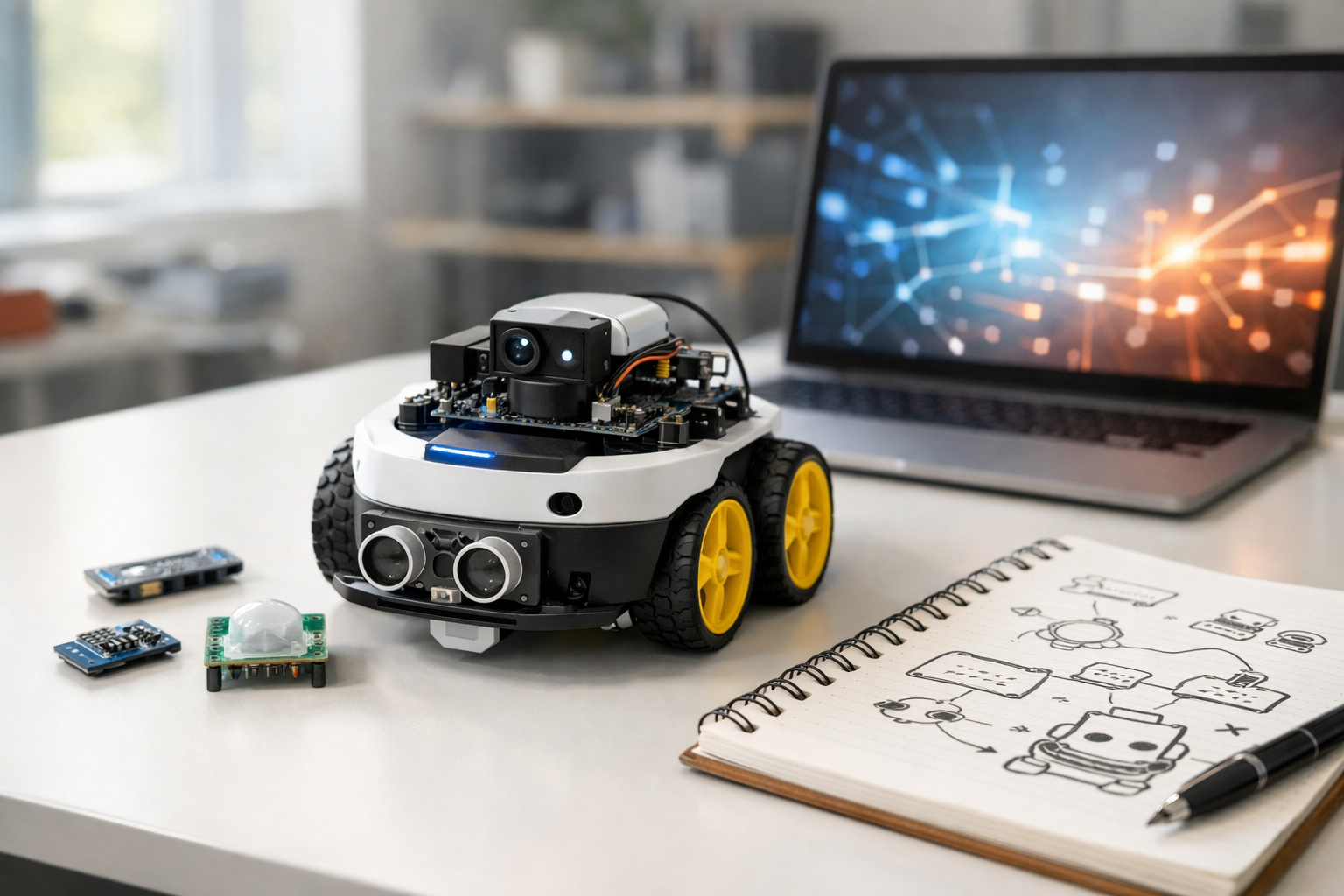
Understand how autonomous systems work without the math overload
Autonomous systems can sound difficult, technical, and out of reach for new learners. This course is designed to change that. If you have ever wondered how self-driving cars, drones, warehouse robots, or smart machines can sense the world and make decisions, this short book-style course gives you a clear and simple starting point. You do not need coding skills, math confidence, or any background in AI. Everything is explained from first principles in plain language.
The course is organized like a short technical book with six connected chapters. Each chapter builds on the last one, so you never feel lost. You begin by learning what autonomous systems actually are and why they matter. Then you move into sensing, understanding, decision-making, action, safety, and real-world applications. By the end, you will have a practical mental model you can use to follow conversations, news, and beginner-level technical material about autonomous technology.
Many introductions to robotics and AI jump too quickly into hard terms, code, or advanced theory. This course takes a different path. It focuses on understanding before complexity. Instead of overwhelming you with formulas, it teaches the big ideas that make autonomous systems work. The goal is not to turn you into an engineer overnight. The goal is to help you truly understand the system as a whole.
First, you will learn the difference between simple automation and true autonomy. This gives you a strong foundation for everything that follows. Next, you will look at sensors such as cameras, radar, GPS, and other tools machines use to gather information. Then you will see how systems turn that information into a basic understanding of the world around them.
After that, the course explains how machines make decisions. You will learn how rules, planning, and beginner-level AI ideas can guide actions. Then you will study how systems act in the real world using movement, control, and feedback. Finally, you will bring everything together through real examples like self-driving vehicles, drones, and service robots, while also exploring safety, trust, and future trends.
This course is ideal for curious learners, students, career explorers, business professionals, and anyone who wants a simple introduction to autonomous systems without technical barriers. It is especially helpful if you want a strong conceptual foundation before deciding whether to learn robotics, AI, or automation more deeply.
If you are completely new, you are in the right place. If you want to continue learning after this course, you can browse all courses for related beginner pathways. If you are ready to start now, you can Register free and begin learning right away.
By the end of this course, you will understand the full beginner-level story of autonomous systems: how they sense, think, decide, and act. You will be able to explain the main parts of an autonomous system in simple language, identify common sensor types, describe how decisions are made, and understand why safety and human oversight matter so much. Most importantly, you will no longer see autonomous systems as a mystery.
This is a practical first step into one of the most important technology areas in the modern world. Whether you want general knowledge, career direction, or a stronger base for future study, this course gives you a clear and approachable path forward.
Autonomous Systems Educator and Robotics Engineer
Sofia Chen designs beginner-friendly learning programs in robotics, automation, and AI systems. She has helped new learners understand complex technical ideas through simple explanations, real-world examples, and step-by-step teaching.
An autonomous system is a machine or software-driven device that can observe what is happening around it, make a choice, and do something useful with limited human help. That idea sounds advanced, but the basic pattern is simple. The system senses the world, interprets what those signals mean, selects an action, and then carries out that action. In this chapter, you will learn to describe that process in plain language and recognize it in familiar technologies.
Beginners often imagine autonomy as a futuristic robot that thinks like a person. In engineering, the meaning is more practical. A system does not need human-like intelligence to be autonomous. It only needs enough capability to pursue a goal on its own within some environment. A robot vacuum that maps rooms and avoids chair legs, a drone that holds its position in the wind, and a car that keeps itself in a lane all show forms of autonomy.
The most useful starting point is to break these systems into parts. First come the sensors, which gather information such as distance, speed, location, images, or touch. Next comes software, which turns raw sensor data into a usable picture of the situation. Then comes decision-making, where rules, logic, or AI choose what to do next. Finally come actions, such as turning wheels, changing speed, moving a robotic arm, or sending a message.
This chapter also introduces a critical distinction: automated is not the same as autonomous. A timed sprinkler is automated because it follows a fixed schedule. A lawn robot that detects obstacles, adjusts its path, and returns to charge itself shows autonomy because it responds to changing conditions. This difference matters because beginners often label any machine that works by itself as autonomous. Engineers are more careful. They ask whether the system can handle variation, uncertainty, and incomplete information without constant human direction.
As you read, keep one practical goal in mind: you should be able to explain how an autonomous system works using everyday language. You do not need advanced math to begin. You need a clear mental model. Think of each system as a loop: sense, think, act, and repeat. That loop is the backbone of robotics, self-driving systems, delivery machines, warehouse robots, and many smart devices.
Engineering judgment enters when deciding how much autonomy is enough. A designer must ask: What is the goal? What can go wrong? How reliable are the sensors? When should the machine stop or ask for help? Good autonomous systems are not just clever. They are safe, limited where necessary, and built to handle uncertainty gracefully. Common beginner mistakes include assuming AI alone creates autonomy, ignoring sensor limitations, and forgetting that every action depends on an imperfect view of the world.
By the end of this chapter, you should be able to recognize autonomous systems in daily life, explain the difference between automation and autonomy, describe the main parts of the system, and compare examples from cars, drones, and homes. Most importantly, you should understand the basic goal of autonomy: getting useful work done in the real world with less need for step-by-step human control.
Practice note for Recognize autonomous systems in everyday life: document your objective, define a measurable success check, and run a small experiment before scaling. Capture what changed, why it changed, and what you would test next. This discipline improves reliability and makes your learning transferable to future projects.
Practice note for Tell the difference between automated and autonomous machines: document your objective, define a measurable success check, and run a small experiment before scaling. Capture what changed, why it changed, and what you would test next. This discipline improves reliability and makes your learning transferable to future projects.
Practice note for Understand the basic goal of autonomy: document your objective, define a measurable success check, and run a small experiment before scaling. Capture what changed, why it changed, and what you would test next. This discipline improves reliability and makes your learning transferable to future projects.
At the beginner level, the clearest definition of an autonomous system is this: it is a system that can pursue a task by itself in a changing environment. The words by itself do not mean perfectly alone forever. Most real systems still depend on humans to set goals, define limits, or step in during unusual situations. What makes them autonomous is that they do not need a person to control every small step.
Consider a robotic vacuum. You may press the start button, but after that it uses sensors to detect walls, furniture, edges, and open floor. Its software estimates where it is, decides where to clean next, and drives its motors to move there. If a chair has been moved since the last cleaning run, the robot does not stop and wait for instructions. It adapts. That ability to respond to a changing situation is central to autonomy.
Beginners sometimes think autonomy means consciousness or free will. In engineering, it does not. A machine can act on its own without understanding the world like a human. It only needs methods for observing, choosing, and doing. Some methods are simple, like a set of if-then rules. Others use AI models that recognize patterns in camera images or estimate the best path through a crowded space.
The practical goal is not to build a machine that behaves like a person in every way. The goal is to build a machine that reliably completes a job under real conditions. That is an important shift in thinking. Engineers care about what the system can detect, how quickly it reacts, how often it succeeds, and how safely it fails. When you describe an autonomous system in simple language, focus on its task, what it senses, how it decides, and what actions it can take.
Automation and autonomy are related, but they are not the same. Automation means a machine carries out a predefined process with little or no human effort during operation. The process is usually fixed or limited. For example, a washing machine runs through programmed stages: fill, wash, rinse, spin. It performs useful work automatically, but it does not build a rich understanding of its surroundings or make many decisions beyond its programmed cycle.
Autonomy adds adaptation. An autonomous machine deals with variation in the environment and changes its behavior accordingly. A self-driving shuttle, for instance, must detect lanes, pedestrians, traffic signs, and other vehicles. It cannot simply replay the same sequence of actions every day. It must choose based on what it senses now.
A helpful test is to ask: if the environment changes, can the machine notice that change and adjust without being told exactly what to do? If the answer is no, you are probably looking at automation, not autonomy. A timer-based sprinkler is automated. A lawn system that checks soil moisture, weather forecasts, and plant needs before watering shows more autonomy.
This difference matters because people often overestimate machine ability. Calling a system autonomous can suggest it handles uncertainty better than it really does. In practice, many products mix both ideas. A warehouse robot may follow an automated route in a known area but switch to autonomous obstacle avoidance if a person steps in front of it. Engineers often combine fixed procedures with flexible decision-making because pure autonomy is expensive, hard to verify, and not always necessary. Good engineering judgment means choosing the simplest level of intelligence that solves the task safely and reliably.
Autonomous systems are easier to understand when you spot them in daily life. In cars, driver-assistance features provide clear examples. Adaptive cruise control uses radar or cameras to measure the distance to the vehicle ahead and adjusts speed to maintain a safe gap. Lane-keeping assistance uses camera data to estimate lane boundaries and gently correct steering. These features sense, decide, and act, but usually within limits. They are often partial autonomy rather than full self-driving.
Drones offer another useful example. A consumer drone may use GPS, cameras, inertial sensors, and barometers to hold altitude and position. If wind pushes it sideways, the flight controller notices the drift and commands the motors to compensate. Some drones can follow a route, avoid obstacles, or return home automatically when the battery is low. Those are strong examples of machines acting on their own toward a goal.
In homes, robot vacuums, lawn mowers, and smart security devices show simpler forms of autonomy. A robot vacuum senses walls and stair edges, estimates room layout, chooses a path, and returns to its charging base. A smart thermostat may learn patterns of occupancy and adjust heating or cooling to save energy while maintaining comfort. A doorbell camera can detect motion and classify whether it sees a person, a package, or a passing car.
When comparing these systems, notice that they differ in environment, speed, and risk. A home robot usually moves slowly in a controlled indoor space. A car operates faster, among people, in weather, traffic, and changing road conditions. A drone adds the challenge of three-dimensional movement and limited battery life. The same basic ideas apply to all of them, but the engineering difficulty rises quickly as the world becomes more dynamic and the cost of mistakes becomes higher.
Autonomous systems are built to do useful work more efficiently, more safely, or in places where constant human control is difficult. That is the basic goal of autonomy. In some cases, autonomy improves convenience. A robot vacuum frees a person from repetitive cleaning. In other cases, autonomy improves precision, such as agricultural machines that apply water or fertilizer more carefully based on local conditions.
Safety is another major reason. Drones can inspect roofs, bridges, or power lines without sending workers into dangerous positions. Autonomous mining vehicles can operate in harsh environments where visibility is poor and fatigue is a serious issue. In logistics, warehouse robots reduce the need for workers to walk long distances carrying heavy items. The machine handles the movement while humans focus on supervision, exceptions, and higher-value decisions.
There is also the problem of scale. A person can control one machine directly, but autonomy allows one operator to supervise many systems. That changes economics. A fleet of delivery robots or agricultural machines becomes practical only if each unit can handle routine decisions locally. Autonomy does not remove people from the system entirely. Instead, it shifts people from moment-by-moment control to design, monitoring, maintenance, and intervention when needed.
A common beginner mistake is to think the purpose is always to replace humans. In reality, many successful systems are built to assist humans, not eliminate them. Another mistake is to assume more autonomy is always better. Sometimes a simpler automated system is cheaper, easier to test, and more reliable. Engineers choose autonomy when the environment changes enough that fixed programming is not sufficient, and when the benefits outweigh the added complexity. Practical outcomes matter more than impressive labels.
The simplest and most useful model of an autonomous system is a loop: sense, decide, act, then repeat. This loop may run many times per second. In a fast-moving drone or car, it must run quickly and reliably. In a slower home robot, it can run more gradually. The exact speed changes, but the structure stays the same.
Sensing means collecting information from the world. Common sensors include cameras, radar, lidar, GPS, microphones, temperature sensors, wheel encoders, and inertial measurement units. Each sensor has strengths and weaknesses. Cameras provide rich visual detail but struggle in darkness or glare. GPS helps with location outdoors but may be inaccurate near tall buildings. Radar works well in bad weather but gives a less detailed picture than a camera. Good engineering combines sensors so that one can support another.
Deciding means turning sensor inputs into action choices. Sometimes this is done with simple rules: if an obstacle is too close, stop. Sometimes it uses planning methods: choose the shortest safe path to the target. Sometimes it uses AI: identify a pedestrian in an image or predict where another vehicle is likely to move. AI helps, but it is only part of the system. Decisions also depend on goals, safety limits, and the current state of the machine.
Acting means sending commands to motors, brakes, steering systems, robotic joints, or other devices that change the world. Actions also create new conditions, which the sensors then observe again. That is why the loop is continuous. Common mistakes in design include trusting noisy sensor data too much, reacting too slowly, or failing to define safe fallback behavior. A practical system must know what to do when it is uncertain, such as slowing down, stopping, or asking for help.
If you want one beginner-friendly way to explain autonomous systems, use this sentence: an autonomous system is a machine that watches what is happening, figures out what it means, and takes the next useful step. That plain-language description is accurate enough to guide your early understanding. It captures the flow without requiring technical jargon.
A practical mental model is to imagine four boxes connected in a circle: sensors, software, decisions, and actions. Sensors gather signals. Software organizes those signals into an estimate of the world. Decision logic chooses what to do next based on goals and rules. Actuators perform the action. Then the cycle starts again. This model works for robots, self-driving features, drones, industrial vehicles, and smart devices in the home.
When comparing systems, ask the same simple questions every time. What is the goal? What can it sense? What choices can it make? What actions can it take? What happens when conditions become unclear? These questions help you describe systems consistently and avoid vague statements like “it uses AI to drive itself.” A stronger explanation would be: “It uses cameras and radar to detect traffic, software to estimate lane position and vehicle distance, decision logic to choose speed and steering, and actuators to control the car.”
This chapter gives you a foundation for the rest of the course. You can now recognize autonomous systems in everyday life, separate autonomy from ordinary automation, explain the core loop of sense, think, and act, and compare examples in practical terms. That understanding is the first step toward studying how these systems are designed, tested, and improved in the real world.
1. Which example best shows an autonomous system rather than a simply automated one?
2. What is the basic loop described in the chapter for how autonomous systems work?
3. What is the main goal of autonomy according to the chapter?
4. Which set of parts matches the chapter's description of an autonomous system?
5. Why are engineers careful about calling a machine autonomous?
An autonomous system cannot make a useful decision unless it has some way to observe what is happening around it. Before a robot can avoid a wall, before a drone can hold its height, and before a self-driving car can stop for a pedestrian, the machine must first gather information from the world. That job belongs to sensors. Sensors are the starting point of the sense-think-act loop. They turn parts of the physical world such as light, sound, motion, distance, heat, or location into signals that software can process.
For beginners, it helps to think of sensors as a machine's way of noticing. Human beings use eyes, ears, skin, and balance. Machines use cameras, microphones, radar, lidar, GPS receivers, wheel encoders, accelerometers, and many other devices. None of these sensors truly “understand” the world by themselves. They simply produce measurements. The real engineering challenge is turning those measurements into something useful enough for decisions and actions.
This chapter explains what sensors do, introduces common sensor types and their jobs, shows how systems turn raw signals into useful information, and explains why sensing is never perfect. These ideas are central to all autonomous systems, from simple vacuum robots to warehouse machines to advanced driver-assistance and self-driving platforms. A good engineer does not ask only, “What data do I have?” They also ask, “How reliable is it, what is missing, and what should the system do when the picture is unclear?”
In practice, sensing is always a trade-off. One sensor may be cheap but inaccurate. Another may work well in daylight but poorly in fog. A third may produce excellent measurements but require heavy computing power. Because of this, engineers choose sensors based on the task, the environment, and the risk of mistakes. Sensing is not only about collecting more data. It is about collecting the right data and understanding its limits.
By the end of this chapter, you should be able to describe how machines sense the world in plain language and connect sensing to the larger autonomous loop of perception, decision, and action. That foundation will help you understand later chapters on planning, control, and AI-based decision making.
Practice note for Understand what sensors do: document your objective, define a measurable success check, and run a small experiment before scaling. Capture what changed, why it changed, and what you would test next. This discipline improves reliability and makes your learning transferable to future projects.
Practice note for Identify common sensor types and their jobs: document your objective, define a measurable success check, and run a small experiment before scaling. Capture what changed, why it changed, and what you would test next. This discipline improves reliability and makes your learning transferable to future projects.
Practice note for See how systems turn raw signals into useful information: document your objective, define a measurable success check, and run a small experiment before scaling. Capture what changed, why it changed, and what you would test next. This discipline improves reliability and makes your learning transferable to future projects.
Practice note for Explain why sensing is never perfect: document your objective, define a measurable success check, and run a small experiment before scaling. Capture what changed, why it changed, and what you would test next. This discipline improves reliability and makes your learning transferable to future projects.
Practice note for Understand what sensors do: document your objective, define a measurable success check, and run a small experiment before scaling. Capture what changed, why it changed, and what you would test next. This discipline improves reliability and makes your learning transferable to future projects.
Practice note for Identify common sensor types and their jobs: document your objective, define a measurable success check, and run a small experiment before scaling. Capture what changed, why it changed, and what you would test next. This discipline improves reliability and makes your learning transferable to future projects.
A sensor is a device that detects some physical property and turns it into a signal a computer can read. That property might be light, sound, acceleration, temperature, pressure, magnetic fields, or distance. In an autonomous system, sensors matter because software cannot directly touch the real world. The system only knows what its sensors report. If those reports are poor, late, or misleading, the machine's decisions will also be poor, late, or misleading.
It is useful to separate sensing into two broad categories. First, there are sensors that look outward at the environment, such as cameras, lidar, radar, and microphones. These help the system detect roads, walls, people, vehicles, obstacles, spoken commands, or weather conditions. Second, there are sensors that look inward at the machine's own state, such as battery monitors, wheel encoders, gyroscopes, accelerometers, and motor current sensors. These help the system estimate where it is, how fast it is moving, whether it is slipping, and whether a component is working normally.
Engineering judgment starts with asking what the machine must know to do its job safely and effectively. A robotic lawn mower needs to know where boundaries and obstacles are. A delivery drone needs to know height, orientation, and wind effects. A self-driving vehicle needs to know lane position, nearby traffic, object motion, and road conditions. That means sensing is never an afterthought. It is part of the core design.
A common beginner mistake is assuming that one sensor can solve the whole perception problem. In reality, each sensor gives only a partial view. Another mistake is treating sensor output as truth. Sensors provide measurements, not certainty. Good autonomous systems are built around this fact. They estimate, compare, double-check, and update their beliefs as new data arrives. In practical terms, strong sensing leads to smoother movement, fewer errors, safer actions, and better decisions under changing conditions.
Some sensor types appear again and again in autonomous systems because they are useful for common tasks. Cameras capture images using light. They are rich in detail and can reveal lane markings, signs, pedestrians, object colors, and scene layout. Cameras are often affordable and powerful, especially when paired with computer vision or AI models. However, they depend heavily on lighting. Glare, darkness, rain, and fog can reduce performance.
Radar uses radio waves to detect objects and estimate their distance and speed. It is especially useful in vehicles because it works better than cameras in poor weather and can directly measure relative motion. Radar may not produce the same visual detail as a camera, but it is excellent for answering questions such as, “Is something ahead of me, and is it moving toward or away from me?”
Lidar sends out laser pulses and measures how long they take to return. This creates detailed 3D maps of surfaces and objects. Lidar is strong at measuring shape and distance, which is why it is often used in mapping, obstacle detection, and navigation. Its limits include cost, sensitivity to some weather conditions, and the need for significant data processing.
GPS estimates geographic position using satellites. It is useful for outdoor navigation, route following, and location tracking across large areas. But GPS is not a perfect answer to position. It can drift, lose accuracy near buildings, and become unreliable indoors or under heavy obstruction. That is why many systems combine GPS with local sensors.
Microphones detect sound. In autonomous systems they can support voice commands, identify alarms, detect unusual noises, or help locate sound sources. Microphones are helpful, but background noise and echoes can make interpretation difficult.
Each of these sensors has a job, a strength, and a weakness. Engineers do not choose sensors because they sound advanced. They choose them because they match the environment and the decisions the system must make. Practical design means asking not just what a sensor can measure, but when it fails and how the system will respond.
Autonomous systems often need answers to four basic questions: How far away is something, where am I, how fast am I moving, and how is that movement changing? These questions sound simple, but real machines answer them by combining many measurements over time.
Distance can be measured in several ways. Lidar and ultrasonic sensors estimate range by timing how long a signal takes to travel out and return. Radar also measures range and is particularly useful over longer distances or in difficult weather. Cameras can estimate distance too, but usually need extra methods such as stereo vision, motion cues, or AI-based depth estimation. Engineers choose based on range, cost, precision, and environment.
Position means knowing where the system is relative to a map, a room, or a path. GPS gives outdoor global position, but local position is often tracked with wheel encoders, inertial measurement units, visual landmarks, or lidar maps. A warehouse robot may know its position by matching scans to known shelves. A drone may estimate position by combining GPS, barometers, cameras, and inertial sensors.
Speed and movement are equally important because safe decisions depend on motion, not just location. A stationary bicycle at the roadside is different from a child running into the street. Radar is strong at measuring speed directly. Wheel encoders estimate how fast wheels turn. Accelerometers and gyroscopes measure changes in motion and orientation. Together they help answer whether the machine is accelerating, turning, slipping, climbing, or drifting off course.
A practical lesson here is that measurement is tied to action. If the system measures distance poorly, braking may be too late. If it estimates position badly, it may miss a turn. If it misunderstands speed, it may react too aggressively or too slowly. Good sensing therefore supports control quality, safety margins, and confidence in decision making.
Sensors do not hand a machine ready-made understanding. They provide raw data. A camera gives pixels. A microphone gives changing pressure signals. A lidar gives many distance points. A GPS receiver gives coordinate estimates with uncertainty. On their own, these streams are hard to use for action. The system needs software to convert them into useful clues about the world.
This conversion process usually happens in stages. First comes signal handling: cleaning, synchronizing, and checking incoming data. Next comes feature extraction, where software looks for patterns such as edges, corners, motion, object shapes, lane lines, or sound signatures. Then comes interpretation: deciding that a cluster of points is probably a person, that a painted line is probably a lane boundary, or that a rapid drop in wheel speed suggests slipping. Finally, these clues are used to estimate a current world state that the planner and controller can act on.
Simple systems may use straightforward rules. For example, “If an obstacle is detected within 30 centimeters, stop.” More advanced systems use machine learning or AI to classify objects, recognize scenes, or estimate depth and motion. Both approaches have value. Rules are easier to inspect and test. AI can handle complex visual patterns that are hard to capture with hand-written rules. In many real systems, both are used together.
A common mistake is skipping the middle steps and assuming raw data is already useful. It is not. Another mistake is trusting a model output without considering confidence and context. A practical engineer asks: How fresh is this data? How certain is this estimate? Does it agree with other sensors? Turning raw signals into useful clues is the heart of perception, and it determines whether later decisions are sensible or fragile.
Sensing is never perfect. Every measurement contains some amount of noise, error, delay, or ambiguity. Noise is random variation in the signal. Error is a difference between the measured value and the true value. Missing information happens when the sensor cannot see, hear, or detect what matters. An autonomous system must be designed with these realities in mind.
Consider a camera facing into bright sunlight. Important details may disappear in glare. A lidar may lose performance in heavy rain. GPS may bounce off buildings and report a wrong position. Wheel encoders may say the robot moved forward even when the wheels spun on a slippery surface. Microphones may be overwhelmed by background noise. These are not rare exceptions. They are normal operating conditions.
This is why engineering judgment matters. Designers add filtering, smoothing, calibration, and consistency checks. They track uncertainty instead of pretending every value is exact. They define fallback behaviors such as slowing down, stopping, asking for human help, or switching to safer modes when confidence drops. Strong systems are not those that never face uncertainty. Strong systems are those that handle uncertainty safely.
Beginners often make two errors. The first is assuming a sensor failure means total silence. More often, failures are subtle: the sensor still gives data, but the data is wrong. The second is assuming more data automatically removes uncertainty. Sometimes extra data adds confusion if it is not validated. In practical deployment, teams spend major effort testing edge cases, strange weather, unusual lighting, interference, and partial failures because real-world sensing breaks in messy ways, not clean textbook ways.
Because no single sensor is perfect, autonomous systems often combine several sensors to build a more reliable picture of the world. This is called sensor fusion. The idea is simple: one sensor can support, correct, or fill gaps in another. A camera may recognize an object visually, radar may confirm its speed, and lidar may provide precise distance and shape. Together, the system gains a stronger basis for action.
Sensor fusion is useful in two main ways. First, it improves robustness. If one sensor struggles in a certain condition, another may still work. For example, a camera may be weak in fog while radar remains useful. Second, fusion improves accuracy. GPS gives broad outdoor position, while inertial sensors and wheel encoders help track motion between GPS updates. The combined estimate is usually more stable than either source alone.
In practice, combining sensors is not as easy as placing them on the machine. Their data must be aligned in time, calibrated in space, and interpreted with care. A delay of even a fraction of a second can matter at high speed. A slightly misaligned camera can shift detected object positions. Good engineering requires careful setup, testing, and monitoring.
The practical outcome is better decision making in the sense-think-act loop. With stronger sensing, the software can make safer choices and the machine can act more smoothly. A warehouse robot can navigate crowded aisles with fewer stops. A drone can maintain stable flight in changing wind. A self-driving system can track nearby traffic more confidently. The lesson is not that more sensors are always better. The lesson is that thoughtfully chosen and well-integrated sensors help autonomous systems cope with the complexity of the real world.
1. What is the main job of sensors in an autonomous system?
2. Which statement best describes what sensors do by themselves?
3. Why might engineers combine multiple sensors in one autonomous system?
4. Why is sensing described as a trade-off?
5. According to the chapter, what should a good engineer ask about sensor data?
An autonomous system does not act wisely just because it has sensors. A camera, lidar, radar, microphone, GPS receiver, or wheel encoder only produces raw signals. Those signals must be turned into a useful description of the world before the machine can make a sensible choice. This chapter explains that middle step: how machines build understanding. In beginner terms, this is the bridge between sense and think. It is the part of the system that answers questions such as: Where am I? What is around me? Which things matter right now? What is moving? What is safe?
Humans perform this task so naturally that it feels effortless. We glance at a hallway and immediately notice walls, doors, people, and free space. A machine has to construct that understanding from data. This process is often called perception. Perception is not magic and it is not all-or-nothing intelligence. It is a practical engineering pipeline that cleans data, combines signals, recognizes patterns, estimates location, and keeps track of uncertainty. Good perception does not need perfect knowledge. It needs knowledge that is useful enough, fast enough, and reliable enough for the next decision.
In real systems, understanding is built continuously. Sensors stream data many times per second. Software checks that data, filters noise, compares measurements over time, detects meaningful features, and updates an internal picture of the surroundings. That internal picture may include nearby objects, road boundaries, walls, obstacles, open paths, and the system's current position on a map. Some parts use simple geometry and rules. Other parts use machine learning to recognize patterns that are hard to describe by hand. The result is not a human-like mind. It is a working model of the environment that supports action.
A useful beginner principle is this: autonomous systems do not need to understand everything. They need to understand the right things for their task. A warehouse robot may care about shelves, floor markings, pallets, and people nearby. A robot vacuum may care about furniture, edges, and obstacles on the floor. A self-driving vehicle cares about lanes, signs, traffic lights, pedestrians, vehicles, and road shape. Engineering judgment means selecting what matters, what can be ignored, and how accurate the system must be for safe performance.
Another important idea is that perception is always time-sensitive. The world changes. A person walks into the path. A vehicle brakes. Lighting shifts. Rain adds noise. The machine cannot build understanding once and keep it forever. It must maintain real-time awareness: a live, updated estimate of its surroundings. That is why this chapter connects maps, objects, surroundings, simple AI, and uncertainty into one story. By the end, you should be able to follow how an autonomous system turns sensor data into practical awareness that guides later decisions.
When beginners first study autonomy, they often imagine a clean sequence: sensor, answer, action. Real systems are more layered. A camera image may support lane detection, object recognition, and traffic sign reading at the same time. A lidar scan may help detect obstacles and also improve localization. GPS may give a rough position, while wheel motion helps fill in short gaps. These pieces support each other. If one sensor becomes weak, another may still provide enough evidence. This is why practical autonomous systems often use sensor fusion, meaning they combine multiple sources instead of trusting just one.
Common mistakes happen when designers expect too much from one sensor or one algorithm. A camera may struggle in fog or darkness. GPS may drift near tall buildings. A learned model may misclassify unusual objects. A map may be outdated. Strong systems are designed with these limits in mind. Instead of asking, “Can this method work in a demo?” engineers ask, “What happens when weather changes, when the floor is shiny, when something unexpected appears, or when data arrives late?” Building understanding is not only about recognition accuracy. It is about dependable awareness under real operating conditions.
As you read the sections in this chapter, keep returning to the core loop: sense, think, act. The perception stage is where sensing becomes usable thinking. It translates measurements into a structured view of the world, and that view becomes the basis for planning and control. If the system misunderstands the world, even a perfect planner can make the wrong move. That is why understanding the environment is one of the most important jobs in autonomous systems.
Sensors do not directly tell a machine, “There is a chair ahead” or “The road curves left.” They produce measurements. A camera produces pixels. A lidar produces distance points. Radar returns echoes and relative speed. Wheel encoders report rotation. GPS gives a position estimate. The first challenge is to convert these separate signals into a coherent picture of the world. This is the beginning of machine understanding.
A practical way to imagine this step is to think of the system building a live sketch. The sketch is not a full photograph of reality. It is a simplified internal model that includes what matters for the task. For a mobile robot, that might mean free space, blocked space, nearby objects, and its own movement. For a self-driving vehicle, it may include lanes, traffic participants, road edges, and likely paths. The machine keeps updating this sketch many times per second.
Before interpretation, raw sensor data often needs cleaning. Cameras may have motion blur or poor lighting. Lidar can include stray points. GPS may jump. Encoders may drift over time. Software usually filters noise, aligns timestamps, and converts data into a common reference frame so measurements from different sensors line up properly. This sounds technical, but the goal is simple: make sure the system is comparing the right things at the right time in the right place.
Engineers also decide how detailed the world picture must be. Too little detail and the system misses important hazards. Too much detail and the system becomes slow or confused by irrelevant information. A beginner-friendly example is a robot vacuum. It does not need to recognize paintings on the wall. It mainly needs boundaries, obstacles, floor area, and drop-offs. Good engineering judgment means building the simplest useful world model, not the most complicated one possible.
A common mistake is to assume more data always means better understanding. In reality, more data can increase noise, delay, and processing cost. A strong design asks what information helps the next decision. If the robot needs to avoid collisions in a hallway, a reliable estimate of walls and open space may matter more than detailed visual classification. The practical outcome of this section is clear: autonomous systems become useful when raw sensor input is transformed into a stable, task-relevant picture of the surroundings.
Once a system has basic sensor data in usable form, it tries to identify meaningful elements in the scene. This is where the machine starts separating the world into categories such as wall, lane marking, pedestrian, vehicle, shelf, door, or obstacle. Different applications focus on different targets, but the principle is the same: detect what matters for navigation and safety.
Some detections can be done with simple methods. A warehouse robot may detect walls from lidar points that line up in straight boundaries. A lane-following robot may detect painted floor tape through color thresholds and edge detection. These methods are often fast, understandable, and easy to debug. They work well in controlled environments. However, the real world is messy. Lighting changes, objects overlap, markings fade, and people move unpredictably. That is where more advanced computer vision and machine learning methods become useful.
In a road setting, lane detection might use camera images to find line shapes and estimate the center of the lane. Object detection models may place boxes around cars, bicycles, or pedestrians. In indoor robotics, software may detect furniture, pallets, or humans in the robot's path. Detection alone is not enough; the system often needs tracking too. If a person appears in one frame and then another, the robot should understand that it is the same person moving through space, not a brand-new object each time.
Engineering judgment matters here because not every detection should trigger the same response. A wall is fixed and must be avoided. A person is dynamic and needs extra caution. A plastic bag blowing across a road may not deserve the same reaction as a child stepping into the path. Systems therefore combine class, position, speed, and direction to estimate what each detected thing means.
A common beginner mistake is to focus only on recognition accuracy in a lab image set. In practice, the key question is whether the detection helps safe and timely decisions in the real environment. The practical outcome is that the machine gains structured awareness: not just “something is there,” but “this is likely a person, moving left to right, five meters ahead.” That kind of understanding supports better planning than raw sensor data ever could.
An autonomous system also needs to know where it is. Recognizing nearby objects is useful, but action becomes much more reliable when the machine can relate those observations to a location. This is the beginner idea behind localization and mapping. Localization means estimating the system's position. Mapping means building or using a representation of the environment. Together, they help the machine connect local sensor readings to a larger spatial picture.
Consider a delivery robot in a building. If it only sees a wall and a doorway, that may not be enough to choose the correct route. But if it knows it is near Room 204 on the second floor, the same observations become meaningful. Likewise, a self-driving system that knows its position on a map can compare current sensor data with expected road layout, lane structure, and intersections. Position turns perception into context.
There are several simple ways machines estimate location. GPS can provide rough outdoor position. Wheel encoders estimate how far the robot has moved. Inertial sensors estimate acceleration and rotation. Cameras or lidar can compare current features against a known map or against previously seen views. In many systems, no single source is trusted completely. The software combines them because each one has strengths and weaknesses. GPS is useful outdoors but can be poor near tall buildings. Wheel motion is smooth short-term but drifts over time. Maps are powerful, but only if they are current enough.
Maps themselves can be simple or detailed. A robot vacuum may create a room outline and mark furniture locations. A warehouse robot may use a grid of free and occupied cells. A road vehicle may use detailed lane-level maps. The goal is not to build a perfect copy of reality. The goal is to support movement decisions. A useful map tells the machine what space is available, where fixed structures are, and how present observations fit into known surroundings.
A common mistake is treating maps as truth. Real environments change. Boxes are moved, doors close, construction appears, and parked vehicles block lanes. Good systems use maps as guidance, not as unquestioned facts. The practical outcome is a machine that knows both what it senses now and how that fits into a broader spatial layout, creating stronger real-time awareness.
Some parts of machine understanding can be written as clear rules. For example, “If distance ahead is below a threshold, slow down.” Other parts are harder to describe by hand. How do you write exact rules for every shape a pedestrian might have, every kind of traffic sign, or every lighting condition in a crowded street? This is where pattern recognition and AI become helpful.
At a beginner level, machine learning can be understood as teaching software to notice useful patterns from examples. Instead of giving the computer a huge list of handcrafted rules for what a stop sign looks like, engineers train a model on many labeled images so it learns common visual features. The same idea can be used for detecting people, reading signs, recognizing lanes, or classifying obstacles. In robotics, these models often work alongside traditional methods rather than replacing them.
This is an important practical point: simple AI does not remove the need for engineering structure. A neural network may recognize an object in an image, but the system still needs calibration, timing, tracking, and decision logic. It still needs to combine camera results with other sensors, estimate distance, and update a world model. AI is one component in a larger pipeline, not the whole autonomous system.
There are also trade-offs. Larger models may recognize more patterns but need more computing power and may introduce delay. Smaller models may be faster but less accurate. Engineers must match the model to the hardware and the safety needs of the task. In a fast-moving vehicle, a slightly less detailed answer that arrives quickly may be more useful than a perfect answer that arrives too late.
A common mistake is believing that AI “understands” the world the way humans do. In most current systems, it does not. It detects patterns that correlate with useful categories. That can be powerful, but it can also fail in unfamiliar situations. The practical outcome is that beginner-friendly AI helps machines recognize important elements of the environment, especially when simple rules are not enough, but it works best when anchored inside a well-designed perception system.
A strong autonomous system does not merely produce answers. It also estimates how sure it is. This idea of confidence and uncertainty is central to safe perception. Sensors are noisy. Conditions change. Models make mistakes. Maps go out of date. If a machine acts as though every estimate is perfect, it can make brittle and dangerous decisions.
Confidence can be thought of as the system's level of trust in a result. For example, an object detector may report a high confidence that a person is in the image, or a localization module may report that position is uncertain because GPS quality is poor. Uncertainty can come from many places: low light, bad weather, missing data, conflicting sensors, or ambiguous shapes. In practice, the system often uses this uncertainty to decide how cautious it should be.
Imagine a robot approaching what might be a doorway. If the camera image is clear and the lidar agrees, the system may proceed normally. If the image is dark and the measurements disagree, the safer response may be to slow down, collect more data, or choose a conservative path. This is an example of engineering judgment encoded in software. The machine does not need absolute certainty; it needs to handle uncertainty sensibly.
One practical method is redundancy. If multiple sensors support the same conclusion, confidence increases. Another is tracking over time. A single strange measurement may be ignored, but repeated consistent observations may strengthen belief. Systems also use thresholds carefully. If thresholds are too aggressive, the robot may react to noise. If they are too weak, it may miss real hazards. Tuning these values is a major part of real-world engineering.
A common beginner mistake is to ask only whether a perception module is right or wrong. Real systems care about how reliable the estimate is and how that reliability changes over time. The practical outcome is better decision-making: uncertainty-aware systems can slow down, ask for more evidence, or choose safer actions when their understanding of the environment is weak.
Autonomous systems are often described with the loop sense, think, act. This chapter sits in the middle of that loop. Understanding the environment comes before action because every later step depends on it. Planning chooses a path based on where obstacles are. Control adjusts motion based on road shape, target location, and current position. Safety checks depend on detecting people, walls, vehicles, and no-go areas. If the system's internal picture is poor, the action may be fast and precise but still wrong.
This is why perception is more than a technical detail. It is the foundation for practical autonomy. A robot that sees open space where a wall actually exists will collide. A vehicle that misreads a lane may steer incorrectly. A delivery robot that does not localize properly may turn into the wrong hallway. In each case, the failure happens before movement, at the stage where the machine formed an incorrect understanding.
Real-time awareness matters because action is continuous. The system cannot build a world model once and then ignore new evidence. It must keep updating as people move, doors open, traffic changes, or surfaces become slippery. Good systems close the loop quickly: sense the latest state, revise the world picture, estimate risk, and only then choose the next action. This repeated process is what makes autonomy responsive rather than scripted.
Engineering judgment appears again in deciding how much understanding is enough before acting. Waiting for perfect certainty may freeze the machine. Acting too early may create risk. Designers balance speed, caution, and task goals. For example, a robot might proceed slowly through a partially uncertain area rather than stop forever, while a self-driving system near pedestrians may require much stronger confidence before moving.
The practical outcome of this whole chapter is simple but important: perception connects sensors to decisions. Maps, object detection, localization, pattern recognition, and uncertainty all contribute to one purpose: giving the machine a useful, timely understanding of its surroundings. Once that understanding exists, planning and control can do their job. Without it, autonomy is just motion without awareness.
1. What is the main role of perception in an autonomous system?
2. Why does the chapter say good perception does not require perfect knowledge?
3. How do different autonomous systems decide what to model in their surroundings?
4. Why is real-time awareness important for autonomous systems?
5. What is the benefit of sensor fusion in practical autonomous systems?
An autonomous system is not just a machine that can move. Its real value comes from choosing what to do next without a person directing every step. That choice may be as simple as stopping when an obstacle appears, or as complex as selecting the safest lane in traffic while staying on schedule. In every case, decision making connects sensing to action. Sensors provide information, software interprets that information, and a decision module selects an action that fits the current goal.
For beginners, it helps to think of decision making as answering three practical questions again and again: What is happening now? What should happen next? What action is best at this moment? This repeats many times per second in a robot vacuum, a warehouse robot, a delivery drone, or a self-driving car. The machine senses the world, thinks about choices, acts, then senses again. This is the core loop of autonomous behavior.
Not all decisions are equally complicated. Some systems rely mostly on fixed rules created by engineers. Others use AI models to score options, predict outcomes, or classify situations. Most real systems combine both. A robot may use a learned model to detect people, but fixed safety rules to decide that it must slow down near them. This layered design is common because it gives flexibility without giving up predictability.
Good decision making is not only about intelligence. It is also about engineering judgment. A practical system must balance speed, safety, battery life, comfort, mission goals, and hardware limits. It must work with incomplete sensor data. It must behave reasonably when the world changes unexpectedly. It must recover from uncertainty instead of failing whenever conditions are imperfect.
In this chapter, you will see how machines choose what to do next, how fixed rules differ from learning-based decisions, how path planning works at a basic level, and how systems balance goals, risks, and limits. You will also see why even strong decision software depends on good sensing. In real autonomous systems, better choices come from the combination of clear goals, reliable data, and carefully designed action logic.
A useful mental model is to separate decisions into levels. A high-level decision might be the mission choice, such as going to room 12 or delivering a package to a certain address. A middle-level decision might be choosing a route or selecting a behavior such as follow, stop, overtake, or wait. A low-level decision might be setting wheel speed, steering angle, or braking force. This separation makes complex systems easier to design and test.
One common beginner mistake is assuming that a machine first builds a perfect understanding of the world and then makes a perfect decision. Real systems rarely have that luxury. Instead, they operate under uncertainty. They estimate. They prioritize. They act with caution when confidence is low. This is why autonomous decision making is less about finding a perfect answer and more about finding a safe, useful, and timely answer.
As you read the sections that follow, focus on workflow rather than formulas. Ask what information the system has, what options it can choose from, what constraints limit those options, and how it updates its choice over time. That practical view will help you compare different autonomous systems and understand why their behavior looks intelligent even when it comes from simple decision structures repeated very quickly.
Practice note for Understand how machines choose what to do next: document your objective, define a measurable success check, and run a small experiment before scaling. Capture what changed, why it changed, and what you would test next. This discipline improves reliability and makes your learning transferable to future projects.
Practice note for Compare fixed rules with learning-based decisions: document your objective, define a measurable success check, and run a small experiment before scaling. Capture what changed, why it changed, and what you would test next. This discipline improves reliability and makes your learning transferable to future projects.
The simplest autonomous decisions come from explicit rules written by engineers. A thermostat is a classic example: if the temperature is below the target, turn heating on; if it is above the target, turn heating off. Many robots start with this style of control because it is easy to understand, test, and improve. A line-following robot may use a rule like: if the line is drifting left in the camera image, steer left slightly. A robot vacuum may use: if bumper pressed, stop, reverse, turn, and continue.
Rule-based behavior works well when the environment is limited and the desired response is clear. It is especially useful for safety. For example, an autonomous cart in a factory may always stop if a person is detected within a certain distance. Engineers like rules for these cases because the behavior is predictable. Predictability matters when people need to trust the system or certify it for real use.
However, fixed rules become harder to manage as situations become more varied. If an autonomous machine must handle shadows, weather, traffic, moving people, changing floor layouts, and uncertain sensor readings, the number of rules can grow quickly. Systems can become brittle, meaning they work well in familiar cases but fail in slightly unusual ones. Too many rules can also conflict with each other, creating confusing behavior.
This is where smarter behavior enters. Instead of manually listing every pattern, engineers may use AI models to recognize situations or estimate what is likely to happen next. A camera model might identify pedestrians, bicycles, doors, shelves, or traffic signs. Another model might predict that a person is about to cross the robot’s path. The final decision can still be rule-based, but the information feeding the rules is richer and more flexible.
In practice, strong systems often blend both methods. A learning model may say, “there is an 85% chance this object is a person,” while a fixed policy says, “if a person may be in the path, reduce speed and create more stopping distance.” This combination is practical because AI helps with complex perception, while rules provide clear behavior boundaries. A common mistake is trying to use AI for everything. In beginner systems, it is usually better to keep the final safety logic simple and explicit.
When comparing rule-based and learning-based decisions, ask four questions: Is the situation repeatable? Is the desired response easy to define? Is safety critical? Does the environment change often? Stable, narrow tasks favor rules. Messy, variable tasks benefit from learned components. Good engineering means choosing the simplest decision method that can handle the real problem reliably.
No autonomous system makes decisions in a vacuum. Every choice is shaped by goals, constraints, and trade-offs. The goal is what the system is trying to achieve, such as reaching a destination, inspecting a crop field, delivering a package, or cleaning a room. Constraints are the limits it must respect, such as battery capacity, legal speed limits, motor power, turning radius, terrain, timing, and safety rules. Trade-offs appear when two good things cannot both be maximized at once.
Consider a self-driving shuttle. One goal is to arrive on time. Another goal is to keep passengers comfortable. Another is to stay safe. If the shuttle brakes too sharply, it may avoid a hazard but make the ride unpleasant. If it drives too cautiously, it may become late or block traffic. The system therefore needs priorities. In most real deployments, safety sits at the top. Comfort and efficiency matter, but they are secondary.
Engineering judgment is the art of setting these priorities clearly. Beginners often think the “best” decision is the fastest one, the shortest route, or the most direct action. In autonomous systems, the best decision is usually the one that satisfies the most important goal while staying within all critical constraints. A warehouse robot might take a slightly longer route because it avoids a busy aisle. A delivery drone might delay departure because wind conditions increase risk. A farm robot might work more slowly to protect crops from damage.
Trade-offs also appear in system design. A robot with limited processing power cannot run every possible model at full speed. It may need to choose between higher accuracy and lower latency. A small mobile robot may prefer smoother turns to save energy, even if a sharper turn is shorter. In these cases, designers often use cost functions or weighted scores. The system compares options by assigning penalties or rewards for time, energy use, safety margin, path smoothness, or distance from obstacles.
A common mistake is failing to define constraints precisely. “Be safe” is not enough. Engineers need actionable limits such as maximum speed in crowded spaces, minimum stopping distance, or required battery reserve before returning to charge. Clear constraints turn vague intentions into practical machine behavior. Another mistake is changing priorities without updating the logic. If a robot is asked to work faster, its stopping and navigation policies may also need review.
Practical autonomous systems succeed because their goals and limits are explicit. When goals conflict, the machine should not guess randomly. It should follow a designed policy: protect people first, protect equipment second, complete the task third, and optimize efficiency only after those needs are satisfied. That structure makes decision making easier to understand, debug, and trust.
Planning is the part of decision making that turns a goal into a sequence of actions. If the goal is “go to the charging dock,” the system must decide how to get there. In a simple environment, that may mean following a known route. In a dynamic environment, it may mean choosing among several possible paths while avoiding obstacles and respecting movement limits. Planning can happen at different scales: route planning decides the general way to go, path planning shapes the local movement, and action planning selects the immediate next step.
A useful beginner example is a robot moving through a room with tables and people. The route may be “go through the hallway, then enter the storage area.” The path may be a smooth curve around a table. The next step may be “slow down and turn slightly right.” Separating planning levels keeps the system organized. High-level planning cares about the map and destination. Low-level planning cares about exact motion.
Good planning is not just about avoiding collisions. The path also needs to be physically possible. A car cannot turn in place like a small robot. A drone must respect altitude limits and wind. A delivery robot may not be able to climb a steep ramp. That means planning always depends on the machine’s own body and capabilities. Engineers call this feasibility. A theoretically short path is useless if the machine cannot actually follow it.
Planners also need to handle uncertainty. Maps may be outdated. A hallway that was clear five minutes ago may now be crowded. For this reason, many systems use a planned path as a guide rather than a fixed promise. They recheck conditions while moving and update the plan when needed. This is one reason autonomous behavior can look fluid: the machine is not following a single frozen instruction but continuously adjusting a plan.
Common mistakes in beginner planning include optimizing only for shortest distance, ignoring stopping distance, and forgetting the cost of turning or reversing. In practice, a slightly longer but smoother route is often better. It may use less energy, reduce wear, and lower risk. Engineers often prefer plans that keep safe margins from obstacles because sensor readings are never perfect.
Practical planning asks: Where am I now? Where do I need to go? What paths are possible? Which option best fits my goals and limits? Once that choice is made, the machine still needs to monitor whether the chosen path remains valid. Planning is therefore not a one-time calculation. It is a repeated process inside the larger sense-think-act loop.
Even the best plan can become wrong a moment later. A person steps into the path. A pallet appears in an aisle. Rain reduces visibility. A wheel slips on loose ground. Autonomous systems therefore need real-time reaction, which means they must update decisions quickly enough to stay safe and useful while the world changes. Reaction is the practical side of autonomy. It is where theory meets moving reality.
Real-time behavior depends on fast sensing, efficient software, and priorities that are already defined. If an obstacle suddenly appears, the system should not begin a long internal debate. It should know which actions are allowed and which rules override everything else. For example, an emergency stop rule may interrupt all other tasks. In engineering, these high-priority behaviors are often isolated and simplified on purpose so that response remains dependable under pressure.
A good way to picture this is to compare strategic planning with reflexes. Strategic planning says, “take the hallway route to the loading area.” Reflexive behavior says, “brake now because something entered the path.” Both are needed. Without planning, the robot wanders inefficiently. Without real-time reaction, it becomes unsafe. The strongest systems combine both, allowing long-term goals and short-term safety actions to work together.
Timing matters. A robot that updates decisions once every five seconds will fail in a fast-changing setting. A highway vehicle may need many updates per second. A slow-moving lawn robot can tolerate slower reaction. This shows an important engineering point: the required decision speed depends on the environment, the machine’s speed, and the consequences of delay. Higher speed usually means less time to correct mistakes, so reaction systems must be faster and more conservative.
Common mistakes include reacting too late, reacting too often, and reacting without context. Reacting too late is obvious. Reacting too often can also be a problem, causing jerky motion or indecisive behavior if the system changes its mind at every small sensor fluctuation. This is why engineers use filtering, confidence thresholds, and short prediction windows. The goal is not to ignore change but to respond to meaningful change without becoming unstable.
Practical autonomous systems are judged heavily on this skill. Users care less about whether the machine can produce a clever plan and more about whether it behaves sensibly when reality changes. Real-time reaction is what makes a system feel robust, safe, and trustworthy in everyday operation.
AI is often described as if it directly controls every autonomous machine decision, but in many real systems it plays a supporting role. AI can help the system understand the scene, predict future events, rank choices, or estimate uncertainty. The final decision may still come from a planner, a rules engine, or a safety controller. This is called decision support, and it is a practical design pattern because it keeps critical behavior easier to inspect.
For example, a self-driving system may use AI to recognize lane markings, vehicles, and pedestrians. Another model may predict that a cyclist is likely to turn left. The planning system then uses that information to choose a safer path or reduce speed. In a warehouse, AI might classify shelf contents or estimate whether a corridor is congested. In agriculture, AI may identify weeds so the robot knows where to spray or where not to drive.
Why not let AI decide everything? One reason is reliability. Learned models can perform very well, but they are sensitive to the quality of their training data and may behave unexpectedly in rare conditions. Lighting, weather, sensor noise, unusual object shapes, or unfamiliar layouts can reduce confidence. If the system blindly trusts a model output, mistakes can spread into bad actions. This is why engineers usually pair AI with checks, limits, and fallback behaviors.
A strong practical pattern is: use AI to estimate, then use engineered logic to decide within safety boundaries. For example, if an AI model gives a low-confidence classification, the robot may slow down, ask for more sensor evidence, or choose the more cautious option. This does not make the system less intelligent. It makes it more robust. Good autonomy is not about acting boldly at all times; it is about acting appropriately based on confidence and risk.
Another important issue is explainability. Rules are easier to explain than neural network outputs. When something goes wrong, engineers need to know whether the fault came from poor sensing, poor prediction, poor decision logic, or actuator limits. Keeping AI in a support role can make debugging and safety review easier, especially in beginner-friendly or industrial systems.
The practical outcome is that AI is best seen as an amplifier, not a magic replacement for engineering. It can make perception and prediction much stronger, but it works best when combined with clear goals, tested rules, and graceful fallback strategies. The more important the decision, the more valuable it is to know how the system will behave when AI is uncertain or wrong.
No decision system can consistently make good choices from poor information. This is one of the most important ideas in autonomous systems. If sensors are noisy, blocked, delayed, miscalibrated, or incomplete, even a smart planner can choose badly. A robot cannot avoid an obstacle it never detected. A vehicle cannot estimate safe braking distance if its speed reading is wrong. A drone cannot hold position well if its estimate of wind or location is poor.
This is why decision making and sensing should never be treated as separate worlds. They are tightly connected. The system’s confidence in what it senses should influence how boldly it acts. When visibility is clear and object tracking is stable, the machine may move efficiently. When confidence drops because of fog, glare, dust, darkness, or conflicting sensor inputs, it should become more cautious. This is practical engineering, not weakness.
Sensor fusion often improves decisions by combining several sources of information. A camera provides visual detail, lidar gives distance, radar can help in poor weather, and wheel encoders report motion. Together they produce a more useful picture than any one sensor alone. But fusion adds its own challenges. If the sensors are not aligned in time or space, the combined result can be misleading. Beginners often underestimate calibration and synchronization, yet these are essential for trustworthy decisions.
Another common issue is stale information. A map or object position that is one second old may already be wrong in a busy environment. Decision software must know how fresh the data is. In some systems, old data is automatically down-weighted or discarded. This prevents the machine from acting confidently on information that no longer matches reality.
Good systems also plan for sensing failure. What happens if the camera is blinded by sunlight? What if GPS is lost indoors? What if dirt covers a sensor? Practical autonomous design includes degraded modes, such as slowing down, switching to backup sensors, returning to a safe area, or requesting human help. These behaviors are part of decision making because they define what the machine should do when its knowledge becomes weak.
The main lesson is simple: smarter decisions begin with better perception. When you evaluate an autonomous system, do not only ask how clever its AI is. Ask how it senses, how reliable that sensing is, how uncertainty is measured, and how the system behaves when sensor quality drops. In real-world autonomy, good decisions are earned through good data, careful interpretation, and sensible action under uncertainty.
1. What is the main role of decision making in an autonomous system?
2. According to the chapter, how do many real autonomous systems make decisions?
3. What is the best description of planning in this chapter?
4. Why do autonomous systems often separate decisions into high, middle, and low levels?
5. When confidence is low or sensor data is incomplete, what should a good autonomous system do?
Up to this point, the course has followed the basic idea that autonomous systems sense the world, think about what is happening, and then act. This chapter focuses on the last part of that loop: action in the real world. A decision inside software is only useful if the machine can turn that decision into controlled movement. That movement might be a robot arm picking up a box, a drone adjusting its height, or a self-driving vehicle slowing down for a pedestrian. In every case, action is where software meets physics, and physics does not forgive mistakes.
Real-world action is harder than it first appears. A machine may correctly decide to turn left, but the steering system could respond too slowly. A robot may decide to grip an object gently, but the motor could apply too much force. An autonomous lawn mower may detect a boundary, but wet grass or wheel slip could cause it to slide past the intended line. This is why engineers do not treat action as a simple output. They build systems that constantly check whether the real result matches the intended result.
That checking process is called feedback, and it is one of the most important ideas in autonomous systems. Instead of sending one command and hoping for the best, the machine keeps measuring what happened and correcting itself. This is how a robot stays balanced, how a delivery robot follows a path, and how an automated braking system holds a safe speed. Feedback and control let the system deal with uncertainty, wear, changing loads, uneven surfaces, and noisy sensors.
Another major theme of this chapter is safety. A machine acting in the world can cause damage if something goes wrong. Sensors can fail, software can misclassify an object, communications can be delayed, batteries can weaken, and parts can jam. Good autonomous design assumes that failures will happen at some point. Because of that, safe systems are built with layers: monitoring, fallback behavior, speed limits, alarms, and emergency stops. Engineers also think carefully about when the machine should continue, when it should slow down, and when it should stop completely.
This chapter connects action, control, and safety as one practical story. You will see how systems turn decisions into movement, how simple control ideas work without advanced math, why feedback loops matter, where failures often appear, and why safety layers are essential in machines that operate around people and changing environments.
As you read, keep the full loop in mind: sense, think, act, and then sense again. Safe autonomy is not a single clever algorithm. It is a disciplined engineering process that connects software decisions to controlled physical behavior in a way that stays understandable, testable, and manageable.
Practice note for Learn how systems turn decisions into action: document your objective, define a measurable success check, and run a small experiment before scaling. Capture what changed, why it changed, and what you would test next. This discipline improves reliability and makes your learning transferable to future projects.
Practice note for Understand feedback and control in simple terms: document your objective, define a measurable success check, and run a small experiment before scaling. Capture what changed, why it changed, and what you would test next. This discipline improves reliability and makes your learning transferable to future projects.
Practice note for Recognize common failure points: document your objective, define a measurable success check, and run a small experiment before scaling. Capture what changed, why it changed, and what you would test next. This discipline improves reliability and makes your learning transferable to future projects.
When an autonomous system acts, it does so through actuators. An actuator is a part that converts a command into physical movement. In a car-like system, that usually means steering, throttle, and brakes. In a warehouse robot, it may mean wheels, lifts, conveyors, or gripping fingers. In an industrial robot, it means rotating joints and end-effectors such as claws, suction tools, or welding heads. These components are the machine's muscles.
Software does not move the world directly. It sends commands like turn 10 degrees, reduce speed, raise the arm, or close the gripper. The hardware then attempts to carry out that instruction. In practice, however, real motion depends on many details: friction, battery level, road slope, wheel slip, payload weight, joint stiffness, and even temperature. That is why action systems must be designed with margins and not just ideal assumptions.
A useful beginner idea is to separate high-level and low-level action. High-level software may decide, "go to the loading area" or "stop before the obstacle." Low-level control translates that into specific motor outputs many times per second. This layering keeps the system organized. It also helps engineers test motion more carefully, because the movement layer can be checked separately from the planning layer.
Different machines need different kinds of movement control. A drone must carefully balance thrust across several propellers. A robotic arm must coordinate multiple joints so the tool tip ends up in the right place. A self-driving shuttle must combine steering and braking smoothly so passengers remain safe and comfortable. Good engineering judgment means understanding that the same decision logic can lead to very different actuator behavior depending on the machine.
One common mistake is to assume that if an actuator works once, it will always respond the same way. In reality, components wear down, loads change, and conditions vary. Designers reduce this risk by measuring actuator performance, limiting force and speed when needed, and building in checks for whether movement actually happened. Safe action begins with knowing what physical parts can do, what their limits are, and how they behave outside the lab.
Control is the process of getting a machine from where it is to where it should be. You do not need advanced equations to understand the main idea. A controller compares a target with the current state and makes adjustments to reduce the difference. If a robot is too far left of a path, control pushes it slightly right. If a vehicle is going too fast, control reduces power or applies braking. If a robot arm is below the desired height, control commands the joint to rise.
Think of a person riding a bicycle. You do not point the bike once and trust it forever. You make small corrections as you move. Autonomous systems work in a similar way. The machine has a goal, observes its current position or speed, and keeps correcting. The important design question is not only whether it reaches the target, but how it gets there. Does it move smoothly? Does it wobble? Does it overshoot and come back? Does it react too slowly?
Simple control often starts with rules such as these: if the error is large, correct more strongly; if the error is small, correct gently; if the system is unstable, slow down. These ideas appear in many forms, from thermostat-like control in a room to speed control in a vehicle. The challenge is tuning. If the controller is too weak, the machine responds sluggishly. If it is too aggressive, it may oscillate or jerk.
Engineering judgment matters here because perfect control is rarely the goal. A hospital delivery robot does not need race-car steering. It needs predictable, smooth motion that is safe around people. Likewise, an agricultural robot may tolerate small path errors if that keeps the system simple and robust in muddy conditions. Control design is always tied to the real mission, environment, and risk level.
A common beginner error is to focus only on the target and ignore constraints. Real systems have limits on speed, acceleration, force, battery power, and turning radius. Good controllers respect those limits. They are not just trying to achieve the objective quickly. They are trying to achieve it safely, repeatedly, and without damaging the machine or the surroundings.
Feedback is what makes autonomous action dependable. Without feedback, a machine sends a command and assumes the world obeyed. With feedback, it checks the result and adjusts. This is essential because the real world is full of uncertainty. Wheels slip on gravel. Wind pushes drones off course. Heavy loads slow down a robotic arm. Sensors may be noisy or delayed. Feedback helps the system stay on track even when conditions change.
The basic feedback loop is simple: measure, compare, correct, repeat. A mobile robot measures its position, compares it with the planned path, and adjusts steering. A warehouse lift measures fork height, compares it with the desired shelf level, and adjusts the motor. An automated braking system measures speed and distance, compares them with a safe target, and increases or decreases braking effort. This loop runs again and again, often many times each second.
One of the best ways to understand feedback is to imagine driving a car manually. You look at the lane, notice drift, turn the wheel slightly, and check again. You hear the engine, feel the speed, and ease off the pedal if needed. Autonomous systems mimic this repeated correction process using sensors and software. The key lesson is that action is not a one-time event. It is an ongoing dialogue between command and observation.
Course correction also improves safety. If the machine sees that the expected movement did not happen, it can slow down, retry, or stop. For example, if a robot commands a joint to rotate but the position sensor shows no change, that may signal a jam. If a self-driving cart turns the wheels but the vehicle still drifts, the surface may be slippery. Feedback turns these situations from hidden failures into detectable problems.
Designers must still be careful. Feedback based on bad measurements can make things worse. If a sensor is wrong, the controller may keep correcting in the wrong direction. That is why practical systems often combine several sources of information and add confidence checks. Good feedback loops do more than correct motion. They provide evidence that the machine is behaving as intended.
No autonomous system should go straight from a developer's laptop into an uncontrolled real environment. Testing is how engineers discover whether decisions, controls, and actuator behavior work together safely. Early testing often starts in simulation, where different paths, obstacles, weather conditions, and failures can be tried quickly. After that comes controlled physical testing in limited spaces, and only then broader real-world operation.
Monitoring is different from testing, though both matter. Testing happens before and during development to reveal weaknesses. Monitoring happens while the system is operating. It checks health and behavior in real time. A monitored system watches battery level, motor current, sensor status, communication delays, temperature, position error, and unusual control outputs. If something goes beyond safe limits, the system can alert, reduce performance, or stop.
Emergency stops are one of the clearest safety layers. An emergency stop, or E-stop, is a direct way to halt dangerous action fast. In industrial robots, this may be a physical button. In autonomous vehicles, it may also include software-triggered safe-stop logic. The important principle is that stopping should not depend on the normal decision system working perfectly. The emergency path must be simple, trusted, and quick.
Practical engineering means deciding what conditions require what response. Not every issue needs a full shutdown. A dirty camera might reduce speed. A weak wireless link might trigger a return-to-base mode. But a failed brake sensor or an unexpected obstacle in a high-risk zone may require immediate stopping. This graded response is part of safe design.
A common mistake is to think of safety checks as optional extras added at the end. In reality, testing, monitoring, and emergency stop design should be part of the system from the beginning. They shape architecture, interface choices, and operating limits. Systems become safer not because one perfect algorithm never fails, but because the design catches trouble early and has clear actions when trouble appears.
Autonomous systems fail in predictable categories, even if the exact event is unexpected. Sensors may provide incomplete, noisy, blocked, or misleading data. Software may contain bugs, timing problems, or poor assumptions about the environment. Actuators may wear out, overheat, stick, or respond differently under load. Power may drop unexpectedly. Networks may lag. Maps may be outdated. These are not rare exceptions. They are normal engineering realities.
One failure point is mismatch between simulation and reality. A robot may work well on clean floors in testing and struggle on uneven surfaces in a real building. Another is edge cases: unusual objects, poor lighting, reflective materials, or human behavior that was not well represented during development. A third is hidden dependency. For example, if several modules quietly rely on the same clock, network, or position estimate, one failure can affect many parts of the system at once.
Designers reduce risk by adding layers and by simplifying where possible. Redundancy is one method: using more than one sensor or more than one way to estimate a critical value. Limits are another: capping speed, force, or range in uncertain situations. Fault detection is also important: checking whether outputs are plausible, whether sensors agree reasonably, and whether actuator commands produce expected motion. If not, the system enters a safer mode.
Another strong practice is graceful degradation. Instead of acting as if everything is normal until total failure occurs, a well-designed machine changes behavior as confidence drops. It may slow down, increase following distance, ask for human help, or stop near a safe point. This is often better than trying to continue full performance under uncertainty.
The practical outcome of good risk reduction is not perfection. It is controlled behavior when reality becomes messy. That is the real standard in autonomous systems. Engineers are not only rewarded for what works on a good day. They are judged by what the system does when sensors disagree, wheels slip, or part of the environment stops matching the plan.
Safety means preventing harm. Reliability means performing consistently over time. In autonomous systems, these ideas are connected but not identical. A system can be reliable at repeating a task and still be unsafe if it handles rare hazards poorly. Likewise, a system can be safe in the sense that it stops often, but unreliable because it cannot complete useful work. Good design balances both.
Safety layers are essential because no single component should be trusted completely. A perception model may miss an object. A planner may choose a risky path. A controller may saturate. A wheel encoder may drift. Human oversight is important not because machines are useless, but because real environments include novelty, ambiguity, and social judgment. Humans can step in when the machine's confidence is low or when a situation falls outside expected rules.
Oversight can take several forms. A person may supervise multiple warehouse robots through a dashboard. A remote operator may assist a delivery vehicle during unusual road events. A factory worker may confirm before a robot enters a shared workspace. The key point is that oversight should be designed clearly. The human must know when attention is needed, what the machine is doing, and how to intervene safely.
Reliability grows from disciplined engineering: clear interfaces, predictable operating modes, logging, maintenance schedules, and repeated validation. Safety grows from hazard thinking: what could go wrong, how severe it would be, how likely it is, and what barriers exist. Together they create trust. Users do not trust autonomous systems because the marketing sounds advanced. They trust them when behavior is understandable, bounded, and supported by evidence.
The practical lesson of this chapter is simple but powerful. Autonomous systems act safely in the real world when movement is controlled, feedback is constant, failure is expected, and safety layers are built in from the start. The best systems are not those that pretend to be infallible. They are the ones that stay stable, reveal uncertainty, and hand control back to safer modes or humans when needed.
1. Why is action in the real world more difficult than simply sending a command from software?
2. What is the main purpose of feedback in an autonomous system?
3. Which example best shows a common failure point mentioned in the chapter?
4. Why are safety layers such as monitoring, fallback behavior, and emergency stops essential?
5. What does the chapter mean by designing a system to 'fail safely'?
By this point in the course, you have seen the core idea behind autonomous systems: a machine senses the world, processes what it notices, makes a decision, and takes action. This chapter pulls those pieces into one clear picture and shows why that simple loop matters in the real world. Autonomous systems are not just laboratory robots or futuristic cars. They already appear in warehouses, hospitals, farms, roads, homes, factories, and skies. Some move through physical space, while others mostly make software decisions, but they all depend on the same basic pattern of sensing, thinking, and acting.
A beginner often learns the parts of a system one by one: cameras, sensors, control software, machine learning, planning, and motors. That is useful, but engineering judgment comes from seeing how these parts interact under pressure. A self-driving car must combine maps, cameras, radar, rules, prediction, and braking in fractions of a second. A warehouse robot must balance speed against safety. A drone must stay stable even when wind changes its path. In practice, autonomous behavior is not created by one magical AI model. It is built from many smaller components working together, often with backups, limits, and careful safety checks.
This chapter also introduces the bigger questions that come with autonomy. When should a machine be trusted? What happens when sensors are wrong, data is biased, or the environment changes? Who is responsible when a system makes a bad decision? These are not advanced questions for later. They are beginner questions, because good engineering starts with understanding not only what a system can do, but also what it should do and where it may fail.
As you read, keep returning to one mental model: an autonomous system is a loop running in the real world. It gathers information, interprets that information, chooses a next step, acts, and then checks again. The quality of the result depends on every part of the loop. Strong sensors with weak decision logic still lead to mistakes. Clever AI with poor data still makes poor choices. Fast actions without safe controls create risk. Real progress comes from connecting all parts of the system, comparing how different machines solve similar problems, and learning to ask practical questions about reliability, safety, and human impact.
By the end of this chapter, you should be able to look at a real machine and describe it in plain language: what it senses, how it decides, what it does, where it might struggle, and what skills you could learn next if you want to explore the field further. That is an important beginner milestone. You are moving from memorizing parts to understanding systems.
Practice note for Connect all parts of an autonomous system into one clear picture: document your objective, define a measurable success check, and run a small experiment before scaling. Capture what changed, why it changed, and what you would test next. This discipline improves reliability and makes your learning transferable to future projects.
Practice note for Explore major real-world use cases: document your objective, define a measurable success check, and run a small experiment before scaling. Capture what changed, why it changed, and what you would test next. This discipline improves reliability and makes your learning transferable to future projects.
Practice note for Understand ethical and social questions at a beginner level: document your objective, define a measurable success check, and run a small experiment before scaling. Capture what changed, why it changed, and what you would test next. This discipline improves reliability and makes your learning transferable to future projects.
Practice note for Build a simple roadmap for learning more: document your objective, define a measurable success check, and run a small experiment before scaling. Capture what changed, why it changed, and what you would test next. This discipline improves reliability and makes your learning transferable to future projects.
Practice note for Connect all parts of an autonomous system into one clear picture: document your objective, define a measurable success check, and run a small experiment before scaling. Capture what changed, why it changed, and what you would test next. This discipline improves reliability and makes your learning transferable to future projects.
Autonomous systems appear in many forms, but they can be compared using the same framework. A self-driving car senses lanes, vehicles, pedestrians, signs, and traffic lights using cameras, radar, lidar, GPS, and maps. It then predicts what nearby road users may do, plans a safe path, and controls steering, acceleration, and braking. A drone uses cameras, GPS, inertial sensors, and altimeters to estimate its position, maintain balance, avoid obstacles, and follow a route. A warehouse robot may use floor markers, laser scanners, wheel encoders, and cameras to move shelves or packages through a busy indoor space. A home robot vacuum uses simpler sensors and simpler decisions, but it still follows the same loop.
The differences between these systems teach an important lesson. Autonomy is not one single technology level. Some systems work in structured environments with clear rules, like factory floors or warehouse aisles. Others work in messy, changing environments, like city streets or crowded sidewalks. In general, the less predictable the environment, the harder the autonomy problem becomes. That is why a robot in a fenced industrial area may be highly reliable, while a robot in open public spaces needs much more sophisticated sensing and safety behavior.
Smart machines in agriculture offer another useful example. A field robot may detect crops, rows, weeds, soil conditions, and obstacles. It might spray only selected plants, reducing chemical use. Here, practical outcomes matter: lower cost, less waste, and more precise work. In hospitals, autonomous systems may move supplies through hallways or assist in surgery with carefully constrained movement. In each case, the goal is not autonomy for its own sake. The goal is dependable performance in a real task.
One common beginner mistake is to focus only on the most famous examples, especially self-driving cars. Cars are important, but the broader field is much wider. Delivery robots, inspection drones, underwater vehicles, farm machinery, industrial arms, and autonomous cleaning machines all solve different versions of the same engineering challenge. Looking across these examples helps you compare tradeoffs. What sensors are affordable? How much delay can the system tolerate? What happens if communication fails? How much human supervision is needed?
When you compare real-world use cases, you start to see that autonomy is really about fitting sensing, software, decisions, and actions to a mission. Good engineering means choosing the right level of complexity. Not every system needs advanced AI. Sometimes simple rules and strong safety limits are more effective than a complicated model. That is a practical mindset you should keep as you continue learning.
To connect the full picture, imagine an autonomous delivery robot starting a route. First, it gathers input from sensors: cameras detect objects, wheel encoders estimate movement, GPS or indoor localization estimates position, and proximity sensors watch for nearby obstacles. This is the sensing stage. Next, software combines these signals into a usable view of the world. Engineers often call this perception and state estimation. The robot identifies where it is, what is around it, and what seems to be moving.
Then comes decision-making. The system asks practical questions: What is the goal? Which path is available? Is a person blocking the way? Should the robot wait, turn, reroute, or stop? Some of these choices come from fixed rules, such as always stopping when an obstacle is too close. Other choices may use AI models, such as classifying whether an object is a person, a cart, or a wall. After choosing a plan, the control system translates that plan into actions, such as adjusting wheel speed or steering angle. Then the loop repeats again, often many times per second.
This start-to-finish view is useful because it shows where failures can happen. A sensor may be dirty. Localization may drift. A perception model may misclassify an object. A planner may choose a path that is technically possible but uncomfortable or unsafe. A motor may not respond as expected. Real autonomous engineering is not just about making each part work on its own. It is about making the whole chain robust when conditions are imperfect.
Engineering judgment matters most at the boundaries between components. For example, if a camera is uncertain because of glare, should the planner slow down automatically? If GPS is unreliable, can the robot fall back to local sensors? If an AI model is not confident, should the machine request human help? These are design choices, not afterthoughts. Strong systems are designed with graceful failure in mind.
A common mistake is to imagine autonomy as a straight line instead of a loop. In reality, the system is always updating. That is why timing, synchronization, and feedback are so important. If the loop is too slow, the machine reacts late. If modules disagree, behavior becomes unstable. Practical system design means balancing accuracy, speed, cost, and safety so the machine performs well in the real world, not just in a demo.
As autonomous systems become more common, technical performance is only part of the story. People must also trust these systems, and that trust has to be earned. A machine that works well most of the time but fails in confusing ways will not be accepted easily. Safety means more than avoiding collisions. It includes predictability, clear limits, good monitoring, and human understanding of what the system can and cannot do.
Trust grows when a system behaves consistently and communicates its state clearly. For example, a delivery robot that stops when uncertain may appear slower, but it can be safer and easier for people to understand. In a car, driver alerts, status displays, and handover warnings matter because human users need to know when the machine is in control and when they must take over. Poorly designed handoffs are a major source of danger, especially when the human assumes the system is more capable than it really is.
Responsibility is another key issue. If an autonomous system makes a harmful decision, who is accountable? The manufacturer, software team, operator, owner, or regulator may all play a role. Beginners do not need legal detail yet, but they should understand the engineering lesson: responsibility influences design. Systems need logs, testing records, safety cases, and clear operational boundaries so that decisions can be reviewed later.
Ethical questions also appear in data and behavior. If a vision model is trained mostly in one kind of environment, it may perform worse in others. If a robot serves only certain users well, it may create unfair outcomes. If automation reduces human jobs in one place but improves safety in another, society must weigh both effects. These questions do not mean autonomy is bad. They mean real deployment requires more than technical excitement.
A common beginner mistake is to think ethics is separate from engineering. In practice, ethical design shows up in concrete choices: adding emergency stops, limiting operating speed, requiring human review, designing for accessibility, documenting failure modes, and testing in diverse conditions. Good autonomous systems are not only smart. They are careful, transparent, and designed with people in mind.
Autonomous systems can be impressive, but current technology still has important limits. Sensors do not see perfectly. Cameras struggle with darkness, glare, fog, and rain. GPS can be inaccurate near tall buildings or indoors. Lidar and radar provide useful data, but they also have range, resolution, and interpretation limits. Even when the hardware is strong, software must deal with uncertainty. The machine rarely knows the world with complete confidence.
Another limit is generalization. A system trained or tuned for one environment may fail in a new one. A robot that works well on clean warehouse floors may struggle on uneven outdoor terrain. A self-driving model trained on common traffic situations may behave poorly in rare edge cases, such as unusual construction zones or unexpected human behavior. This is one reason why testing and domain limits are so important. Good engineers ask not just, "Does it work?" but also, "Where does it stop working reliably?"
Autonomy also has a long tail of rare events. Most of the time, situations are routine. The challenge comes from uncommon but important moments: a child running into the street, a fallen tree, a sensor blocked by mud, an animal crossing, or a communication outage. Building for these cases is difficult and expensive. It often requires redundant sensing, conservative decisions, and well-designed fallback behavior.
Energy, computing power, and cost create further tradeoffs. More sensors and more advanced models can improve performance, but they also increase expense, power use, and maintenance complexity. In many real products, engineers must choose what is good enough for the task while still meeting safety and business requirements. That balance is part of practical engineering judgment.
One common mistake is to assume that because an autonomous system performs well in a demo video, it is close to perfect in all situations. Real deployment is harder than demonstration. Weather changes, people behave unpredictably, hardware ages, and environments evolve. Understanding these limits does not reduce the value of autonomous systems. Instead, it helps you think clearly about where autonomy works best today and where more research and careful design are still needed.
Autonomous systems affect many industries, and this creates both challenges and opportunities. Logistics uses robots to move inventory, sort packages, and optimize warehouse flow. Agriculture uses automated tractors, crop-monitoring drones, and precision spraying systems. Manufacturing uses robotic arms and machine vision for repetitive or hazardous tasks. Transportation explores driver assistance, self-driving features, and route automation. Healthcare uses robotic support tools, monitoring systems, and autonomous delivery inside facilities. These applications can improve safety, consistency, speed, and efficiency.
For workers, the impact is mixed. Some repetitive tasks may be reduced or changed, while new roles grow in maintenance, supervision, safety analysis, data labeling, systems integration, simulation, and field support. In many cases, autonomy does not fully replace humans. It changes the human role from direct manual control to oversight, exception handling, planning, and improvement. That means people still matter greatly, especially when systems fail or face unusual situations.
Future trends will likely include better sensor fusion, more capable edge computing, stronger simulation tools, and tighter cooperation between humans and machines. Instead of fully independent robots everywhere, many near-term systems will be semi-autonomous. They will automate specific parts of a job while leaving difficult judgment calls to humans. This hybrid model is often more practical than full autonomy because it matches technology to real operating limits.
Another trend is specialization. Rather than one robot doing everything, many successful systems are designed for narrow tasks in controlled settings. This is an important practical outcome for beginners to notice. Progress often comes from solving a smaller problem extremely well. A hospital delivery robot does not need to drive on highways. A farm drone does not need to understand indoor warehouse shelves. Matching the machine to the task is often the smartest business and engineering strategy.
If you are considering future study or a career path, this field is broader than just robotics programming. It includes mechanical design, electronics, embedded systems, control theory, computer vision, AI, safety engineering, testing, and product management. The future of autonomy will be shaped by teams, not lone inventors.
If you want to keep learning, the best next step is to build a simple roadmap instead of trying to study everything at once. Start by reviewing the foundation from this course: sensors, software, decisions, and actions inside the sense-think-act loop. Make sure you can explain an autonomous system in plain language. If you can describe what a machine senses, how it processes input, how it chooses, and how it acts, you already have a strong beginner framework.
From there, choose one practical learning path. If you like physical machines, study basic robotics, motors, controllers, and microcontrollers. If you enjoy software, focus on Python, data handling, perception, and introductory machine learning. If system behavior interests you most, learn about control loops, path planning, and simulation. Beginners often make the mistake of jumping directly into advanced AI models without understanding the full system. A better path is to learn one layer deeply while keeping the whole loop in view.
Hands-on practice helps the most. You might simulate a robot in a beginner-friendly environment, experiment with a small wheeled robot kit, or analyze sensor data from a simple camera or distance sensor. Even a toy project teaches useful lessons about noise, delay, calibration, battery limits, and unexpected behavior. Those practical lessons are what turn concepts into engineering intuition.
Finally, keep your expectations realistic and your curiosity active. Autonomous systems are exciting because they connect software to the real world, but that also makes them messy and demanding. You do not need to master everything immediately. Your next goal is simpler: become someone who can look at a robot, drone, or self-driving system and ask good questions. What does it sense? What assumptions does it make? What happens when it is uncertain? What would make it safer or more useful? Those questions are the beginning of real expertise.
1. What is the main mental model for understanding an autonomous system in this chapter?
2. Why does the chapter say it is not enough to study sensors, software, and motors one by one?
3. Which statement best matches the chapter’s view of how autonomous behavior is built?
4. Which question is presented as a beginner-level ethical or social concern?
5. By the end of the chapter, what should a beginner be able to do?

- Learning Evolved.
- Intelligence Amplified.


