AI Robotics & Autonomous Systems — Beginner
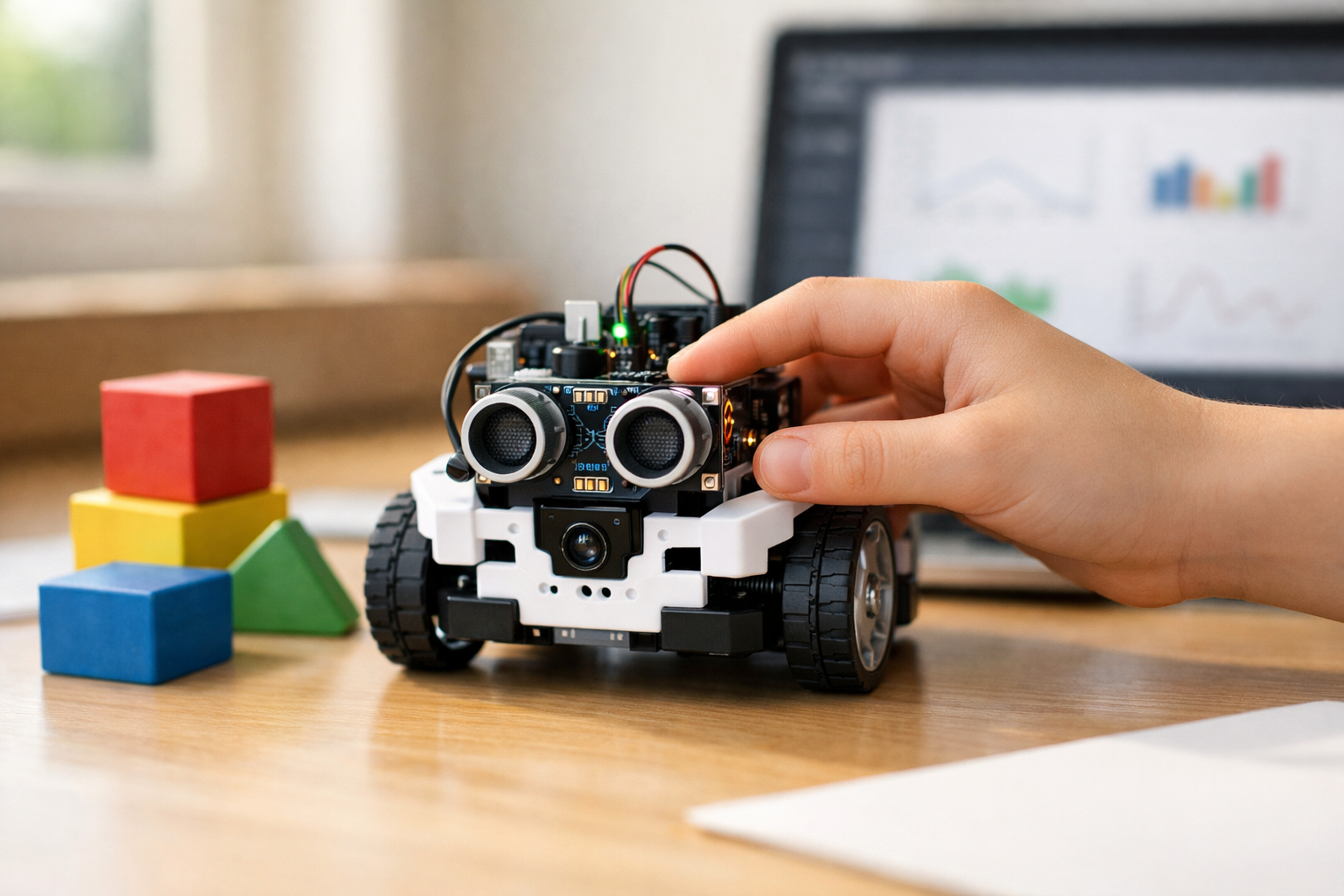
Understand robot AI step by step, even with zero experience
How do robots know where to go, what to pick up, or when to stop? For many beginners, artificial intelligence in robotics can feel mysterious and hard to approach. This course turns that big topic into a short, clear, book-style learning journey. You do not need coding, math, engineering, or data science experience. Everything is explained in plain language from the ground up.
In this course, you will learn how robots sense the world, how they process information, and how simple AI helps them make better decisions. Instead of jumping into technical details too quickly, the course begins with the basic building blocks of a robot. You will see how sensors collect information, how motors create movement, and how a control system connects the two.
The course is structured like a short technical book with six connected chapters. Each chapter builds on the one before it, so you never feel lost. First, you learn what a robot is and how it interacts with its environment. Next, you discover what AI really means inside a robot and how it differs from simple automation. Then you move into data, training, and learning in the simplest possible way.
After that, the course introduces robot decision-making. You will understand ideas such as classification, prediction, planning, and feedback without needing formulas or code. Later chapters explain how robots can improve through practice, rewards, and correction. The final chapter brings everything together with real-world examples, safety concerns, and a practical path for what to learn next.
Many robotics courses assume too much too early. This one does the opposite. It treats every concept as new and explains it from first principles. If you have ever wondered what machine learning means for robots, what data does, or why some robots seem smart while others only follow fixed rules, this course gives you clear answers.
The goal is not to turn you into an engineer in a few hours. The goal is to help you truly understand the core ideas. By the end, you will be able to describe how robots learn in everyday language, identify where AI fits into autonomous systems, and speak with confidence about the basic logic behind robot behavior.
This course is made for absolute beginners. It is a strong fit for curious learners, students exploring technology, professionals changing careers, and anyone who wants a simple entry point into robotics and AI. If you have seen robots in warehouses, homes, hospitals, or videos online and wanted to understand what is happening behind the scenes, this course is for you.
You can take this course as a standalone introduction or use it as a starting point before more advanced topics like coding, computer vision, or autonomous navigation. If you are ready to begin, Register free and start learning today. You can also browse all courses to continue your AI learning path after this one.
You will understand the difference between sensing, control, automation, and learning. You will know how examples and feedback help robots improve. You will also recognize the limits of robot AI, including mistakes, bias, safety risks, and the continued need for human oversight. Most importantly, you will leave with a simple mental model you can carry into any future study of robotics.
If you want a calm, clear, and practical introduction to how robots learn, this course gives you the right starting point.
Robotics Educator and Machine Learning Engineer
Sofia Chen designs beginner-friendly learning programs in robotics and artificial intelligence. She has helped students and career changers understand complex technical ideas through simple examples, real-world robots, and clear step-by-step teaching.
When people hear the word robot, they often imagine a human-shaped machine that walks, talks, and makes clever decisions. In real engineering, a robot can be much simpler. A robot is a machine that can sense something about the world, process that information, and then act in a physical way. That basic pattern matters more than its shape. A robot might be a vacuum cleaner, a warehouse cart, a drone, a factory arm, or a small toy that follows a line on the floor. Some robots look advanced, but even very simple ones still follow the same core idea: input, decision, and action.
This chapter builds your first mental model of a smart robot. Think of a robot as having a body, a way to notice the world, a way to move, and a control system that connects noticing to moving. In robotics, AI usually means the part that helps the robot make better choices from data instead of only following fixed instructions. Not every robot uses machine learning, and not every smart behavior is AI. Some robots run on clear rules written by humans. Others improve by training on examples or by learning from feedback and practice. As a beginner, the most useful skill is learning to separate these ideas while still seeing how they work together in one system.
A practical way to understand robotics is to ask four simple questions. What can the robot sense? What can it do physically? How does it decide what to do next? How does it know whether it is doing well? Those questions guide real engineering judgment. A robot with weak sensors will make poor decisions no matter how fancy its software is. A robot with a great camera but weak motors may understand the world but fail to act. A robot with movement and sensing but no feedback may repeat the same mistake again and again. Good robotic design is about balance.
In this chapter, you will meet the basic parts of a robot, understand sensors, motors, and control, see how robots turn input into action, and build a first clear picture of how robot intelligence fits into the whole machine. Keep this image in mind as you read: a robot is a loop. It notices, thinks, acts, checks the result, and adjusts. That loop is the foundation for everything that comes later, from simple rule-based machines to robots that learn from experience.
One common beginner mistake is to focus only on the “brain” and ignore the physical world. In robotics, software and hardware are always linked. A robot may have a smart algorithm, but if its distance sensor is noisy or its wheels slip on the floor, the result can still be poor. Another mistake is to assume that learning always replaces rules. In practice, robots often combine both. A warehouse robot may use fixed safety rules, trained vision models to detect objects, and simple feedback control to keep moving straight. Real robots are layered systems, and understanding those layers will make the rest of this course much easier.
By the end of this chapter, you should be able to explain in simple words what AI means in robotics, describe how data becomes action, and recognize the difference between a robot that follows instructions and one that improves through feedback or training. That foundation will help you see robots not as magic machines, but as understandable engineered systems.
Practice note for Meet the basic parts of a robot: document your objective, define a measurable success check, and run a small experiment before scaling. Capture what changed, why it changed, and what you would test next. This discipline improves reliability and makes your learning transferable to future projects.
A machine becomes a robot when it can interact with the physical world in a purposeful way. A basic calculator processes information, but it does not sense its surroundings or move anything in response. A robot does more. It gathers information through sensors, processes that information, and then produces a physical action using motors or other actuators. That action might be moving across a room, gripping an object, adjusting speed, or changing direction. In other words, a robot connects information to motion.
This is why a robotic vacuum counts as a robot even though it does not look like a person. It senses walls, furniture, or dirt; decides where to go; and drives its wheels to clean the floor. A factory robotic arm also qualifies because it uses position sensors and control software to move tools precisely. The exact task changes, but the structure remains the same.
It is helpful to think of three ingredients. First, the robot must sense something. Second, it must compute or decide. Third, it must act physically. If one of these is missing, the machine may still be useful, but it is less robotic. A timer-controlled fan can turn on and off, but if it never measures anything and never adapts, it behaves more like an automatic device than a true robot.
Engineering judgment matters here. People often label any machine with automation as AI or robotics, but that can blur important differences. A robot can be simple and still be a robot. It does not need deep learning, speech, or human-like behavior. Many successful robots do one narrow job very well. Beginners often underestimate how valuable narrow competence is in engineering. A line-following robot that senses a black track and keeps itself centered is already teaching the essential logic of robotics: observe, decide, act, repeat.
A practical outcome of understanding this definition is that you start evaluating machines by function, not by appearance. Ask: what does it sense, what decisions does it make, and what can it physically do? That question set gives you a reliable way to identify robots in the real world.
A useful beginner model is to divide a robot into body, brain, and moving parts. The body is the physical structure: the frame, wheels, arms, joints, shell, battery, and wiring. The brain is the control system, usually a microcontroller or onboard computer running software. The moving parts are the devices that actually produce force or motion, such as wheel motors, servo motors, grippers, or pumps. These parts work together continuously.
The body matters more than many beginners expect. A heavy robot needs stronger motors. A tall robot may tip over easily. A robot meant for rough outdoor ground needs a different frame and wheel design than a robot meant for a smooth warehouse floor. Physical design limits what the software can achieve. Even a well-programmed robot will struggle if its center of mass is unstable or its battery is too weak.
The brain receives signals from sensors and sends commands to actuators. Sometimes the brain is tiny and simple, as in a toy robot. Sometimes it is powerful, like the computer in a self-driving research vehicle. In both cases, the core job is similar: read data, compare it with goals, choose an action, and repeat quickly. Some decisions are direct rules, such as “if obstacle is near, stop.” Other decisions depend on trained models, such as recognizing a pedestrian in an image.
One common mistake is to imagine the robot brain as a single magical intelligence. In real systems, robots often use layers of control. A high-level planner may choose a destination, a mid-level controller may decide a path, and a low-level controller may manage wheel speed many times per second. Separating these layers makes systems easier to design and debug.
The practical lesson is that robots are systems, not single parts. If a robot fails, the problem may come from structure, wiring, software logic, power supply, or movement hardware. Good engineers avoid guessing. They break the robot into parts, test each one, and then test how the parts interact. That habit will serve you throughout robotics.
Sensors are how robots notice the world. They do not understand the world the way humans do. Instead, they measure signals: light, distance, sound, force, rotation, temperature, speed, location, or acceleration. A camera measures light patterns. A microphone measures sound waves. A bump sensor detects contact. A wheel encoder measures rotation. The robot’s software then turns these raw measurements into useful information.
It is common to describe sensors as a robot’s eyes, ears, and touch, but that analogy has limits. Human senses are rich and flexible. Robot sensors are often narrow and noisy. A distance sensor may give imperfect readings on shiny surfaces. A camera may struggle in darkness. A GPS receiver may be inaccurate near tall buildings. Because of this, engineering with sensors means handling uncertainty. Robots rarely get a perfect picture of the world.
This is where practical judgment becomes important. A good robotic design chooses sensors that fit the task and environment. For line following, simple light sensors may be enough. For a warehouse robot, lidar or depth sensors may help avoid collisions. For balancing, an inertial sensor can estimate tilt and rotation. Adding more sensors is not always better. More sensors can increase cost, power use, wiring complexity, and software difficulty. The best choice is usually the simplest set of sensors that can do the job safely and reliably.
Beginners also make the mistake of trusting sensor data too much. Real sensors drift, fail, and produce noise. Engineers often smooth measurements, combine different sensors, or compare readings over time. For example, a robot vacuum may use wheel motion, wall sensing, and bump detection together because each source alone has weaknesses. This combination is one reason robots can behave more robustly.
In practical terms, sensors are the beginning of robot intelligence. If the robot cannot measure the right signals, it cannot react well. Before asking whether a robot is smart, first ask whether it is sensing the right things clearly enough to support good decisions.
If sensors are how robots notice the world, actuators are how robots change it. An actuator turns electrical, hydraulic, or pneumatic energy into physical motion or force. In beginner robotics, the most common actuators are electric motors. These may spin wheels, rotate joints, open a gripper, or tilt a camera. Other actuators include linear actuators that push in a straight line, solenoids that make quick mechanical movements, and pumps that move air or fluids.
Movement is never just about turning something on. A robot often needs the right amount of movement at the right time. That means controlling speed, direction, force, and position. A wheel motor may need to spin faster on one side to turn. A robotic arm joint may need to stop at an exact angle. A delivery robot may need smooth acceleration so it does not tip its load. This is why actuators are tightly linked to control software.
Physical constraints matter. Motors have torque limits. Batteries can run low. Wheels can slip. Arms can shake if they move too fast. A common beginner mistake is to command a robot to move without considering friction, weight, momentum, or surface conditions. In simulation, movement can look perfect. In the real world, hardware pushes back. Good robot design respects that.
Another useful idea is that action is not only movement across space. A robot can act by pressing, lifting, sorting, spraying, cutting, or holding position. Even staying still on purpose can be an important controlled action. In industrial robots, accurate repeated motion often matters more than human-like motion.
The practical outcome is simple: robot behavior depends as much on mechanics and power as on logic. To understand what a robot can really do, look at its actuators and how precisely they can be controlled. Smart decisions are valuable only if the robot can turn them into reliable physical action.
The heart of robotics is the control loop. A control loop is the repeating cycle in which a robot senses, decides, acts, and then senses again to check the result. This loop can happen many times per second. Without it, a robot would act blindly. With it, the robot can adjust to change and correct mistakes.
Consider a simple line-following robot. Its sensors read the floor and detect whether the black line is centered under the robot. The controller compares the current reading with the desired position. If the line is too far left, the robot slows the left wheel or speeds up the right wheel. Then it reads the sensors again. This is a complete sense-think-act cycle. It may look simple, but it captures the foundation of autonomous behavior.
This section also helps explain the difference between rules, training, and learning. A rule-based robot uses direct instructions such as “if too close, turn right.” A trained system uses examples to build a model, such as learning to recognize objects from images. A learning robot changes its behavior based on feedback and practice, improving over time. In robotics, these approaches are often combined. A drone may use fixed safety rules, a trained vision model, and feedback control to keep itself stable in the air.
Feedback is especially important. If a robot sends a command but never checks the result, small errors can grow. A wheel may slip or a battery may weaken. Feedback lets the robot compare what it wanted with what actually happened. This is one of the key ideas behind robots improving through practice. Even simple systems can adjust repeated actions when they measure outcomes.
A practical engineering habit is to draw the loop on paper: sensor input, controller, actuator output, world response, new sensor input. If you can sketch that loop clearly, you usually understand the robot much better. It is one of the best mental tools for beginners.
Robots are already part of daily life, even when people do not notice them. A robotic vacuum senses walls, stairs, and obstacles, then adjusts its path. A warehouse robot moves shelves or packages by combining maps, sensors, and wheel control. A factory arm places parts with high precision using motor control and position sensing. A lawn robot senses boundaries and cuts grass automatically. Each example uses the same basic structure you have learned in this chapter.
These examples also show different levels of intelligence. Some systems rely mostly on rules. A robot vacuum may follow programmed behaviors for edge cleaning, obstacle avoidance, and docking to recharge. Other systems use machine learning. A delivery robot may use a trained model to recognize sidewalks, people, or objects. In more advanced cases, robots improve through repeated experience, adjusting paths or grasp strategies from feedback. This is where learning becomes practical, not magical.
A useful way to study everyday robots is to ask what they sense, what they decide, and what they physically do. For example, an automatic sliding door has a sensor and motion, but it performs a very narrow reactive function. A warehouse picker has richer sensing, path planning, and task control, making it more clearly robotic. This kind of comparison helps sharpen your understanding.
One beginner mistake is to think advanced robotics only happens in research labs. In reality, many important robots are boring on purpose. They are built to be safe, repeatable, and cost-effective. Good engineering often looks ordinary from the outside. The value is in reliable performance.
The practical outcome of this chapter is that you should now be able to look at real machines and mentally trace their robotic loop. You can identify the parts, the sensors, the actions, and the decision logic. That mental model is the starting point for understanding how robots become smarter through training, feedback, and learning in later chapters.
1. According to the chapter, what most defines a robot?
2. What is the main job of sensors in a robot?
3. Why might a robot still perform poorly even if it has advanced software?
4. How does the chapter describe AI in robotics?
5. Which sequence best matches the robot loop described in the chapter?
When people hear the words artificial intelligence, they often imagine a robot that thinks like a person. In real robotics, the idea is much simpler and much more useful. AI inside a robot usually means methods that help the robot turn messy sensor data into better choices. A robot does not begin with magic understanding. It begins with hardware, software, and a task. It senses the world, processes what it notices, chooses an action, and then checks what happened next. AI becomes important when the world is too variable for a tiny fixed script to handle well.
This chapter helps you separate automation from real learning. That distinction matters because many machines look smart even when they are only following strict instructions. A timed factory arm may place parts all day with amazing speed, but if the part shifts slightly and the arm cannot adapt, it is automated rather than intelligent. By contrast, a robot that adjusts its path after noticing people, boxes, or changing light is doing something closer to AI. The robot is still not “alive” or “human.” It is simply using methods that connect perception, prediction, and action more flexibly.
A practical way to think about robot AI is this: sensors collect data, software interprets the data, a decision system selects an action, motors carry out that action, and feedback shows whether the action helped. Cameras, distance sensors, touch sensors, wheel encoders, microphones, and GPS all produce signals. Those signals by themselves are not knowledge. The robot must organize them into useful information such as “wall ahead,” “object on the left,” “I am drifting off course,” or “this route is slower than expected.” AI methods help with that interpretation and with choosing what to do next.
Beginners often make a common mistake here. They assume AI replaces programming. It does not. Every robot still depends on careful engineering: safe limits, good sensor placement, clean data, tested control loops, and clear goals. AI works inside those engineering choices. If a robot has poor sensors, weak batteries, or badly designed rewards, no amount of AI language will save it. Good robotics always combines mechanical design, electronics, software, and decision logic.
Another useful distinction is between rules, training, and learning. Rules are written directly by a human: “If the front sensor is less than 20 centimeters, stop.” Training means showing a system many examples so it can adjust internal parameters: for example, showing a robot vision system thousands of images labeled “chair,” “box,” and “person.” Learning is the broader idea that the robot improves behavior from data or feedback rather than only from hand-written instructions. Some robots use mostly rules. Some use trained models. Many real robots use both at once.
In this chapter, you will see the simplest idea of artificial intelligence in robotics: AI is a tool that helps a robot make better decisions in situations that are uncertain, changing, or too complex to cover with exact rules alone. You will also connect these ideas to real robot tasks such as vacuum cleaning, warehouse delivery, obstacle avoidance, and route planning. By the end, you should be able to explain in plain language what AI means inside a robot, when a machine is simply automated, and when it is actually using data to improve its choices.
Think like an engineer as you read the chapter. Ask: What does the robot sense? What decision is being made? Which part is fixed by rules, and which part changes from data? What kind of mistakes can happen? Those questions are more useful than asking whether a robot is “truly intelligent.” In robotics, useful systems win over dramatic ideas.
Practice note for Separate automation from real learning: document your objective, define a measurable success check, and run a small experiment before scaling. Capture what changed, why it changed, and what you would test next. This discipline improves reliability and makes your learning transferable to future projects.
Inside a robot, artificial intelligence usually means a set of methods that help the machine interpret information and choose actions under uncertainty. That is much narrower than human-style thinking, and that is good news for beginners. You do not need to imagine a robot with feelings or self-awareness. Instead, imagine a machine trying to answer practical questions: Where am I? What is in front of me? Which action is safest? Which path is faster? Did my last action improve the situation?
The key word is uncertainty. Real environments are noisy and imperfect. A camera may be affected by shadows. A distance sensor may bounce off shiny surfaces. Wheels may slip. People may walk into the robot’s path. If every situation were perfectly predictable, simple programs would be enough. AI becomes useful because the robot needs a way to cope when the world does not match a rigid script.
One simple definition is this: AI in robotics is software that helps a robot turn sensor data into decisions that work better across many situations. Sometimes that software is a trained model. Sometimes it is a search algorithm or planner. Sometimes it is a system that estimates what the robot cannot directly measure. The shared idea is not magic intelligence but improved decision making from data.
Engineering judgment matters here. A good robotics engineer does not add AI just to sound modern. They ask whether the task truly needs adaptation. If a conveyor belt always moves identical boxes under fixed lighting, hand-coded logic may be enough. If a service robot must work in homes with pets, toys, carpets, and moving people, it probably needs stronger perception and smarter choice methods. The practical outcome is better reliability in changing conditions, not a robot that “thinks like us.”
Every robot runs programs, even when people call it intelligent. A program can include fixed rules, mathematical control, planning methods, and machine learning models. For beginners, it helps to start with rules. A rule is an explicit instruction written by a human, such as: if the bumper is pressed, reverse for one second. Rules are easy to understand, easy to test, and often essential for safety. Emergency stop behavior, speed limits, and battery protection are usually rule-based because engineers want clear, predictable responses.
But rules alone have limits. Suppose you try to write instructions for a robot moving through a busy hallway. You may add many statements: if person on left, move right; if obstacle ahead, slow down; if path blocked, wait. Soon the number of cases grows large, and the interactions between rules become messy. The robot may hesitate, spin, or choose poor paths because the world contains more combinations than the programmer expected.
This is where decision making becomes the deeper idea. A robot often needs to compare options, estimate likely outcomes, and choose the action that best fits a goal. The goal might be “reach the charging dock safely,” “pick the correct item,” or “clean the floor quickly without missing spots.” Some systems do this with fixed scoring formulas. Others use learned models to predict which action is better. In both cases, the robot is going beyond a simple one-line reaction.
A common beginner mistake is to treat rules and AI as enemies. In practice, robots blend them. Rules set boundaries and handle obvious cases. Smarter methods handle ambiguity inside those boundaries. For example, a delivery robot may use learned vision to detect people, but a fixed safety rule still limits speed near crosswalks. The practical lesson is simple: rules provide structure, while AI can provide flexibility.
Automation means a machine carries out a task with little direct human control. That does not automatically mean the machine is learning. A robot can be highly useful, precise, and fast while still doing exactly what it was programmed to do on day one. Consider a factory arm that picks a part from the same position every cycle. It may use sensors to confirm the part is present and controllers to move smoothly, but if it cannot improve from experience or adapt beyond its preset cases, it is automated rather than learning.
Another example is a line-following robot in a classroom. If it uses a light sensor to stay on a dark strip of tape, it is responding to sensor input, but that alone is not AI. It is following a known rule: keep the sensor reading near a target value. This is valuable engineering, but it is not learning from data in the richer sense. The robot does not discover a better strategy after many runs. It simply applies the same control logic again and again.
Why does this distinction matter? Because people often overestimate what a robot can do. If you think an automated machine is learning, you may trust it in situations it was never designed for. That is a safety and reliability problem. A warehouse robot that works perfectly in marked lanes may fail badly if you place it in an unstructured office. The machine was not foolish; the human expectation was wrong.
A practical engineering habit is to ask: what changes inside the robot after experience? If the answer is “nothing important,” then you are likely looking at automation, not learning. That is not an insult. Many excellent robots should remain fixed and predictable. The main point is to label the system honestly so you know its strengths, weaknesses, and limits.
A robot uses AI in a meaningful way when experience, data, or prediction helps it choose actions better than a simple fixed script would. This can happen at different stages. The robot may use AI to recognize objects in camera images, to estimate its position on a map, to predict whether a path is blocked, or to select a motion policy that has worked well before. In each case, the robot is doing more than repeating a hard-coded response. It is using information patterns to improve behavior.
Feedback is central to this process. The robot acts, observes the result, and updates future choices. Imagine a mobile robot trying to drive across different floor surfaces. If it notices that smooth tile causes more slipping than carpet, it can reduce speed in similar future conditions. Or imagine a robotic gripper learning how much force to use on soft packages versus rigid boxes. The improvement comes from comparing expected and actual outcomes.
There are several ways this can happen. A robot might be trained before deployment using examples collected by humans. It might also keep adapting while it works, though engineers must be careful with safety when allowing on-the-job learning. In many commercial systems, the “learning” happens offline in development, while the deployed robot uses the learned model to make better decisions in real time.
A common mistake is assuming AI guarantees good choices. It does not. If the training data is narrow, the robot may fail in unfamiliar settings. If the reward or objective is badly defined, it may optimize the wrong thing. Good engineering judgment means checking performance under realistic conditions, measuring failure modes, and keeping safety rules in place. The practical outcome is not perfection, but improved action selection in messy real environments.
Cleaning robots offer a clear example of the spectrum from rules to AI. A basic robot vacuum may move with simple patterns: drive forward until hitting an obstacle, turn, continue, and repeat. That is automation. A smarter vacuum may build a map, estimate which rooms are already cleaned, recognize furniture, and choose a more efficient route. If it improves coverage by interpreting sensor data and adapting its path, it is showing practical AI behavior. It still follows programmed goals, but its choices are more informed and flexible.
Delivery robots are another useful case. A simple one might follow a painted line or a fixed set of waypoints. That works in controlled spaces. A more advanced delivery robot must notice pedestrians, avoid temporary obstacles, handle changing lighting, and sometimes reroute around blocked corridors. Here, AI can help with perception, path planning, and prediction. The robot may combine camera data, depth sensing, and map information to decide whether to slow down, stop, or take another route.
These examples also show why mixed systems are common. A cleaning robot may use learned object detection but still rely on fixed rules to avoid stairs. A delivery robot may use AI to classify obstacles but keep a strict rule that emergency braking always overrides everything else. This combination is not a weakness. It is good design.
For beginners, the main workflow to remember is practical: sense the world, interpret the data, choose an action, perform the action, and use feedback to improve future decisions. Once you can describe that loop in a robot vacuum or delivery cart, you are already understanding the heart of robot AI much better than many casual technology discussions do.
Beginners should care about robot AI because it changes how you understand what robots can and cannot do. Without this chapter’s distinctions, it is easy to fall into two bad habits: believing every robot is intelligent, or believing AI is just marketing. The truth sits between those extremes. Some robots are mostly automated tools. Some use machine learning in specific parts of their workflow. Some improve through feedback in carefully designed ways. Knowing the difference helps you ask better questions and build more realistic expectations.
This knowledge also helps you make design choices later. If you build a simple robot project, you will need to decide whether fixed rules are enough or whether the task needs adaptation. That decision affects cost, data needs, testing effort, and safety planning. AI can improve flexibility, but it also adds complexity. More sensing, more training data, and more validation may be required. Good beginners learn early that “smart” systems need disciplined engineering, not just exciting buzzwords.
There is also a practical career benefit. Robotics teams need people who can explain systems clearly. If you can describe how sensors become decisions, and how feedback improves performance, you can communicate with programmers, mechanical engineers, product managers, and nontechnical users. Clear explanation is a real technical skill.
Most importantly, understanding robot AI lets you see robots as systems rather than magic boxes. That mindset will support every chapter that follows. You will look at a robot and ask: what does it sense, what does it know, what choices does it make, what feedback does it use, and where can it fail? Those questions are the foundation of real robotics thinking.
1. Which example from the chapter best shows AI rather than simple automation?
2. According to the chapter, what is the simplest idea of AI inside a robot?
3. What does the chapter say about sensor data by itself?
4. How does the chapter distinguish rules, training, and learning?
5. Why does the chapter emphasize feedback in robot behavior?
In earlier ideas about robots, it is easy to imagine a machine that follows a list of fixed rules: if the light is red, stop; if the wall is close, turn; if the battery is low, go charge. That rule-based style is still useful, and many real robots depend on it every day. But modern robots often need something more flexible. A home robot may see toys, shoes, pets, and shadows in changing places. A warehouse robot may meet boxes of different sizes. A farm robot may work in bright sun one hour and under clouds the next. In these situations, writing every possible rule by hand becomes hard. This is where learning from data becomes important.
In simple words, data is the robot's record of experience. It can come from cameras, distance sensors, microphones, touch sensors, wheel movement, motor current, GPS, and many other sources. By collecting many examples, engineers can help a robot system notice useful patterns. Instead of directly programming every answer, they train a model that learns a relationship between what the robot senses and what it should predict or do. The robot is not "thinking like a human," but it is becoming better at mapping inputs to useful outputs.
A beginner-friendly way to understand this is to separate three ideas: rules, training, and learning. Rules are hand-written instructions from a person. Training is the process of showing many examples to a model so it can adjust itself. Learning is the result of that training: the model becomes able to respond to new situations that are similar to what it practiced on. Then, when the robot is working in the real world, it uses the trained model to make fast decisions. This use stage is different from the training stage, and that difference matters in engineering.
Robots do not learn from magic. They learn from data that is collected, organized, checked, and tested. Good robot learning usually follows a workflow. First, define the task clearly. Next, collect examples from sensors. Then prepare labels if needed, train a model, test it carefully, and finally deploy it on the robot. After deployment, engineers watch performance, gather feedback, and improve the system again. In this chapter, you will follow that full idea in plain language. You will see what data means for a robot, how examples teach a robot system, why training and using a model are not the same thing, and how a simple robot learning pipeline works in practice.
As you read, keep one practical question in mind: what job is the robot trying to do better because of data? That question helps engineers avoid a common mistake, which is building a fancy model before clearly defining the real problem. Good robot learning starts with the task, uses the right examples, and ends with behavior that is actually useful in the physical world.
Practice note for Understand data in plain language: document your objective, define a measurable success check, and run a small experiment before scaling. Capture what changed, why it changed, and what you would test next. This discipline improves reliability and makes your learning transferable to future projects.
Practice note for See how examples teach a robot system: document your objective, define a measurable success check, and run a small experiment before scaling. Capture what changed, why it changed, and what you would test next. This discipline improves reliability and makes your learning transferable to future projects.
Practice note for Learn the difference between training and using a model: document your objective, define a measurable success check, and run a small experiment before scaling. Capture what changed, why it changed, and what you would test next. This discipline improves reliability and makes your learning transferable to future projects.
Practice note for Follow a simple robot learning workflow: document your objective, define a measurable success check, and run a small experiment before scaling. Capture what changed, why it changed, and what you would test next. This discipline improves reliability and makes your learning transferable to future projects.
For a robot, data is information gathered from the world, from the robot's own body, or from human input. A camera image is data. A laser distance reading is data. The angle of a robot arm joint is data. Even a note from a person saying "this object is a cup" can become data. In plain language, data is what the robot system has available to notice what is happening and to learn from experience.
Data matters because a robot cannot act intelligently without some way to connect situations to outcomes. If a robot vacuum keeps bumping into chair legs, it needs sensor data to notice where obstacles are. If a delivery robot must stay on a path, it needs movement and position data to estimate where it is. If a sorting robot must pick ripe fruit, it needs visual data that helps distinguish color, shape, and texture. The data is not the action itself. Instead, it is the evidence used to choose an action.
A useful engineering habit is to ask two questions: what input data does the robot receive, and what output do we want? Inputs might be images, sound, distance, speed, or touch. Outputs might be a label such as "person" or "box," a number such as steering angle, or a decision such as stop, pick, or turn left. Once these are clear, the learning problem becomes easier to describe.
Beginners sometimes think more data always means better learning. That is not always true. Data must match the task. A warehouse robot learning to avoid forklifts needs examples from a warehouse, not random internet photos. A robot arm learning to grasp objects may need close-up camera views and force readings, not just wide room images. Good engineers focus on relevant data, not just large amounts of it.
Another important point is that robot data is often noisy. Sensors can be blocked, lighting can change, wheels can slip, and measurements can drift. Real robots work in messy environments, so the data often contains errors and uncertainty. That does not make learning impossible. It simply means the robot system must be designed with care. The better the data represents real operating conditions, the more useful the trained model will be.
A robot system often learns from examples. An example is one piece of data, or one small bundle of data, together with the answer we want the model to learn. If a camera image shows a stop sign and a person marks it as "stop sign," that mark is a label. If a robot arm image shows a successful grasp and is marked "good grasp," that is also a labeled example. Labels give meaning to raw data so the model can connect inputs to desired outputs.
Not all learning uses labels, but labels are the easiest place to start. They are especially common in beginner examples because they make the learning goal visible. The model sees many labeled examples and gradually notices patterns. It may discover that stop signs often have a certain shape and color, or that successful grasps tend to happen when the gripper is aligned in a particular way. The system is not memorizing one single image. It is trying to learn a pattern that generalizes to new but similar cases.
This is why examples matter more than isolated facts. One photo of a cup does not teach much. Hundreds or thousands of varied examples can teach something useful. The variation matters: cups can be large, small, bright, dark, partly hidden, or placed on different backgrounds. If the robot only sees one type of cup during training, it may fail in a real room with different lighting or clutter.
Engineering judgment is important here. Suppose you want a robot to detect people in a hallway. If every training image shows people standing in the center and facing forward, the model may learn that narrow pattern instead of the true idea of a person. Then it may struggle when people are near the edge, partly hidden, or carrying bags. Good examples show the range of conditions the robot will face.
A common mistake is assuming the model understands the world the way humans do. It does not. It only finds statistical patterns in the data it receives. If the training set accidentally links the wrong background with the right answer, the model may learn the background instead of the object. That is why careful labeling and thoughtful example collection are central to robot learning.
Training is the stage where the model practices. A helpful analogy is teaching a beginner to sort objects. You do not give one example and expect perfect skill. You show many cases, give corrections, and let practice shape better responses. In machine learning for robots, training works in a similar way. The model receives many examples, compares its guesses to the correct answers, and adjusts internal settings to reduce mistakes.
This process happens before the robot starts using the model in normal operation. During training, time is spent learning from data. During use, often called inference or deployment, the robot applies what it learned to new sensor inputs. Beginners often mix these two stages together. The difference is important. Training can be slow and may happen on a powerful computer. Using the model on a robot usually must be fast, reliable, and efficient.
Consider a simple line-following robot with a camera. During training, engineers collect many images of the floor and label the correct steering direction. The model learns patterns that connect visual position of the line to left, right, or straight movement. Later, when the robot drives in real time, it is no longer learning from scratch. It is using the trained model to predict the steering command from each new camera frame.
Practical robot systems often combine learning with rules. A learned model might estimate where a path is, while rule-based safety code still says "stop if an obstacle is too close." This mix is common because learning is powerful but not perfect. Engineers protect the robot with limits, safety checks, and fallback behaviors.
A common training mistake is using too few examples or examples that are too similar. Another mistake is training for the wrong goal. If the real need is safe navigation in dim light, but the model is trained mostly on bright daytime images, practice has not matched the true job. Good training means repeated exposure to examples that look like the robot's future world.
So in plain language, training is practice with many examples, feedback about mistakes, and repeated adjustment until the model becomes useful. It is not instant, and it is not magic. It is a structured process that turns data into a model the robot can later use.
After training, engineers must ask a practical question: did the robot learn something useful, or did it only get good at the training examples? This is the purpose of testing. Testing means checking performance on data the model did not use during training. If the model works only on familiar examples but fails on new ones, it has not learned in a useful way.
For robots, useful testing goes beyond a single score. Accuracy can help, but the real issue is whether the model supports safe and effective behavior. A robot that identifies boxes correctly 95% of the time may still be unacceptable if its errors happen around fragile items or people. Engineers therefore look at where mistakes happen, how often they happen, and how serious the results could be.
Imagine a robot that must recognize doors in a building. Testing should include bright hallways, dim corners, partially open doors, glass doors, and doors with signs on them. A good test set represents real variation. If testing data is too easy or too similar to training data, results may look better than they really are. This is one of the most common beginner mistakes.
Another practical step is field testing. A model may perform well on saved datasets but behave differently on a moving robot with vibration, changing light, and timing delays. Real-world robot learning should be checked in the environment where the system will work. Even a simple pilot run can reveal issues that never appeared during offline training.
Engineering judgment matters most when deciding if the model is good enough for the task. In a toy demo, a few errors may be acceptable. In a hospital or factory, the same error rate may be far too risky. Testing is not just about proving the model works. It is about discovering limits early, before those limits become real-world failures.
Good data helps a robot learn the right lesson. Bad data teaches the wrong lesson, hides the real problem, or leaves out important situations. The difference is often more important than the choice of algorithm. Many robot learning failures come from weak data rather than from weak mathematics.
Good data is relevant, varied, and correctly labeled. It reflects the task the robot will actually perform. If a robot must work in a warehouse at night, then night images and sensor readings should be included. If a robot hand must grasp soft packages and hard boxes, both should appear in training examples. Variety makes the model more robust because it sees different versions of the same underlying task.
Bad data can take many forms. Labels may be wrong because humans made mistakes. Important cases may be missing, such as rainy outdoor scenes for a delivery robot. The data may be biased toward one environment, one object type, or one camera angle. Some datasets are full of duplicates, meaning the model sees almost the same example again and again and learns less than expected.
One subtle problem is shortcut learning. Suppose all images of "target object" were taken on a blue table, while non-target objects were shown on a gray floor. The model may learn table color instead of object identity. It can appear successful during testing if the same shortcut remains present, then fail badly in deployment. This is why engineers inspect data carefully, not just model scores.
Feedback is part of improving data quality. When a robot makes mistakes in the real world, those failures can become new training examples. This closes the loop between practice and improvement. Over time, the dataset becomes more representative of reality, and the model can improve.
For beginners, the practical lesson is simple: if you want better robot learning, first look at the data. Ask whether it matches the true environment, whether the labels are trustworthy, and whether difficult cases are included. Better data often leads to better robots more reliably than simply using a more complex model.
A robot learning pipeline is the step-by-step workflow that turns raw experience into useful behavior. For beginners, it helps to keep the process simple and concrete. Start with the task. Write one clear sentence describing what the robot must do, such as "detect obstacles from camera images" or "predict steering direction from floor images." If the task is vague, the whole project becomes confusing.
Next, collect data from the robot's sensors in realistic conditions. Save examples from the places, lighting, speeds, and object types the robot will actually encounter. Then prepare labels if the task requires them. For classification, labels might be names like "wall," "person," or "empty path." For control tasks, labels might be desired steering angles or grasp success results.
After that, split the data into training examples and testing examples. Train the model on the training set so it can practice on many cases. Then evaluate on the testing set to see whether it learned a pattern that works on unseen data. If results are weak, do not immediately jump to a new algorithm. First inspect the data, labels, and task definition. Often the real fix is better examples.
Once the model performs well enough, place it into the robot system for real use. This stage must consider speed, memory, battery use, and safety. A model that works on a laptop may be too slow on a small mobile robot. Engineers may simplify the model or run some parts off-board depending on the application.
Finally, monitor the robot after deployment. Collect cases where it fails, behaves uncertainly, or meets new conditions. Add those cases back into the dataset, retrain if needed, and test again. This improvement cycle is how robots get better through feedback and practice.
This pipeline captures the main idea of robot learning from data. Sensors provide information, examples provide guidance, training builds a model, testing checks usefulness, and deployment connects the model to action. With this workflow, you can see how data becomes decisions and why careful engineering matters at every step.
1. Why do modern robots often need to learn from data instead of relying only on fixed rules?
2. In this chapter, what is data described as for a robot?
3. What is the difference between training and using a model?
4. Which step should come first in a good robot learning workflow?
5. What common mistake does the chapter warn engineers to avoid?
In earlier chapters, we looked at how robots sense the world and how data moves from sensors into software. Now we reach the next important step: decision-making. A robot is useful not just because it can measure distance, detect light, or read a camera image, but because it can turn those measurements into action. That action might be stopping before a wall, turning toward a box, slowing down on a slippery floor, or choosing which item to pick up. In simple terms, robot decision-making is the process of deciding what to do next.
For beginners, it helps to think of robot decisions as a chain. First, the robot senses something. Next, it interprets what those sensor values mean. Then it chooses an action. Finally, motors, wheels, arms, or grippers carry out that choice. This chapter connects sensing, thinking, and motion into one story. It also introduces three common kinds of robot thinking: classification, prediction, and choice. These are not mysterious ideas. They are practical tools engineers use every day.
One important comparison in robotics is the difference between rule-based control and learned behavior. A rule-based robot follows explicit instructions written by a person. For example: “If distance is less than 20 centimeters, stop.” This method is simple, clear, and often very reliable. A learned system behaves based on examples, training, or past experience. For example, a robot might learn from many camera images how to tell a cup from a bottle. Neither method is always better. Rules are easier to understand and test. Learned systems can handle messy situations that are hard to describe with exact rules. Real robots often use both together.
Good robot decision-making is also about engineering judgment. A perfect decision method on paper may fail in a noisy, real environment. Sensors can be wrong. Lighting changes. Floors are uneven. People move unpredictably. Because of this, engineers do not only ask, “Can the robot decide?” They also ask, “Can it decide safely, consistently, and fast enough?” A delivery robot, for example, may not need the smartest possible model if a simpler one works reliably in hallways every day.
Another practical idea is that robot decisions are usually small and repeated. Most robots do not make one giant decision and then finish the job. Instead, they make many tiny decisions in sequence: move forward a little, check again, adjust direction, slow down, avoid an obstacle, continue, and stop at the goal. This repeated loop is what makes robots seem responsive. It also means mistakes can be corrected quickly through feedback.
As you read this chapter, keep one simple workflow in mind:
This chapter will show how these parts fit together. By the end, you should be able to explain in simple words how robots move from raw sensor readings to practical decisions, and how rules, training, and feedback all help robots improve their behavior.
Practice note for Compare rule-based control and learned behavior: document your objective, define a measurable success check, and run a small experiment before scaling. Capture what changed, why it changed, and what you would test next. This discipline improves reliability and makes your learning transferable to future projects.
Practice note for Understand classification, prediction, and choice: document your objective, define a measurable success check, and run a small experiment before scaling. Capture what changed, why it changed, and what you would test next. This discipline improves reliability and makes your learning transferable to future projects.
Practice note for See how robots plan small actions: document your objective, define a measurable success check, and run a small experiment before scaling. Capture what changed, why it changed, and what you would test next. This discipline improves reliability and makes your learning transferable to future projects.
At any moment, a robot usually has more than one possible action. A mobile robot might go forward, turn left, turn right, slow down, or stop. A robot arm might reach, wait, rotate its wrist, or open its gripper. Decision-making begins by comparing these choices and selecting the one that best matches the robot’s goal while respecting safety limits.
A simple way to do this is with rule-based control. Engineers write clear instructions such as: “If the front sensor sees an obstacle, stop,” or “If the line is drifting left, steer left a little.” Rule-based systems are common because they are easy to understand, fast to run, and predictable. If the robot behaves badly, an engineer can inspect the rule and change it. This is valuable in factories, homes, and classrooms where reliability matters.
Learned behavior works differently. Instead of listing every rule by hand, engineers give the robot examples or training experiences. The system then learns patterns that help it choose actions. This is useful when the world is too complicated for simple rules. For instance, a warehouse robot may learn how to recognize when a path looks blocked even if boxes are stacked in many different ways. However, learned behavior can be harder to explain. It may work well most of the time but fail in surprising edge cases.
In practice, many robots combine both approaches. A robot vacuum may use learned vision to recognize furniture, but still follow hard safety rules such as “never drive down stairs.” This mix is common because rules provide strong safety boundaries, while learned models add flexibility.
A common beginner mistake is assuming the robot should always make the most advanced choice. In reality, the best choice method depends on the task. If a robot only needs to stop at a wall, a simple threshold rule may be better than a trained model. Engineers choose methods based on speed, cost, available data, and the consequences of mistakes. Good decision-making is not only about intelligence. It is about matching the tool to the job.
The practical outcome is clear: robots choose between possible actions by combining goals, sensor input, and constraints. The choice may be as simple as a fixed rule or as flexible as a learned policy, but the robot still answers the same question: what should I do next?
Classification means putting something into a category. In robotics, classification helps answer questions like: “Is this object a bottle or a can?” “Is this area free space or blocked?” “Is the sound a human voice or machine noise?” A robot often cannot act well until it knows what kind of thing it is dealing with.
Some classification can be done with rules. For example, if a color sensor measures mostly black, a line-following robot may classify that surface as the track. If a temperature sensor goes above a threshold, the robot may classify the motor as overheating. These are simple but useful categories. Rule-based classification works well when the sensor patterns are clean and easy to separate.
Other tasks need machine learning. Camera images are a good example. A cup may look different depending on angle, lighting, distance, or background. Writing rules for every case would be difficult. A learned classifier can train on many examples and discover patterns that separate cups from plates or people from chairs. This is one of the most common uses of machine learning in robots.
Classification is not only about objects. Robots also classify situations. A robot may determine whether it is in a hallway, near a doorway, or facing a dead end. A farm robot may classify a plant as healthy or unhealthy. A service robot may classify whether a person is approaching or standing still. These categories help the robot decide what to do next.
Engineering judgment matters here because classification is never perfect. Sensors are noisy, and categories can overlap. A box partly hidden behind another box may be hard to identify. Good robot systems therefore avoid making big decisions from one weak classification alone. They may combine multiple sensors, check confidence levels, or ask for repeated evidence before acting.
A common mistake is treating a classification output as absolute truth. If a robot thinks an object is a bottle with 55% confidence, it should behave more carefully than if confidence is 99%. In practical systems, uncertain classification often leads to safer actions, such as slowing down, taking another image, or handing control to a simple backup rule. Classification helps robots recognize the world, but wise robots also handle uncertainty.
Prediction means estimating a future value or event. In robotics, this might be predicting where a moving person will be in one second, how long a battery will last, whether the robot will slip on a surface, or how far the robot will travel after a wheel command. Prediction matters because many robotic actions take time. By the time the robot finishes reacting, the world may have changed.
A basic prediction can come from physics and rules. If a wheel turns at a known speed for a known time, the robot can estimate how far it will move. If an object has been moving left in several recent camera frames, the robot can predict that it may continue left for a short time. These simple predictions are often enough for beginner robots.
Machine learning can improve prediction when patterns are complicated. For example, a robot in a busy store might learn typical human movement patterns near shelves. A drone may learn how wind affects its motion. A delivery robot may predict when hallways are crowded based on time of day. These predictions help the robot make better decisions before problems happen.
Prediction supports decision-making by letting the robot compare outcomes. If it continues straight, will it reach the goal faster or hit an obstacle? If it turns now, will it avoid a person crossing the path? If the battery is dropping, should it continue the task or return to charging? These are practical questions about the future, not just the present.
One engineering challenge is that prediction becomes less reliable the farther ahead the robot looks. Predicting the next half-second may be easy. Predicting the next minute may be much harder. Because of this, many robots use short prediction horizons. They predict a little, act a little, and then measure again. This creates a safer and more stable workflow.
A common mistake is trusting a prediction model without checking whether conditions have changed. A robot trained in a quiet lab may predict poorly in a noisy warehouse. Practical systems monitor real results and update estimates continually. In robotics, prediction is not fortune-telling. It is a useful estimate that helps the robot prepare for likely outcomes and choose better actions in time.
Planning is the process of deciding a sequence of small actions that move the robot toward a goal. If classification tells the robot what it sees, and prediction suggests what may happen next, planning answers: “How should I move from here to there safely?” In simple robots, planning may be only a few steps long. In larger systems, it can involve maps, routes, and obstacle avoidance.
For beginners, it helps to think of planning as breaking a big task into tiny moves. A robot does not just decide “go to the table.” It may instead choose: turn 10 degrees, move forward 20 centimeters, check sensors, adjust right, move again, and stop when close enough. This step-by-step approach is practical because it gives the robot many chances to react to new sensor information.
Rule-based planning is common in structured spaces. For example, if the path ahead is clear, move forward. If blocked, rotate until a clear direction appears. This can work surprisingly well in simple environments. Learned methods can help when movement choices depend on rich sensor patterns, such as navigating among people or handling cluttered rooms.
Safe planning depends on constraints. Engineers must consider the robot’s size, turning radius, speed, braking distance, and sensor blind spots. A plan that looks good on a map may still fail if the robot cannot turn tightly enough or stop quickly enough. This is where engineering judgment is essential. Good plans respect not only the destination but also the robot’s physical limits.
A common beginner mistake is planning only for success and not for recovery. Real robots need fallback behaviors. If a path becomes blocked, what should happen? If a wheel slips, can the robot retry? If the robot loses sight of an object, does it pause or search? Robust planning includes these small recovery steps.
The practical outcome of planning is smooth, safe motion rather than random movement. The robot connects sensing, thinking, and motion by repeatedly asking where it is, what is nearby, what action is safest, and whether that action moves it closer to the goal. Small action plans are the bridge between decision logic and real physical behavior.
No robot makes perfect decisions all the time. Wheels slip, sensors drift, lighting changes, and objects move unexpectedly. That is why feedback loops are so important. A feedback loop means the robot acts, measures the result, compares that result with what it wanted, and then corrects the next action. This cycle is one of the most powerful ideas in all of robotics.
Imagine a robot told to drive straight for one meter. Without feedback, it might send one motor command and hope for the best. But motors are never identical, and the floor may not be even. With feedback, the robot checks wheel encoders, heading sensors, or camera data while moving. If it starts drifting, it adjusts motor power. This constant correction leads to much better performance.
Feedback also helps with learning and improvement. If a robot predicts that turning 15 degrees will align it with a doorway but ends up still off-center, that difference becomes useful information. Over time, the robot or its engineers can tune rules, improve models, or retrain a learning system based on these errors. This is how robots improve through feedback and practice.
In practical systems, feedback can be very fast and simple. A line-following robot repeatedly checks whether the line is centered and corrects left or right. A gripper checks force and stops squeezing when it has enough pressure. A drone checks orientation many times per second to stay stable. These are all feedback loops, even when no advanced AI is involved.
A common mistake is adding decision logic without enough measurement. If the robot cannot tell whether an action worked, it cannot correct itself. Another mistake is correcting too aggressively. If a robot overreacts to every tiny sensor change, it may wobble or oscillate. Good engineering finds a balance between responsiveness and stability.
The practical lesson is simple: robot intelligence is not just choosing an action once. It is noticing the results and adjusting. Feedback turns one-time decisions into continuous improvement. In real robots, this is what makes behavior look controlled, reliable, and adaptable instead of rigid and fragile.
Let us connect everything with one concrete example. Imagine a small wheeled robot moving down a hallway while carrying supplies. It has a front distance sensor, wheel encoders, and a small camera. Its job is to move forward, avoid obstacles, and stop at a marked delivery area.
The process begins with sensing. The distance sensor reports how far away the nearest object is. The camera looks for the delivery marker. The wheel encoders measure how much the robot has moved. These are raw numbers and images, not decisions yet.
Next comes thinking. First, the robot classifies the situation. Is the path ahead clear or blocked? Is the visible sign the correct delivery marker or just another object? Then it predicts what will happen next. If it keeps moving at the current speed, will it reach the obstacle too soon to stop safely? Will one more small turn line it up with the marker? After classification and prediction, the robot chooses an action: continue forward slowly, turn slightly right, or stop.
Planning then turns that choice into small motion commands. Instead of saying “drive to the end,” the robot may command the wheels to move forward a short distance, then check sensors again. This step-by-step planning keeps behavior safe and flexible. If a person suddenly steps into the hallway, the robot does not continue blindly. The next sensor update changes the next action.
Feedback closes the loop. Suppose the robot planned to move straight, but encoder data and camera alignment show that it drifted left. The controller corrects the motor commands. Suppose the camera was uncertain about the marker. The robot may slow down and take another look instead of rushing forward. If the front sensor reading becomes too small, a safety rule overrides everything and commands a stop.
This example shows how sensing, thinking, and motion connect together in a practical robot. It also shows the difference between rules and learning. The stop-distance safety check may be a simple rule, while marker recognition from the camera may use a trained classifier. Together, these parts create behavior that is both understandable and useful. That is the core of robot decision-making: gather data, interpret it, choose carefully, move in small steps, and keep correcting with feedback.
1. What is the main difference between rule-based control and learned behavior in robots?
2. Which sequence best matches the chapter’s simple robot decision chain?
3. Why might engineers choose a simpler decision method for a delivery robot in hallways?
4. According to the chapter, how do most robots make decisions during a task?
5. What is the purpose of feedback in the robot workflow described in the chapter?
In earlier chapters, we looked at how robots sense the world, follow instructions, and turn data into actions. Now we move to an important idea: robots can improve over time. They do not improve because they “want” to, and they do not learn in the same way humans do. Instead, they improve because engineers design systems that compare what happened with what should have happened. That comparison is called feedback, and it is at the heart of learning.
A beginner-friendly way to think about robot learning is this: the robot tries something, measures the result, and then adjusts. If the result is useful, the system may repeat that behavior more often. If the result is poor, the system may reduce that behavior or try something different. This cycle of action, result, and adjustment is what makes practice meaningful. Without feedback, practice is just repetition. With feedback, practice becomes improvement.
Reward is one of the clearest ways to guide a robot. A reward is not a feeling or a prize in the human sense. It is simply a score or signal that tells the learning system, “this outcome was better” or “this outcome was worse.” A robot that stays on a path might receive a positive reward. A robot that bumps into a wall or wastes battery power might receive a lower reward. Over many attempts, the robot can discover which choices lead to better total results.
Mistakes are not only normal in robot learning; they are necessary. A robot often starts with weak behavior because it has not yet collected enough experience. It may take a wrong turn, grip an object too loosely, or move too fast on a slippery floor. These errors create information. Engineers study them, data systems record them, and learning algorithms use them to make later actions better. In other words, mistakes are not the opposite of learning. They are part of the training process.
This chapter also helps you separate different kinds of learning. Sometimes a robot learns from labeled examples prepared by people. Sometimes it looks for patterns in data without labels. Sometimes it learns by trying actions and receiving rewards. These three broad ideas are supervised learning, unsupervised learning, and reinforcement learning. For beginners, the key is not memorizing definitions alone. The key is understanding when each one is useful in real robot tasks.
Good engineers are careful when building learning robots. They ask practical questions. What feedback signal is reliable? What goal should the robot optimize? What happens if the reward is too simple? Are the training examples fair and complete? Does the robot perform safely outside the lab? These questions matter because a robot can seem smart during testing but fail in the real world if it learned from poor feedback, biased data, or unrealistic practice conditions.
By the end of this chapter, you should be able to describe robot learning in simple words: robots improve through feedback, reward, correction, and repeated practice. You should also recognize that trial and error is not random chaos. It is a structured engineering process. Designers set goals, define measurements, collect outcomes, and refine behavior. Learning systems do not remove the need for human judgment. They increase the need for careful design.
Think of a simple home robot learning to dock with its charger. At first it may miss the charging contacts. Sensors report position, the system checks whether charging started, and the software updates future movement choices. Over many runs, the docking becomes smoother and faster. This is a practical, grounded example of learning by practice, reward, and correction. The robot is not magically becoming intelligent. It is improving because its behavior is connected to outcomes and those outcomes are used to guide change.
That is the central idea of this chapter: robot learning is a feedback-driven loop. Notice, act, evaluate, adjust, and try again. This loop appears in many forms, from warehouse robots improving routes to robot arms learning how firmly to grip objects. The details can be mathematical, but the main story is simple and useful for beginners. Robots learn when their actions are connected to measurable results, and when those results are used to change future behavior.
Feedback is the information a robot gets after it does something. The robot takes an action, sensors observe what happened, and the system compares the result with the goal. This comparison tells the robot whether it is moving in the right direction or not. In simple terms, feedback answers the question, “How did that go?” Without this answer, a robot cannot improve in a meaningful way.
Imagine a line-following robot on a classroom floor. Its sensors detect whether it is centered over the line or drifting left or right. If it drifts, the sensor reading changes. That change is feedback. The controller can then correct the motor speeds. In a learning system, the robot does more than correct once. It can store experience and adjust future behavior so it drifts less often. That is why feedback is the heart of learning: it connects action to consequence.
Engineers care deeply about the quality of feedback. If the feedback is delayed, noisy, or misleading, the robot may learn the wrong lesson. For example, if a delivery robot gets a success signal only at the end of a long route, it may struggle to know which turns helped and which hurt. Better engineering may add smaller feedback signals along the way, such as staying in the lane, avoiding obstacles, and minimizing travel time.
A common beginner mistake is to think feedback means only “good” or “bad.” In practice, feedback can be rich and continuous. It can measure distance from a target, amount of slip, battery use, speed, stability, or safety margin. The more thoughtfully feedback is designed, the more useful learning becomes. Practical robot learning always starts with a clear question: what result are we measuring, and how will that measurement guide better behavior over time?
A reward is a signal that scores an outcome. It tells the robot, in a very simple numerical way, whether an action helped or hurt the goal. Rewards are useful because robots often face many possible actions. The reward helps the system prefer actions that lead to better results. If the goal is to reach a destination quickly and safely, the reward might be higher for forward progress and lower for collisions or wasted energy.
Rewards must match the real goal. This is where engineering judgment matters. If a warehouse robot is rewarded only for speed, it may move fast but take unsafe paths. If it is rewarded only for avoiding contact, it may become too cautious and stop being useful. Good reward design balances several needs at once: success, efficiency, safety, and reliability. In real systems, the reward is often a combination of factors rather than a single number from one event.
Think about a robot arm learning to place objects in bins. A simple reward plan could be: positive reward for placing the object correctly, small penalty for dropping it, and small penalty for taking too long. Over time, the robot can discover that smooth and controlled motion leads to better total reward than fast but careless movement. This is how reward helps robots improve: it turns goals into measurable signals the learning system can use.
A common mistake is making rewards too vague or too narrow. If the reward only checks the final result, the robot may need too many attempts to learn. If the reward ignores important side effects, the robot may find a technically high-scoring but undesirable behavior. In practice, engineers test and revise reward systems many times. Better behavior usually comes not from a magic algorithm, but from carefully connecting the robot’s score to the outcomes people actually care about.
Trial and error means the robot tries actions, observes the results, and adjusts based on what happened. For beginners, this may sound messy, but in robotics it is usually structured and controlled. The robot is not just acting randomly forever. It explores enough to gather information, then uses that information to improve decisions. This is one of the clearest ways to understand learning by practice.
Consider a small robot learning how much force to use when pushing open a light door. If it pushes too softly, the door does not move. If it pushes too hard, it wastes energy and may become unstable. Through repeated attempts, the robot can compare force level with success. It gradually finds a better range. The same idea applies to turning corners, docking with a charger, climbing a small ramp, or choosing a path around obstacles.
Mistakes are a normal part of this process. Early attempts may be poor because the system does not yet know what works best. This is not failure in the engineering sense; it is data collection. Each incorrect attempt adds information about what to avoid or what to change. That is why training often begins in simulation or a safe test area. Engineers allow errors where they are affordable and controlled, then move better policies into real hardware.
One practical lesson is that trial and error needs boundaries. A robot should not be free to “learn” in ways that damage itself, people, or the environment. Safety checks, limited action ranges, emergency stops, and supervised testing are all part of responsible design. The goal is to let the robot learn from mistakes without allowing dangerous mistakes. In good robotics practice, trial and error is guided exploration, not careless experimentation.
Robot learning can sound complicated because there are different learning styles. A simple way to separate them is to ask where the guidance comes from. In supervised learning, people provide labeled examples. In unsupervised learning, the system looks for patterns without labels. In reinforcement learning, the robot tries actions and learns from rewards and outcomes. Each style is useful for different tasks in robotics.
Supervised learning is like learning from answer sheets. A robot vision system may be trained with thousands of images labeled “box,” “cup,” or “person.” The system learns to connect image patterns with the correct label. This is practical for object detection, quality inspection, or recognizing parts on an assembly line. The strength of supervised learning is clarity. The challenge is that labeled data takes time and effort to collect.
Unsupervised learning is more like sorting without a teacher naming everything first. A robot may examine sensor data and discover that certain patterns often occur together. This can help with grouping similar environments, detecting unusual behavior, or compressing data into simpler forms. Beginners should remember that unsupervised learning usually finds structure, not final answers. Engineers often use it to prepare data or reveal patterns they did not notice before.
Reinforcement learning is the most directly connected to reward and trial and error. Here, the robot takes actions and receives scores based on what happens. It gradually learns which action choices lead to better long-term results. This is useful in navigation, balancing, game-like tasks, and some manipulation problems. The practical lesson is simple: supervised learning learns from examples, unsupervised learning finds patterns, and reinforcement learning learns from consequences. Real robots may use all three together in one system.
Learning does not always produce good results. A robot can learn slowly, learn the wrong thing, or appear successful in testing but fail in real use. One reason is poor feedback. If the score does not truly represent the goal, the robot may optimize the wrong behavior. Another reason is weak training data. If the robot sees only a narrow range of examples, it may struggle when conditions change.
Bias can happen when the training data does not represent the real world fairly. Imagine a delivery robot vision system trained mostly in bright hallways. It may perform well there but struggle in dim rooms or crowded spaces. A home robot trained only with certain object shapes may fail on unfamiliar household items. Bias is not only a social issue; in robotics it is also a practical engineering issue because missing variety leads to unreliable behavior.
Another failure mode is overfitting. This means the robot performs very well on the training examples but has not learned a general skill. It has memorized patterns that do not transfer. A robot arm may become excellent at picking up one exact box from one exact table position, yet fail when the box rotates slightly. To avoid this, engineers vary the training conditions, test on new cases, and measure real-world performance rather than only lab success.
There is also the problem of reward hacking, where the robot finds a shortcut that earns reward without solving the real task properly. For example, a cleaning robot rewarded only for movement coverage might repeatedly cross the same area instead of cleaning efficiently. The practical solution is careful evaluation. Engineers must inspect behavior, not just scores. Good learning systems are built with diverse data, realistic tests, and constant checking for hidden failure patterns.
Practice changes robot performance when each attempt produces useful feedback and that feedback updates future behavior. At the beginning of training, robot actions may be rough, inconsistent, or inefficient. Over repeated runs, the robot can become more accurate, faster, and more stable. This improvement does not happen because time passes. It happens because the system uses results from previous attempts to adjust decisions.
Take a robot that learns to navigate a hallway. Early on, it may slow too much near walls, choose awkward turns, or stop unnecessarily. As it gathers more experience, it can improve path choice, smoother steering, and confidence around common obstacles. Engineers often track these changes with performance graphs: fewer collisions, lower travel time, reduced battery use, or higher task completion rate. Practice becomes visible through measurable trends.
Not all improvement is steady. Sometimes progress is quick at first and then slows. Sometimes a robot becomes better in one situation but worse in another. That is why engineers regularly test under different conditions. They want to know whether practice creates real skill or only narrow skill. Practical robotics is about dependable performance, not just one impressive demo.
The most important takeaway is that practice works only when combined with correction. Repeating a bad method can strengthen bad behavior. Repeating with measurement, comparison, and adjustment can build competence. This is true whether the robot is learning to grip objects, follow a path, sort packages, or dock for charging. Over time, good practice turns uncertain behavior into reliable behavior. That is the promise of robot learning: not perfection, but gradual improvement guided by feedback, reward, and careful engineering.
1. What makes practice actually help a robot improve?
2. In this chapter, what is a reward for a robot?
3. Why are mistakes considered necessary in robot learning?
4. Which situation best matches reinforcement learning?
5. Why must engineers think carefully about feedback, rewards, and training conditions?
In the earlier chapters, you learned the basic story of robot intelligence: a robot senses the world, turns sensor data into useful information, chooses an action, and then learns from results through feedback and practice. This final chapter brings those ideas into the real world. Instead of thinking about robots only as classroom examples, we will look at where robot AI is already useful, where it still fails, and why engineering judgment matters as much as clever software.
Robot AI is powerful because it connects perception, decision-making, and action. A camera alone is not useful unless a system can interpret what it sees. A motor alone is not useful unless a controller knows when and how to move it. In real applications, robots combine rules, training data, and learned behaviors. Some tasks are simple enough for fixed rules. Others require machine learning because the world is too messy, variable, and uncertain for a hand-written script to cover every case.
But real-world robotics is not magic. A robot may work well in one room and fail badly in another. It may perform safely most of the time but make a surprising mistake when lighting changes, when an object is partly hidden, or when a human behaves in an unexpected way. That is why professional robotics teams think not only about what a robot can do, but also about what it should do, what it must never do, and when a human must stay in control.
This chapter will help you explore real uses of robot AI, recognize the limits of autonomous systems, understand safety and fairness, and finish with a clear path for continued learning. If you remember one big idea, let it be this: robot learning is useful when it improves actions in the real world, but it must always be guided by careful testing, clear goals, and responsible human oversight.
As you read, connect each example back to the full robot workflow you now know well:
That cycle appears in homes, hospitals, farms, factories, warehouses, and self-driving systems. The details change, but the pattern stays the same. Understanding that pattern gives you a practical way to judge new robotics claims. When someone says a robot is “smart,” you can now ask smart questions: What does it sense? What was it trained on? What actions can it take? How does it recover from errors? Who supervises it? What happens when conditions change?
The goal of beginner robotics education is not to convince you that robots can do everything. It is to help you see clearly where robot AI works, where it struggles, and how to keep learning in a grounded, engineering-minded way. That is the mindset you will carry forward after this course.
Practice note for Explore real uses of robot AI: document your objective, define a measurable success check, and run a small experiment before scaling. Capture what changed, why it changed, and what you would test next. This discipline improves reliability and makes your learning transferable to future projects.
Practice note for Recognize the limits of autonomous systems: document your objective, define a measurable success check, and run a small experiment before scaling. Capture what changed, why it changed, and what you would test next. This discipline improves reliability and makes your learning transferable to future projects.
Practice note for Understand safety, fairness, and human oversight: document your objective, define a measurable success check, and run a small experiment before scaling. Capture what changed, why it changed, and what you would test next. This discipline improves reliability and makes your learning transferable to future projects.
Practice note for Finish with a clear map for continued learning: document your objective, define a measurable success check, and run a small experiment before scaling. Capture what changed, why it changed, and what you would test next. This discipline improves reliability and makes your learning transferable to future projects.
Robot AI already appears in many everyday and professional settings, but the successful examples are usually narrower than science fiction suggests. In homes, robot vacuum cleaners are a classic case. They use sensors to detect walls, furniture, stairs, and floor coverage. Some follow simple rules, while more advanced models build maps and learn efficient paths over time. The practical outcome is not “general intelligence.” It is a useful service: cleaning a familiar environment with minimal supervision.
In hospitals, robots help with delivery, transport, disinfection, and sometimes assisted surgery. A delivery robot may carry medications or supplies through hallways using maps, localization, and obstacle avoidance. The AI here often focuses on route planning, recognizing blocked paths, and operating safely around people. In surgical systems, the robot is usually not fully autonomous. Human experts remain central because the environment is sensitive, the cost of error is high, and edge cases matter enormously.
On farms, robots are used for crop monitoring, precision spraying, harvesting support, and milking. A farm robot may use cameras to detect fruit, estimate ripeness, or distinguish crops from weeds. This is a strong example of machine learning in robotics because outdoor conditions vary constantly. Light changes, plants overlap, shapes differ, and dirt or weather affects visibility. A hand-written rule may fail quickly, while a trained model can adapt better if it has seen enough varied examples.
Warehouses are one of the most successful areas for robot AI because the environment can be partly structured. Mobile robots move shelves, bring items to workers, or transport packages. Vision systems identify barcodes, labels, and objects. Planning systems optimize routes to reduce delays and avoid collisions. Even here, however, engineering judgment is critical. Designers often simplify the environment to make the robot more reliable. Floors are marked, shelves are standardized, and robot paths are restricted. This is an important lesson for beginners: good robotics is often about shaping the problem, not just building a smarter algorithm.
A common mistake is to assume that if a robot works in one setting, it will work equally well everywhere. In reality, success depends on matching the AI method to the task, data, safety requirements, and environment. The best real-world robots solve valuable problems with a clear workflow from sensing to action.
Robots can be impressive, but they still struggle with many things that humans find easy. One major challenge is common sense. A person can usually guess that a shiny floor might cause slipping, that a bag may contain loose items, or that a chair pushed halfway under a table still blocks movement. A robot may not understand these situations unless its sensors, models, and training data capture them clearly.
Another difficulty is uncertainty. Sensors are noisy. Cameras can be affected by shadows, glare, darkness, or fog. Lidar can miss transparent or reflective surfaces. Touch sensors only help after contact has already happened. Even a well-trained model may make the wrong classification if an object is hidden, damaged, upside down, or unlike the examples seen during training. In machine learning, this is a practical lesson: models learn patterns from data, not full human understanding.
Robots also struggle with changing environments. A warehouse can be partly controlled, but a busy street, a cluttered kitchen, or a disaster zone is much harder. Objects move unexpectedly. People behave differently from one another. Rules that worked yesterday may fail today. That is why autonomous systems often perform best when the task is narrow and the environment is at least somewhat predictable.
Language and social meaning are also difficult. A human can interpret tone, gesture, implied intent, and context. A robot may detect words but miss what really matters. If a nurse says, “Not now, this patient needs space,” a robot must interpret both the instruction and the surrounding situation. This is far more complex than matching words to actions.
Beginners sometimes think failure means the robot is badly designed. Sometimes that is true, but often the deeper issue is that the world is messy. Good engineering means identifying where uncertainty enters the system, measuring performance honestly, and building fallback behaviors. If the robot is unsure, it may slow down, ask for help, stop, or return to a safe state. A reliable robot is not one that never faces uncertainty. It is one that handles uncertainty in a controlled way.
Safety is not an extra feature added at the end of robot design. It is a central requirement from the beginning. When a robot moves through the world, especially near people, every sensing and decision step can affect safety. If perception is wrong, planning may be wrong. If planning is too slow, the action may be unsafe by the time it happens. Real robot systems therefore use layers of protection rather than trusting a single model to do everything.
One common safety method is to separate normal behavior from emergency behavior. A robot may use AI to recognize objects and plan efficient motion, but it may rely on simpler, highly reliable rules for collision avoidance, speed limits, or emergency stopping. This is a practical example of combining learning with fixed rules. Engineers do not always ask, “Can AI do this?” They ask, “What is the safest and most dependable way to do this?”
Trust is built when a robot behaves predictably and clearly. If a delivery robot suddenly changes direction without warning, people may feel unsafe even if no accident occurs. Good design includes visible signals such as lights, sounds, screen messages, or movement patterns that communicate intention. In shared spaces, human understanding matters almost as much as technical accuracy.
Human supervision is especially important when the cost of error is high. A robot may assist a warehouse team, support a surgeon, or inspect hazardous equipment, but a trained person should still oversee important decisions. Human oversight can mean approving actions, monitoring exceptions, setting boundaries, or taking control when confidence is low. This is not a sign that the robot failed. It is a sign of responsible system design.
A common mistake is over-automation: giving the robot more responsibility than its sensing, training, or testing supports. Another mistake is assuming that because a robot performs well in demonstrations, it is ready for uncontrolled environments. Safe robotics depends on testing edge cases, logging errors, reviewing near misses, and improving both software and procedures over time.
Robot AI does not only raise technical questions. It also raises human questions about privacy, fairness, and responsibility. Many robots collect images, audio, location information, or behavior data. In a home, workplace, school, hospital, or public space, that data can be sensitive. Responsible robotics means asking what data is collected, why it is needed, how long it is stored, who can access it, and whether people understand that collection is happening.
Fairness matters because AI systems can perform better for some people or situations than for others. For example, a vision system may work well under lighting conditions common in the training data but poorly in darker settings. A robot assistant may be easier to use for one language group than another. A delivery or service robot may be designed around average users while creating obstacles for people with disabilities. These are not abstract concerns. They directly affect whether a robot is useful, respectful, and safe in real life.
Ethics in robotics often comes down to practical design choices. Should a robot record continuously, or only when needed? Should it send all data to the cloud, or process more locally on the device? Should users be able to review and delete stored data? Should the robot explain why it stopped, rerouted, or requested human help? Small choices like these shape trust and accountability.
Responsible robotics also means being honest about limits. Marketing sometimes makes systems sound more autonomous or more accurate than they really are. This can lead users to trust them too much. Clear communication is an ethical duty. People should know when a robot is using probabilistic predictions, when a human is still expected to supervise, and when the system may be uncertain.
For beginners, the key lesson is simple: building a robot is not only about making it work. It is about making it work in a way that respects people. Good robot design balances usefulness, safety, privacy, fairness, and transparency.
By this point, you have a working mental model of how robots learn: sensors gather data, software interprets it, controllers choose actions, and feedback improves future behavior. The best next step is to strengthen that model through small, practical projects. You do not need an advanced research lab to continue. A simple wheeled robot, a camera-equipped microcontroller, or even a simulator can teach a great deal.
Start by choosing one skill at a time. If you want to understand perception, build a project that detects lines, obstacles, or simple objects. If you want to understand control, tune a robot so it follows a path smoothly. If you want to explore learning, compare a hand-written rule system with a trained classifier on a narrow task. This focused approach helps you see the difference between rules, training, and learning in a concrete way.
It also helps to study the workflow of real robotics engineering. Learn how data is collected and labeled. Learn why test conditions must differ from training conditions. Learn how to measure success with numbers such as accuracy, completion time, energy use, or safety incidents. Many beginners jump too quickly to fancy models, but real progress often comes from better data, better problem framing, and better evaluation.
A practical learning roadmap might include:
If you continue learning, aim for depth before breadth. Understand one sensor well. Understand one control loop well. Understand one learning example well. Strong robotics skills grow from repeated cycles of testing, observing, adjusting, and reflecting.
Let us finish by bringing the whole course together in one simple picture. Robot AI is the process of turning sensing into action in a way that improves performance over time. A robot first notices the world through sensors such as cameras, lidar, microphones, touch sensors, or wheel encoders. Those raw signals are then processed into information the robot can use: a map, an object label, a position estimate, a speed reading, or a prediction about what may happen next.
Next, the robot decides what to do. Sometimes this is based on fixed rules written by engineers. Sometimes it is based on a trained model that recognizes patterns from data. Often it is a mixture of both. The chosen action is carried out by motors, grippers, wheels, or other actuators. After acting, the robot receives feedback. Did it stay on course? Did it avoid the obstacle? Did it grasp the object? Did the human operator approve the result? This feedback is what allows improvement through tuning, retraining, or direct learning from experience.
You also learned that learning does not remove limits. Robots can be fast, accurate, and useful, yet still lack broad common sense. They can perform well in structured settings and still struggle in messy, changing ones. That is why safe deployment depends on engineering judgment, testing, fallback behaviors, and human supervision.
The most important practical outcome from this course is not memorizing vocabulary. It is gaining a clear, realistic way to think. When you see any robot system, you can now ask: What does it sense? How does it interpret data? Is it following rules, using training, or actually learning? How does it know whether it succeeded? What are its limits? Who stays responsible when something goes wrong?
If you can answer those questions, you already understand the core of beginner robot AI. That is a strong foundation for deeper study and for judging real-world robotics with confidence and common sense.
1. According to the chapter, what is the main reason robot AI can be powerful in real-world tasks?
2. Why might a robot that works well in one room fail in another?
3. What does the chapter say professional robotics teams should consider besides what a robot can do?
4. Which choice best matches the robot workflow described in the chapter?
5. What is the chapter's main takeaway about robot learning?

- Learning Evolved.
- Intelligence Amplified.


