Economics — April 9, 2026 — Edu AI Team
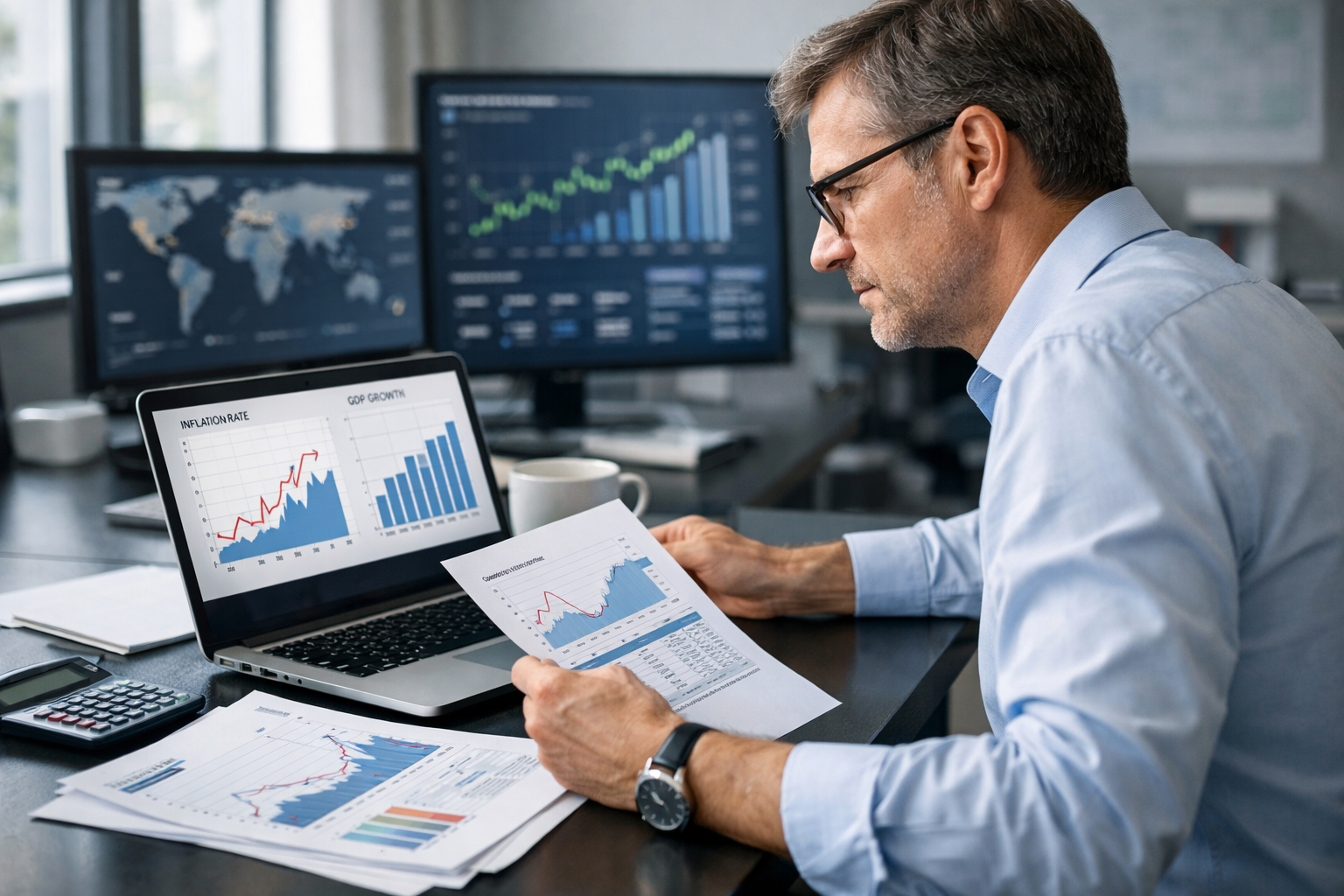
AI helps economists forecast inflation and GDP growth by finding patterns in huge amounts of economic data faster and more accurately than many traditional methods alone. It can scan information such as prices, wages, consumer spending, shipping activity, business surveys, and even news articles to estimate where the economy may be heading next. In simple terms, AI acts like a very fast pattern-finding assistant that helps economists make better-informed forecasts about rising prices and economic growth.
For beginners, this matters because inflation and GDP growth affect everyday life. Inflation influences the cost of food, rent, fuel, and bills. GDP growth helps show whether an economy is expanding, slowing down, or heading toward recession. When economists forecast these trends well, governments, central banks, businesses, and households can make better decisions.
Before looking at AI, let us define the two main ideas.
Inflation means prices are rising over time. If a basket of everyday goods costs $100 this year and $104 next year, inflation is 4%.
GDP stands for gross domestic product. It is a common measure of the total value of goods and services produced in a country. If GDP is growing, the economy is usually producing more. If GDP shrinks for a period, that can signal weakness.
Economists try to forecast both because they affect interest rates, wages, business investment, and employment. But forecasting is difficult because millions of things influence the economy at once.
Economists have long used statistical models to predict inflation and GDP growth. These methods are useful, but they can struggle when the world changes quickly.
For example, think about what happened during the pandemic. Consumer spending shifted suddenly. Supply chains broke down. Energy prices moved sharply. Traditional models often rely on past relationships, but when those relationships change, predictions can become less reliable.
There are three big challenges:
This is where AI becomes useful.
In economic forecasting, AI often means machine learning. Machine learning is a type of computer system that learns patterns from past data and uses those patterns to make predictions.
You can think of it like this: if you showed a human expert thousands of examples of price movements, wage changes, and consumer spending patterns, they might start to notice signals that come before inflation rises. Machine learning does something similar, but on a much larger scale and much faster.
It does not “understand” the economy like a human economist does. Instead, it looks for useful relationships in data.
Inflation is driven by many factors: wages, energy costs, transport costs, import prices, consumer demand, and supply shortages. AI can process many of these inputs at the same time.
For example, an AI model might study:
A human economist can review these too, but AI can detect subtle combinations that are easy to miss.
Official inflation reports may come once a month. But AI can work with daily or even hourly information. That means economists can estimate inflation before the official release.
This is sometimes called nowcasting, which means estimating what is happening right now rather than waiting for delayed official numbers.
For instance, if food prices across major online retailers rise 2% in a few weeks, AI systems may pick that up before the full consumer price report is published.
Modern AI can also read text using methods from natural language processing. That means it can examine central bank speeches, company earnings calls, news stories, and business surveys.
If many companies start mentioning “higher input costs” or “wage pressure,” AI can turn those words into signals that may help predict inflation.
GDP is usually reported with a delay. By the time an official GDP figure is released, the economy may already have changed. AI helps close that gap.
Economists can feed AI models with up-to-date signals such as:
These signals can give a faster view of whether economic activity is rising or falling.
Sometimes GDP growth changes because of patterns that are not simple or direct. For example, weaker export orders, lower transport volumes, and falling business confidence together may point to slowing growth. AI is often better than simple models at spotting these complex relationships.
AI is especially useful for near-term forecasting, such as predicting the current quarter or next quarter. That is valuable for policymakers and businesses making immediate decisions.
For example, if an AI model suggests quarterly GDP growth may slow from 2.1% to 1.2%, central banks and finance ministries may prepare for weaker demand.
Imagine an economist wants to forecast inflation three months ahead.
Without AI, they may use a smaller set of traditional indicators such as last month’s inflation, wage growth, and oil prices.
With AI, they can add hundreds of extra signals, including:
The AI model studies how these signals behaved before earlier inflation increases. It then produces a forecast, such as inflation rising from 3.1% to 3.6% over the next few months.
The economist does not simply accept the number without question. They review it, compare it with other evidence, and decide whether it makes economic sense. This is important: AI supports economists; it does not replace them.
For beginners interested in learning more about these skills, you can browse our AI courses to explore beginner-friendly paths in AI, data science, and economics.
AI is powerful, but it is not magic. There are important limits.
If the data is incomplete, delayed, biased, or inaccurate, the prediction can be poor. This is a simple but critical rule in AI.
Wars, pandemics, policy shifts, and energy shocks can break old patterns. A model trained on yesterday’s economy may struggle in today’s economy.
Economists often need to justify forecasts to central banks, governments, or business leaders. If an AI model gives a prediction without a clear explanation, that can be a problem.
That is why many professionals combine AI tools with traditional economic reasoning instead of relying on AI alone.
You do not need to be an expert to start. A beginner can build a strong foundation step by step.
Useful starting areas include:
If you are changing careers or learning from scratch, this mix of economics and AI can be especially valuable. Many modern roles in finance, policy, and analytics now expect some comfort with data and intelligent tools. Edu AI offers beginner-focused learning paths, and many course topics are designed to support practical skills that connect with widely recognised ecosystems from AWS, Google Cloud, Microsoft, and IBM where relevant.
Understanding how AI helps economists forecast inflation and GDP growth is not just for researchers. It matters for:
The good news is that you do not need advanced mathematics on day one. Start with plain-English concepts, then move into simple tools and examples. If you are curious about costs before choosing a learning path, you can view course pricing and compare beginner options.
AI helps economists forecast inflation and GDP growth by turning large, messy, fast-moving data into clearer signals about where the economy may be heading. It improves speed, adds more information, and supports better short-term decision-making. But human judgement still matters, especially when the economy changes in unexpected ways.
If you want to understand AI in plain English and build practical skills step by step, a structured beginner course can help. As a simple next step, you can register free on Edu AI and start exploring beginner-friendly courses in AI, Python, data science, and economics at your own pace.

- Learning Evolved.
- Intelligence Amplified.