Economics — April 8, 2026 — Edu AI Team
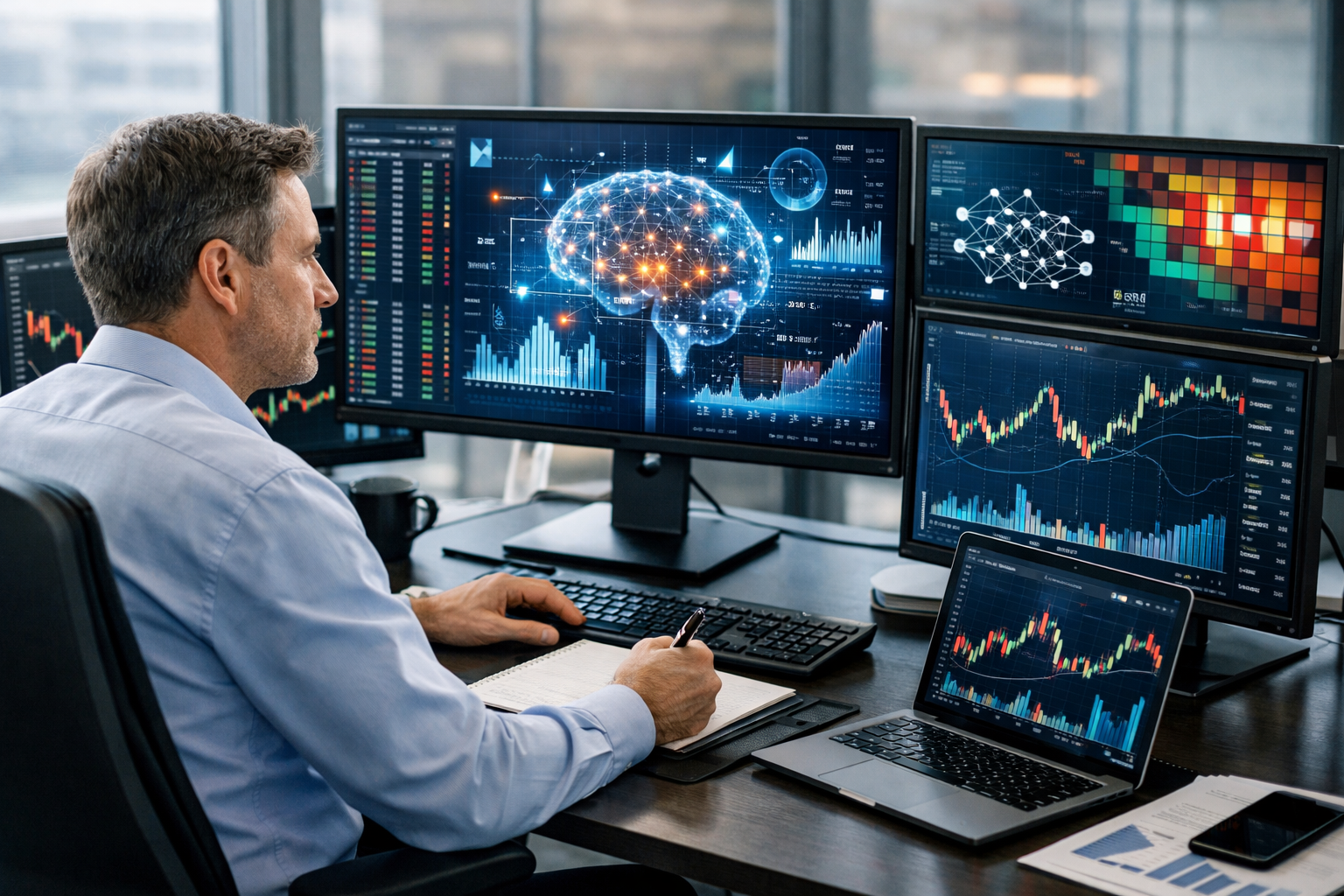
AI is used in stock market trading and analysis to process huge amounts of financial data, spot patterns faster than humans, estimate possible price movements, measure risk, and even place trades automatically. In simple terms, AI helps traders and investors make sense of information such as stock prices, company reports, breaking news, and social media posts. It does not guarantee profits, but it can help people make faster, more informed decisions.
If you are completely new to this topic, think of AI as software that learns from past examples. Instead of manually checking hundreds of stock charts or reading thousands of news headlines, an AI system can scan them in seconds and look for signals that may matter.
Before going further, it helps to define a few basic ideas in plain English.
Artificial intelligence (AI) is a broad term for computer systems that perform tasks that usually need human thinking, such as recognizing patterns or making predictions.
Machine learning is one part of AI. It means teaching a computer using data rather than giving it every rule by hand. For example, instead of telling a program exactly what every “good” stock setup looks like, you give it years of market data and let it learn common patterns.
Trading means buying and selling financial assets, such as stocks, to try to make a profit. Some traders hold for minutes or hours. Others hold for days or weeks.
Analysis means studying information before making an investment decision. That can include price charts, company earnings, economic reports, or news stories.
AI can be used for both trading and analysis. Sometimes it only supports a human decision. In other cases, it can automatically place trades based on pre-set rules.
One of the most common uses of AI is studying historical price data. Markets create huge streams of numbers every second: opening price, closing price, daily high, daily low, volume, and more. A human can review some of this data, but AI can review far more.
For example, an AI model may look at 10 years of daily stock prices and learn that when certain conditions happen together, a stock often rises 3% to 5% over the next week. This is called pattern recognition, which simply means finding repeated shapes or behaviors in data.
Stock prices often move after earnings reports, product launches, mergers, or leadership changes. AI tools can read text from these reports and identify whether the language is positive, negative, or uncertain.
This is often called sentiment analysis. In simple language, it means checking the emotional tone of words. If many reports about a company suddenly become negative, AI may flag that as a warning sign.
For example, if a company reports lower sales, weaker future guidance, and rising costs, an AI system may classify the news as negative faster than a person reading dozens of reports manually.
AI is also used to scan financial news websites, social media posts, and discussion forums. Why? Because market prices are influenced not only by hard numbers, but also by human emotion.
If thousands of posts suddenly mention a stock with strong excitement or fear, AI can measure that change. This does not always mean the stock will move in a certain direction, but it gives traders another clue.
This matters because markets can react in minutes. A human may need hours to read and summarize the conversation. AI can do it almost instantly.
Good investing is not only about finding opportunities. It is also about avoiding large losses. AI can help estimate risk by checking how volatile a stock has been, how it reacts to bad news, or how connected it is to wider market movements.
For example, if two stocks look similar on the surface, AI may identify that one has a much higher history of sharp drops during economic uncertainty. That can help an investor choose more carefully.
A trading signal is a suggestion to buy, sell, or hold based on data. AI can create these signals by combining many factors at once, such as price momentum, trading volume, news sentiment, and broader market conditions.
Imagine a system that checks 50 indicators every minute. A human beginner would find that overwhelming. AI can combine them and output a simple result: “possible buy,” “possible sell,” or “wait.”
Some firms use AI inside algorithmic trading, which means software automatically places trades according to programmed logic. This can help when speed matters. In fast-moving markets, even a few seconds can affect price.
For example, if an AI model detects an unusual price gap and the rules say to buy under certain conditions, the system can place the order immediately. This removes some human delay and emotion.
Large hedge funds and trading firms often use versions of this approach because they handle massive amounts of data and need to react quickly.
Many people know what they want to buy but struggle with when to buy and when to sell. AI can help estimate better entry and exit points by studying past behavior. It may suggest that a stock tends to bounce after dropping to a certain level, or that gains often fade after a rapid spike.
That does not mean the system is always right. It simply means AI can test many timing ideas across years of data much faster than a person can.
AI is not only for short-term traders. Long-term investors can use it to build and manage a portfolio. A portfolio is simply your collection of investments.
AI can suggest how to spread money across sectors such as technology, healthcare, energy, and finance. This is called diversification, which means not putting all your money into one place. It can also rebalance a portfolio when one area becomes too risky or too large.
Suppose an investor wants to study 100 technology stocks. Doing this manually would take many hours.
Instead of reading endless data tables, the investor gets a shortlist of 10 stocks to study more closely. This is one of the biggest benefits of AI: it helps narrow attention from too much information to a manageable set of choices.
For anyone curious about the basics behind these tools, it helps to browse our AI courses and see how beginner-friendly topics like machine learning, Python, and finance fit together.
AI sounds powerful, but it has important limits.
AI learns from historical data. But markets change. A strategy that worked in 2021 may fail in 2026 if interest rates, regulations, or investor behavior change.
If the data is incomplete, outdated, or misleading, the AI system can make poor predictions. This is often summarized as “garbage in, garbage out.”
Unexpected events such as wars, natural disasters, political shocks, or sudden regulation changes can move markets in ways no model predicted.
Some beginners assume AI can “beat the market” automatically. That is not true. Even advanced firms with expert teams lose money on bad trades. AI is a tool, not a magic machine.
No. You do not need to be a programmer to understand how AI is used in stock market trading and analysis. At the beginner level, the most important thing is learning the core ideas:
Later, if you want to build simple models yourself, learning basic Python can help. Python is a popular programming language used in AI and finance because it is readable and beginner-friendly.
If you are exploring this as a possible career move or study path, learning foundations in AI, data, and finance can make the topic much less intimidating. You can also view course pricing to compare beginner learning options before committing.
The best path is usually to begin with fundamentals rather than trying to create a hedge-fund-style trading bot on day one.
AI is used in stock market trading and analysis to study large amounts of data, identify useful patterns, read financial text, monitor market sentiment, estimate risk, and support or automate trading decisions. For beginners, the key point is simple: AI helps turn overwhelming market information into clearer signals.
But it is not a shortcut to guaranteed profits. The most successful use of AI in finance combines technology, human judgment, and a clear understanding of risk.
If this topic has sparked your interest, a practical next step is to learn the basics of AI, machine learning, and beginner-friendly finance concepts in one place. You can register free on Edu AI to start exploring lessons at your own pace, or browse introductory courses to build confidence before diving deeper into trading and analysis.




- Learning Evolved.
- Intelligence Amplified.