AI Education — April 29, 2026 — Edu AI Team
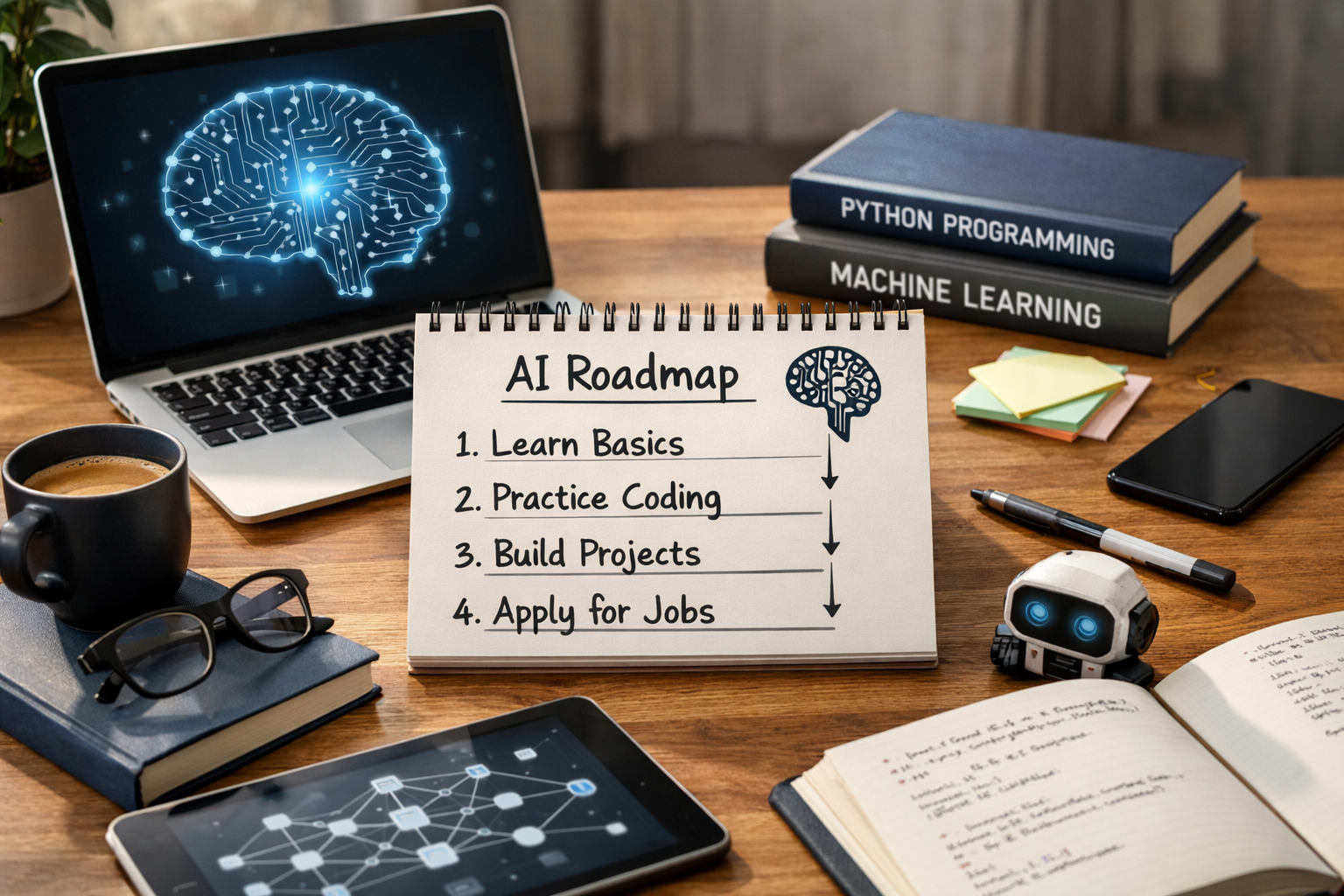
If you are wondering how to change careers into AI with a simple beginner roadmap, the short answer is this: start with basic digital and Python skills, learn what machine learning means in plain English, build 2-3 beginner projects, and then apply your existing work experience to an entry-level AI role. You do not need a computer science degree to begin. Most career changers can build a realistic foundation in 3 to 6 months of part-time study if they follow a clear plan and focus on practical learning instead of trying to learn everything at once.
That matters because AI can feel confusing from the outside. People hear terms like machine learning, neural networks, data science, and generative AI, and assume they need years of advanced maths before they can start. In reality, many beginner-friendly AI career paths begin with simple concepts: teaching computers to spot patterns, make predictions, or generate useful content from examples.
This guide explains the process step by step for complete beginners, including people coming from teaching, sales, customer support, finance, marketing, operations, healthcare, or other non-technical backgrounds.
Artificial intelligence, or AI, means software systems that can perform tasks that usually need human judgment, such as recognizing images, answering questions, finding trends in data, or making recommendations. A common part of AI is machine learning, which means training a computer to learn patterns from data instead of giving it every rule manually.
For example, imagine teaching a child to identify spam emails. You might show many examples of good emails and spam emails. Over time, they notice patterns. Machine learning works in a similar way: the computer studies examples and learns what features often appear together.
This field is attracting career changers for three simple reasons:
If you have worked in another field already, you are not starting from nothing. You are adding AI skills to experience you already have.
One of the biggest beginner mistakes is trying to learn every part of AI at the same time. Instead, pick a starting direction. You can always specialise later.
Here are a few beginner-friendly paths:
You do not need perfect clarity on day one. You just need a direction that helps you avoid overwhelm.
Before writing much code, understand the basic ideas. For example:
A beginner should be able to explain, in simple words, how Netflix recommends shows or how email spam filters work. If you can explain those examples clearly, you are building real understanding.
This is also the right stage to explore structured beginner lessons. If you want a guided route, you can browse our AI courses to find beginner-friendly options in machine learning, Python, data science, generative AI, and related topics.
Python is a popular programming language used widely in AI because it is readable and beginner-friendly. Think of it as a way to write instructions that a computer can follow.
You do not need to become a full software engineer first. Start with the basics:
A realistic target is 4 to 6 weeks of regular practice to become comfortable with beginner Python. For many people, 30 to 45 minutes a day is enough to start building momentum.
Many people avoid AI because they fear maths. The truth is simpler. At the beginner stage, you mainly need comfort with school-level ideas like averages, percentages, charts, and basic probability. Probability means thinking about how likely something is to happen. Statistics means finding meaning in numbers.
If you can understand ideas like “80 out of 100 customers renewed” or “sales increased by 15%,” you already have a useful starting point. You can deepen the maths later if your career path needs it.
Projects are what turn learning into evidence. Employers want proof that you can apply ideas, even at a basic level.
Your first projects do not need to be impressive. They need to be clear and useful. For example:
For each project, explain:
This matters more than fancy language. Clear thinking is attractive to hiring managers.
This step is where many career changers become stronger candidates than they expect. Suppose you worked in retail. You understand customers, sales patterns, stock issues, and demand changes. That knowledge can help you build useful retail AI projects. If you worked in HR, you understand hiring workflows, employee data, and people processes. If you worked in finance, you already understand numbers, risk, and forecasting.
In other words, your old career is not wasted. It gives your AI learning a business context.
A good interview answer is not “I want to work in AI because it is popular.” A better answer is “I worked in logistics for five years, and now I want to use AI and data tools to improve forecasting and planning in supply chains.”
Do not wait until you feel ready for senior machine learning engineer jobs. Aim first for realistic transition roles such as:
These jobs often value curiosity, consistency, and business awareness as much as technical depth.
Here is a simple roadmap for the first three months:
If you want more structure, course-based learning can help you stay on track. Many learners prefer guided paths that move from Python into AI topics in the right order. Edu AI offers beginner-focused learning across AI, machine learning, deep learning, NLP, computer vision, reinforcement learning, computing, and more. Relevant courses are designed to support practical job skills and align with major certification frameworks from AWS, Google Cloud, Microsoft, and IBM where appropriate.
For most absolute beginners studying part-time, a realistic first milestone is 3 to 6 months to build foundational skills and a few projects. Reaching a job-ready level may take longer depending on your weekly study time, previous experience, and target role. Someone studying 8 to 10 hours a week can usually make visible progress within one season, not one decade.
The key is consistency. Fifty focused hours of hands-on beginner study can do more for your confidence than months of random reading.
Changing careers into AI does not require genius-level maths, a perfect background, or an expensive degree. It requires a simple roadmap, steady practice, and a willingness to start small. If you want a structured way to begin, you can register free on Edu AI and explore beginner learning paths at your own pace. If you are comparing options before committing, you can also view course pricing and choose the route that matches your goals and budget.
Your best next step is not to learn everything about AI today. It is to begin one clear step this week and keep moving.




- Learning Evolved.
- Intelligence Amplified.