Languages — April 11, 2026 — Edu AI Team

AI is revolutionising language learning in 2026 by making study more personal, more interactive, and much faster for beginners. Instead of following the same textbook path as everyone else, learners now get lessons that adapt to their level, instant feedback on pronunciation, real-time conversation practice, and smart review systems that help them remember words for longer. In simple terms, AI helps people learn a language in a way that feels closer to having a patient tutor available at any time of day.
That matters because traditional language learning often had three big problems: it moved too slowly, it treated every learner the same, and it gave very little speaking practice. AI tools in 2026 are changing all three. They do not replace human teachers completely, but they do make learning more accessible, especially for busy adults, complete beginners, and people studying on a budget.
Before going further, let us define the term clearly. Artificial intelligence, or AI, means computer systems designed to perform tasks that usually need human thinking. In language learning, that includes understanding speech, checking grammar, suggesting the next lesson, translating sentences, and even holding simple conversations.
One part of AI is called machine learning. This means a system improves by learning from data instead of following only fixed rules. For example, if an app has listened to millions of examples of spoken English, Spanish, or Japanese, it can become better at recognising pronunciation mistakes and giving feedback.
Another important area is natural language processing, often shortened to NLP. This is the branch of AI that helps computers work with human language. It allows apps to read what you write, understand what you say, and respond in a useful way.
One of the biggest changes is personalisation. Older learning systems often pushed every student through the same unit order: greetings, numbers, colours, food, travel, and so on. But real learners are different. One person needs English for job interviews. Another wants Korean for travel. Someone else needs French speaking practice but already understands grammar.
AI systems can track performance and adjust lessons in real time. If you learn new vocabulary quickly but struggle with listening, the platform can give you more audio exercises. If you keep making the same grammar mistake, it can repeat that topic with simpler examples.
This matters because targeted practice usually saves time. Instead of spending 10 hours reviewing what you already know, you focus on the 2 or 3 weak areas that are actually slowing you down.
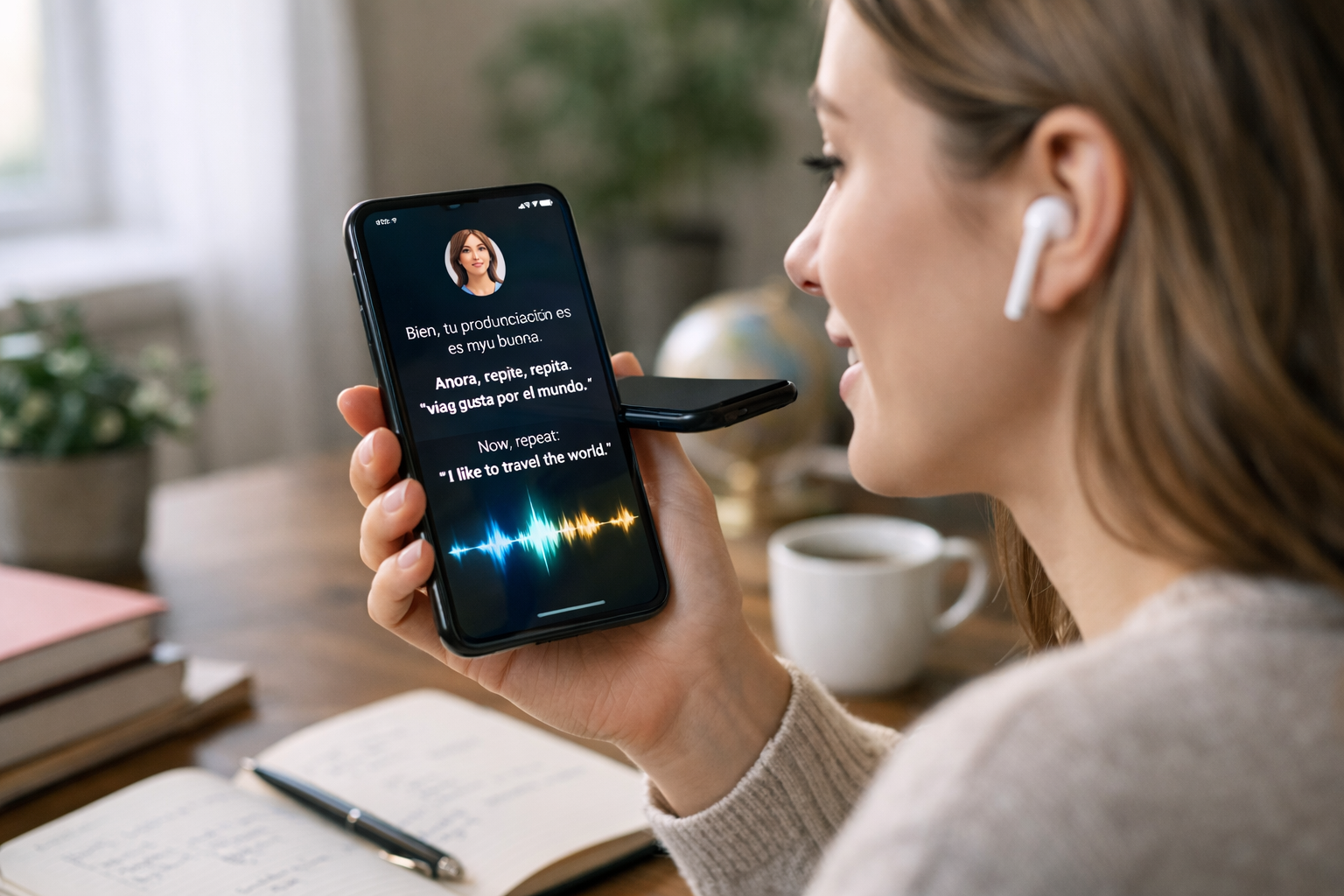
Speaking has always been one of the hardest parts of learning a language alone. In the past, many learners had to wait for a classroom teacher or paid tutor to correct them. In 2026, AI speech tools can listen to your voice and point out mistakes immediately.
For example, an app may tell you that your stress pattern in an English word is wrong, or that a French vowel needs to be more nasal. This does not mean AI understands speech perfectly in every case, but it is now accurate enough to help beginners practise daily without feeling lost.
The real benefit is repetition. A human tutor may only hear you say a phrase three times in a lesson. An AI speaking tool can let you repeat it 30 times until it feels natural.
Many beginners know words and grammar but freeze when it is time to speak. AI chat partners are helping solve this. In 2026, learners can practise conversations on common topics like ordering food, introducing themselves, asking for directions, or answering interview questions.
These tools are useful because they remove social pressure. Some learners feel embarrassed speaking with native speakers at first. Talking to an AI system can feel safer. You can make mistakes, restart, slow the conversation down, and ask for explanations in plain language.
For busy adults, this is a major advantage. Instead of booking a live session, they can practise for 10 minutes before work, during lunch, or late at night.
Learning words is one thing. Remembering them two weeks later is another. AI now helps by predicting when you are about to forget something and showing it again at the right time. This approach is sometimes called spaced repetition, which simply means reviewing information at carefully timed intervals.
In 2026, AI review systems go further than basic flashcards. They can notice patterns such as:
That leads to more efficient study. Even 15 to 20 minutes a day can become productive when the review system focuses on the right material at the right moment.
Old translation tools often turned language into awkward, unnatural sentences. Modern AI systems are much better at understanding context. This means they are more likely to choose the right meaning based on the full sentence, not just individual words.
For beginners, this can be a huge support. If you read a news article or listen to a short audio clip, AI can explain phrases, show simpler versions, and compare formal and informal wording. That helps learners understand how language is actually used in real life.
However, there is a warning here: translation is a support tool, not a full learning strategy. If you rely on translation for every sentence, progress can become slow. The best use is as a helper, not a crutch.
AI is especially powerful for people starting from zero because it lowers the most common barriers to entry. Beginners often worry about four things:
AI tools help with each one. They offer flexible schedules, low-pressure speaking practice, personalised starting points, and clear progress tracking. That makes language learning feel less overwhelming.
Think of it like having a learning assistant that watches your progress and keeps adjusting the journey so it stays challenging but not confusing. You still need effort, but you waste less of it.
It is important to keep expectations realistic. AI is powerful, but it is not magic. In 2026, language-learning AI still has limits.
So the best approach is usually a blend: use AI for daily practice, speed, and convenience, then add human interaction for deeper communication and confidence.
If you are new to both AI and language study, keep your plan simple. You do not need ten apps. You need a repeatable routine.
This kind of structure works because it mixes input, practice, and review. In plain English, that means you learn something new, use it, and then revisit it before you forget it.
If you want to understand more about the technology behind these tools in beginner-friendly language, you can browse our AI courses to see accessible learning paths across AI, NLP, and language-focused topics.
Most likely, no. AI is more likely to change the teacher's role than remove it. Teachers are still valuable for motivation, culture, advanced explanation, and real human conversation. What AI does well is handle repetition, quick correction, and personalised drills at scale.
A good comparison is this: calculators did not remove maths teachers, but they changed how maths is taught. In the same way, AI will not end language education. It will make it more flexible, more data-driven, and more tailored to individual learners.
AI in language learning is not brand new, but 2026 stands out because several improvements have come together at once: better speech recognition, more natural conversation systems, stronger personalisation, and easier access through phones and web platforms. In earlier years, many tools felt robotic or limited. Now they are far more usable for everyday learners.
This means people can begin faster, practise more often, and stay engaged longer. For career changers, travellers, students, and professionals, that is a meaningful shift. Language learning is becoming less dependent on expensive tutoring and fixed class schedules.
And for learners curious about the wider world of AI, this can also be a first step into digital skills. Many students who start by using AI for languages later become interested in how speech recognition, machine learning, and natural language processing actually work.
If you are excited by how AI is revolutionising language learning in 2026, the best next step is to start small and stay consistent. Focus on one language goal, one study routine, and one set of tools you can use regularly.
Edu AI is built for beginners who want plain-English learning without needing a technical background. You can register free on Edu AI to explore beginner-friendly lessons, or view course pricing if you want to compare learning options before committing. A simple first step today can lead to real speaking confidence over time.



- Learning Evolved.
- Intelligence Amplified.